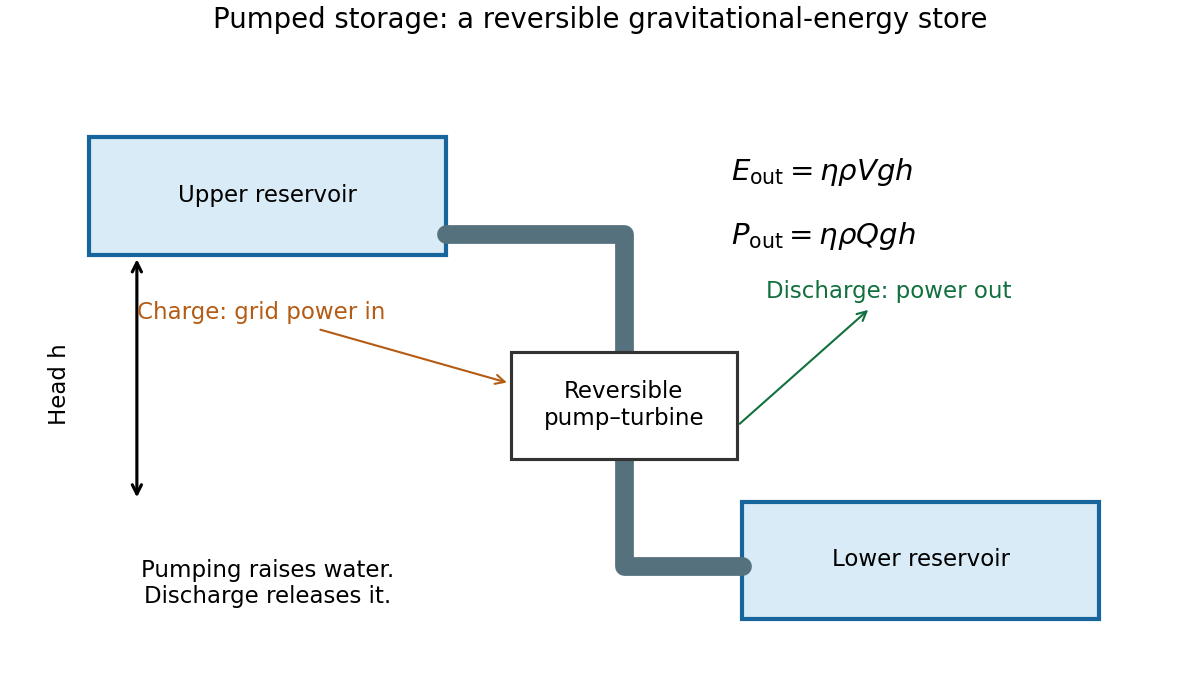
A pumped-storage plant moves water uphill using electrical power, then returns it through a turbine and generator when electricity is needed. The upper and lower reservoirs set the usable volume and head; pumps, penstocks, valves and reversible pump-turbines set the power and flow. The plant stores energy rather than generating net energy over a cycle.
Figure 1.
Gravitational storage separates reservoir energy capacity from pump and turbine power
. An original functional diagram shows an upper and a lower reservoir connected through a penstock and reversible pump-turbine. Charging uses grid electricity to lift water; discharge returns gravitational potential energy through the generator. Details.
For constant head, the gravitational energy is . With the stated generation efficiency,
At GW, gives
Head variation, dead volume and hydraulic losses beyond the stipulated efficiency have been neglected.
To deliver kWh with the same head and efficiency needs of water, roughly a m cube, together with a m elevation difference and a lower reservoir. At a m head it would need about . This contrasts with the small fuel volume: the useful energy density of lifted water depends on its external head, not its chemical composition.
Pumped storage offers long service life, fast dispatch, substantial power, and separate choices of storage volume and turbine rating. Its drawbacks include geographic constraints, construction cost and time, ecological impacts, evaporation and water requirements, plus round-trip losses. The quoted generation efficiency alone is not the round-trip efficiency because pumping also consumes more than the stored potential energy.
The rock cylinder has mass and rises through . Equating its useful energy to the reservoir result cancels the common efficiency and gravity:
Its height is about m and its lift about m, ignoring buoyancy as instructed. Stored energy scales as , excavated volume roughly as , and lined area as . If excavation dominates cost, cost per unit stored energy decreases approximately as . Seals, increasing pressure, geology, leakage, supporting structure and power equipment can change that scaling; a volume law is not a complete cost model.
The Shockley-Queisser calculation treats a single-junction solar cell with a single band gap, in steady state, with one collected electron-hole pair per absorbed above-gap photon, an ideal absorption edge, thermalized carriers and radiative recombination as the limiting recombination process. The source spectrum, cell temperature, angular acceptance and optical concentration must be specified. Below-gap photons are transmitted; energy above the gap is lost during carrier thermalization; the cell must emit photons by detailed balance, producing a recombination current and an entropy-related voltage loss. Delivering power at finite current also puts the operating voltage below the open-circuit voltage. Nonradiative recombination, resistance and imperfect collection worsen a real cell but are not required for the ideal limit.
Three ways to change those assumptions are tandem solar cells, which divide the spectrum among gaps and reduce both transmission and thermalization losses; hot-carrier solar cells, which aims to collect excess carrier energy before thermalization; and carrier multiplication or spectral conversion, which aims to use a high-energy photon for more than one excitation or combine otherwise unusable sub-gap photons. These concepts have additional practical losses and do not automatically outperform an optimized conventional device. The usual unconcentrated single-junction optimum is approximately one third under a terrestrial solar spectrum, rather than a universal efficiency independent of illumination.
For the geometrical estimate, take the stated horizontal equinox irradiance to set a constant direct-normal reference. The equinox solar-noon elevation is , so this reference is . A south-facing panel with tilt has noon incidence factor , where . Relative to the plane-of-array rating,
These are the results of that idealized geometrical normalization, not credible seasonal production forecasts. Its inferred direct-normal irradiance already exceeds the approximately solar irradiance outside the atmosphere, so the supplied horizontal benchmark cannot describe a purely direct noon beam literally. Real direct and diffuse fractions, atmospheric attenuation at low winter elevation, cell temperature and inverter clipping are unspecified. An alternative assumption of direct-normal irradiance gives approximately and kW. A physically unique maximum cannot be inferred without an irradiance model.
The stated annual output corresponds to full-rated hours, an average power of kW and a capacity factor of . Night, cloud, seasonal day length and other losses explain the large difference from an instantaneous sunlit estimate.
For a national scale estimate, take UK area , population , and annual mean solar input . Covering five percent with twenty-percent-efficient modules gives
This is comparable with an order- kWh daily per-person primary-energy budget, and much larger than electricity use alone, of order - kWh per person per day. It is a gross area-and-flux estimate: access land, shading, seasonal storage, curtailment and conversion between primary energy and electrical end use all affect its interpretation.

Pinned article: Introduction to the OurBigBook Project

Welcome to the OurBigBook Project! Our goal is to create the perfect publishing platform for STEM subjects, and get university-level students to write the best free STEM tutorials ever.
Everyone is welcome to create an account and play with the site: ourbigbook.com/go/register. We belive that students themselves can write amazing tutorials, but teachers are welcome too. You can write about anything you want, it doesn't have to be STEM or even educational. Silly test content is very welcome and you won't be penalized in any way. Just keep it legal!
We have two killer features:
  1. topics: topics group articles by different users with the same title, e.g. here is the topic for the "Fundamental Theorem of Calculus" ourbigbook.com/go/topic/fundamental-theorem-of-calculus
    Articles of different users are sorted by upvote within each article page. This feature is a bit like:
    • a Wikipedia where each user can have their own version of each article
    • a Q&A website like Stack Overflow, where multiple people can give their views on a given topic, and the best ones are sorted by upvote. Except you don't need to wait for someone to ask first, and any topic goes, no matter how narrow or broad
    This feature makes it possible for readers to find better explanations of any topic created by other writers. And it allows writers to create an explanation in a place that readers might actually find it.

    Figure 1.
    Screenshot of the "Derivative" topic page
    . View it live at: ourbigbook.com/go/topic/derivative
  2. local editing: you can store all your personal knowledge base content locally in a plaintext markup format that can be edited locally and published either:
    This way you can be sure that even if OurBigBook.com were to go down one day (which we have no plans to do as it is quite cheap to host!), your content will still be perfectly readable as a static site.
    Figure 5. . You can also edit articles on the Web editor without installing anything locally.
    Video 3.
    Edit locally and publish demo
    . Source. This shows editing OurBigBook Markup and publishing it using the Visual Studio Code extension.

  3. https://raw.githubusercontent.com/ourbigbook/ourbigbook-media/master/feature/x/hilbert-space-arrow.png
  4. Infinitely deep tables of contents:
    Figure 6.
    Dynamic article tree with infinitely deep table of contents
    .
    Descendant pages can also show up as toplevel e.g.: ourbigbook.com/cirosantilli/chordate-subclade
All our software is open source and hosted at: github.com/ourbigbook/ourbigbook
Further documentation can be found at: docs.ourbigbook.com
Feel free to reach our to us for any help or suggestions: docs.ourbigbook.com/#contact