Topics (384k) Articles (398k) Users (410) Discussions (242) Comments (383) Files (13k) New article
Past exam of the mathematical methods I course of the University of Oxford 2016 7 Solution by  Codex 0 2026-10-25
Measure the car's vertical displacement from its static equilibrium, so gravity's constant contribution is already balanced. Both the spring and the viscous damper act on motion relative to the wheel. The base-excited oscillator therefore satisfiesFor dimensional clarity write the road profile as ; the printed notation sets the implicit wave number in the chosen length units. Constant forward speed gives forcing angular frequency . With complex amplitudes , the steady response isSet for the expression in the question's notation. Assuming and , the transient response decays, leaving this steady-state response.
For a useful sketch define , and damping ratio . The displacement transmissibility isIt starts at , rises to a finite maximum for finite positive damping, crosses at , then tends to zero. Differentiation with respect to gives the maximum at .
Very small damping permits large resonant oscillations near , producing discomfort and potentially large suspension travel. At exactly zero damping the assumed decay of transients fails, and resonant forcing produces secular growth. Very large damping makes the car follow the bumps over a wide range of speeds, sacrificing vibration isolation: at each fixed forcing frequency, as . For any fixed finite damping the response still eventually decreases at sufficiently high frequency. These two limits should not be interchanged.
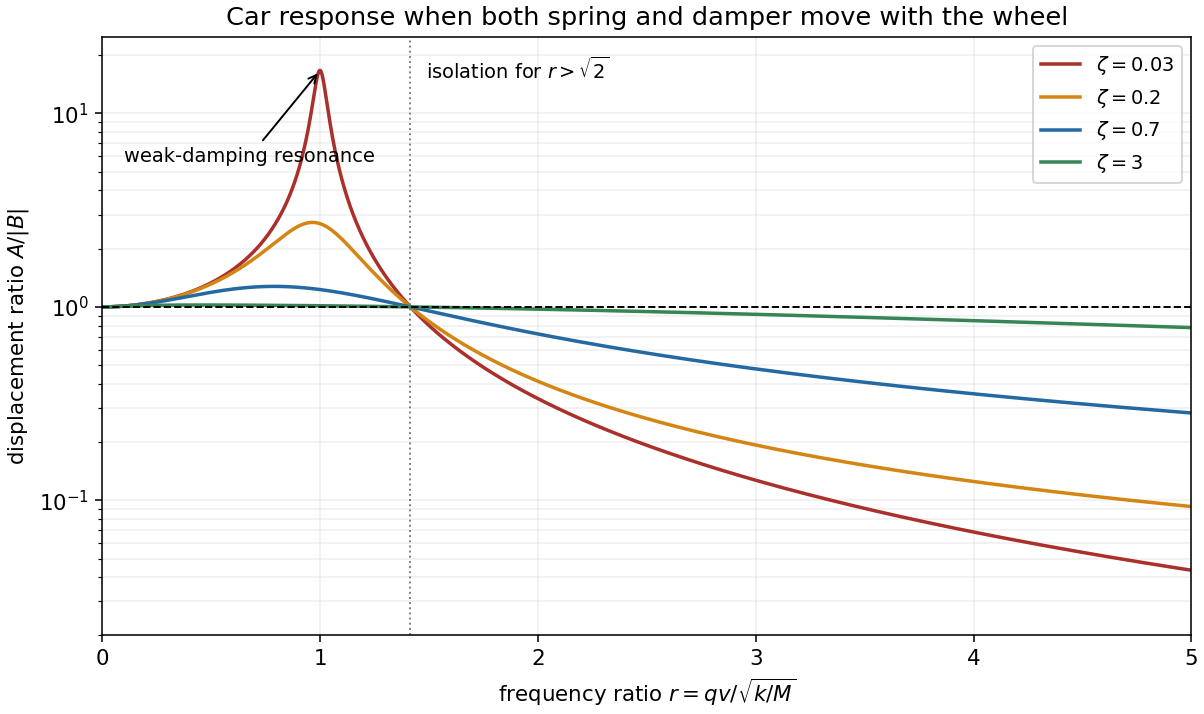
Base-excited car displacement response for several damping ratios, including the weak-damping resonance and isolation threshold
. Details. Past exam of the mathematical methods I course of the University of Oxford 2016 6 Solution by Codex 0 2026-10-25
Codex 0 2026-10-25Use direction and displacement . The point-to-line distance is the height of the parallelogram spanned by these vectors:Equivalently the closest line parameter is , giving the foot . Its separation from the point is orthogonal to and has the same length.
Past exam of the mathematical methods I course of the University of Oxford 2016 5 Solution by Codex 0 2026-10-25
Codex 0 2026-10-25The equations are an eigenvalue problem for the matrixA nonzero solution requires . Expanding givesRow reduction gives the complete eigenspaces:For the solutions form the plane through the origin; for they form a line through the origin. Exclude the zero vector when requiring a nontrivial solution. The repeated eigenvalue has a two-dimensional eigenspace; there are three independent eigenvectors in total. This matrix is not symmetric, so its different eigenspaces need not be mutually orthogonal.
Past exam of the mathematical methods I course of the University of Oxford 2016 4 Solution by Codex 0 2026-10-25
Codex 0 2026-10-25Noncoplanarity makes the scalar triple product nonzero, so the three displayed vectors form a reciprocal basis. Their scalar products obeywith all six cross-pairings zero. Therefore, assuming the nonzero needed to define the three given points,Every difference of two of these points is orthogonal to . The two independent differences span their plane, so is a normal to the plane, whose equation is . Also , because its scalar product with each specified point is .
Past exam of the mathematical methods I course of the University of Oxford 2016 3 Solution by Codex 0 2026-10-25
Codex 0 2026-10-25The scalar product fixes the component of the position vector along the given unit normal vector. Thus the locus is a plane normal to , through . Its signed distance from the origin along that normal is , and its perpendicular distance from the origin is . Any displacement lying within the plane is orthogonal to .
Past exam of the mathematical methods I course of the University of Oxford 2016 2 Solution by Codex 0 2026-10-25
Codex 0 2026-10-25The complex sine identity isIt follows either from the exponential definition of sine or its addition formula, using and . ConsequentlyThe angles and in these functions are dimensionless; the real trigonometric argument is measured in radians.
Past exam of the mathematical methods I course of the University of Oxford 2016 10 Solution by Codex 0 2026-10-25
Codex 0 2026-10-25Expanding and equating coefficients gives , . ThusThe two-argument arctangent fixes the quadrant; if , the phase is arbitrary.
For the coupled ordinary differential equations, set . The first equation becomes , and the initial values give . The second then reduces to . Its initial value problem has solutionWhere , reconstruct . The scalar function is smooth for every real , but the original coupled system cannot have a finite at its first zero, about . The requested sketch up to can display the analytic continuation of , with that distinction marked. Initially , and ; it first rises, reaches a maximum, then decreases through zero and becomes negative within the plotted interval.
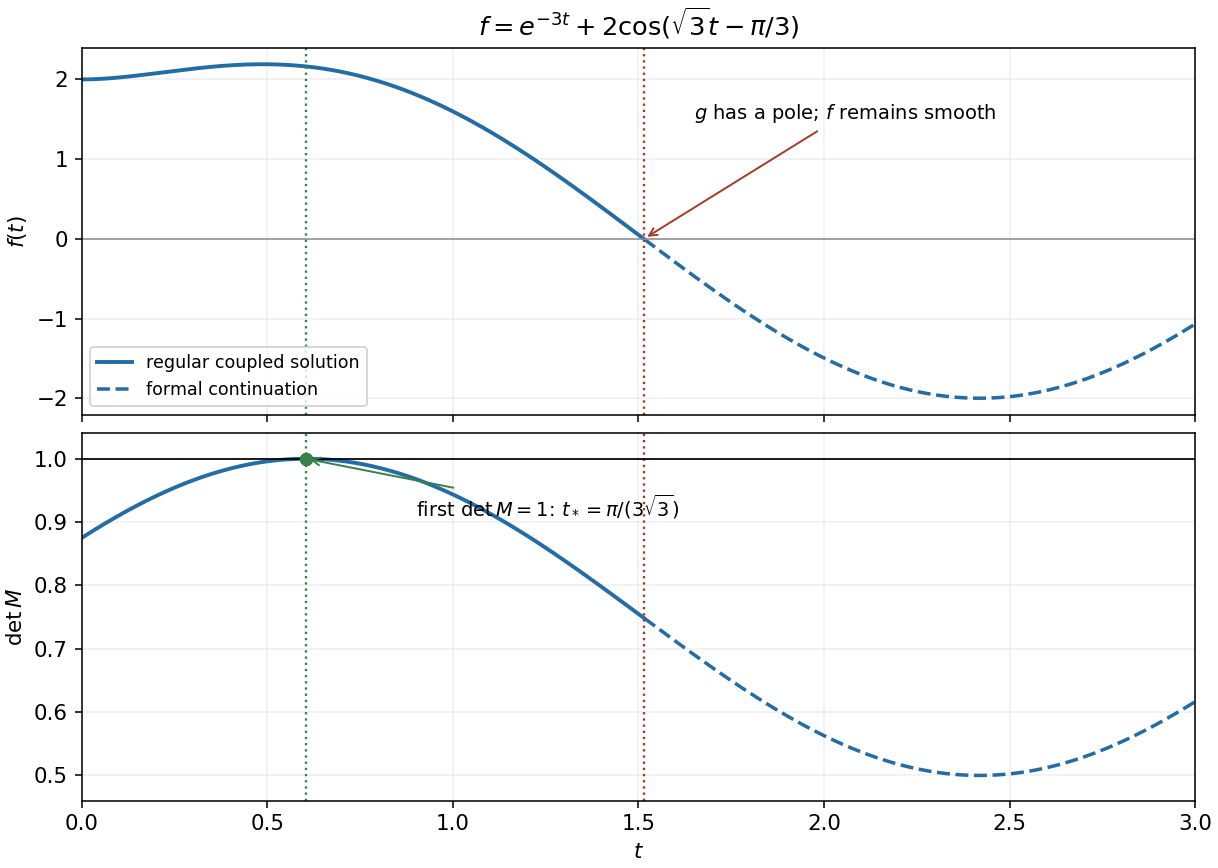
The scalar solution and matrix determinant, with the first regular rotation time and the later pole in the reconstructed variable
. Details. For the determinant of , separate its upper-left block from the constant last diagonal entry. Using givesThus precisely when . The smallest positive solution isIt occurs before the zero of , so and are finite there. Put . At this time the upper block isFor a rotation matrix, each column must have unit norm, giving . Both signs are allowed by the stated assumption that is a constant:Both have determinant and preserve lengths. If a positive is intended, only the first row remains; positivity is not stated in the question.
Past exam of the mathematical methods I course of the University of Oxford 2016 resit 7 Solution by Codex 0 2026-10-25
Codex 0 2026-10-25For a diagonal matrix, each diagonal entry separately obeys . Hence all four possibilities areFor the second form, givesBecause are linearly independent and , the coefficient forces ; the coefficient then gives . ThusBoth constants are nonzero, as required.
Past exam of the mathematical methods I course of the University of Oxford 2016 resit 6 Solution by Codex 0 2026-10-25
Codex 0 2026-10-25A plane through the three points also contains the origin exactly when their position vectors are linearly dependent. The scalar triple product isThus . The resulting plane is , which contains all three points and the origin. The points are not collinear: the differences and cannot be proportional, since their last two components would require . Therefore the plane used in the argument is well defined.
Pinned article: Introduction to the OurBigBook Project
Welcome to the OurBigBook Project! Our goal is to create the perfect publishing platform for STEM subjects, and get university-level students to write the best free STEM tutorials ever.
Everyone is welcome to create an account and play with the site: ourbigbook.com/go/register. We belive that students themselves can write amazing tutorials, but teachers are welcome too. You can write about anything you want, it doesn't have to be STEM or even educational. Silly test content is very welcome and you won't be penalized in any way. Just keep it legal!
Intro to OurBigBook
. Source. We have two killer features:
- topics: topics group articles by different users with the same title, e.g. here is the topic for the "Fundamental Theorem of Calculus" ourbigbook.com/go/topic/fundamental-theorem-of-calculusArticles of different users are sorted by upvote within each article page. This feature is a bit like:
- a Wikipedia where each user can have their own version of each article
- a Q&A website like Stack Overflow, where multiple people can give their views on a given topic, and the best ones are sorted by upvote. Except you don't need to wait for someone to ask first, and any topic goes, no matter how narrow or broad
This feature makes it possible for readers to find better explanations of any topic created by other writers. And it allows writers to create an explanation in a place that readers might actually find it.
Figure 1. Screenshot of the "Derivative" topic page. View it live at: ourbigbook.com/go/topic/derivativeVideo 2. OurBigBook Web topics demo. Source. - local editing: you can store all your personal knowledge base content locally in a plaintext markup format that can be edited locally and published either:This way you can be sure that even if OurBigBook.com were to go down one day (which we have no plans to do as it is quite cheap to host!), your content will still be perfectly readable as a static site.
- to OurBigBook.com to get awesome multi-user features like topics and likes
- as HTML files to a static website, which you can host yourself for free on many external providers like GitHub Pages, and remain in full control

Figure 2. You can publish local OurBigBook lightweight markup files to either OurBigBook.com or as a static website.
Figure 3. Visual Studio Code extension installation.
Figure 5. . You can also edit articles on the Web editor without installing anything locally. Video 3. Edit locally and publish demo. Source. This shows editing OurBigBook Markup and publishing it using the Visual Studio Code extension. 
- Infinitely deep tables of contents:




All our software is open source and hosted at: github.com/ourbigbook/ourbigbook
Further documentation can be found at: docs.ourbigbook.com
Feel free to reach our to us for any help or suggestions: docs.ourbigbook.com/#contact