Topics (384k) Articles (398k) Users (410) Discussions (242) Comments (383) Files (13k) New article

Catherine A. Rychert and Peter M. Shearer used fifteen years of global seismic wave observations to image a sharp interface near the lithosphere-asthenosphere boundary. Conversions from P waves to S waves constrain the interface's depth and sharpness: a transition that preserves high-frequency converted phases is too sharp to be explained by a broad thermal gradient alone. Their interpretation therefore considers composition, melting and seismic anisotropy, and distinguishes the interface beneath oceans from a possible internal boundary inside thicker cratons.[ref]
A global view of the lithosphere-asthenosphere boundary by Catherine A. Rychert and Peter M. Shearer. Abstract, converted phases, sharpness and tectonic-setting-dependent interpretation
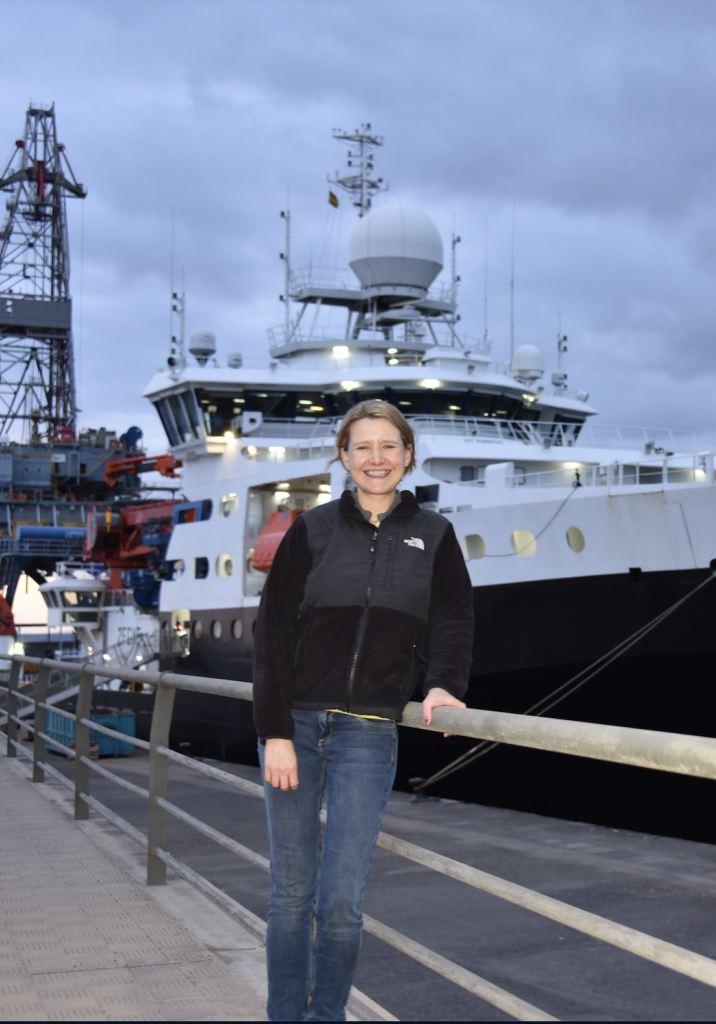
A seismology researcher studying lithosphere and asthenosphere structure. Institutional profile: mit.whoi.edu/faculty/5644/
Kiyoo Wadati established that some earthquakes originate far deeper than the shallow sources then commonly assumed. His 1927 study analyzed recorded waveforms and seismic travel times, including the 27 July 1926 event interpreted as occurring about beneath central Japan. The argument used instrumental observations to constrain source depth, rather than inferring it solely from surface damage. He also investigated the geographical distribution of deep events, helping make deep earthquake sources an observable part of the Earth's interior.[ref]
The existence of deep-focus earthquakes and their study by Kiyoo Wadati. 1927 original Japanese abstract, waveform/travel-time analysis and the July 1926 event; source title translated here
A seismology researcher associated with the recognition of deep earthquakes and the Wadati-Benioff zone.

Hugo Benioff investigated whether sequences of earthquakes could reveal large faults extending far below the Earth's surface. His 1949 study used accumulated estimates of elastic-rebound strain increments to compare events as possible movements on one structure. He interpreted the Tonga–Kermadec and South American sequences as activity on great inclined faults reaching roughly depth. The observations helped establish the deep geometry later associated with a Wadati-Benioff zone; the original fault interpretation belongs to the historical development preceding modern subduction theory.[ref]
Seismic evidence for the fault origin of oceanic deeps by Hugo Benioff. 1949 paper abstract, strain-increment method and inclined deep structures
A seismology researcher associated with deep earthquake distributions, the Wadati-Benioff zone and seismograph development.

Hugo Benioff in 1964, portrait hosted by the Caltech Seismological Laboratory
. John Tuzo Wilson introduced transform faults as a distinct type of boundary needed to connect seafloor spreading and other relative plate motions. Where two spreading-ridge segments are offset, active sliding occurs on the connecting part of the fracture; its continuation beyond a ridge can separate crust moving together and need not remain an active plate boundary. The geometry predicts a slip direction that cannot be inferred merely by treating the offset ridge as a formerly continuous line. His 1965 proposal made a structural pattern into a test of plate tectonics.[ref]
A New Class of Faults and their Bearing on Continental Drift by John Tuzo Wilson. 1965 paper, transform geometry between offset spreading centers

Portrait of John Tuzo Wilson
. Stephen Morris, University of Toronto, 1992. CC BY-SA 3.0, via Wikimedia Commons. Source.Miles Bodmer coauthored onshore–offshore seismic tomography of the Cascadia subduction zone. Relative arrival delays reveal along-strike changes in mantle seismic velocity, which were compared with plate locking and episodic slip patterns.[ref]
Buoyant Asthenosphere Beneath Cascadia Influences Megathrust Segmentation by Miles Bodmer and others. Abstract and section 4: tomographic observations and buoyancy hypothesis
Gina M. Schmalzle coauthored a study of persistent creep in the Cascadia subduction zone. It combines station-position time series, uplift measurements and paleoseismic subsidence to estimate plate locking and compare deformation over different timescales.[ref]
Central Cascadia subduction zone creep by Gina M. Schmalzle and others. Abstract: GPS, tide-gauge/levelling and paleoseismic constraints
Reduced interseismic uplift and reduced earthquake subsidence motivate partial-creep models for central Cascadia. The proposed connection with Siletzia involves permeability and pore pressure; the measured deformation and the mechanism proposed to explain it remain distinct parts of the argument.
Frank G. Lemoine coauthored a high-resolution lunar gravity solution from GRAIL spacecraft tracking. The GRGM900C model represents the field using spherical harmonics and compares it with the gravity predicted from lunar surface topography.[ref]
GRGM900C: A degree 900 lunar gravity model from GRAIL primary and extended mission data by Frank G. Lemoine and others. Abstract and sections 4.2–4.3: tracking solution and gravity/topography comparison
Higher harmonic degree resolves shorter spatial scales, but useful resolution also depends on orbit geometry and measurement uncertainty. Residual gravity after topographic correction helps investigate subsurface density structure.
Derrick Hasterok coauthored an analysis of oceanic heat flux measurements used to estimate the Earth's heat loss. Filtering sites by sediment cover and proximity to seamounts reduces the influence of ventilated hydrothermal circulation when testing conductive cooling models.[ref]
Oceanic heat flow: implications for global heat loss by Derrick Hasterok and others. Abstract: database filtering, hydrothermal ventilation and conductive heat loss
Water can carry heat laterally through young oceanic crust, so a local conductive measurement can underestimate the heat lost by the larger region. Survey environment is therefore part of the interpretation.
Heidrun Kopp coauthored seismic refraction surveys of the O'Higgins Seamount Group and Juan Fernández Ridge. Wide-angle arrivals constrain the structure of an oceanic ridge approaching an Andean subduction zone.[ref]
Seismic investigations of the O'Higgins Seamount Group and Juan Fernández Ridge by Heidrun Kopp and others. Abstract: crossed seismic profiles, limited crustal thickening and hydration interpretation
The study tests whether extra crust alone supplies enough slab buoyancy to explain shallow subduction. Seismic speeds also depend on hydration and material composition, making the relation between the mapped ridge and the descending plate a physical interpretation rather than a purely geometric one.
Kalle Kiik coauthored a magnetic survey and subsurface model of the Lonar impact crater. The study compares measured magnetic anomalies with rock magnetic properties and the geometry of the surrounding Deccan Traps.[ref]
Magnetic Anomaly and Model of the Lonar Meteorite Impact Crater in Maharashtra, India by Kalle Kiik and others. Sections 3–6: magnetic-property measurements, background model and profile interpretation
A magnetic profile is the field of a three-dimensional source, not a direct section through it. Accounting for background magnetization and surface topography helps separate the crater-related signal from its surroundings.
Embryologist who investigated fertilization and nuclear participation in the development of embryos.
Embryologist whose separated sea-urchin blastomeres demonstrated regulatory development in the tested conditions.
Education researcher whose research is represented by Revisiting the marshmallow test by Tyler W. Watts and others.
A researcher investigating reading, language development or the processes supporting literacy.[ref]
Constraints in the production of written text in children with specific language impairments by Julie E. Dockrell and others. Exceptional Children 73, 147–164; 64 children with language-impairment history, measures at eight and written text at ten
Researcher whose work includes Using knowledge of children's mathematics thinking in classroom teaching: an experimental study by Thomas P. Carpenter and others.

Portrait of Thomas P. Carpenter
. Photograph hosted by Heinemann; credits and usage information are on the linked source page. Source. Pinned article: Introduction to the OurBigBook Project
Welcome to the OurBigBook Project! Our goal is to create the perfect publishing platform for STEM subjects, and get university-level students to write the best free STEM tutorials ever.
Everyone is welcome to create an account and play with the site: ourbigbook.com/go/register. We belive that students themselves can write amazing tutorials, but teachers are welcome too. You can write about anything you want, it doesn't have to be STEM or even educational. Silly test content is very welcome and you won't be penalized in any way. Just keep it legal!
Intro to OurBigBook
. Source. We have two killer features:
- topics: topics group articles by different users with the same title, e.g. here is the topic for the "Fundamental Theorem of Calculus" ourbigbook.com/go/topic/fundamental-theorem-of-calculusArticles of different users are sorted by upvote within each article page. This feature is a bit like:
- a Wikipedia where each user can have their own version of each article
- a Q&A website like Stack Overflow, where multiple people can give their views on a given topic, and the best ones are sorted by upvote. Except you don't need to wait for someone to ask first, and any topic goes, no matter how narrow or broad
This feature makes it possible for readers to find better explanations of any topic created by other writers. And it allows writers to create an explanation in a place that readers might actually find it.
Figure 1. Screenshot of the "Derivative" topic page. View it live at: ourbigbook.com/go/topic/derivativeVideo 2. OurBigBook Web topics demo. Source. - local editing: you can store all your personal knowledge base content locally in a plaintext markup format that can be edited locally and published either:This way you can be sure that even if OurBigBook.com were to go down one day (which we have no plans to do as it is quite cheap to host!), your content will still be perfectly readable as a static site.
- to OurBigBook.com to get awesome multi-user features like topics and likes
- as HTML files to a static website, which you can host yourself for free on many external providers like GitHub Pages, and remain in full control

Figure 2. You can publish local OurBigBook lightweight markup files to either OurBigBook.com or as a static website.
Figure 3. Visual Studio Code extension installation.
Figure 5. . You can also edit articles on the Web editor without installing anything locally. Video 3. Edit locally and publish demo. Source. This shows editing OurBigBook Markup and publishing it using the Visual Studio Code extension. 
- Infinitely deep tables of contents:




All our software is open source and hosted at: github.com/ourbigbook/ourbigbook
Further documentation can be found at: docs.ourbigbook.com
Feel free to reach our to us for any help or suggestions: docs.ourbigbook.com/#contact