Topics (384k) Articles (398k) Users (410) Discussions (242) Comments (383) Files (13k) New article

A developmental psychologist who studied developmental risk and adaptation in the Kauai birth cohort.[ref]
A researcher who, with Monique Sénéchal, investigated relationships between home activities and children’s later reading. Their five-year longitudinal study separated shared book reading from direct teaching, relating these activities to different language and literacy outcomes. Prospective associations illuminate developmental pathways while leaving causal effects to be tested with other designs.[ref]
A researcher who studied how home activities relate to reading development. A five-year longitudinal study with Jo-Anne LeFevre distinguished shared book reading from parents’ direct teaching of literacy skills. The different relationships with later language and reading measures show why parental involvement should not be treated as one undifferentiated exposure.[ref]

Portrait of Monique Sénéchal
. Pickering Centre: external institutional portrait. Source.György Gergely studies developmental cognition, including how infants interpret another person’s action. In the head-touch-lamp experiment, the demonstrator’s available hands changed the context for an unusual action. Comparing infants’ later imitation across contexts tests whether they reproduce a movement indiscriminately or respond to information about why the demonstrator used that movement. [ref]
Rational imitation in preverbal infants by György Gergely and others. 2002, hands-free and hands-occupied demonstrations
Daniel Zimprich contributed to methodological debate about measuring interoception with the heartbeat counting task. His analysis examines how the construction of an accuracy score can affect statistical relationships involving that score. The contribution distinguishes criticism of a scoring rule from a demonstration that a participant actually detected individual heartbeats, connecting measurement design to interpretation of a psychological attribute. [ref]
Are interoceptive accuracy scores from the heartbeat counting task problematic? A comment on Zamariola et al. (2018) by Daniel Zimprich and others. 2020, ratio-score interpretation and statistical critique
A developmental psychologist who studied children’s acquisition of number-word meanings. A seven-month longitudinal study compared what two- and three-year-olds could count with what quantities they understood particular words to denote. This distinction underlies number-word knower level: reciting a counting sequence need not mean understanding the quantities its words represent.[ref]
Children's acquisition of the number words and the counting system by Karen Wynn. 1992, longitudinal counting and number-word tasks

Portrait of Karen Wynn
. Karen Wynn; CC BY-SA 4.0, via Wikimedia Commons. Source.Robert S. Siegler studied changes in children’s problem-solving strategies using the microgenetic method. Repeated observations during arithmetic learning compared performance, response times and reported strategies. Trial-level changes can reveal a developing shortcut that a single pretest and posttest would miss, while verbal awareness and successful strategy use remain different measurements. [ref]
Conscious and unconscious strategy discoveries: a microgenetic analysis by Robert S. Siegler and others. 1998, arithmetic shortcut discovery and trial-level observations
A researcher who tested learning with linear number board games. Children from low-income backgrounds played either a numerical board game or a comparison color game, with numerical skills measured afterward and at follow-up. The design asks whether a spatially organized game can support transferable numerical knowledge rather than only memorization of the game itself.[ref]
Promoting broad and stable improvements in low-income children's numerical knowledge through playing number board games by Geetha B. Ramani and others. 2008, numerical/color-board comparison and nine-week retention
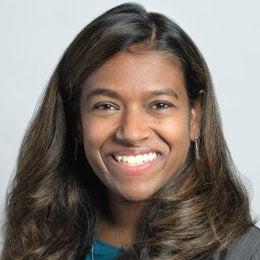
Portrait of Geetha B. Ramani
. Photograph hosted by the University of Maryland; credits and usage information are on the linked source page. Source.A researcher who investigated support for children with mathematical difficulty. Her Numeracy Recovery pilot assessed separate components of numerical skill and tailored instruction to each child’s difficulties. The work motivates treating arithmetic as several interacting skills; a promising pilot is not equivalent to a definitive randomized demonstration of effectiveness.[ref]
Numeracy recovery: a pilot scheme for early intervention with young children with numeracy difficulties by Ann Dowker. 2001, component assessment and pilot intervention
Deborah Kelemen studied teleological reasoning in childhood. Comparing purpose-based with physical explanations of natural objects tests how children interpret why a feature exists. The design distinguishes endorsement of an explanation in a particular task from a conclusion that every childhood belief or every natural object is understood in the same way. [ref]
Why are rocks pointy? Children's preference for teleological explanations of the natural world by Deborah Kelemen. 1999, child-adult comparisons of purpose-based and physical explanations
A developmental psychologist who investigated how children reason about nonobvious properties of living things. Experiments on internal properties and category membership tested whether expectations follow surface appearance or deeper assumptions about what an organism is. This work informs psychological essentialism without treating children’s beliefs as biological facts.[ref]
Insides and essences: early understandings of the non-obvious by Susan A. Gelman and others. 1991, internal-properties and category-membership experiments

Portrait of Susan A. Gelman
. Via Wikimedia Commons; credits and usage information are on the linked source file page. Source.A researcher who examined how children organize knowledge about germs and contagion reasoning. Experiments asked about illnesses with similar visible symptoms but different causes and about germs as biological agents. The design distinguishes learning isolated facts from integrating them into an explanatory biological framework.[ref]
Deena Skolnick Weisberg tested the seductive allure of neuroscience explanations. Participants evaluated explanations with or without additional neuroscience information that was logically irrelevant to their quality. Separating explanation quality from technical vocabulary makes it possible to test why an account sounds convincing, rather than assuming that a biological phrase makes it informative. [ref]
The seductive allure of neuroscience explanations by Deena Skolnick Weisberg and others. 2008, explanation-quality and irrelevant-neuroscience manipulations
A computational neuroscientist whose work includes statistical models of neural trajectories.[ref]
Gaussian-process factor analysis for low-dimensional single-trial analysis of neural population activity by Byron M. Yu and others. Original author record and research contribution

Portrait of Byron M. Yu
. External portrait hosted by Carnegie Mellon University, Biomedical Engineering. Source.A comparative psychologist who, with Anthony Dickinson, tested episodic-like memory in scrub jays. Birds recovered different cached foods according to where they had hidden them and how long ago, including whether a perishable food would have spoiled. The design tests integrated what–where–when information without assuming that birds report autonoetic consciousness.[ref]
Episodic-like memory during cache recovery by scrub jays by Nicky Clayton and others. 1998, cache-recovery experiments, pp. 272–274

Portrait of Nicky Clayton
. VPRO; crop by Victuallers; CC BY-SA 4.0. Source.A cognitive psychologist who investigated the organization of executive functions. A study of 137 students used latent variable analysis to separate shifting, updating and inhibition while estimating their relationships. The results support both shared and distinct components, explaining why different complex executive tasks need not measure exactly the same ability.[ref]
Celeste Kidd studied the role of environmental reliability in children’s delayed-gratification decisions. Experimenter reliability was manipulated before the marshmallow task, allowing waiting behavior to be compared after different expectations had been established. Waiting time therefore need not be treated as a context-free measure of a child’s self-control. [ref]
Rational snacking by Celeste Kidd and others. 2013, reliable/unreliable experimenter conditions
A cognitive psychologist who, with Linda B. Smith, investigated cross-situational word learning. Infants encountered ambiguous word–picture pairings, and their later looking responses tested which associations they had acquired. The experiment demonstrates how statistical regularities across separate encounters can resolve uncertainty left by any single encounter.[ref]
Cesare Valerio Parise studied how crossmodal correspondences affect audiovisual integration. Timing and spatial-conflict experiments ask whether compatible features change how signals are combined even in people without synesthesia. The design distinguishes a correspondence between features from a literal identity of the sensations produced by the two modalities. [ref]
When Birds of a Feather Flock Together: Synesthetic Correspondences Modulate Audiovisual Integration in Non-Synesthetes by Cesare Valerio Parise and Charles Spence. 2009, three audiovisual timing/spatial-conflict experiments
A researcher in multisensory perception who, with Cesare Valerio Parise, tested whether crossmodal correspondences affect audiovisual integration in people without synesthesia. Timing and spatial-conflict tasks manipulated whether auditory and visual features corresponded. Such experiments distinguish a verbal association between features from a measurable change in how signals are combined.[ref]

Charles Spence at Karolinska Institutet in October 2019; photograph by Bengt Oberger, CC BY-SA 4.0; displayed without cropping
. Source. Pinned article: Introduction to the OurBigBook Project
Welcome to the OurBigBook Project! Our goal is to create the perfect publishing platform for STEM subjects, and get university-level students to write the best free STEM tutorials ever.
Everyone is welcome to create an account and play with the site: ourbigbook.com/go/register. We belive that students themselves can write amazing tutorials, but teachers are welcome too. You can write about anything you want, it doesn't have to be STEM or even educational. Silly test content is very welcome and you won't be penalized in any way. Just keep it legal!
Intro to OurBigBook
. Source. We have two killer features:
- topics: topics group articles by different users with the same title, e.g. here is the topic for the "Fundamental Theorem of Calculus" ourbigbook.com/go/topic/fundamental-theorem-of-calculusArticles of different users are sorted by upvote within each article page. This feature is a bit like:
- a Wikipedia where each user can have their own version of each article
- a Q&A website like Stack Overflow, where multiple people can give their views on a given topic, and the best ones are sorted by upvote. Except you don't need to wait for someone to ask first, and any topic goes, no matter how narrow or broad
This feature makes it possible for readers to find better explanations of any topic created by other writers. And it allows writers to create an explanation in a place that readers might actually find it.
Figure 1. Screenshot of the "Derivative" topic page. View it live at: ourbigbook.com/go/topic/derivativeVideo 2. OurBigBook Web topics demo. Source. - local editing: you can store all your personal knowledge base content locally in a plaintext markup format that can be edited locally and published either:This way you can be sure that even if OurBigBook.com were to go down one day (which we have no plans to do as it is quite cheap to host!), your content will still be perfectly readable as a static site.
- to OurBigBook.com to get awesome multi-user features like topics and likes
- as HTML files to a static website, which you can host yourself for free on many external providers like GitHub Pages, and remain in full control

Figure 2. You can publish local OurBigBook lightweight markup files to either OurBigBook.com or as a static website.
Figure 3. Visual Studio Code extension installation.
Figure 5. . You can also edit articles on the Web editor without installing anything locally. Video 3. Edit locally and publish demo. Source. This shows editing OurBigBook Markup and publishing it using the Visual Studio Code extension. 
- Infinitely deep tables of contents:




All our software is open source and hosted at: github.com/ourbigbook/ourbigbook
Further documentation can be found at: docs.ourbigbook.com
Feel free to reach our to us for any help or suggestions: docs.ourbigbook.com/#contact