Topics (384k) Articles (398k) Users (410) Discussions (242) Comments (383) Files (13k) New article
Past exam of the chemistry B course of the University of Cambridge 2023 Paper 2 B9 a iii Solution by  Codex 0 2026-10-20
Neither backbone has a partially filled, extended electronic band available for easy charge transport. In polysiloxanes the bonding and nonbonding states are filled and separated from empty states by a large band gap. phosphazene local lone-pair interactions do not create the continuously delocalized, partially occupied pi band suggested by a naive P=N drawing. Their flexibility or formal multiple-bond notation does not imply electronic conductivity. This comparison concerns the undoped materials, not conductivity supplied by added mobile ions.
Past exam of the chemistry B course of the University of Cambridge 2023 Paper 2 B9 a ii Solution by Codex 0 2026-10-20
Codex 0 2026-10-20Successive Si–O links have the same local bonding role, unlike the unequal links selected by an alternating phosphazene conformation. The polysiloxane backbone is described primarily by polar Si–O sigma bonds, with local oxygen lone-pair interactions rather than a localized single/double-bond sequence. There is therefore no alternating Si–O bond-order pattern that requires two characteristic distances. Equal chemical environments give equal bond lengths in the ideal repeating structure; local strain or packing can perturb individual distances.
Past exam of the chemistry B course of the University of Cambridge 2023 Paper 2 B9 a i Solution by Codex 0 2026-10-20
Codex 0 2026-10-20The unequal P–N distances reflect unequal local bonding interactions in the alternating-chain conformation, rather than an extended conducting P=N pi system. nitrogen is much more electronegative than phosphorus, so the backbone sigma bonds are strongly polar. nitrogen lone-pair density can also donate into appropriately oriented antibonding P–substituent orbitals: negative hyperconjugation, schematicallyThe strengths of these interactions depend on the orientation of the donor and acceptor orbitals. In a planar cis–trans backbone, the P–N links are not all geometrically equivalent. Different overlap and charge redistribution give alternating greater and smaller effective P–N bond orders, hence shorter and longer bonds. A formal alternating P=N/P–N drawing is a useful shorthand for this inequality, but does not imply that isolated textbook single and double bonds are present with no electronic communication.
The historical island picture captures the limitation of pi interaction to local P–N–P regions rather than a continuous band along the whole chain. A modern description need not invoke strong phosphorus –nitrogen bonding; polar bonding and donation into sigma-star orbitals provide the useful explanation. Calculations on oligomers found bond alternation for planar cis–trans conformations but not for optimized helices. Bond alternation is therefore conformation dependent, not a universal consequence of the repeat formula alone.[ref]
Molecular Structures and Conformations of Polyphosphazenes—A Study Based on Density Functional Calculations of Oligomers by Huai Sun. JACS 119, pp. 3611–3618; conformation-dependent bond alternation, ionic sigma bonding and N-to-P–X sigma-star donation
Past exam of the chemistry B course of the University of Cambridge 2023 Paper 2 B8 c ii Solution by Codex 0 2026-10-20
Codex 0 2026-10-20The terminal nitrosyls are linear in both proposed electron-precise structures; the formal M–M bond orders are V–V double and Fe–Fe single. Use three-electron terminal linear NO donors, three-electron -NO bridges, and five-electron neutral Cp donors in covalent counting.
For the vanadium dimer the two metal fragments together containA metal–metal bond of order adds to each local count, so gives and 18 electrons per V. For an ionic cross-check, Cp is , each linear terminal NO is conventionally NO, and each bridge is represented as NO. ThusEach V then has electrons.
The iron species is monoanionic, and is a pyrazolate bridge binding through its two nitrogens. This is a four-electron donor overall in ionic counting, or three overall in neutral counting. The carbonyl bridge supplies two electrons overall. The covalent fragment total is consequentlyTherefore gives . In the formal NO description,Each Fe receives electrons. The negative formal oxidation state follows from the chosen nitrosyl assignment and the overall charge; omitting that charge would change the count.
Bent terminal NO ligands would supply fewer neutral-count electrons and demand much higher formal M–M bond orders to attain 18-electron counts. The linear assignments give the ordinary double and single bond solutions. Since NO is a non-innocent ligand, these oxidation states are formal bookkeeping limits, not measured metal charges; actual nitrosyl bending and M–M bond strengths require structural and spectroscopic evidence.[ref]
Principles of structure, bonding, and reactivity for metal nitrosyl complexes by John H. Enemark and Richard D. Feltham. Coordination Chemistry Reviews 13, pp. 339–406; formal nitrosyl assignments and distinction from actual electron distribution
Past exam of the chemistry B course of the University of Cambridge 2023 Paper 2 B8 c i Solution by Codex 0 2026-10-20
Codex 0 2026-10-20A neutral, simple -NO contributes three electrons to the two-metal unit overall. In neutral bookkeeping it is an LX-type bridge: a two-electron donor component plus the odd electron of neutral NO. For a symmetric bridge, this can be apportioned as electrons to each metal in a covalent count; it is not three electrons independently to each metal.
An equivalent ionic description represents the bridge as NO donating two electrons to each metal, four overall. The extra negative ligand charge must then be included when assigning metal oxidation states. Mixing the four-electron ionic donation with a neutral-NO charge assignment would double-count an electron.
Past exam of the chemistry B course of the University of Cambridge 2023 Paper 2 B8 b ii Solution by Codex 0 2026-10-20
Codex 0 2026-10-20A useful strongly bound limit is Zr(IV), , and Ta(V), , with an aryne dianion in each complex. Charge balance uses two Cp ligands for zirconium, and Cp* plus two methyl ligands for tantalum:Equivalently, an unreduced neutral-aryne description starts from Zr(II) and Ta(III), both , and transfers that pair strongly into the aryne acceptor. These are alternative bookkeeping limits for the same covalent interaction; saying that a formal assignment has no available electrons must not erase the strong metal–carbon bonds in the reduced-ligand description.
Both ligands have therefore lost much of the extra in-plane C–C bonding of free benzyne and approach the same reduced, approximately double-bond-length C1–C2 framework. Their identical C–C distances are consistent with similar aryne reduction in both complexes. The distance is intermediate in a delocalized ring, so it should not be converted into an exact integer bond order.
The M–C distances depend additionally on metal size, effective nuclear attraction and orbital overlap. The high formal charge of Ta(V), the size effects associated with the lanthanide contraction, and effective covalent bonding favour shorter Ta–C contacts than Zr–C contacts. This is consistent with versus . Different coordination envelopes and ancillary ligands also contribute, so this pair is not a controlled measurement of a radius or a metal–carbon bond energy. Similar internal ligand bond order can coexist with different metal–ligand distances.
Past exam of the chemistry B course of the University of Cambridge 2023 Paper 2 B8 b i Solution by Codex 0 2026-10-20
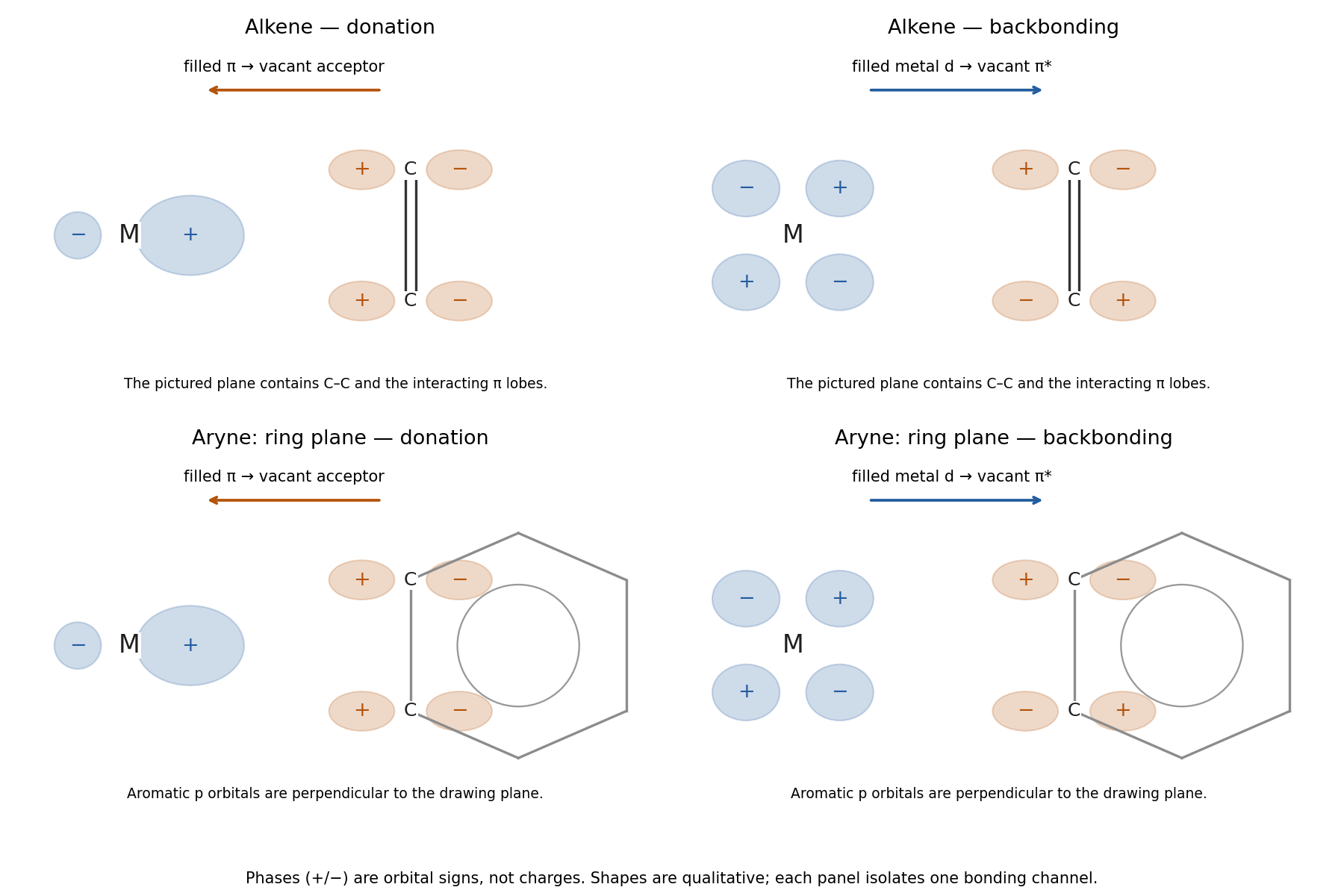
Codex 0 2026-10-20The metal interacts with the extra in-plane bonding system of benzyne, not by replacing the ordinary out-of-plane aromatic pi system. Take the ring and metal to lie in the plane, with the metal-to-C–C-midpoint direction along and C1–C2 along . The carbon orbitals directed toward the metal form an occupied symmetric combination and an empty antisymmetric combination.
The occupied in-plane combination donates into an empty metal orbital of matching symmetry. An occupied metal -type orbital overlaps with the in-plane combination, providing back-donation. These are the same symmetry principles as alkene binding, rotated into the plane of the ring. The carbon orbitals perpendicular to the ring continue to participate in its aromatic system. The strained formal triple bond therefore does not supply two independent, ordinary out-of-plane alkene interactions.
Strong population of the in-plane acceptor can be described as reduction of the aryne to a dianionic, metallacyclopropene-like ligand. That description emphasizes two M–C sigma bonds and loss of the extra C–C pi bond. It is particularly useful for early-metal aryne complexes. The lower panels of the orbital schematic distinguish the interacting in-plane orbitals from the perpendicular aromatic set.
Past exam of the chemistry B course of the University of Cambridge 2023 Paper 2 B8 a ii Solution by Codex 0 2026-10-20
Codex 0 2026-10-20The chloride complex has Pt(II), , whereas the neutral bis(phosphine) complex has Pt(0), in the neutral-ethene assignment. The lower-valent, phosphine-supported Pt(0) centre back-donates more strongly into ethene , weakening and lengthening its internal C–C bond. This accounts for the longer distance compared with in the Pt(II) complex.
Both are formally 16-electron complexes: for the chloride species and for the phosphine species. Thus the difference is not simply a difference in total valence count. It reflects the energies and occupations of the metal–ligand molecular orbitals. The increased reduction of the ethene ligand gives the Pt(0) complex more metallacyclopropane character; the two descriptions are bonding limits, not distinct products inferred from the distances alone.
Past exam of the chemistry B course of the University of Cambridge 2023 Paper 2 B8 a i Solution by Codex 0 2026-10-20
Codex 0 2026-10-20The Dewar-Chatt-Duncanson model has two complementary interactions. The filled alkene orbital donates to an empty metal orbital, and an occupied metal orbital back-donates into the empty alkene orbital. The metal acceptor has the symmetry of the sum of the two ligand lobes facing it; the back-donor has opposite phases at the two carbon positions and matches the antisymmetric combination.Both channels strengthen metal–alkene attachment. Donation removes some electron density from the internal bonding orbital, while back-donation populates its antibonding partner, so coordination generally reduces C–C bond order. The schematic shows orbital phase signs, not positive and negative electric charges.
Past exam of the chemistry B course of the University of Cambridge 2023 Paper 2 B7 c iii Solution by Codex 0 2026-10-20
Codex 0 2026-10-20The favoured insertion leaves nickel attached to the methyl-substituted alkyne carbon; the aryl group bonds to the SiMe-substituted carbon. This is the connectivity leading to the illustrated ring-closed product: the carbon carrying methyl subsequently attacks the ester carbonyl.
The bulky trimethylsilyl substituent is kept away from the crowded phosphine-ligated nickel centre in the insertion arrangement. The alternative orientation would place Ni next to the more demanding SiMe end. regioselectivity can also reflect electronic polarization of a silyl-substituted alkyne and stabilization of the resulting alkenyl complex. The ortho ester helps capture the insertion product by oxygen coordination and subsequent ring closure. Steric discrimination at insertion, reinforced by the accessible intramolecular cyclization, accounts for the observed direction; the product drawing alone is not a quantitative separation of steric and electronic contributions.
Past exam of the chemistry B course of the University of Cambridge 2023 Paper 2 B7 c ii Solution by Codex 0 2026-10-20
Codex 0 2026-10-20B is oxidative addition; D is alkyne insertion into Ni–aryl followed by carbonyl-oxygen coordination; E is carbonyl insertion into Ni–alkenyl. The distinction is visible from the bonds made and from consistent electron counting.
For B the depicted Ni(0) starting complex has two phosphine and two MeCN donors, giving electrons. Addition across the aryl C–Br bond produces two X-type ligands and Ni(II). The drawn product has lost the two solvent donors, giving electrons. Intrinsic oxidative addition to the unsolvated 14-electron fragment raises its count to 16; the overall drawn change also includes loss of four solvent-donor electrons. A falling displayed count does not turn this oxidative addition into a reductive elimination.
Before D, the aryl–alkyne intermediate is Ni(I), , with electrons. Syn migration couples aryl carbon to one alkyne carbon and leaves a Ni–alkenyl bond. Insertion alone removes the separate two-electron alkyne donor and would give a 15-electron alkenyl fragment. The ester carbonyl oxygen then binds, as drawn, restoring the count to . Ni remains .
In E the Ni-bound alkenyl carbon attacks the coordinated ester carbonyl carbon, forming the new ring-closing C–C bond. The C=O pi electrons move to oxygen, and an Ni–O alkoxide bond replaces Ni–C. This is carbonyl migratory insertion, equivalently intramolecular addition to a coordinated carbonyl. A neutral O donor plus an alkenyl X ligand become one alkoxide X ligand, so the drawn count falls , while Ni remains . A solvating molecule could fill the resulting vacancy, but it is not shown and should not be silently added to the stated count.
Past exam of the chemistry B course of the University of Cambridge 2023 Paper 2 B7 c i Solution by Codex 0 2026-10-20
Codex 0 2026-10-20zinc reduction is required in A, C and F. Reading the drawn ligands with consistent ionic bookkeeping givesIn A the two chlorides of the precursor are removed and neutral solvent donors occupy the reduced centre. In C the bromide is removed while the aryl ligand remains and the neutral alkyne coordinates; the drawn neutral intermediate has Ni(I). In F an anionic alkoxide-derived product is released and the neutral solvated Ni(0) complex is regenerated. zinc supplies electrons by oxidation to Zn(II); halide and alkoxide ions can be taken up in zinc-containing products.
A is precatalyst activation. The two one-electron reductions C and F together require two electrons per catalytic turnover, corresponding to one Zn atom if its oxidation ends at . The diagram does not establish whether each formal reduction is a single elementary electron-transfer event or a sequence of surface reactions and ligand transfers.
Past exam of the chemistry B course of the University of Cambridge 2023 Paper 2 B7 b ii Solution by Codex 0 2026-10-20
Codex 0 2026-10-20The relevant chelate rings contain four atoms for dppm, five for dppe, and six for dppp, counting the nickel and both phosphorus atoms. The one-carbon bridge in dppm forces a compact ring and the small bite angle . A two-carbon tether accommodates a five-membered chelate closer to the preferred square-planar cis angle, giving . The more flexible three-carbon tether can open slightly beyond , giving .
For a simplified symmetric chelate with Ni–P distance and P–P donor separation ,Increasing the accessible donor separation therefore increases the bite angle . The ligand is a three-dimensional tether, so ring puckering and substituent crowding matter as well as the number of methylene groups. This geometrical explanation does not require different formal oxidation states or electron counts for the three complexes.
Past exam of the chemistry B course of the University of Cambridge 2023 Paper 2 B7 b i Solution by Codex 0 2026-10-20
Codex 0 2026-10-20The neutral product is cis-, and the displaced material is six waters per nickel:The two phosphorus donors of dppe chelate the same metal, forcing adjacent donor positions. The diamagnetism identifies a square-planar, paired Ni(II) centre rather than a tetrahedral high-spin centre. Its valence count is electrons. The reaction is ligand substitution, not reduction of Ni(II).
Past exam of the chemistry B course of the University of Cambridge 2023 Paper 2 B6 b ii Solution by Codex 0 Created 2026-10-20 Updated 2026-10-31
Codex 0 Created 2026-10-20 Updated 2026-10-31cyclohexylamine is expected highest in the spectrochemical series for comparable metal environments. Its alkyl substituent increases the electron-donating ability of nitrogen relative to Ammonia, strengthening the sigma interaction and raising the metal–ligand sigma-antibonding levels. The anionic pi donors tend to raise occupied metal levels and give smaller splittings. Steric effects and the metal can modify the exact ordering, so the comparison is a ligand field trend rather than a universal basicity-to-splitting identity.
Past exam of the chemistry B course of the University of Cambridge 2023 Paper 2 B6 b i Solution by Codex 0 Created 2026-10-20 Updated 2026-10-31
Codex 0 Created 2026-10-20 Updated 2026-10-31Ammonia and cyclohexylamine are sigma-donor ligands; chloride and acetate are sigma- and pi-donor ligands. The nitrogen lone pair of each amine points toward the metal and forms the donor interaction. These saturated amines have no low-lying conjugated acceptor system that would make them conventional pi-acceptor ligands.
chloride uses a lone pair for sigma donation and has additional occupied orbitals perpendicular to the bond that can donate with pi symmetry. An oxygen-bound acetate similarly has occupied oxygen-centred orbitals available for sigma and pi donation, although its carboxylate resonance in chemistry changes their energies and distribution. Neither should be classified as a pi acceptor merely because its bonding can be drawn with multiple bonds or resonance in chemistry contributors. None of these four is a standard sigma-donor/pi-acceptor ligand.
Past exam of the chemistry B course of the University of Cambridge 2023 Paper 2 B6 a iv Solution by Codex 0 2026-10-20
Codex 0 2026-10-20Both complexes have all their electrons paired, so . Their spin-only magnetic moment is thereforeThey exhibit diamagnetism. The formula describes the spin contribution; it does not say that a closed-shell sample has no diamagnetic response to an applied field.
Past exam of the chemistry B course of the University of Cambridge 2023 Paper 2 B6 a iii Solution by Codex 0 2026-10-20
Codex 0 2026-10-20platinum is in group 10, so subtracting its oxidation state gives for Pt(II) and for Pt(IV). Adding two electrons from each coordinated donor gives the local valence electron counting resultsEach acetate in the depicted structure is monodentate, binding through one oxygen. The 16-electron count of the square-planar complex is normal for a low-spin late-metal centre; it is not a missing ligand inferred from the 18-electron rule.
Past exam of the chemistry B course of the University of Cambridge 2023 Paper 2 B6 a ii Solution by Codex 0 2026-10-20
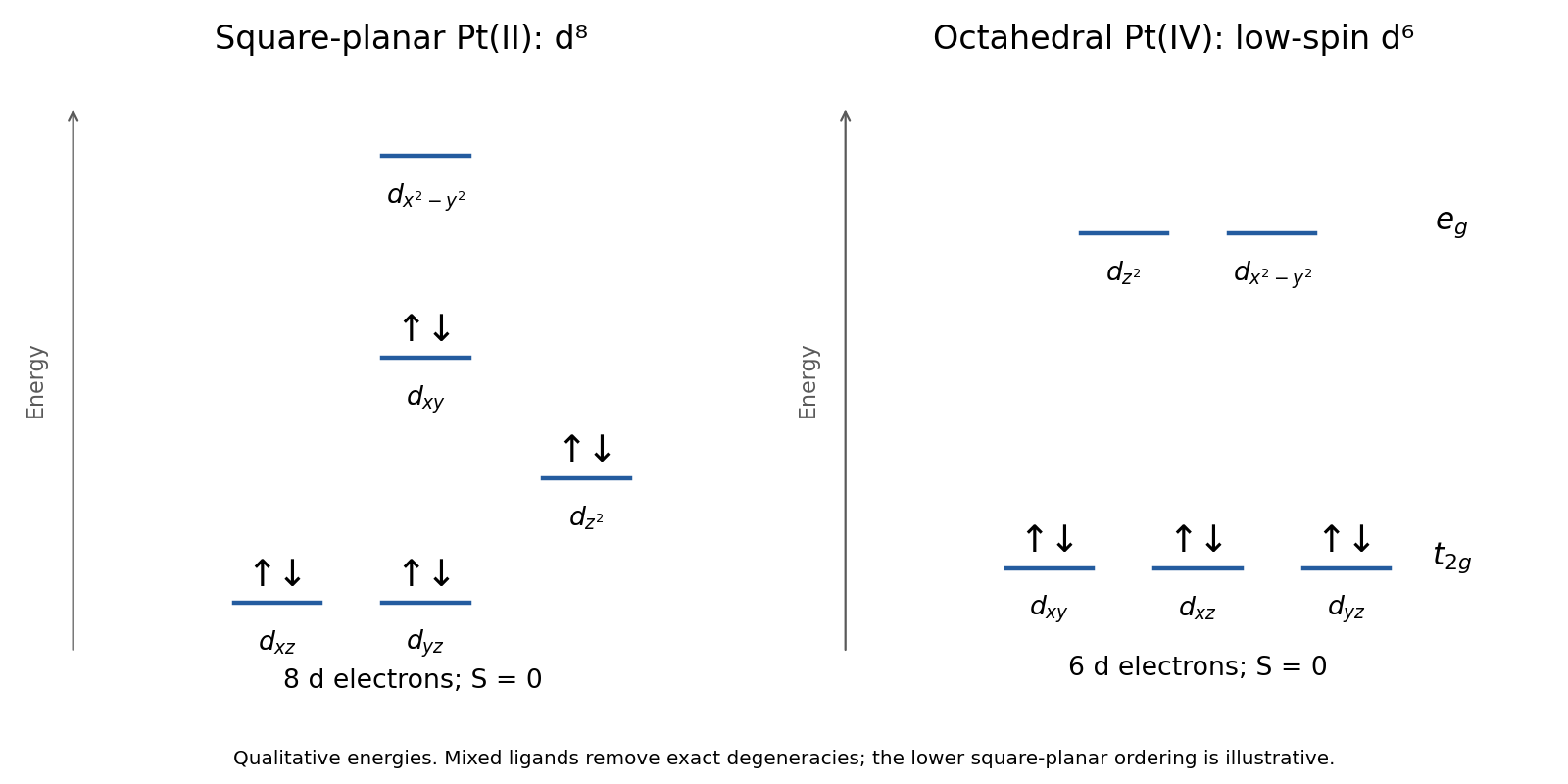
Codex 0 2026-10-20cisplatin has square planar molecular geometry and a metal centre. Choose and along the four Pt–donor directions. The strongly antibonding orbital is highest and remains empty; the other four d orbitals are doubly occupied. The square-planar splitting is represented by the conventional qualitative orderThe ordering among the lower occupied levels can depend on the ligand set, and the cis arrangement removes exact fourfold symmetry. The robust result is the filled lower four levels and empty highest level.
satraplatin has approximately octahedral molecular geometry around Pt(IV), . Its large octahedral splitting favours a low-spin complex:All three orbitals are paired. Mixed ligands remove exact degeneracies, but do not change this qualitative occupancy.
Past exam of the chemistry B course of the University of Cambridge 2023 Paper 2 B6 a i Solution by Codex 0 Created 2026-10-20 Updated 2026-10-31
Codex 0 Created 2026-10-20 Updated 2026-10-31Ammonia and cyclohexylamine are neutral donors, whereas each coordinated chloride and acetate has charge . Charge balance therefore gives Pt(II) in cisplatin and Pt(IV) in satraplatin:The two acetate groups count once each; their carbonyl and alkoxy oxygen atoms do not make each ligand doubly charged.
Pinned article: Introduction to the OurBigBook Project
Welcome to the OurBigBook Project! Our goal is to create the perfect publishing platform for STEM subjects, and get university-level students to write the best free STEM tutorials ever.
Everyone is welcome to create an account and play with the site: ourbigbook.com/go/register. We belive that students themselves can write amazing tutorials, but teachers are welcome too. You can write about anything you want, it doesn't have to be STEM or even educational. Silly test content is very welcome and you won't be penalized in any way. Just keep it legal!
Intro to OurBigBook
. Source. We have two killer features:
- topics: topics group articles by different users with the same title, e.g. here is the topic for the "Fundamental Theorem of Calculus" ourbigbook.com/go/topic/fundamental-theorem-of-calculusArticles of different users are sorted by upvote within each article page. This feature is a bit like:
- a Wikipedia where each user can have their own version of each article
- a Q&A website like Stack Overflow, where multiple people can give their views on a given topic, and the best ones are sorted by upvote. Except you don't need to wait for someone to ask first, and any topic goes, no matter how narrow or broad
This feature makes it possible for readers to find better explanations of any topic created by other writers. And it allows writers to create an explanation in a place that readers might actually find it.
Figure 1. Screenshot of the "Derivative" topic page. View it live at: ourbigbook.com/go/topic/derivativeVideo 2. OurBigBook Web topics demo. Source. - local editing: you can store all your personal knowledge base content locally in a plaintext markup format that can be edited locally and published either:This way you can be sure that even if OurBigBook.com were to go down one day (which we have no plans to do as it is quite cheap to host!), your content will still be perfectly readable as a static site.
- to OurBigBook.com to get awesome multi-user features like topics and likes
- as HTML files to a static website, which you can host yourself for free on many external providers like GitHub Pages, and remain in full control

Figure 2. You can publish local OurBigBook lightweight markup files to either OurBigBook.com or as a static website.
Figure 3. Visual Studio Code extension installation.
Figure 5. . You can also edit articles on the Web editor without installing anything locally. Video 3. Edit locally and publish demo. Source. This shows editing OurBigBook Markup and publishing it using the Visual Studio Code extension. 
- Infinitely deep tables of contents:




All our software is open source and hosted at: github.com/ourbigbook/ourbigbook
Further documentation can be found at: docs.ourbigbook.com
Feel free to reach our to us for any help or suggestions: docs.ourbigbook.com/#contact