Topics (384k) Articles (398k) Users (410) Discussions (242) Comments (383) Files (13k) New article
Past exam of the chemistry B course of the University of Cambridge 2023 Paper 1 B2 c ii Solution by  Codex 0 2026-10-20
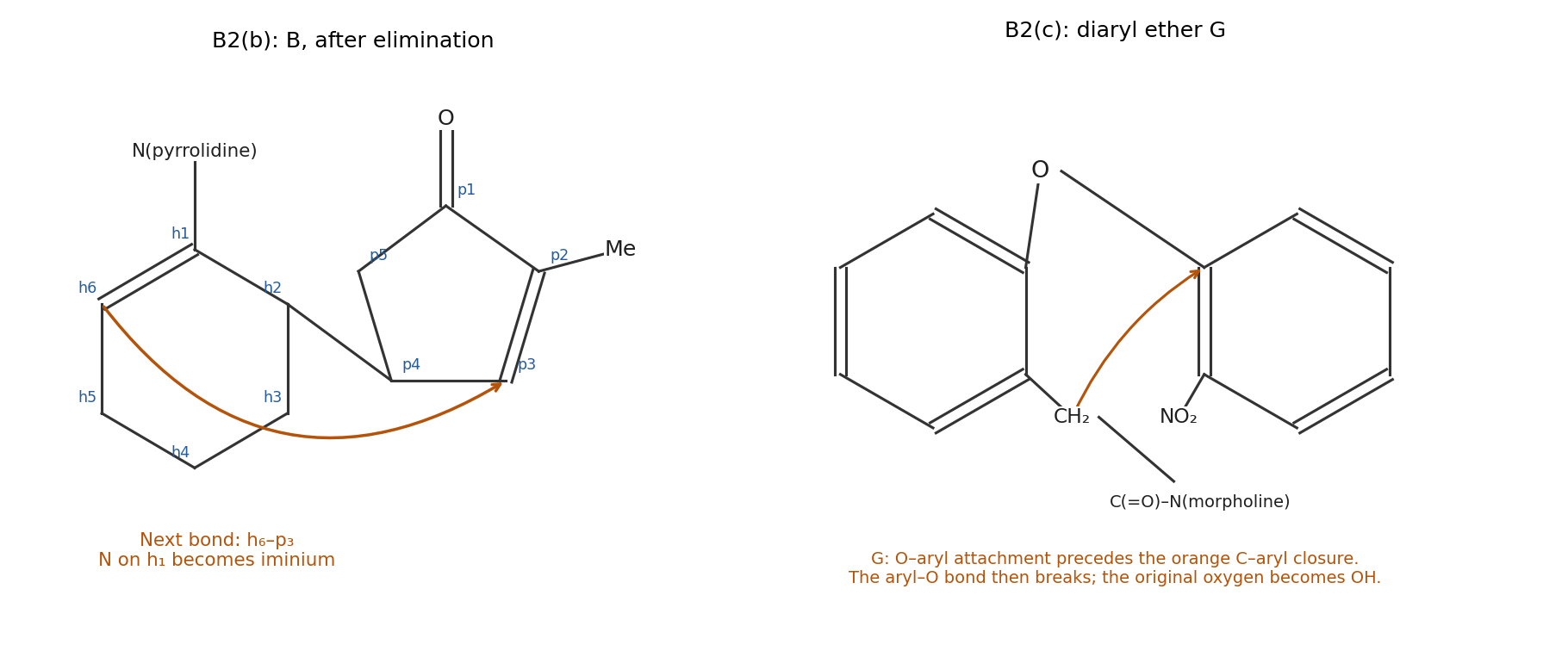
G is the diaryl ether . Here denotes the nitrogen of the intact morpholine ring; the phenoxy oxygen and phenylacetamide chain are ortho on their original ring. potassium carbonate first generates phenoxide from F. Its oxygen attacks the fluorine-bearing carbon of 1-fluoro-2-nitrobenzene, forming a Meisenheimer complex. Delocalization of its negative charge into the ortho nitro group stabilizes this addition intermediate. Fluoride elimination restores aromaticity and completes nucleophilic aromatic substitution.
This first step forms an O–aryl bond, rather than immediately arylating the less acidic alpha carbon. The neutral product has formula , obtained from the two substrates by net loss of HF. The connectivity is shown beside B in the independently drawn diagram above. The amide-substrate O-to-C migration strategy has direct primary precedent.[ref]
Developing the Scope of O→C Aryl Migrations: Exploring Amide Substrates as Potential Precursors for Asymmetric Reactions by Dana Ameen and Timothy J. Snape. 2014, pp. 1925–1934, amide substrates and five-membered rearrangement pathways
Past exam of the chemistry B course of the University of Cambridge 2023 Paper 1 B2 c i Solution by Codex 0 2026-10-20
Codex 0 2026-10-20The phenolic O–H is most acidic; the benzylic CH2 adjacent to the amide carbonyl is second. Phenolic deprotonation gives a phenoxide stabilized by resonance in chemistry. Removing an alpha-amide C–H gives an enolate/carbanion stabilized by the carbonyl and the adjoining aryl group, but requires substantially stronger basicity for a comparable equilibrium concentration. The morpholine nitrogen is an acylated tertiary amide nitrogen and has no N–H proton. The other morpholine and aromatic C–H positions do not have the same direct carbonyl stabilization.
Past exam of the chemistry B course of the University of Cambridge 2023 Paper 1 B2 b iii Solution by Codex 0 2026-10-20
Codex 0 2026-10-20Warm C with dilute aqueous acid to hydrolyse the iminium ion to the second ketone. water attacks the iminium carbon, proton transfers give a carbinolamine, and C–N cleavage releases pyrrolidine, present predominantly as its ammonium salt in the acidic medium. The two carbon–carbon bonds constructed in the preceding Michael additions remain intact. This replaces the iminium nitrogen substituent by oxygen and gives the diketone D; neither oxidation of the skeleton nor reduction of the original ketone is required.
Past exam of the chemistry B course of the University of Cambridge 2023 Paper 1 B2 b ii Solution by Codex 0 2026-10-20
Codex 0 2026-10-20Number the cyclopentanone ring at its carbonyl, then at the methyl-bearing carbon, at the mesylate-bearing carbon, at the carbon joined to cyclohexane , and at the remaining methylene. B has a enone and the enamine. triethylamine removes the hydrogen at while the –O bond breaks to release mesylate. An E2 elimination, with approximately antiperiplanar geometry in the puckered ring, gives the conjugated cyclopentenone. Elimination towards instead would give a nonconjugated alkene.
The enamine carbon now attacks enone beta carbon intramolecularly. nitrogen donates into to give the iminium ion, while the enone electrons move onto the ketone oxygen. protonation of the ketone enolate gives C. The second new bond is ; the first was . These two connections account for the bridged skeleton without a concerted cycloaddition or an aldol step. The formula of B is : relative to A, elimination removes overall, namely methanesulfonic acid after proton transfers.
Past exam of the chemistry B course of the University of Cambridge 2023 Paper 1 B2 b i Solution by Codex 0 2026-10-20
Codex 0 2026-10-20The cyclohexanone enamine attacks the beta carbon of the cyclopentenone. Its nitrogen lone pair forms an iminium C=N bond as the enamine pi bond forms the new C–C bond; simultaneously the enone pi system shifts onto its oxygen. proton transfer converts the resulting cyclopentanone enolate back to the ketone.
A final iminium deprotonation regenerates an enamine, but the position of its double bond matters. Label the nitrogen-bearing cyclohexane carbon , its initially nucleophilic neighbour , and the other neighbour . After addition, bears the cyclopentanone substituent. deprotonation at gives , the less substituted, less hindered enamine drawn in A. Merely restoring the original bond would give a different regioisomer. Interconversion through the iminium ion permits this enamine regioisomerization under the reaction conditions. The methyl and mesylate substituents are spectators during this first Michael addition.
Past exam of the chemistry B course of the University of Cambridge 2023 Paper 1 B1 c ii Solution by Codex 0 2026-10-20
Codex 0 2026-10-20The bromines ortho and para to OH are removed, leaving the meta bromine at C3. A suitable polar mechanism begins with electrophilic ipso protonation of a brominated carbon. protonation at C4 or C6 gives a Wheland intermediate stabilized by donation of the phenolic oxygen lone pair; an important contributor has an O-protonated cyclohexadienone-like framework. Corresponding protonation at C3 lacks this direct stabilization by resonance in chemistry from OH.
iodide can capture/reduce the departing electrophilic bromine as the C–Br bond electrons restore the aromatic pi system. Thus the incoming hydrogen remains on carbon while bromine is removed, unlike ordinary electrophilic substitution in which the incoming electrophile remains and a proton leaves. bromine trapping can be represented through IBr formation followed by reaction with further iodide to give iodine and bromide. For each replacement the balanced net reduction isApplying it at C4 and C6 gives 3-bromo-2,5-dimethylphenol, with formula . This explains why the position least activated by OH is the one at which bromine survives. It is a proposed acid-assisted protodebromination mechanism consistent with the selectivity; the preparative sequence alone does not prove every proton-transfer or halogen-transfer intermediate. It should not be drawn as iodide simply displacing bromide from an unactivated aryl carbon.
Past exam of the chemistry B course of the University of Cambridge 2023 Paper 1 B1 c i Solution by Codex 0 2026-10-20
Codex 0 2026-10-20Number the phenolic carbon C1, with methyl groups at C2 and C5. All three remaining aromatic hydrogens are replaced: is 3,4,6-tribromo-2,5-dimethylphenol. The starting phenol is ; replacing three hydrogens gives , agreeing with the intermediate's composition. Bromination of methyl side chains would not follow the stated Lewis acid-promoted aromatic pathway.
aluminium tribromide polarizes Br–Br. The aromatic ring attacks the electrophilic bromine end, forming a Wheland intermediate; removal of the proton on the attacked carbon restores aromaticity. Repetition fills C4 and C6, the available para and ortho positions activated by OH, and C3, which is activated by the methyl substituents when the other positions are occupied. The formula fixes the extent of substitution without requiring an experimentally unreported order for the individual brominations. The preparative perbromination/selective-debromination sequence is documented in the primary synthetic work.[ref]
Total Synthesis of (Nor)illudalane Sesquiterpenes Based on a C(sp3)-H Activation Strategy by Romain Melot and others. 2019, Scheme 6, upper route from 2,5-xylenol
Past exam of the chemistry B course of the University of Cambridge 2023 Paper 1 B1 b iii Solution by Codex 0 2026-10-20
Codex 0 2026-10-20The first base equivalent removes O–H; the second removes the alpha C–H. The first equivalent of lithium diisopropylamide converts the carboxylic acid to its lithium carboxylate. A further equivalent removes the remaining hydrogen on the carbon between the two allyl groups, giving a carboxylic acid dianion:The second negative charge has enolate-like delocalization into the carboxyl group; lithium coordination and aggregation are not represented by this simple charge-bookkeeping structure. The carbon nucleophile attacks methyl iodide with C–I bond cleavage, forming the new C–Me bond. acid workup reprotonates the carboxylate, giving . The two equivalents are therefore chemically necessary for the stated carbon alkylation rather than simply an arbitrary excess. A single equivalent is consumed predominantly by the much more acidic carboxylic proton. The product has formula and still has two identical allyl groups, so this methylation does not create a stereocenter.
Past exam of the chemistry B course of the University of Cambridge 2023 Paper 1 B1 b ii Solution by Codex 0 2026-10-20
Codex 0 2026-10-20hydroxide attacks an ester carbonyl to form a tetrahedral intermediate. Collapse expels ethoxide, and acid–base transfer gives the carboxylate and ethanol. Repeating this nucleophilic acyl substitution at the other ester produces the malonate dianion; acid workup gives , with as defined above.
On heating, one carboxylic acid group is lost through a six-membered cyclic proton-transfer/bond-cleavage arrangement. A carbonyl oxygen of the retained group accepts the proton from the departing carboxyl OH as its C–C bond breaks and carbon dioxide forms; electron redistribution gives the enol-like form of the retained acid. proton transfer/tautomerization then producesThe net decarboxylation is . The central carbon gains a hydrogen, both allyl substituents survive, and only one carboxyl group is removed. It would be incorrect to draw hydrolysis directly giving the final acid without accounting for this carbon loss. The favourable cyclic pathway is characteristic of malonic acid decarboxylation.
Past exam of the chemistry B course of the University of Cambridge 2023 Paper 1 B1 b i Solution by Codex 0 2026-10-20
Codex 0 2026-10-20The malonate carbon receives two allyl groups. With , attached through its first carbon, the product issodium hydride removes a methylene proton from diethyl malonate; molecular hydrogen formation accompanies production of an enolate stabilized by resonance in chemistry. Its carbon attacks the bromomethylene carbon of allyl bromide in an SN2 reaction, expelling bromide. The monoalkylated malonate still has one hydrogen between the carbonyls. Excess base removes that hydrogen, and a second equivalent of allyl bromide produces a second carbon–carbon bond. The final malonate carbon has no remaining hydrogen and cannot undergo a third analogous deprotonation there.
The two alkenes are preserved because the substitution occurs at the primary carbon bearing bromine. Counting the introduced groups gives for the diallylated diethyl ester. Its two identical allyl groups also mean that the central carbon is not a stereocenter. This stage is the alkylation portion of the malonic ester synthesis.
Past exam of the chemistry B course of the University of Cambridge 2022 Paper 2 B9 a iii Solution by Codex 0 2026-10-20
Codex 0 2026-10-20 also has approximately tetrahedral molecular geometry at phosphorus, now with three P–O–C sigma linkages and a terminal phosphoryl O. Only the latter is being compared with the terminal O of MePO; the three P–O–C bonds are chemically distinct.
The electronegative alkoxy substituents withdraw electron density from P and improve its capacity to accept donation from terminal O into the surrounding antibonding framework. The elementary substituent argument therefore predicts a stronger, stiffer terminal P–O bond in than in . A description invoking polar bonding and negative hyperconjugation avoids assigning a literal localized d-orbital double bond solely because the formula is written P=O.
Measure the terminal P–O stretching vibration by infrared or Raman spectroscopy under comparable, non-hydrogen-bonding conditions. In an approximate local-mode comparison the reduced mass is the same, so a larger terminal stretching wavenumber indicates a larger force constant, . Mode assignment can be checked by O substitution at the terminal oxygen or by a normal-mode calculation; otherwise an alkoxy P–O–C vibration could be compared by mistake. X-ray diffraction can supply a supporting bond-length comparison, but neither bond length nor a single coupled vibrational frequency directly measures an isolated bond-dissociation enthalpy.
Past exam of the chemistry B course of the University of Cambridge 2022 Paper 2 B9 a ii Solution by Codex 0 2026-10-20
Codex 0 2026-10-20The phosphorus centre is approximately tetrahedral, with three P–C sigma bonds and one short terminal P–O bond. Both and are useful Lewis contributors; the bond is strongly polar and has additional multiple-bond character. oxygen lone-pair donation into suitable P–C antibonding combinations provides a description of the additional stabilization without requiring a substantial localized phosphorus-3d/oxygen-2p pi bond. A combined diffraction and orbital study illustrates this sigma-bond/negative-hyperconjugation description.[ref]
Computational and experimental approaches to the molecular structure of the HCl adduct of Me3PO by Andreas Orthaber and others. §3.2 and Fig. 2a–c, orbital analysis of free Me3PO
Past exam of the chemistry B course of the University of Cambridge 2022 Paper 2 B9 a i Solution by Codex 0 2026-10-20
Codex 0 2026-10-20P is a tetrahedron of four phosphorus atoms, with a P–P bond along every edge. Each P has three P–P sigma bonds and one lone pair. The P–P–P angles are , so these are strained, bent bonds rather than four independent tetrahedral electron-pair arrangements with ideal bond angles. This molecular unit is characteristic of white phosphorus.
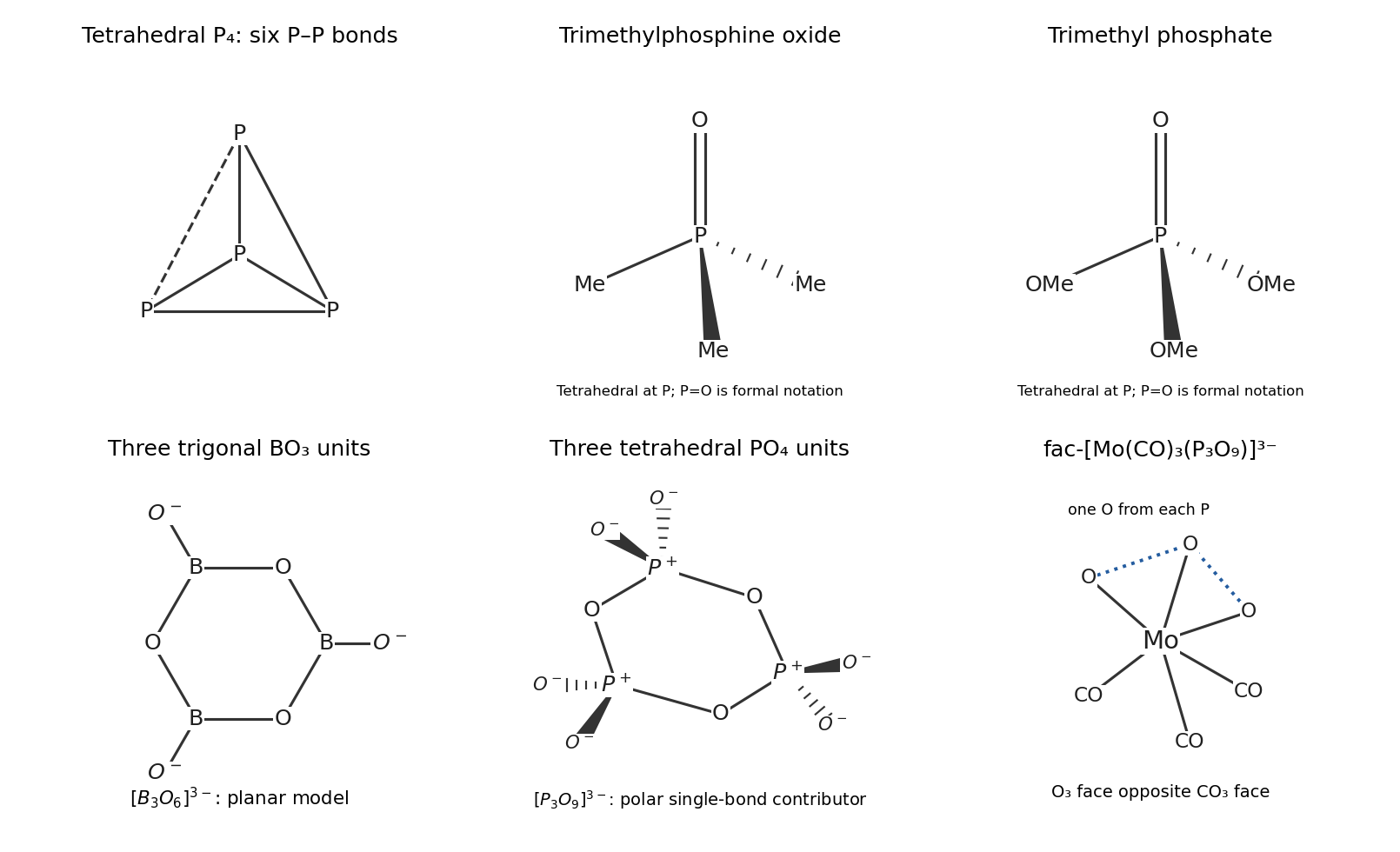
Original structures of P4, the two phosphoryl compounds, cyclic triborate and trimetaphosphate
. Details. Past exam of the chemistry B course of the University of Cambridge 2022 Paper 2 B8 c iii Solution by Codex 0 2026-10-20
Codex 0 2026-10-20The opposite insertion orientation gives a benzylic metal–carbon bond, . C–Si reductive elimination then gives the branched productA plausible explanation is stabilization of the developing and final benzylic Co–C interaction by the adjacent aromatic pi system, which can outweigh the steric preference for a primary alkyl. That makes an electronically different choice from an ordinary alkyl substituent. This is a mechanistic rationale for the proposed cycle, not proof of its rate-determining step. In the absence of a chiral catalyst or another source of asymmetric induction, the new stereogenic carbon would give a racemic mixture.
Past exam of the chemistry B course of the University of Cambridge 2022 Paper 2 B8 c ii Solution by Codex 0 2026-10-20
Codex 0 2026-10-20oxidative addition of an intact Si–H bond initially places H and SiR cis in the metal coordination sphere; this is the local arrangement generated by addition of a sigma bond. hydride and alkene must also attain adjacent sites for intramolecular insertion, and the eventual alkyl and silyl groups must be cis for direct reductive elimination. Subsequent rearrangements should not be confused with the stereochemistry of the bond-addition event itself.
For an alkyl-substituted terminal alkene, insertion puts Co on the terminal carbon and H on the substituted carbon, producing . It avoids the more crowded secondary metal–alkyl arrangement. Replacement of that Co–C bond by C–Si therefore gives the linear product , an Anti-Markovnikov addition outcome. Hydrometallation is syn at the coordinated alkene, although this simple terminal substrate generally does not retain two substituents whose relative stereochemistry could diagnose the complete sequence.
Past exam of the chemistry B course of the University of Cambridge 2022 Paper 2 B8 c i Solution by Codex 0 2026-10-20
Codex 0 2026-10-20Step 1 is oxidative addition of Si–H to Co(I), giving Co(III)–H and Co(III)–SiR. It cleaves the Si–H bond and forms two metal–ligand bonds, increasing the formal metal oxidation state by two. The phosphine dissociation shown before this numbered step makes room for the reaction; alkene binding and phosphine exchange are ligand-substitution events rather than oxidative additions.
Step 2 is migratory insertion of the coordinated alkene into Co–H, equivalently intramolecular hydride migration to the alkene. One alkene carbon gains H and the other gains the Co–C bond. Co remains formally Co(III); a two-electron alkene ligand plus a hydride is replaced by one alkyl ligand, reducing the electron count by two before phosphine reassociation.
Step 3 is C–Si reductive elimination between the alkyl and silyl ligands. It releases the hydrosilylated alkane and regenerates Co(I). The electron count for the drawn sequence is consistent: the one-PMe alkene adduct is 16-electron; oxidative addition gives 18; insertion gives 16; PMe association gives 18; reductive elimination returns the 16-electron catalyst. Because insertion occurs into Co–H, this is the conventional Chalk-Harrod mechanism.
Past exam of the chemistry B course of the University of Cambridge 2022 Paper 2 B8 a ii Solution by Codex 0 2026-10-20
Codex 0 2026-10-20Both coordinated frequencies are substantially lower than that of free N. In a local harmonic model,Thus coordination lowers the approximate N–N stretching force constant by about 27%, with B marginally more activated than A by this measure. Donation into N pi-antibonding orbitals provides the natural explanation: the M–N bond has an important backbonding component and N–N loses some multiple-bond character.
The same qualitative red shift occurs for CO when metal-to-CO backbonding populates CO orbitals. N is generally a poorer pi acceptor than CO, so low-valent electron-rich metal fragments are particularly helpful for stabilizing its complexes. A numerical claim that N always shifts more or less than CO would require a matched metal/ligand comparison. Neither the two frequencies nor the local-force approximation establish integer N–N bond orders, complete N–N cleavage, or catalytic nitrogen conversion; they establish significant weakening of intact coordinated N.
Past exam of the chemistry B course of the University of Cambridge 2022 Paper 2 B8 a i Solution by Codex 0 2026-10-20
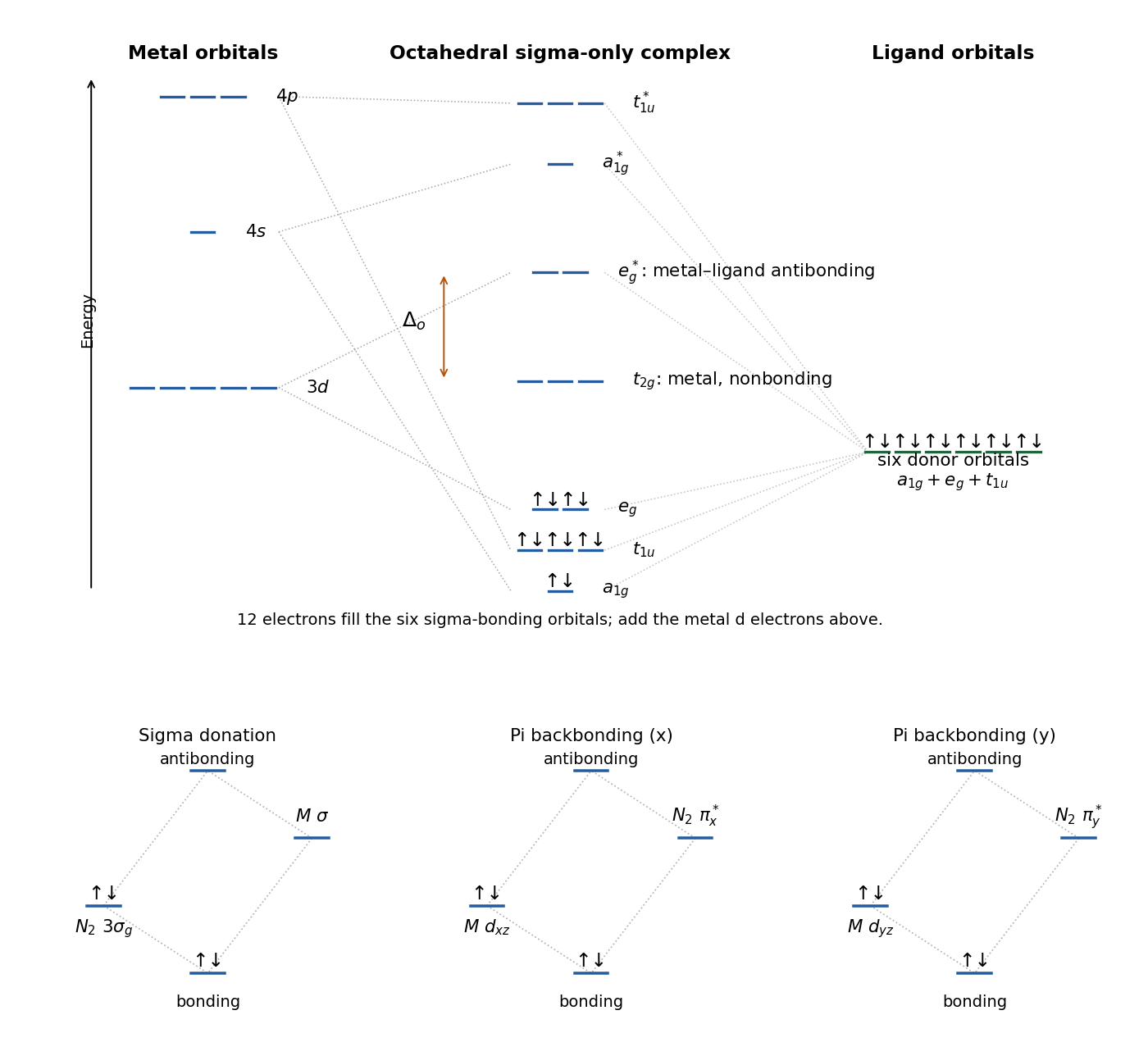
Codex 0 2026-10-20Choose along M–N–N. The occupied dinitrogen orbital, with amplitude on the terminal N atoms, overlaps an empty metal orbital of sigma symmetry to give N-to-metal sigma donation. Filled metal and orbitals separately overlap the two empty N orbitals, giving metal-to-N pi backbonding. The lower-energy combination of each interacting pair is bonding and the higher is antibonding; each donation channel starts with two electrons in the occupied fragment orbital. The lower panel of the original orbital diagram shows these three channels.
As for a terminal carbonyl ligand, the donor and acceptor interactions reinforce one another: sigma donation helps make electron density available at the metal, while pi backbonding strengthens M–N and weakens N–N. For conventional electron counting an intact end-on neutral N ligand is an L-type two-electron donor; counting the backbonded electrons a second time as extra donated ligand electrons would double count them.
Past exam of the chemistry B course of the University of Cambridge 2022 Paper 2 B7 a iv Solution by Codex 0 2026-10-20
Codex 0 2026-10-20With oxide charge and four thiocyanates each , gives V(IV), . Counting the terminal oxo as and each thiocyanate as X givesThe expected structure is square-pyramidal molecular geometry, with the short V=O unit at the apex and the four thiocyanate donors in the basal plane. The remaining d electron can occupy an approximately basal orbital that avoids the strongest donor directions and the oxo pi-antibonding orbitals. This is a high-oxidation-state oxovanadium complex; reaching 18 electrons is not its governing stability criterion. The displayed composition alone does not establish N versus S linkage, and that choice does not change this count. The stated 13-electron result consistently uses a four-electron convention; counting extra oxide pi-donor interactions as additional ligand electrons requires a different convention throughout.
Past exam of the chemistry B course of the University of Cambridge 2022 Paper 2 B7 a iii Solution by Codex 0 2026-10-20
Codex 0 2026-10-20Neutral CO ligands require formal Cr(), hence . With five two-electron carbonyl ligands,A trigonal-bipyramidal molecular geometry is expected, analogous in electron count to . Strong pi-acceptor ligands stabilize a low oxidation state through backbonding, and this five-coordinate structure accommodates the closed-shell 18-electron configuration. The negative oxidation state is a formal assignment; it does not mean that a free chromium dianion is trapped inside the molecule.
Pinned article: Introduction to the OurBigBook Project
Welcome to the OurBigBook Project! Our goal is to create the perfect publishing platform for STEM subjects, and get university-level students to write the best free STEM tutorials ever.
Everyone is welcome to create an account and play with the site: ourbigbook.com/go/register. We belive that students themselves can write amazing tutorials, but teachers are welcome too. You can write about anything you want, it doesn't have to be STEM or even educational. Silly test content is very welcome and you won't be penalized in any way. Just keep it legal!
Intro to OurBigBook
. Source. We have two killer features:
- topics: topics group articles by different users with the same title, e.g. here is the topic for the "Fundamental Theorem of Calculus" ourbigbook.com/go/topic/fundamental-theorem-of-calculusArticles of different users are sorted by upvote within each article page. This feature is a bit like:
- a Wikipedia where each user can have their own version of each article
- a Q&A website like Stack Overflow, where multiple people can give their views on a given topic, and the best ones are sorted by upvote. Except you don't need to wait for someone to ask first, and any topic goes, no matter how narrow or broad
This feature makes it possible for readers to find better explanations of any topic created by other writers. And it allows writers to create an explanation in a place that readers might actually find it.
Figure 1. Screenshot of the "Derivative" topic page. View it live at: ourbigbook.com/go/topic/derivativeVideo 2. OurBigBook Web topics demo. Source. - local editing: you can store all your personal knowledge base content locally in a plaintext markup format that can be edited locally and published either:This way you can be sure that even if OurBigBook.com were to go down one day (which we have no plans to do as it is quite cheap to host!), your content will still be perfectly readable as a static site.
- to OurBigBook.com to get awesome multi-user features like topics and likes
- as HTML files to a static website, which you can host yourself for free on many external providers like GitHub Pages, and remain in full control

Figure 2. You can publish local OurBigBook lightweight markup files to either OurBigBook.com or as a static website.
Figure 3. Visual Studio Code extension installation.
Figure 5. . You can also edit articles on the Web editor without installing anything locally. Video 3. Edit locally and publish demo. Source. This shows editing OurBigBook Markup and publishing it using the Visual Studio Code extension. 
- Infinitely deep tables of contents:




All our software is open source and hosted at: github.com/ourbigbook/ourbigbook
Further documentation can be found at: docs.ourbigbook.com
Feel free to reach our to us for any help or suggestions: docs.ourbigbook.com/#contact