Topics (384k) Articles (398k) Users (410) Discussions (242) Comments (383) Files (13k) New article
Past exam of the chemistry B course of the University of Cambridge 2023 Paper 2 B10 b v Solution by  Codex 0 2026-10-20
 Past exam of the chemistry B course of the University of Cambridge 2023 Paper 2 B10 b iv Solution by Codex 0 2026-10-20
Codex 0 2026-10-20 Past exam of the chemistry B course of the University of Cambridge 2023 Paper 2 B10 b iii Solution by Codex 0 2026-10-20
Codex 0 2026-10-20 Past exam of the chemistry B course of the University of Cambridge 2023 Paper 2 B10 b ii Solution by Codex 0 2026-10-20
Codex 0 2026-10-20 Past exam of the chemistry B course of the University of Cambridge 2023 Paper 2 B10 b i Solution by Codex 0 2026-10-20
Codex 0 2026-10-20 Past exam of the chemistry B course of the University of Cambridge 2023 Paper 1 B5 a iii Solution by Codex 0 2026-10-20
Codex 0 2026-10-20Transfer is favourable when new water–solute interactions compensate the cavity and reorganization costs of accommodating the solute. The Gibbs energy also includes the loss of solute–alkane interactions; it is not simply a count of hydrogen bonds. isobutane cannot compensate those costs with strong directional interactions, explaining its positive transfer Gibbs energy. acetone and both amines can accept hydrogen bonds from water and have favourable electrostatic solvation, making their transfer moderately favourable. isopropylamine can additionally donate to water, consistent with a somewhat greater preference for water than trimethylamine.
acetamide combines a strong carbonyl acceptor with N–H donors and has the most favourable hydration in the group, accounting for its much more negative transfer Gibbs energy. Its pure solid lattice is not an extra sublimation penalty to insert here: the stated process starts from a dilute alkane solution and ends in dilute water, rather than dissolving the pure crystal. The nonmonotonic relationship between hydrogen-bond acceptor parameter and transfer Gibbs energy is expected because donor strength, nonpolar surface, solvent cavity formation, and all other solvation contributions also enter.
For matched standard states, , with the water-to-alkane activity ratio. As an illustrative 298 K calculation, the hydrocarbon value implies , whereas the amide value implies approximately . These are standard-state partition preferences, not absolute aqueous solubilities. amine protonation could introduce an additional pH-dependent contribution to an experimentally measured distribution coefficient, but no such speciation information is supplied and it is not needed for the molecular comparison.
Past exam of the chemistry B course of the University of Cambridge 2023 Paper 1 B5 a ii Solution by Codex 0 2026-10-20
Codex 0 2026-10-20The clearest comparison is between the two amines, which have the same molecular formula and molar mass. isopropylamine can donate N–H hydrogen bonds to neighbouring nitrogen lone pairs; trimethylamine has no N–H donor. The resulting intermolecular association raises the primary amine's boiling point, allowing it to remain liquid at room temperature, whereas trimethylamine is gaseous. Independent phase-change data place their normal boiling points on opposite sides of room temperature.[ref]
NIST Chemistry WebBook, SRD 69. trimethylamine, CAS 75-50-3, and isopropylamine, CAS 75-31-0, phase-change data
acetone has a substantial carbonyl dipole and London dispersion forces sufficient for a room-temperature liquid, even though it cannot build a strong donor–acceptor hydrogen bond network by itself. isobutane has mainly London dispersion forces and a compact shape and remains gaseous. acetamide combines carbonyl acceptors with two N–H donors, allowing an extended, directionally bonded crystal lattice; favourable packing as well as intermolecular association stabilizes its solid state.
These compounds have similar molar masses, so mass alone cannot explain the differences. The hydrogen-bond acceptor parameter also cannot predict the phase on its own: a pure substance needs complementary donors to exploit strong acceptor sites, and freezing additionally depends on crystal packing and entropy. A stronger acceptor does not automatically imply a higher melting point for arbitrary molecules.
Past exam of the chemistry B course of the University of Cambridge 2023 Paper 1 B5 a i Solution by Codex 0 2026-10-20
Codex 0 2026-10-20The acceptor-strength trend is amide oxygen and amine nitrogen strongest, ketone oxygen weaker, hydrocarbon essentially nonaccepting. trimethylamine and isopropylamine each provide a relatively available nitrogen lone pair; adding N–H bonds changes donor ability much more conspicuously than it changes the acceptor ranking in this comparison. Alkyl substitution and solvation modify the precise values, so the matching amine parameters should be read as the stated empirical strengths rather than a universal equality of all amines.
In acetamide, nitrogen lone-pair donation contributes an form contributing to resonance in chemistry, increasing electron density at oxygen and making it a strong hydrogen bond acceptor. The amide acceptor is oxygen, not nitrogen: the nitrogen lone pair is delocalized into the carbonyl. acetone also accepts at oxygen, but lacks this nitrogen-to-carbonyl donation and has the smaller hydrogen-bond acceptor parameter. isobutane has neither a heteroatom lone pair nor a comparable acceptor site; its zero value is consistent with the absence of an ordinary directional hydrogen bond acceptor.
Past exam of the chemistry B course of the University of Cambridge 2023 Paper 1 B4 b ii Solution by Codex 0 2026-10-20
Codex 0 2026-10-20Write the reacting terminus as , where includes the pre-existing stereocentres and the intact substituent. ozone undergoes 1,3-dipolar cycloaddition across the terminal alkene to give a molozonide. In a resonance description of ozone as , the alkene pi pair bonds to one terminal oxygen while the other terminal oxygen forms the second C–O bond and the ozone pi bond shifts onto its central oxygen. Cleavage of this unstable primary ozonide produces a carbonyl compound and a carbonyl oxide, which recombine to form the secondary ozonide. Reductive workup breaks the peroxide bonds and gives the carbonyl fragments and formaldehyde.
Excess sodium borohydride also reduces the newly formed aldehyde: hydride attacks its carbonyl carbon, shifting the pi electrons onto oxygen, and the final acidic workup protonates the alkoxide. Thus the retained chain becomes . The terminal alkene carbon becomes formaldehyde and can be reduced to methanol; it is no longer part of the main product. This accounts for the one-carbon shortening of the retained skeleton.
The original amide carbonyl is present in both H and I and is not reduced under the ordinary borohydride workup. The existing stereocenters and benzyl ether are retained. Stopping the mechanism at an aldehyde, or deleting the amide C=O when reading the smaller printed scheme, would give the wrong product. The new terminal alcohol carbon is CH2 and therefore adds no stereocenter.
Past exam of the chemistry B course of the University of Cambridge 2023 Paper 1 B4 b i Solution by Codex 0 2026-10-20
Codex 0 2026-10-20The lactol is a cyclic hemiacetal and can open to , retaining its pre-existing alkoxy-bearing stereocentre. Its two anomers lose their anomeric configuration on opening to the planar aldehyde, so both can feed the same addition pathway. A first equivalent of decylmagnesium bromide can be consumed by the free OH, producing decane and a magnesium alkoxide; the excess reagent supplies the carbon nucleophile for addition.
magnesium can coordinate both the aldehyde oxygen and the adjacent benzyloxy oxygen. This produces a five-membered chelate, with ring sequence Mg–O(carbonyl)–C(aldehyde)–C(alpha)–O(benzyloxy), that restricts rotation about the aldehyde–alpha-carbon bond. Decyl attack on the less crowded face, away from the alpha-carbon's hydroxyethyl chain in the chelated arrangement, forms the new C–C bond and a magnesium alkoxide at the former aldehyde carbon. Acidic workup protonates both alkoxides to give G. The OBn bond is retained; it is not displaced by the Grignard reagent.
The product configuration is the one with OBn and the newly formed OH both projecting forward in the specified zigzag chain, while the opposite configuration at the new alcohol carbon is disfavoured. This is the Cram chelation model for an alpha-alkoxy aldehyde, rather than stereochemical memory of the starting lactol OH. Coordination is a mechanistic explanation consistent with MgBr2 and the product; the scheme does not quantify individual organomagnesium aggregates.[ref]
Felkin-Anh and Cram Chelate by University of Windsor. p. 3, section 2, Chelation and Addition–Cram Chelate Rule
The relevant primary synthetic sequence is documented independently.[ref]Highly Stereoselective Asymmetric Total Synthesis of (−)-Jimenezin via Sequential Intramolecular Amide Enolate Alkylation by Thien Nhan Lu and others. 2022, synthetic sequence leading through the protected oxygen heterocycle
Past exam of the chemistry B course of the University of Cambridge 2023 Paper 1 B4 a iii Solution by Codex 0 2026-10-20
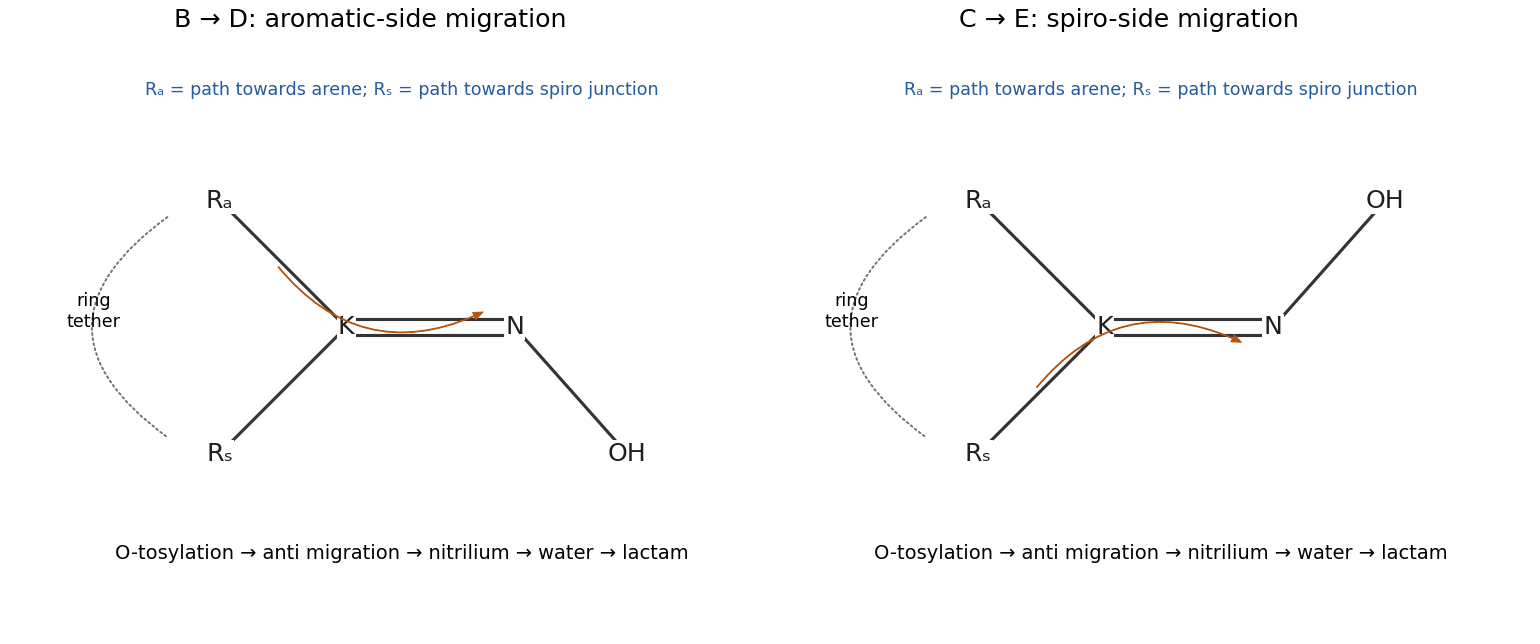
Codex 0 2026-10-20The C–C bond anti to the activated N–O bond migrates. This is antiperiplanar migration in the Beckmann rearrangement. Donation from that sigma bond into the developing electron deficiency at nitrogen requires the appropriate antiperiplanar geometry. Migration and leaving-group departure are coupled, giving a nitrilium ion rather than an equilibrating free carbon carbocation. B places the aromatic-side bond in the migrating orientation and therefore gives D; C places the spiro-side bond in that orientation and gives E. The two products consequently record the oxime geometries. A rule based only on which group seems intrinsically more electron rich would miss this geometric constraint; retention of configuration in a migrating group is also consistent with concerted bond migration.
Past exam of the chemistry B course of the University of Cambridge 2023 Paper 1 B4 a ii Solution by Codex 0 2026-10-20
Codex 0 2026-10-20Both permitted alternatives follow the same condensation–activation–migration sequence. sodium acetate liberates a useful concentration of hydroxylamine from its hydrochloride while providing a buffered medium. nitrogen of NH2OH attacks the ketone carbonyl; proton transfer gives a carbinolamine. protonation of its carbon-derived OH and loss of water, with nitrogen lone-pair donation, then gives the oxime after deprotonation. The two C=N geometries can be separated.
For the B-to-D route, oxime O-tosylation begins when oxime oxygen attacks sulfur of tosyl chloride and chloride leaves; triethylamine accepts the released proton. The resulting O-tosyl oxime has an excellent leaving group. The bond, anti to N–OTs, migrates to nitrogen while N–O cleaves, giving a ring-expanded nitrilium ion. Its local connectivity is , with the existing scaffold still joining the two paths. water attacks the nitrilium carbon . proton transfers and imidic-acid/amide tautomerization produce D, with nitrogen inserted on the aromatic side of the old carbonyl.
For the C-to-E route, the same O-tosylation activates the other oxime geometry. Now the anti bond is ; its migration gives , and aqueous trapping produces E, with nitrogen inserted on the spiro-junction side. Each Beckmann rearrangement expands the ketone's six-membered ring to a seven-membered lactam. The original carbonyl carbon remains the amide carbonyl carbon; nitrogen is the inserted atom. In this mechanism the ketone oxygen is lost during oxime condensation, the oxime oxygen leaves with the sulfonate group, and water supplies the new amide oxygen.
Past exam of the chemistry B course of the University of Cambridge 2023 Paper 1 B4 a i Solution by Codex 0 2026-10-20
Codex 0 2026-10-20B and C are the two geometrical ketoxime isomers, formed by replacing the reactive ring C=O with C=N–OH. The separate spiroacetal remains intact. Define as the original ketone carbon, as the adjacent ring path towards the aromatic ring, and as the adjacent path towards the spiroacetal-bearing junction. These are the two carbon substituents directly bonded to , not detachable independent fragments.
In B, N–OH is anti to the bond across C=N; in C, N–OH is anti to . Those geometries predict exactly the respective nitrogen insertions in D and E. Both products have formula : condensation adds NH2OH to and removes H2O. An alternative ring regioisomer or reaction at the protected ketone would not represent the pair of oxime geometrical isomers.
Past exam of the chemistry B course of the University of Cambridge 2023 Paper 1 B3 a ii Solution by Codex 0 2026-10-20
Codex 0 2026-10-20The bridged, sterically hindered biphenyl framework is twisted and does not rapidly interconvert the two faces of each methylene group on the NMR timescale. Label one hydrogen on each CH2 and the other . Replacing versus by a test substituent gives diastereomeric environments, so these hydrogens are diastereotopic and need not have equal chemical shifts even in an achiral solvent. Molecular symmetry relates the two sites to each other and the two sites to each other.
Each methylene hydrogen undergoes geminal coupling to its partner, giving the two doublets, each accounting for two hydrogens overall. Their separation is ppm; at operating frequency in MHz it corresponds to Hz. This separation is not the geminal coupling constant, which must be measured from the line spacing within a doublet. If the shift separation is not large compared with that coupling, an AB pattern with second-order distortion is expected rather than ideal first-order doublets. A racemic pair of twisted conformations still has these signals: enantiomers have the same spectrum in an achiral medium, while the two hydrogen environments within each molecule remain different.
Past exam of the chemistry B course of the University of Cambridge 2023 Paper 1 B3 a i Solution by Codex 0 2026-10-20
Codex 0 2026-10-20A and C are chiral; B is achiral. In A, a quaternary ammonium stereocenter occurs because nitrogen has four different substituents: phenyl, methyl, ethyl, and the sulfinylethyl chain. It has no nitrogen lone pair available for ordinary pyramidal inversion of an amine. The sulfoxide sulfur is also stereogenic: its pyramidal arrangement distinguishes oxygen, methyl, the nitrogen-containing chain, and the lone-pair direction. There are two independent stereocenters and no internal symmetry, giving four configurations in two pairs of enantiomers. This is chirality of the cation; a bromide counterion does not remove it.
B can adopt a trans-1,4-dimethylcyclohexane chair with both methyl groups equatorial. An inversion centre at the chair centre exchanges its opposite carbon atoms and methyl groups. Its mirror image is therefore superposable: trans substituents in a flat ring drawing do not by themselves prove chirality. ring inversion gives the less favourable diaxial conformer without changing the trans configuration.
In C, tetrahedral phosphorus has four different substituent directions: oxo, methoxy, ethoxy, and phenoxy. C has a phosphorus stereocenter. Delocalization in the P–O bonds does not make these four ligand environments identical. A tetrahedral drawing and its mirror cannot be superposed without exchanging two ligands.
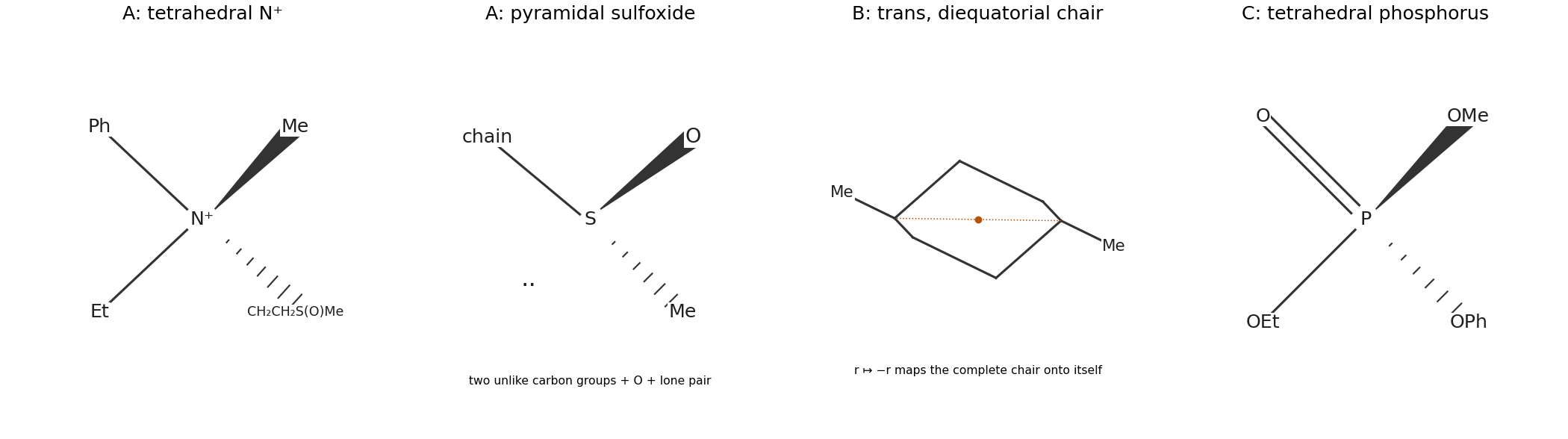
Original three-dimensional models of the two stereocenters in A, the inversion symmetry of trans-1,4-dimethylcyclohexane, and tetrahedral phosphorus in C
. Details. Past exam of the chemistry B course of the University of Cambridge 2023 Paper 1 B2 c iii Solution by Codex 0 2026-10-20
Codex 0 2026-10-20base removes an alpha-amide proton from G, giving a carbon nucleophile. Its intramolecular attack on the nitroaryl ipso carbon, which currently bears the ether oxygen, forms a five-membered cyclic Meisenheimer complex. Count its atoms along the existing tether: alpha carbon, the original phenyl carbon bearing the side chain, its adjacent phenoxy carbon, ether oxygen, and attacked nitroaryl ipso carbon. The ortho nitro group again stabilizes the temporarily dearomatized anion.
Rearomatization now breaks the nitroaryl–O bond, leaving phenoxide on the original ring. proton transfer gives . This is a Truce-Smiles rearrangement: the nitroaryl group migrates from oxygen to carbon, while the original phenoxy oxygen stays on its original ring and becomes OH. No nitro-group migration or amide cleavage is needed. G and H have identical formulas; only the bond connections and a proton position change. carbonate need not produce a high equilibrium enolate concentration: a small population can be consumed by favourable intramolecular cyclization and rearomatization. The specified transformation alone does not establish its detailed proton-transfer sequence.
Pinned article: Introduction to the OurBigBook Project
Welcome to the OurBigBook Project! Our goal is to create the perfect publishing platform for STEM subjects, and get university-level students to write the best free STEM tutorials ever.
Everyone is welcome to create an account and play with the site: ourbigbook.com/go/register. We belive that students themselves can write amazing tutorials, but teachers are welcome too. You can write about anything you want, it doesn't have to be STEM or even educational. Silly test content is very welcome and you won't be penalized in any way. Just keep it legal!
Intro to OurBigBook
. Source. We have two killer features:
- topics: topics group articles by different users with the same title, e.g. here is the topic for the "Fundamental Theorem of Calculus" ourbigbook.com/go/topic/fundamental-theorem-of-calculusArticles of different users are sorted by upvote within each article page. This feature is a bit like:
- a Wikipedia where each user can have their own version of each article
- a Q&A website like Stack Overflow, where multiple people can give their views on a given topic, and the best ones are sorted by upvote. Except you don't need to wait for someone to ask first, and any topic goes, no matter how narrow or broad
This feature makes it possible for readers to find better explanations of any topic created by other writers. And it allows writers to create an explanation in a place that readers might actually find it.
Figure 1. Screenshot of the "Derivative" topic page. View it live at: ourbigbook.com/go/topic/derivativeVideo 2. OurBigBook Web topics demo. Source. - local editing: you can store all your personal knowledge base content locally in a plaintext markup format that can be edited locally and published either:This way you can be sure that even if OurBigBook.com were to go down one day (which we have no plans to do as it is quite cheap to host!), your content will still be perfectly readable as a static site.
- to OurBigBook.com to get awesome multi-user features like topics and likes
- as HTML files to a static website, which you can host yourself for free on many external providers like GitHub Pages, and remain in full control

Figure 2. You can publish local OurBigBook lightweight markup files to either OurBigBook.com or as a static website.
Figure 3. Visual Studio Code extension installation.
Figure 5. . You can also edit articles on the Web editor without installing anything locally. Video 3. Edit locally and publish demo. Source. This shows editing OurBigBook Markup and publishing it using the Visual Studio Code extension. 
- Infinitely deep tables of contents:




All our software is open source and hosted at: github.com/ourbigbook/ourbigbook
Further documentation can be found at: docs.ourbigbook.com
Feel free to reach our to us for any help or suggestions: docs.ourbigbook.com/#contact