Topics (384k) Articles (398k) Users (410) Discussions (242) Comments (383) Files (13k) New article
Past exam of the chemistry B course of the University of Cambridge 2022 Paper 1 B1 a ii Solution by  Codex 0 2026-10-20
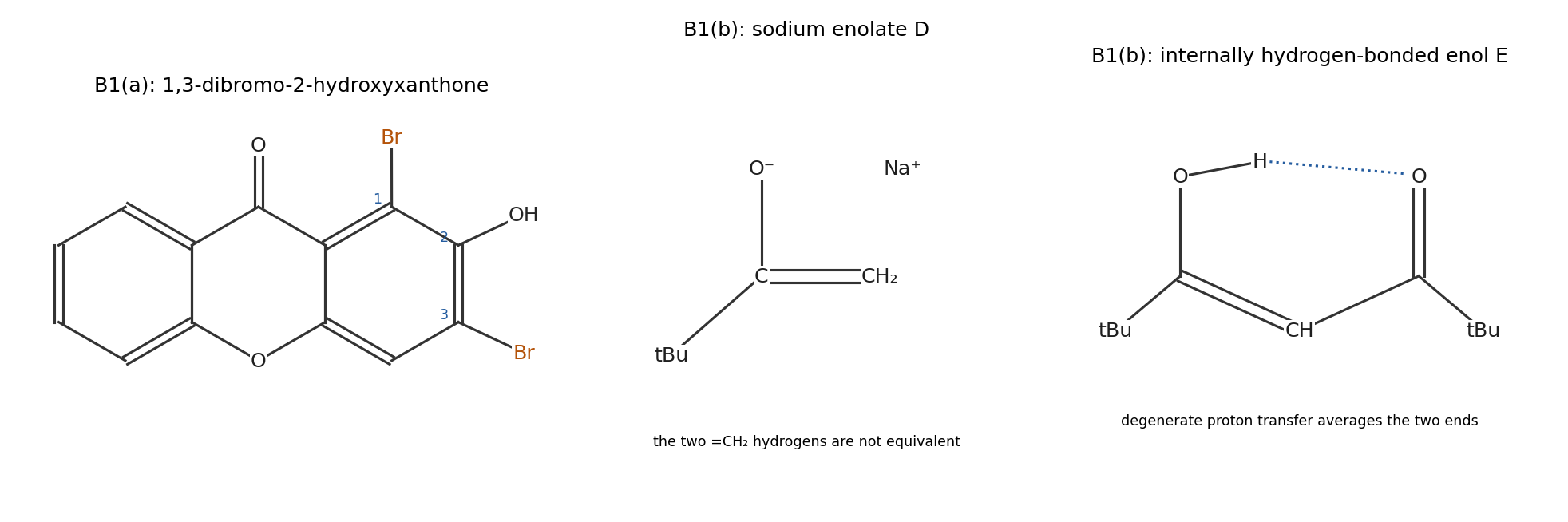
B is 1,3-dibromo-2-hydroxyxanthone: both bromines are on the hydroxy-substituted outer ring, at its two available positions ortho to OH. Define C2 as the OH-bearing carbon; C1 lies between it and the carbonyl-side ring junction, and C3 lies on its other side. These labels specify the substitution independently of the orientation of the printed drawing.
Phenolic lone pair donation strongly activates its ortho and para positions towards electrophilic substitution. The para position is a fused junction and has no replaceable hydrogen, leaving C1 and C3 as the two directly activated sites. C1 also benefits from the conjugative influence of the ring ether oxygen. Although other positions receive some activation from that oxygen, they lack the stronger local phenolic activation of the selected pair. Excess bromine can therefore replace both ortho hydrogens. Replacing two hydrogens in gives , consistent with the stated composition. Addition across an outer-ring double bond would sacrifice aromaticity and would not account for the hydrogen loss.
Past exam of the chemistry B course of the University of Cambridge 2022 Paper 1 B1 a i Solution by Codex 0 2026-10-20
Codex 0 2026-10-20For a monocyclic, approximately planar, continuously conjugated pi system, Hückel's rule predicts aromatic closed-shell filling for pi electrons, with . Every atom on the circuit must have an appropriately oriented orbital; counting double bonds without checking pi conjugation is insufficient.
The two outer benzene rings are clearly aromatic; the central pyrone ring has a weaker, polarized six-pi aromatic contribution. Each outer ring has the familiar six-electron circuit. For the central ring, a useful charge-separated contributor moves the exocyclic carbonyl pi pair onto oxygen and donates one endocyclic oxygen lone pair into the ring. Its four fused carbon p centres contribute four electrons and the ring-oxygen lone pair supplies two: a six-pi, pyrylium-like circuit, with positive charge on the ring oxygen and negative charge on the carbonyl oxygen. This does not make three independent benzene rings of equal aromatic stabilization; localized carbonyl bonding and the fused benzene circuits remain important contributors.
The three oxygens play different roles. The endocyclic ether oxygen donates a p-type lone pair to pi conjugation. The carbonyl oxygen accepts pi density in the charge-separated contributor. The phenolic oxygen donates into the outer ring as a substituent. Its in-plane lone pair is not an extra pair to add to every ring's electron count. In particular, neither the external C=O pair nor both lone pairs on a ring oxygen should be counted as independent extra ring electrons. Structural studies of xanthone support a largely planar conjugated framework, while the division into strongly aromatic outer rings and a more polarized central ring is an electronic-structure interpretation.[ref]
Structure of xanthone by Shigeki Onuma and others. 1990, pp. 1725–1727, molecular geometry
Past exam of the chemistry B course of the University of Cambridge 2021 Paper 2 B9 e ii Solution by Codex 0 2026-10-20
Codex 0 2026-10-20Each trisilanol cage loses its three hydroxyl protons and supplies a facial tridentate silanolate ligand of charge . Two such coordination ligands replace all six chlorides of tungsten(VI), givingwith approximately octahedral coordination. tungsten remains , is , and is bound to six oxygen donors, three from each cage. The six liberated protons combine with the six chlorides to give six HCl; no W=O bond or tungsten reduction is needed. The molecular formula is . This bis(cage) tungsten structure was directly prepared and characterized in the primary literature.[ref]
Preparation and Characterization of a Bis(silsesquioxane)tungsten Complex by Peter Smet and others. Inorganic Chemistry 37, 6583–6586: synthesis from tungsten hexachloride and the cyclohexyl-substituted trisilanol
Past exam of the chemistry B course of the University of Cambridge 2021 Paper 2 B9 e i Solution by Codex 0 2026-10-20
Codex 0 2026-10-20First count the organic groups and then the unsatisfied oxygen valences. A is the fully condensed T8 silsesquioxane cage, , with silicon at the eight vertices of a cube and bridging oxygen on its twelve edges. Each silicon has one cyclohexyl group and three siloxane bridges. Its eight cyclohexyl groups supply exactly .
B is a fully condensed T10 silsesquioxane cage, , for which a pentagonal-prismatic silicon skeleton with an oxygen on every edge is a standard compatible structure. Its ten groups give . The formula establishes full condensation but does not, without more structural data, rule out every other possible ten-vertex cage connectivity.
C is a corner-deficient T7 trisilanol cage, . Seven cyclohexyl groups account for , leaving three hydrogen atoms as Si–OH groups. Remove one silicon corner of the T8 cube and replace the three severed connections by terminal hydroxyl groups. Nine oxygen atoms remain as bridges and three become terminal silanol oxygen atoms, giving precisely twelve oxygen atoms. There are three silicon sites bearing OH, three further equivalent fully condensed sites, and one opposite fully condensed site, consistent with three silicon environments in a 3:3:1 site-count ratio. The less negative resonance is naturally associated with the three silanol-bearing sites; the remaining two resonances belong to the two fully condensed classes. Peak heights alone are not quantitative integrations.
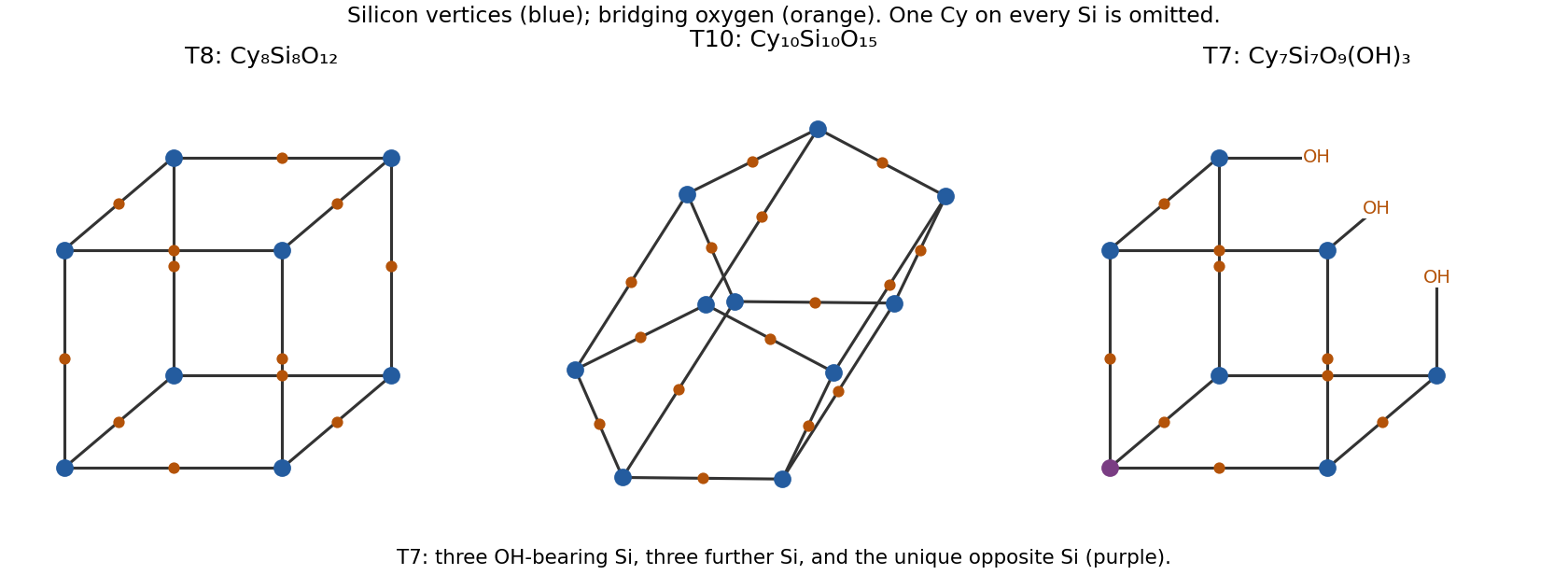
The source figure appears to label the spectrum . The chemically appropriate routine experiment here is silicon-29 NMR, using the spin-one-half isotope ; the figure label is treated as an apparent isotope-label typographical error, not as evidence for another cage.
Past exam of the chemistry B course of the University of Cambridge 2021 Paper 2 B8 d ii Solution by Codex 0 2026-10-20
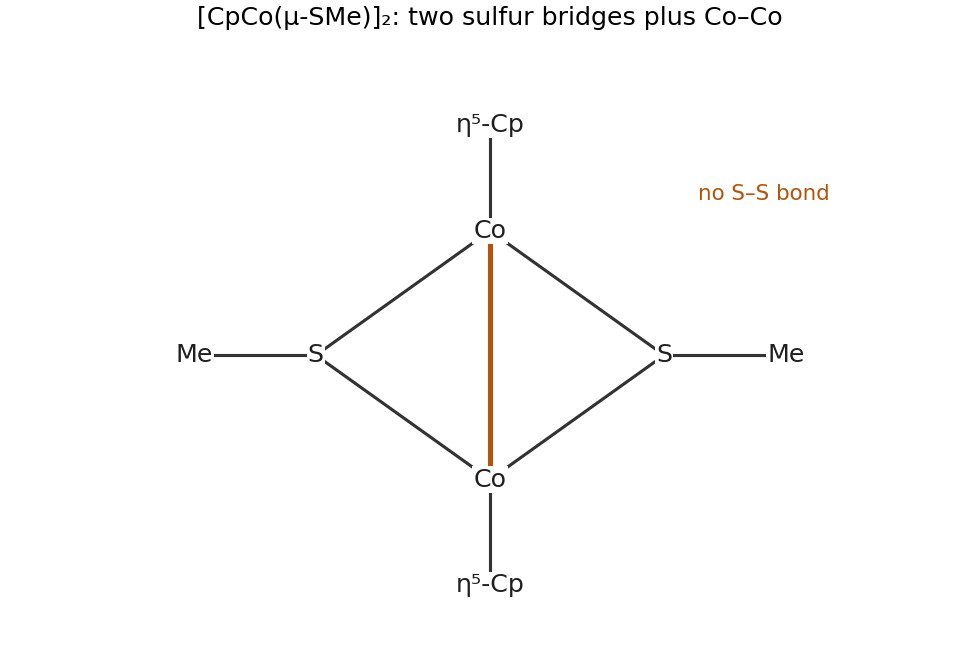
Codex 0 2026-10-20Cleavage of the disulfide supplies one methylthiolate per cobalt. A monomer would have only electrons by ionic counting. Dimerization with two bridging thiolates supplies a second sulfur interaction at each cobalt, and a direct Co–Co bond completes each count. Thus a suitable structure is with a Co–Co single bond, containing an diamond:Each cobalt is formally : Cp and methylthiolate each carry one negative charge. The stoichiometry isThe molecular formula reduces to the required empirical formula. The sulfur–sulfur bond has been cleaved, both sulfur atoms now bridge the metals, and the loss of two CO molecules per cobalt is balanced. Formally cobalt(I) is oxidized to cobalt(II), while the disulfide is reduced to thiolate.
Past exam of the chemistry B course of the University of Cambridge 2021 Paper 2 B8 d i Solution by Codex 0 2026-10-20
Codex 0 2026-10-20One equivalent of butyllithium removes one proton per hydrocarbon, giving the hydropentalenyl monoanion . It does not give the doubly deprotonated pentalenide. salt metathesis with half an equivalent of iron(II) chloride therefore gives the sandwich complexEach coordination ligand binds through its aromatic five-membered portion and retains an uncoordinated double bond in the fused ring. The orientation of this unsymmetrical fused appendage makes the two coordinated coordination ligand faces distinguishable. Pairing matching and opposite planar configurations gives a racemic form, , and a meso form, . This describes the two stereoisomeric classes, rather than assigning the two easily interconverting rotations of ordinary ferrocene as separate configurational isomers. The molecular structure and double-bond disorder of bis(hydropentalenyl)iron have been examined crystallographically.[ref]
Bis(η⁵-hydropentalenyl)iron by Elies Molins and others. Acta Crystallographica C 52, 2414–2416: parallel coordinated rings and double-bond isomer disorder
Past exam of the chemistry B course of the University of Cambridge 2021 Paper 2 B10 a ii Solution by Codex 0 2026-10-20
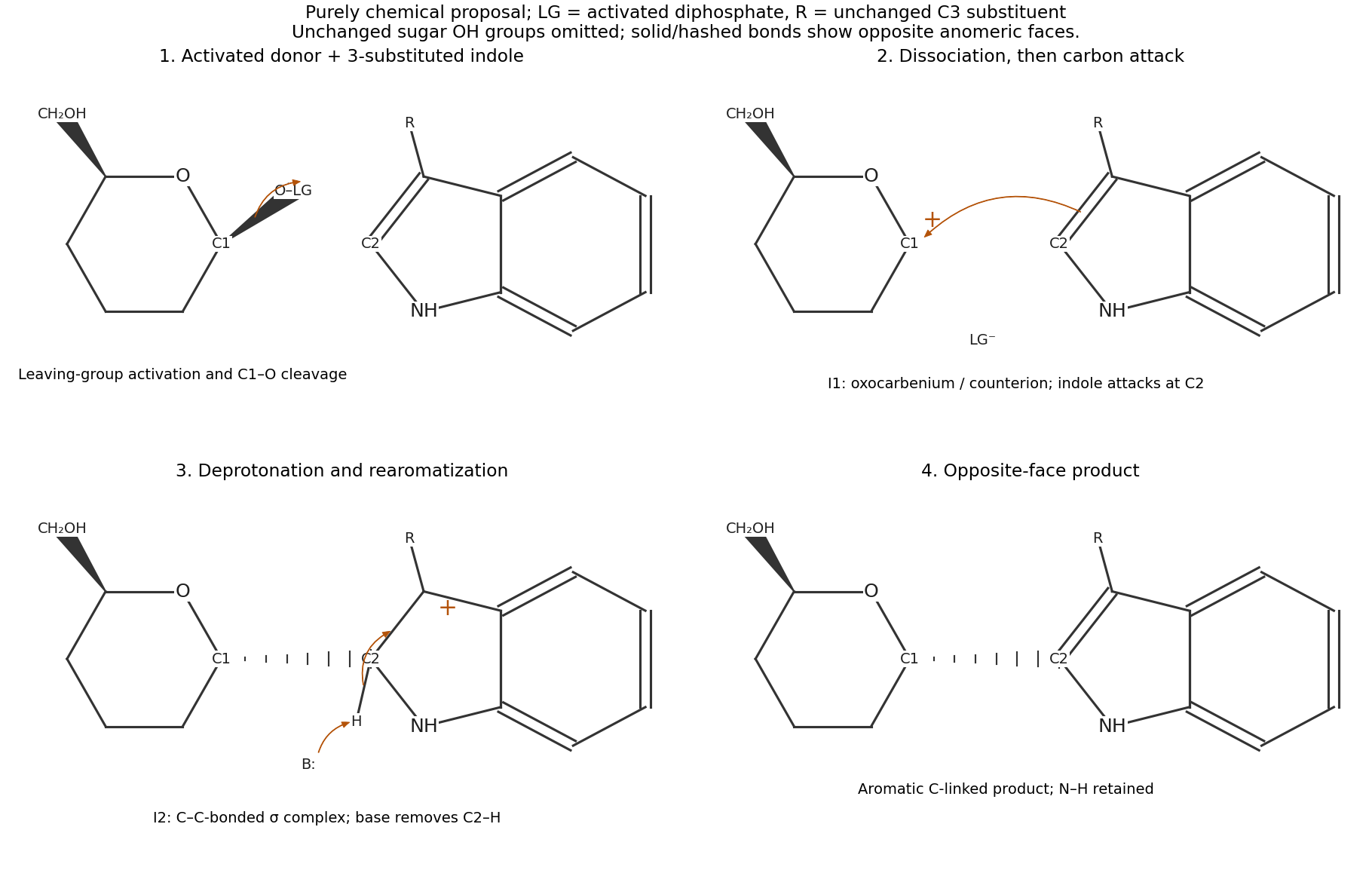
Codex 0 2026-10-20For the three elementary transformations just proposed, a qualitative free-energy profile has three transition states and two intermediates. The sugar substituents and indole C3 substituent stay unchanged, so the structural shorthand below suppresses them while retaining the reacting atoms.
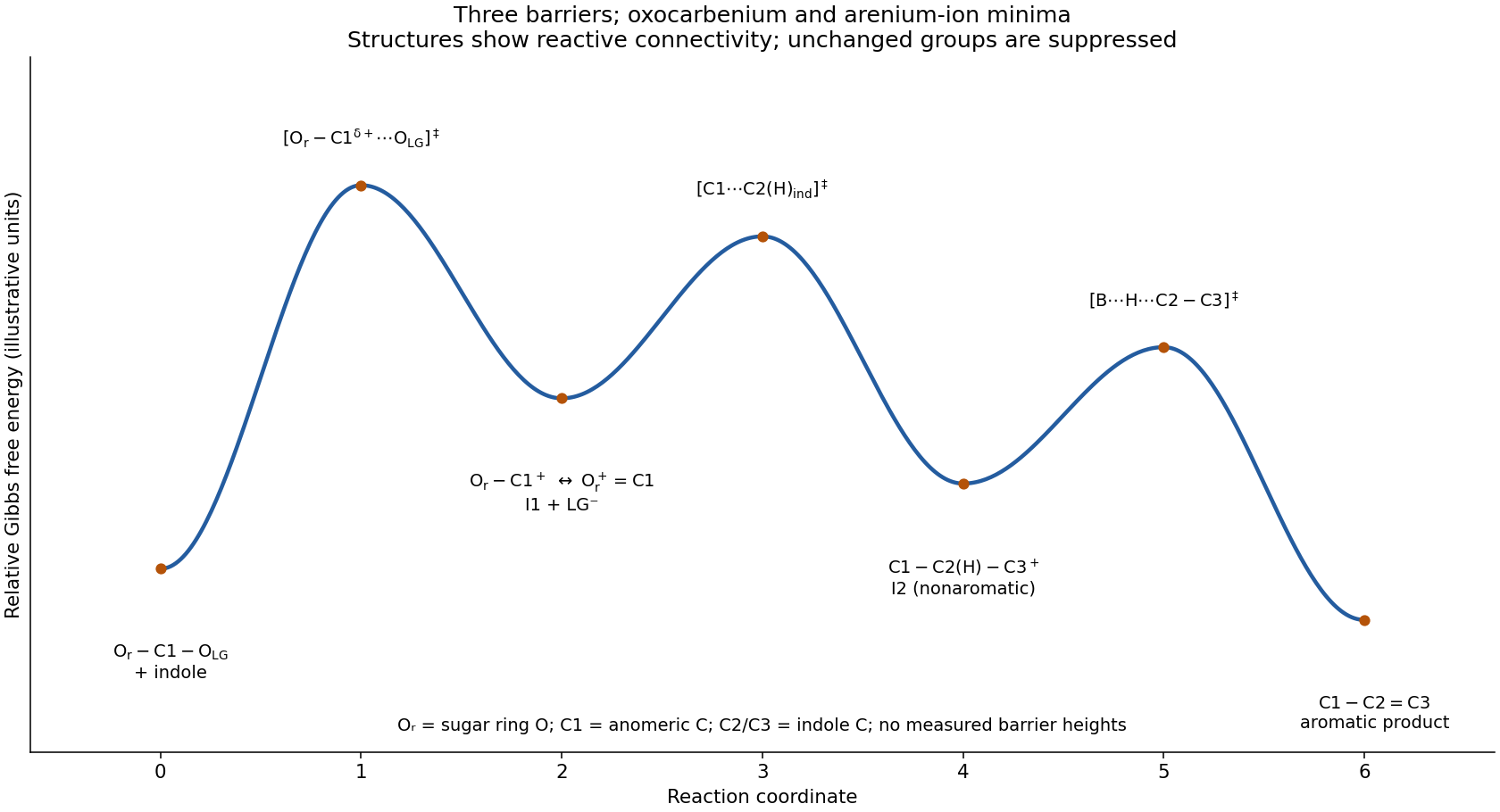
Qualitative three-step free-energy profile with intermediate and transition-state connectivity
. Details. The first transition state has a partially broken anomeric C1–O(leaving group) bond and developing oxocarbenium character, . Its following minimum is the glycosyloxocarbenium ion plus counterion. The second transition state has a forming C1–C2 bond, , and developing positive charge in the indole. Its following minimum is the covalently joined arenium ion with an intact C2–H bond. The third transition state has simultaneous C2–H cleavage, B–H formation and restoration of the indole pi bond, . It leads to the aromatic C-linked product and protonated base.
The vertical separations are illustrative because no activation free energies or equilibrium constants are supplied. In particular, the highest barrier cannot be identified experimentally from this drawing alone. protonation of the leaving group is treated as an initial rapid equilibrium in the chosen mechanism; explicitly resolving it would add the corresponding proton-transfer state and intermediate.
Past exam of the chemistry B course of the University of Cambridge 2021 Paper 2 B10 a i Solution by Codex 0 2026-10-20
Codex 0 2026-10-20Treat the reacting carbon skeletons as an activated glycosyl donor and a 3-substituted indole. The new linkage is an anomeric-carbon–indole-C2 carbon–carbon bond, not a bond to indole nitrogen. A plausible purely chemical pathway is a dissociative electrophilic aromatic substitution:
- Activation of the anomeric diphosphate leaving group, for example by acid, permits cleavage of its bond to the anomeric carbon. The ring oxygen stabilizes the resulting glycosyloxocarbenium ion, represented by the resonance pair . A nearby diphosphate counterion may remain in a contact ion pair.
- The indole C2–C3 pi bond attacks C1 through C2. This makes the new C1–C2 bond and gives an arenium ion, with C2 temporarily tetrahedral and still bearing its original hydrogen. Positive charge can be delocalized over the pyrrolic portion, including an indolium resonance contributor.
- A base removes that C2 hydrogen. The C2–H bond electrons restore the C2–C3 pi bond and aromaticity, releasing the C-glycosylation product while retaining N–H.
The drawn donor and product have opposite anomeric faces: the anomeric leaving group is on the same face as the hydroxymethyl substituent, while the new carbon substituent is on the opposite face. Thus the target has net inversion at the anomeric carbon. A tight ion pair with the departing group shielding its original face can rationalize opposite-face capture in this proposed pathway. A freely solvated planar oxocarbenium ion would not by itself guarantee exclusive inversion; competing faces, hydrolysis and other products remain possible without an experimentally specified chemical promoter. This is a plausible non-enzymatic mechanism, not a claim that the uncatalysed reaction is rapid or clean in neutral water.
Past exam of the chemistry B course of the University of Cambridge 2021 Paper 1 B5 c iii Solution by Codex 0 2026-10-20
Codex 0 2026-10-20 Past exam of the chemistry B course of the University of Cambridge 2021 Paper 1 B5 c ii Solution by Codex 0 2026-10-20
Codex 0 2026-10-20 Past exam of the chemistry B course of the University of Cambridge 2021 Paper 1 B5 c i Solution by Codex 0 2026-10-20
Codex 0 2026-10-20 Past exam of the chemistry B course of the University of Cambridge 2021 Paper 1 B5 b iii Solution by Codex 0 2026-10-20
Codex 0 2026-10-20The strongest donor belongs to the acid, , and the strongest acceptor to the aminopyridine, . The cocrystal pairs the strongest donor with the strongest acceptor, while the reciprocal amino-NH···carbonyl contact closes a complementary two-contact motif.
Using the simple favorable-contact score , one heterodimer givesThe self-associated comparison, normalized to the same two molecules and two hydrogen bonds, is half an acid dimer plus half an aminopyridine dimer:ThusIn a model where bond free energy contains , this is a favorable energy change. No bonds have been artificially added to one side of the comparison: both alternatives contain two contacts per acid/aminopyridine pair.
The calculation rationalizes the hydrogen-bond preference. It is not a complete crystal free energy: packing, additional contacts, entropy and possible solvent effects also matter. Without a specified calibration, the numerical score should not be promoted to a measured cocrystallization free energy.
Past exam of the chemistry B course of the University of Cambridge 2021 Paper 1 B5 b ii Solution by Codex 0 2026-10-20
Codex 0 2026-10-20Two molecules of the aminopyridine form a self-complementary dimer through two N–H···N contacts. In each direction, one exocyclic amino hydrogen is the donor and the pyridine ring nitrogen of the other molecule is the acceptor.
Orient the two amino/pyridine-N edges toward one another, as in the second panel of the original homodimer drawing. Each molecule donates one NH and accepts at one ring N; the second amino H remains available for additional packing contacts. The chlorine substituent is retained but is not one of the two principal donor–acceptor sites.
Past exam of the chemistry B course of the University of Cambridge 2021 Paper 1 B5 b i Solution by Codex 0 2026-10-20
Codex 0 2026-10-20Two molecules of the carboxylic acid form a cyclic carboxylic-acid dimer. Let Ar denote the meta-methylphenyl group. One molecule donates its OH hydrogen to the other's carbonyl oxygen, and the second donates back:
The two contacts close an eight-membered hydrogen-bonded ring, shown explicitly below.
The two contacts close an eight-membered hydrogen-bonded ring, shown explicitly below.
Both molecules therefore act once as hydrogen-bond donor and once as hydrogen-bond acceptor, giving two O–H···O=C contacts. This is the conventional self-complementary dimer motif; the schematic is not a prediction of every weaker contact in an unprovided crystal structure.
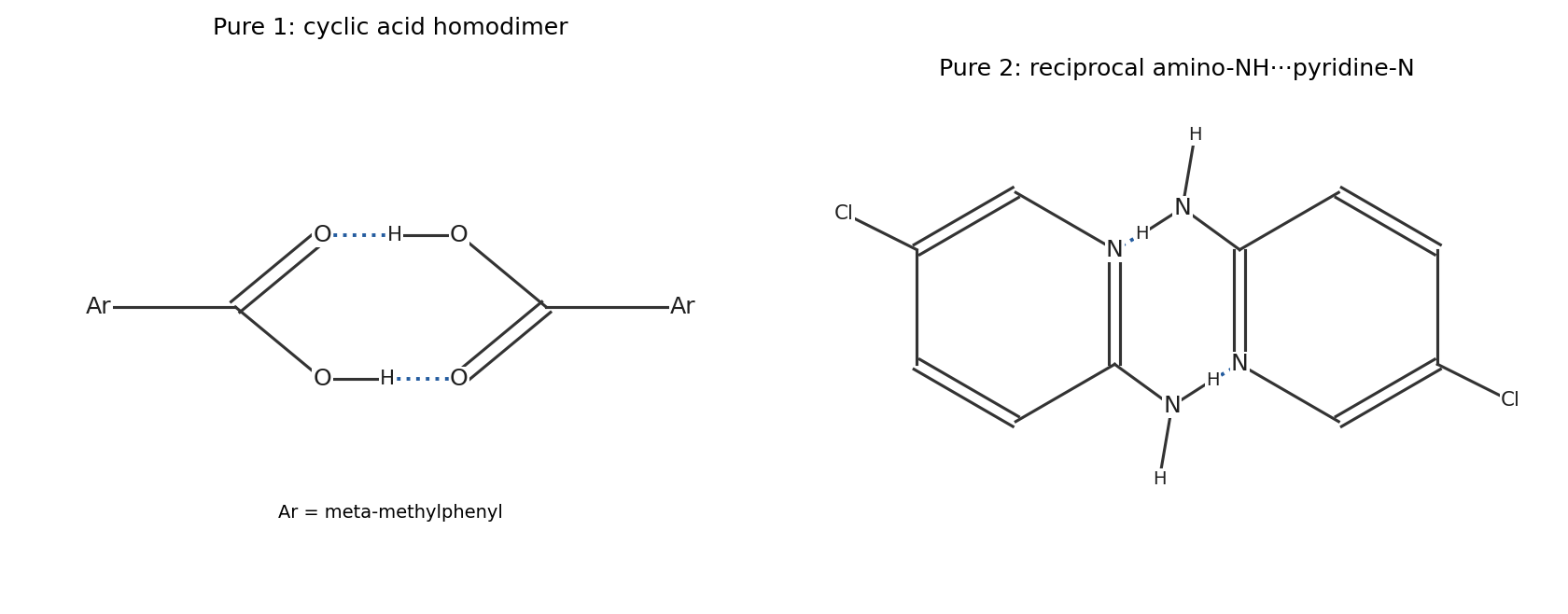
Original hydrogen-bonding structures for the two pure-compound homodimers
. Details. Past exam of the chemistry B course of the University of Cambridge 2021 Paper 1 B3 d ii Solution by Codex 0 2026-10-20
Codex 0 2026-10-20sulfide first opens one epoxide by backside attack, giving a carbon-bound thiolate and an alkoxide. Using the same numbering, take this first attack at C2: the C2–S bond is down and C3–O remains up.
The attached sulfur still bears a nucleophilic lone pair and negative charge. It attacks C5 of the second epoxide intramolecularly, breaking C5–O and closing a bridge between C2 and C5. Work-up protonates the oxygen anions at C3 and C6. Thus B is 7-thiabicycloheptane-2,5-diol, with both OH groups on the face opposite the sulfur bridge.
Both C–S bonds are formed by inversion at their attacked epoxide carbons. Because the original epoxides are cis, both new C–S bonds point to the same opposite face and one sulfur chemical atom can connect them. The 1,4 bridge gives two five-membered sulfur-containing circuits, unlike the more strained closure between nearby 1,3 positions.
The sulfur therefore replaces two separate external nucleophiles: two epoxides are opened but only one sulfur chemical atom is incorporated. Adding that sulfur and two work-up protons gives , consistent with B.
Past exam of the chemistry B course of the University of Cambridge 2021 Paper 1 B3 d i Solution by Codex 0 2026-10-20
Codex 0 2026-10-20Number the cyclohexane consecutively, putting the top methylene group at C1 and the two original epoxides at C2/C3 and C5/C6. Both epoxide oxygens are up.
A is a diazidocyclohexanediol, with each epoxide replaced by one azide and one alcohol. A standard successive chair-favored opening gives N3 down at C2 and C5, OH up at C3 and C6. This is the 1,4-diazido/1,4-diol connectivity drawn in the bottom row of the original map.
For each opening, azide attacks from the face opposite oxygen, breaking one C–O bond with inversion at the attacked carbon. protonation of the two resulting alkoxides gives the two OH groups. After the first opening, the preferred conformation of the opened portion must be used for the second trans-diaxial opening; simply imposing one unchanged chair on both steps can select the wrong regioisomer.
Past exam of the chemistry B course of the University of Cambridge 2021 Paper 1 B2 a ii Solution by Codex 0 2026-10-20
Codex 0 2026-10-20For an amine-first pathway, use triethylamine as a nucleophile in a reversible conjugate addition. Its lone pair attacks C3 of the enone; electron shifts through C2 and the carbonyl give a zwitterionic enolate with a C3– bond.
The C2 nucleophilic site of that enolate attacks , installing C2–Br and releasing bromide. Removal of C2–H by base then reforms C2=C3 while the C3–N bond breaks back to neutral triethylamine. This addition–bromination–elimination sequence gives the same C2-brominated enone and regenerates the nucleophilic amine, with another base equivalent accepting the eliminated proton.
These are alternative formal sequences requested by the question, not a kinetic determination that one must dominate under unspecified conditions. In particular, the amine-first sequence does not require triethylamine to generate a high concentration of a vinylic carbanion by direct deprotonation.
Past exam of the chemistry B course of the University of Cambridge 2021 Paper 1 B2 a i Solution by Codex 0 2026-10-20
Codex 0 2026-10-20Number the enone carbonyl carbon C1, the adjacent alkene carbon C2 and the ethoxy-bearing alkene carbon C3. In the bromine-first pathway, the enol-ether-like unit attacks at C2, breaking the Br–Br bond. The intermediate has a new C2–Br bond and positive charge at C3, stabilized as an oxonium chemical resonance contributor by donation from the ethoxy oxygen.
triethylamine removes the remaining C2 hydrogen. Its C–H bonding pair reforms C2=C3 and neutralizes the oxonium system. The result is replacement of the vinylic C2–H by C2–Br, with the original enone and ethoxy group retained. If bromide first captures the cationic intermediate, the equivalent vicinal dibromide can eliminate HBr to reach the same product.
The ethoxy group makes this alkene sufficiently electron-rich for the electrophilic-addition description. It is important to place bromine at C2 and restore the double bond, rather than stop at a saturated addition product.
Past exam of the chemistry B course of the University of Cambridge 2021 Paper 1 B1 b ii Solution by Codex 0 2026-10-20
Codex 0 2026-10-20The new ring is formed by intramolecular Friedel-Crafts addition to the ketone. titanium tetrachloride coordinates the ketone oxygen of the cyclic beta-ketoester, increasing electrophilicity at that carbonyl carbon. The nearby electron-rich aryl ring attacks this activated ketone at the available position ortho to its ethyl tether.
The electron-flow sequence is: an aromatic bond forms the new aryl–carbonyl-carbon bond, the ketone bond moves onto oxygen, and loss of the aromatic proton restores aromaticity. The two-carbon tether and the shared quaternary carbon make the newly closed carbocycle six-membered. Hydrolytic work-up converts the titanium-bound alkoxide into the tertiary alcohol.
The lactone carbonyl survives. This is an addition to the ketone with retention of its oxygen as OH, rather than an acyl substitution that removes that oxygen. The pendant terminal alkene is not involved. These bond changes account for the fused aromatic ring system and the alcohol in C without needing to assign the new stereochemistry.
Past exam of the chemistry B course of the University of Cambridge 2021 Paper 1 B1 b i Solution by Codex 0 2026-10-20
Codex 0 2026-10-20Let denote the 2,5-dimethoxyphenyl group. A is the doubly C-alkylated beta-ketoesterThe central carbon has no hydrogen after the second step. The alkene, ester and tert-butyl ether remain intact.
carbonate reversibly removes a proton from the methylene group between the two carbonyl groups. The resulting resonance-stabilized enolate attacks the primary iodoethyl carbon of the aryl-containing reagent by an displacement, releasing iodide. The monoalkylated intermediate still has one proton at the same activated carbon. A second deprotonation followed by attack on the primary bromide introduces the but-3-en-1-yl group.
The beta-dicarbonyl position is much more acidic than the methylene group next to the ketone and ether at the other end, explaining the alkylation site. Counting the retained carbon skeleton gives , including the two carbonyl groups and one terminal alkene. The second panel of the original product drawing specifies this connectivity.
Pinned article: Introduction to the OurBigBook Project
Welcome to the OurBigBook Project! Our goal is to create the perfect publishing platform for STEM subjects, and get university-level students to write the best free STEM tutorials ever.
Everyone is welcome to create an account and play with the site: ourbigbook.com/go/register. We belive that students themselves can write amazing tutorials, but teachers are welcome too. You can write about anything you want, it doesn't have to be STEM or even educational. Silly test content is very welcome and you won't be penalized in any way. Just keep it legal!
Intro to OurBigBook
. Source. We have two killer features:
- topics: topics group articles by different users with the same title, e.g. here is the topic for the "Fundamental Theorem of Calculus" ourbigbook.com/go/topic/fundamental-theorem-of-calculusArticles of different users are sorted by upvote within each article page. This feature is a bit like:
- a Wikipedia where each user can have their own version of each article
- a Q&A website like Stack Overflow, where multiple people can give their views on a given topic, and the best ones are sorted by upvote. Except you don't need to wait for someone to ask first, and any topic goes, no matter how narrow or broad
This feature makes it possible for readers to find better explanations of any topic created by other writers. And it allows writers to create an explanation in a place that readers might actually find it.
Figure 1. Screenshot of the "Derivative" topic page. View it live at: ourbigbook.com/go/topic/derivativeVideo 2. OurBigBook Web topics demo. Source. - local editing: you can store all your personal knowledge base content locally in a plaintext markup format that can be edited locally and published either:This way you can be sure that even if OurBigBook.com were to go down one day (which we have no plans to do as it is quite cheap to host!), your content will still be perfectly readable as a static site.
- to OurBigBook.com to get awesome multi-user features like topics and likes
- as HTML files to a static website, which you can host yourself for free on many external providers like GitHub Pages, and remain in full control

Figure 2. You can publish local OurBigBook lightweight markup files to either OurBigBook.com or as a static website.
Figure 3. Visual Studio Code extension installation.
Figure 5. . You can also edit articles on the Web editor without installing anything locally. Video 3. Edit locally and publish demo. Source. This shows editing OurBigBook Markup and publishing it using the Visual Studio Code extension. 
- Infinitely deep tables of contents:




All our software is open source and hosted at: github.com/ourbigbook/ourbigbook
Further documentation can be found at: docs.ourbigbook.com
Feel free to reach our to us for any help or suggestions: docs.ourbigbook.com/#contact