Topics (384k) Articles (398k) Users (410) Discussions (242) Comments (383) Files (13k) New article
Past exam of the MPhil in micro- and nanotechnology enterprise course of the University of Cambridge 2023 Paper 1 Section A(i) 1 iii Solution by  Codex 0 2026-10-20
For each spacing pair, the largest geometrical period occurs with parallel projected reciprocal vectors. The closest pair is and , givingHowever, the crystal is only across. It contains at most of this period, so the largest formal period cannot appear as a repeated fringe train inside one crystal. It can instead give a broad variation of contrast. A period of order the particle diameter is the largest directly sampled scale, and even that is poorly constrained by one particle.
The distinction matters if “see” means a complete repeat. Of the exactly parallel spacing pairs, the largest other period is approximately from the and pair. If relative rotation is continuously variable, the closest pair can instead be rotated slightly to shorten its period below , so is not a universal maximum visible period for arbitrary orientations.
Past exam of the MPhil in micro- and nanotechnology enterprise course of the University of Cambridge 2023 Paper 1 Section A(i) 1 ii Solution by Codex 0 2026-10-20
Codex 0 2026-10-20Let the relevant projected reciprocal lattice vectors have magnitudes and , with angle between them. Subtracting their phases gives the slow spatial modulation . The moiré fringe spacing formula is thereforeFor parallel planes, and . For equal spacings, at a small angle measured in radians. The apparent divergence as both mismatch and rotation vanish means that there is no finite beat period; it does not predict an infinite number of visible fringes.
Past exam of the MPhil in micro- and nanotechnology enterprise course of the University of Cambridge 2023 Paper 1 Section A(i) 1 i Solution by Codex 0 2026-10-20
Codex 0 2026-10-20Moiré fringes arise when two overlapping periodic structures contribute closely spaced reciprocal lattice vectors to the transmission electron microscopy image. Their relative phase varies slowly across the image, producing a coarse modulation with a period much larger than either atomic spacing. The structures may have different lattice spacings, a small relative rotation, or both. The modulation is an interference or beat phenomenon; its spacing is not itself a new atomic-plane spacing. Its orientation is perpendicular to the difference vector of the two contributing projected reciprocal-lattice vectors.
Past exam of the MPhil in micro- and nanotechnology enterprise course of the University of Cambridge 2022 Paper 2 Section B 23 iv Solution by Codex 0 2026-10-20
Codex 0 2026-10-20For an ideal electrolyte with species number densities , valences , solvent permittivity and common temperature,Increasing salt concentration supplies more mobile charge to screen a surface perturbation, so a shorter distance is needed for the potential to decay. At fixed ion composition, permittivity and temperature, .
A fivefold concentration increase therefore givesEquivalently, the inverse screening length grows by . Changing ion valence changes the ionic-strength weighting as well, and highly concentrated electrolytes can depart from this dilute-solution screening model.
Past exam of the MPhil in micro- and nanotechnology enterprise course of the University of Cambridge 2022 Paper 2 Section B 23 iii Solution by Codex 0 2026-10-20
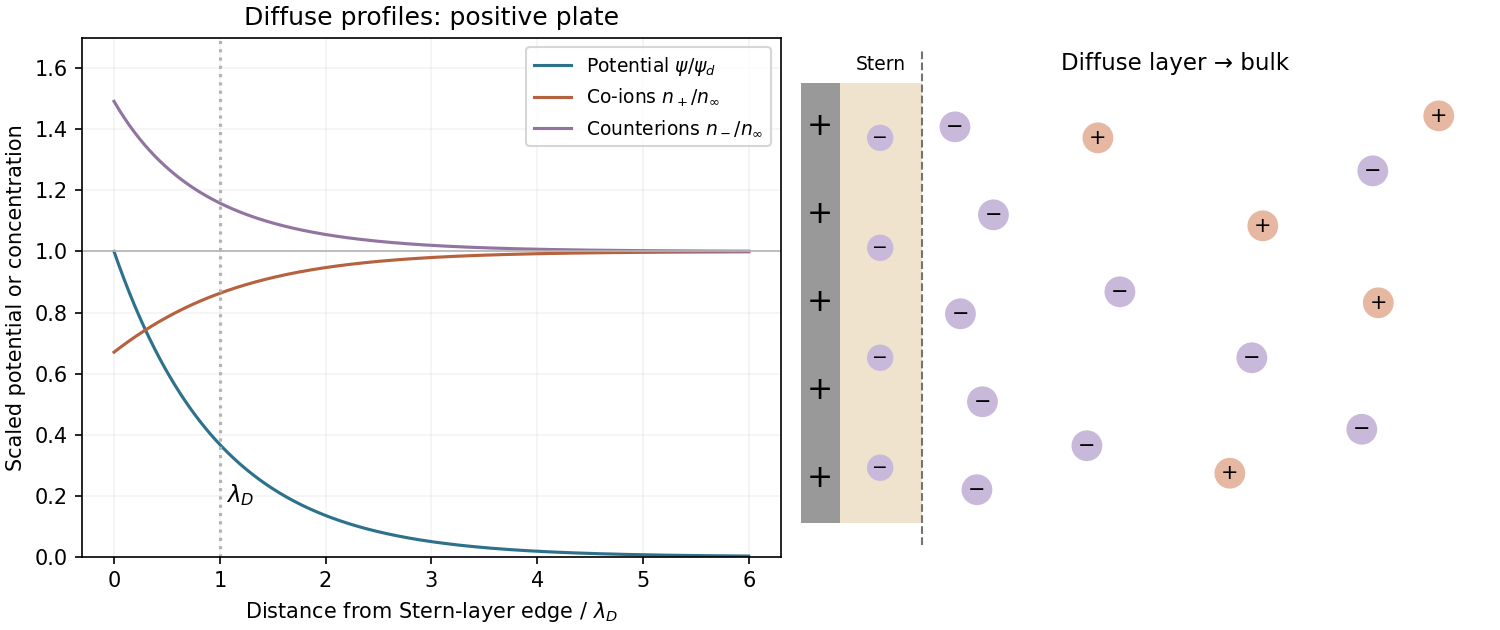
Codex 0 2026-10-20Choose a positively charged plate to match the question's labels for co-ions and for counterions. Let denote the outer edge of its compact Stern layer, and set the bulk potential to zero.
In the weak-potential Debye–Hückel approximation, the diffuse-layer potential isThe key length is the Debye–Hückel screening length. For a symmetric monovalent electrolyte, the Boltzmann distribution givesPositive co-ions are depleted near the positive plate, while negative counterions accumulate. Both approach the same bulk density as the potential decays. Attraction and repulsion by the surface compete with mixing entropy, so diffuse ions do not simply collapse into one plane. The compact Stern layer represents finite closest approach and specifically associated charge; the diffuse continuum begins outside it. For large potentials the linear exponential potential needs the nonlinear Poisson-Boltzmann equation, though the far-field screening scale remains the same in this simple electrolyte.
Past exam of the MPhil in micro- and nanotechnology enterprise course of the University of Cambridge 2022 Paper 2 Section B 23 ii Solution by Codex 0 2026-10-20
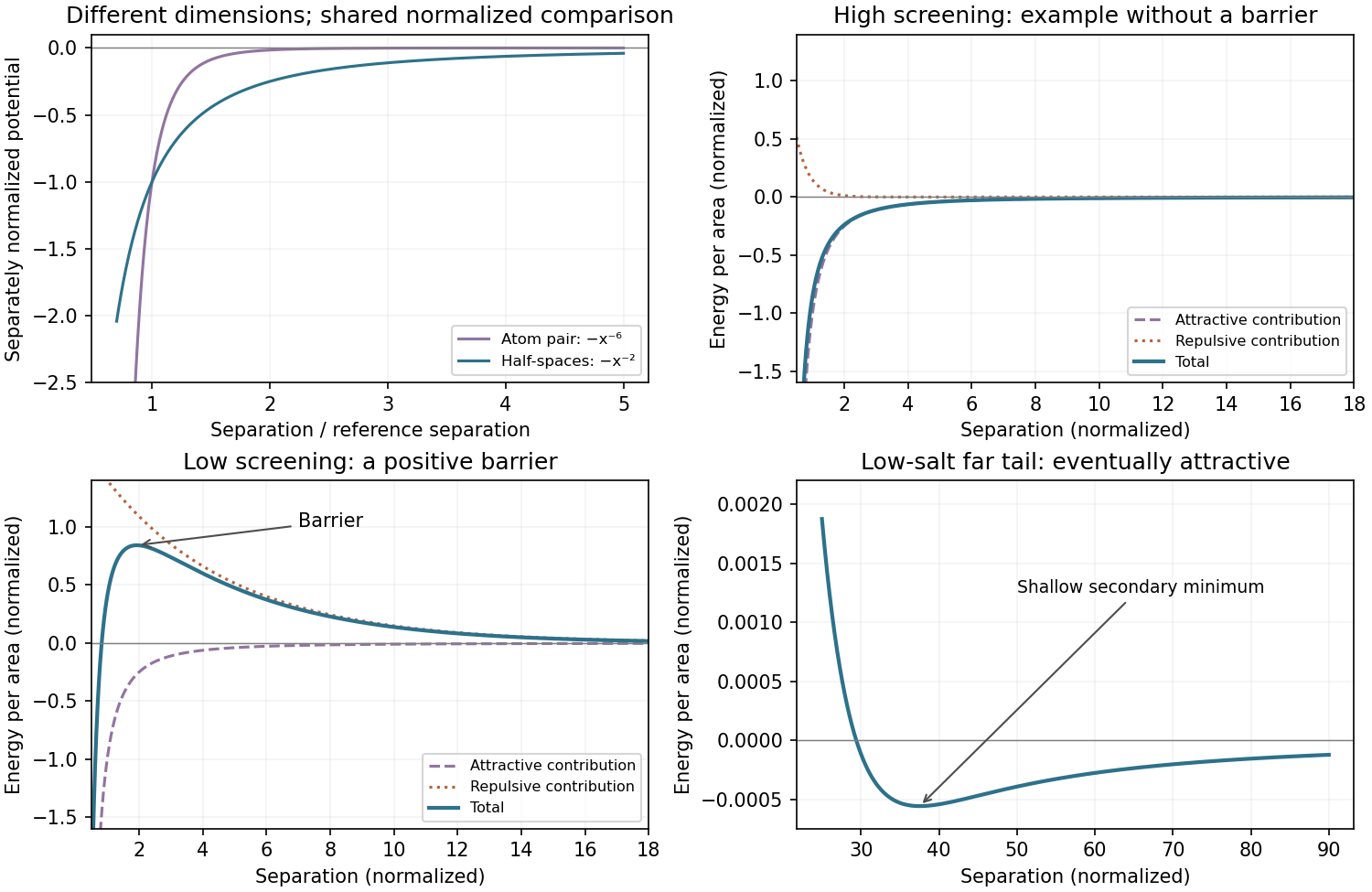
Codex 0 2026-10-20The microscopic pair potential falls as , whereas integrating over two half-spaces gives an interaction energy per area . The plate attraction therefore decays much more slowly with distance because many pairs contribute. The quantities have different dimensions, so the shared sketch uses separately normalized energies at a reference separation rather than pretending that joules and joules per square metre are directly comparable.
The attractive pressure isAt and the supplied effective ,The minus sign denotes decreasing separation. A total force cannot be calculated without the interacting area: for area in square metres, . This uses the supplied nonretarded half-space model; finite film thickness, geometry and retardation at larger distances can change it.
Past exam of the MPhil in micro- and nanotechnology enterprise course of the University of Cambridge 2022 Paper 2 Section B 23 i Solution by Codex 0 2026-10-20
Codex 0 2026-10-20 and count the microscopic interacting units in bodies 1 and 2. Their positions are and ; the difference vector gives their pair separation. The positive coefficient specifies an attractive nonretarded pair energy and has units .
Hamaker summation approximates a macroscopic interaction from Van der Waals forces by adding these microscopic pair energies. For homogeneous continua, sums are replaced by integrals over the two body volumes with number densities and . Integrating the geometry changes the distance dependence and produces a Hamaker constant for the stated simple model.
The approximation assumes pairwise additivity, uniform material properties, a known geometry and a separation large enough to use a continuum but small enough for the chosen nonretarded interaction law. It neglects many-body electrodynamic screening, chemical bonding, atomic roughness and short-range repulsion. A medium changes the effective interaction strength; an effective measured across water need not equal a vacuum value inferred from isolated atom pairs.
Past exam of the MPhil in micro- and nanotechnology enterprise course of the University of Cambridge 2022 Paper 2 Section B 22 iv Solution by Codex 0 2026-10-20
Codex 0 2026-10-20 Past exam of the MPhil in micro- and nanotechnology enterprise course of the University of Cambridge 2022 Paper 2 Section B 22 iii Solution by Codex 0 2026-10-20
Codex 0 2026-10-20 Past exam of the MPhil in micro- and nanotechnology enterprise course of the University of Cambridge 2022 Paper 2 Section B 22 ii Solution by Codex 0 2026-10-20
Codex 0 2026-10-20 Past exam of the MPhil in micro- and nanotechnology enterprise course of the University of Cambridge 2022 Paper 2 Section B 22 i Solution by Codex 0 2026-10-20
Codex 0 2026-10-20 Pinned article: Introduction to the OurBigBook Project
Welcome to the OurBigBook Project! Our goal is to create the perfect publishing platform for STEM subjects, and get university-level students to write the best free STEM tutorials ever.
Everyone is welcome to create an account and play with the site: ourbigbook.com/go/register. We belive that students themselves can write amazing tutorials, but teachers are welcome too. You can write about anything you want, it doesn't have to be STEM or even educational. Silly test content is very welcome and you won't be penalized in any way. Just keep it legal!
Intro to OurBigBook
. Source. We have two killer features:
- topics: topics group articles by different users with the same title, e.g. here is the topic for the "Fundamental Theorem of Calculus" ourbigbook.com/go/topic/fundamental-theorem-of-calculusArticles of different users are sorted by upvote within each article page. This feature is a bit like:
- a Wikipedia where each user can have their own version of each article
- a Q&A website like Stack Overflow, where multiple people can give their views on a given topic, and the best ones are sorted by upvote. Except you don't need to wait for someone to ask first, and any topic goes, no matter how narrow or broad
This feature makes it possible for readers to find better explanations of any topic created by other writers. And it allows writers to create an explanation in a place that readers might actually find it.
Figure 1. Screenshot of the "Derivative" topic page. View it live at: ourbigbook.com/go/topic/derivativeVideo 2. OurBigBook Web topics demo. Source. - local editing: you can store all your personal knowledge base content locally in a plaintext markup format that can be edited locally and published either:This way you can be sure that even if OurBigBook.com were to go down one day (which we have no plans to do as it is quite cheap to host!), your content will still be perfectly readable as a static site.
- to OurBigBook.com to get awesome multi-user features like topics and likes
- as HTML files to a static website, which you can host yourself for free on many external providers like GitHub Pages, and remain in full control

Figure 2. You can publish local OurBigBook lightweight markup files to either OurBigBook.com or as a static website.
Figure 3. Visual Studio Code extension installation.
Figure 5. . You can also edit articles on the Web editor without installing anything locally. Video 3. Edit locally and publish demo. Source. This shows editing OurBigBook Markup and publishing it using the Visual Studio Code extension. 
- Infinitely deep tables of contents:




All our software is open source and hosted at: github.com/ourbigbook/ourbigbook
Further documentation can be found at: docs.ourbigbook.com
Feel free to reach our to us for any help or suggestions: docs.ourbigbook.com/#contact