Topics (384k) Articles (398k) Users (410) Discussions (242) Comments (383) Files (13k) New article
Past exam of the MPhil in micro- and nanotechnology enterprise course of the University of Cambridge 2022 Paper 1 Section B 8 v Solution by  Codex 0 2026-10-20
 Past exam of the MPhil in micro- and nanotechnology enterprise course of the University of Cambridge 2022 Paper 1 Section B 8 iv Solution by Codex 0 2026-10-20
Codex 0 2026-10-20 Past exam of the MPhil in micro- and nanotechnology enterprise course of the University of Cambridge 2022 Paper 1 Section B 8 iii Solution by Codex 0 2026-10-20
Codex 0 2026-10-20 Past exam of the MPhil in micro- and nanotechnology enterprise course of the University of Cambridge 2022 Paper 1 Section B 8 i Solution by Codex 0 2026-10-20
Codex 0 2026-10-20 Past exam of the MPhil in micro- and nanotechnology enterprise course of the University of Cambridge 2022 Paper 1 Section B 12 iv Solution by Codex 0 2026-10-20
Codex 0 2026-10-20Nanowires can increase by reducing lattice heat conduction more strongly than they degrade useful electronic transport. A wire diameter comparable to important phonon mean free paths introduces boundary scattering and reduces the lattice part of thermal conductivity. Interfaces, surface roughness and suitable nanostructure can suppress long-mean-free-path phonons while preserving shorter-mean-free-path carrier transport.
Electronic confinement or energy-dependent scattering can also change the Seebeck coefficient and thermoelectric power factor, but neither improvement is automatic. Surface depletion, disorder and contact resistance may instead reduce electrical conductivity; a smaller wire is not necessarily better. The necessary comparison is the complete ratio over the operating temperature range. The experimentally established benefit of nanostructuring is especially clear when it suppresses phonon heat conduction while retaining a useful power factor.[ref]
High-Thermoelectric Performance of Nanostructured Bismuth Antimony Telluride Bulk Alloys by Bed Poudel and others. 2008, nanostructured-alloy thermal-conductivity and figure-of-merit measurements
Past exam of the MPhil in micro- and nanotechnology enterprise course of the University of Cambridge 2022 Paper 1 Section B 12 ii Solution by Codex 0 2026-10-20
Codex 0 2026-10-20A generator couple has a p-type and an n-type thermoelement joined electrically at the hot face, with their other ends connected through a load at the cold face. The legs are electrically in series and thermally in parallel. Electrically insulating, thermally conducting plates couple them to the hot source and cold sink; metal interconnects carry current. The Seebeck effect provides an open-circuit electromotive force , where the magnitude of is the difference between the two leg Seebeck coefficients.
For fixed junction temperatures, constant properties and internal resistance ,Differentiate with respect to load resistance:The derivative changes from positive to negative at , soThe load voltage is then half the open-circuit voltage. The heat source and sink must sustain the temperature difference; an isolated hot object cools as energy is extracted. Maximum power and maximum conversion efficiency are different operating points: the efficiency-optimal load is generally larger than .
Past exam of the MPhil in micro- and nanotechnology enterprise course of the University of Cambridge 2022 Paper 1 Section B 12 i Solution by Codex 0 2026-10-20
Codex 0 2026-10-20For one homogeneous thermoelectric material, the dimensional thermoelectric figure of merit isThe dimensionless quantity is . The Seebeck coefficient measures the open-circuit voltage response to a temperature difference and reflects the energy asymmetry of charge-carrier transport. The electrical conductivity depends on carrier density and mobility and sets electrical loss; . The thermal conductivity is , with contributions from carriers and phonons, and represents unwanted heat leakage.
Increasing carrier concentration usually raises while reducing once transport becomes strongly degenerate. The electronic part of also tends to rise, approximately through the Wiedemann-Franz law where applicable. This competition produces an intermediate optimum, commonly in heavily doped semiconductors, rather than in a very resistive insulator or an ordinary high-carrier-density metal. The optimum depends on band structure and scattering; the schematic is not a universal measured concentration curve.
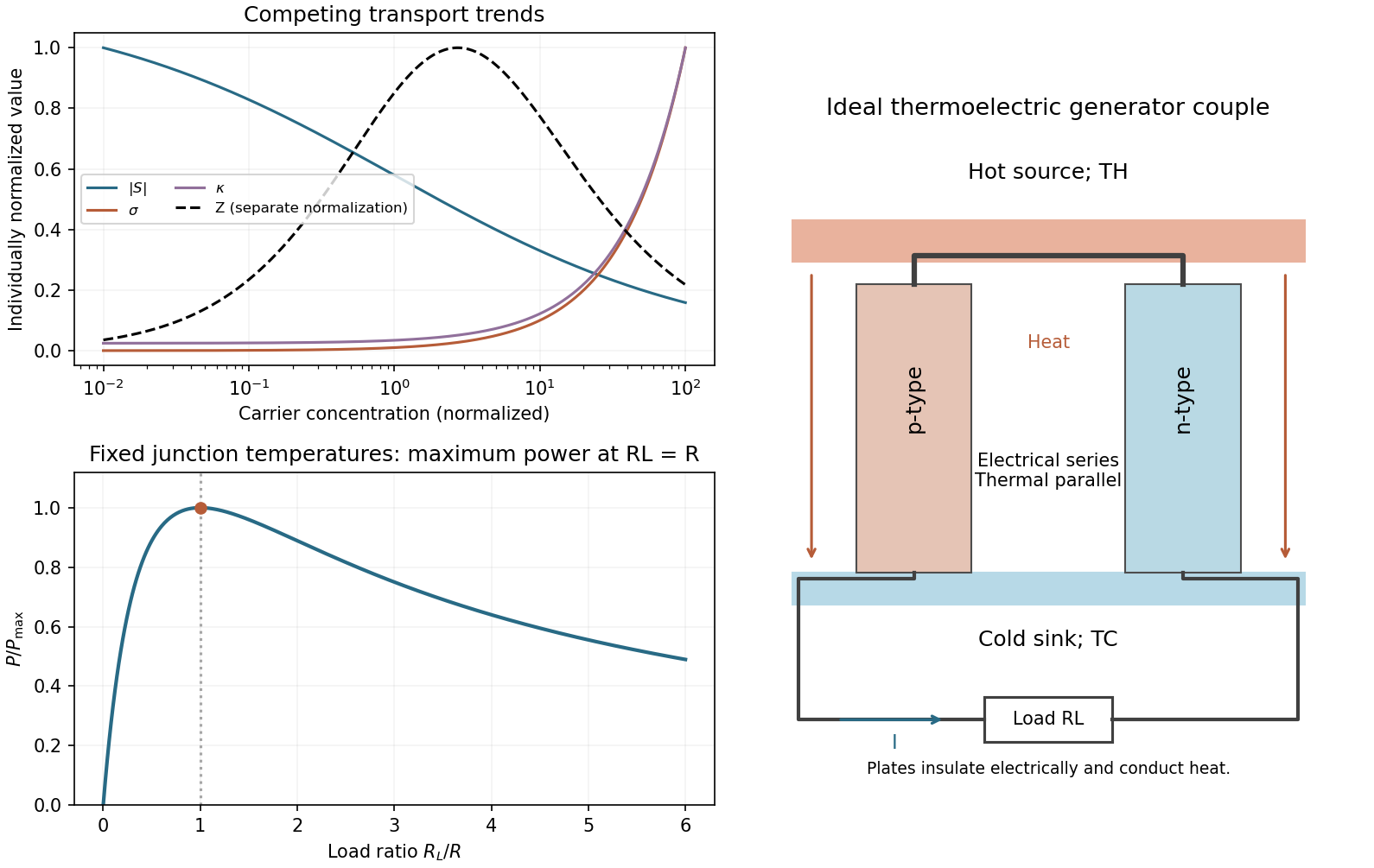
Thermoelectric carrier trade-offs, a generator couple and load matching
. Original normalized carrier-property curves, a circuit schematic and the calculated dimensionless load-power curve. The carrier curves illustrate competing trends and do not assert material-specific measurements. Details. Past exam of the MPhil in micro- and nanotechnology enterprise course of the University of Cambridge 2022 Paper 1 Section B 11 iii Solution by Codex 0 2026-10-20
Codex 0 2026-10-20A lithium–oxygen system can have much greater theoretical active-material specific energy because it avoids the heavy transition-metal host and carbon host of the preceding insertion cell. Oxygen can be taken from the surroundings, but a mass comparison must say whether that oxygen is counted.
The peroxide reaction transfers two electrons per unit. If oxygen is counted, the reactant mass per two electrons iscompared with for two electrons in the idealized lithium-ion reaction. At the same average voltage, the active-material specific energy would therefore be larger by . If only stored lithium is counted, the ideal mass advantage is larger still, but this excludes the oxygen and is not a like-for-like closed-cell mass basis.
The source supplies no lithium-peroxide formation free energy or oxygen-electrode potential, so it does not determine an absolute lithium–oxygen voltage or specific energy. Real devices require an oxygen electrode, gas-management and electrolyte; insulating discharge products, parasitic reactions, charging overpotential and mass transport reduce the practical advantage. The question's reaction is chemical oxygen reduction, not a biological energy pathway.
Pinned article: Introduction to the OurBigBook Project
Welcome to the OurBigBook Project! Our goal is to create the perfect publishing platform for STEM subjects, and get university-level students to write the best free STEM tutorials ever.
Everyone is welcome to create an account and play with the site: ourbigbook.com/go/register. We belive that students themselves can write amazing tutorials, but teachers are welcome too. You can write about anything you want, it doesn't have to be STEM or even educational. Silly test content is very welcome and you won't be penalized in any way. Just keep it legal!
Intro to OurBigBook
. Source. We have two killer features:
- topics: topics group articles by different users with the same title, e.g. here is the topic for the "Fundamental Theorem of Calculus" ourbigbook.com/go/topic/fundamental-theorem-of-calculusArticles of different users are sorted by upvote within each article page. This feature is a bit like:
- a Wikipedia where each user can have their own version of each article
- a Q&A website like Stack Overflow, where multiple people can give their views on a given topic, and the best ones are sorted by upvote. Except you don't need to wait for someone to ask first, and any topic goes, no matter how narrow or broad
This feature makes it possible for readers to find better explanations of any topic created by other writers. And it allows writers to create an explanation in a place that readers might actually find it.
Figure 1. Screenshot of the "Derivative" topic page. View it live at: ourbigbook.com/go/topic/derivativeVideo 2. OurBigBook Web topics demo. Source. - local editing: you can store all your personal knowledge base content locally in a plaintext markup format that can be edited locally and published either:This way you can be sure that even if OurBigBook.com were to go down one day (which we have no plans to do as it is quite cheap to host!), your content will still be perfectly readable as a static site.
- to OurBigBook.com to get awesome multi-user features like topics and likes
- as HTML files to a static website, which you can host yourself for free on many external providers like GitHub Pages, and remain in full control

Figure 2. You can publish local OurBigBook lightweight markup files to either OurBigBook.com or as a static website.
Figure 3. Visual Studio Code extension installation.
Figure 5. . You can also edit articles on the Web editor without installing anything locally. Video 3. Edit locally and publish demo. Source. This shows editing OurBigBook Markup and publishing it using the Visual Studio Code extension. 
- Infinitely deep tables of contents:



All our software is open source and hosted at: github.com/ourbigbook/ourbigbook
Further documentation can be found at: docs.ourbigbook.com
Feel free to reach our to us for any help or suggestions: docs.ourbigbook.com/#contact