Topics (384k) Articles (398k) Users (410) Discussions (242) Comments (383) Files (13k) New article
Past exam of the MPhil in micro- and nanotechnology enterprise course of the University of Cambridge 2023 Paper 1 Section A(iii) 5 iii Solution by  Codex 0 2026-10-20
The left-hand open quinoid dianion is pink/purple; the right-hand closed lactone is colorless. In the colored form, a longer conjugated electronic system extends through the quinoid framework. The resulting lower-energy electronic transitions can absorb visible light, producing the observed complementary color.
The closed lactone contains a tetrahedral central carbon that interrupts conjugation between the aromatic fragments. Its remaining electronic transitions are mainly at higher energy, so the molecule does not strongly absorb visible wavelengths. It still absorbs ultraviolet light: colorless does not mean absence of electronic transitions.
The explanation concerns the two drawn forms of phenolphthalein. It does not assert that a single colored form remains dominant at arbitrarily high pH; additional equilibria can alter the spectrum outside the usual indicator range.
Past exam of the MPhil in micro- and nanotechnology enterprise course of the University of Cambridge 2023 Paper 1 Section A(ii) 4 iv Solution by Codex 0 2026-10-20
Codex 0 2026-10-20Zero step coverage means that a sidewall or hidden surface receives essentially no film even though a horizontal reference surface is coated. Deposition shadowing occurs when an upper edge intercepts trajectories that would otherwise reach a lower region. A directional high-vacuum evaporant flux can therefore coat a feature top while leaving vertical or reentrant walls uncoated.
Sputtering generally releases material from an extended target with a broad angular distribution; gas collisions can further redistribute arrival directions. More oblique trajectories can reach sidewalls, so the extreme zero-coverage behavior of an ideal collimated evaporant beam is reduced.
The absolute claim that these effects never occur in sputtering is too strong. Low-pressure directional sputtering and high-aspect-ratio or reentrant features can still exhibit shadowing and poor coverage. Broader incidence improves access; it does not make a physical deposition process universally conformal.
Past exam of the MPhil in micro- and nanotechnology enterprise course of the University of Cambridge 2023 Paper 1 Section A(ii) 4 iii Solution by Codex 0 2026-10-20
Codex 0 2026-10-20In evaporative deposition, atoms travel mainly along straight trajectories from a compact source. For an ideal cosine-emitting source below a parallel wafer, a point at lateral radius and source separation receives approximatelyConsequently . Increasing makes arrival angles and distances more similar across a fixed wafer, improving uniformity. But the central flux falls as for a fixed source output, so the deposition rate decreases and less evaporated material is collected.
Rotation averages azimuthal variations, and source shaping or multiple sources can help, but simple rotation does not remove a radial flux gradient. Raising source output can partly compensate at the cost of source heating, consumption and possible material limitations. The trade-off follows from geometry rather than an intrinsic prohibition on simultaneously optimizing a more elaborate system.
Past exam of the MPhil in micro- and nanotechnology enterprise course of the University of Cambridge 2023 Paper 1 Section A(ii) 4 ii Solution by Codex 0 2026-10-20
Codex 0 2026-10-20At fixed reactant partial pressures and temperature, their ideal-gas bulk concentrations remain approximately fixed. Lowering total pressure means removing diluent rather than automatically lowering the reactant concentration.
In the continuum molecular-diffusion regime, gas diffusivities scale approximately as . Delivery through a comparable boundary layer is therefore faster, increasing relative to . The system tends toward reaction-limited operation, where concentration differences between substrate locations are smaller. This commonly improves thickness uniformity and access to recessed surfaces.
The qualification is important: changing pressure can also change flow velocity and the boundary layer, gas-phase chemistry and precursor depletion. In narrow structures at low pressure, Knudsen transport limits the simple improvement. Improved transport does not correct a large substrate-temperature gradient in a strongly temperature-sensitive reaction-limited process.
Past exam of the MPhil in micro- and nanotechnology enterprise course of the University of Cambridge 2023 Paper 1 Section A(ii) 4 i Solution by Codex 0 2026-10-20
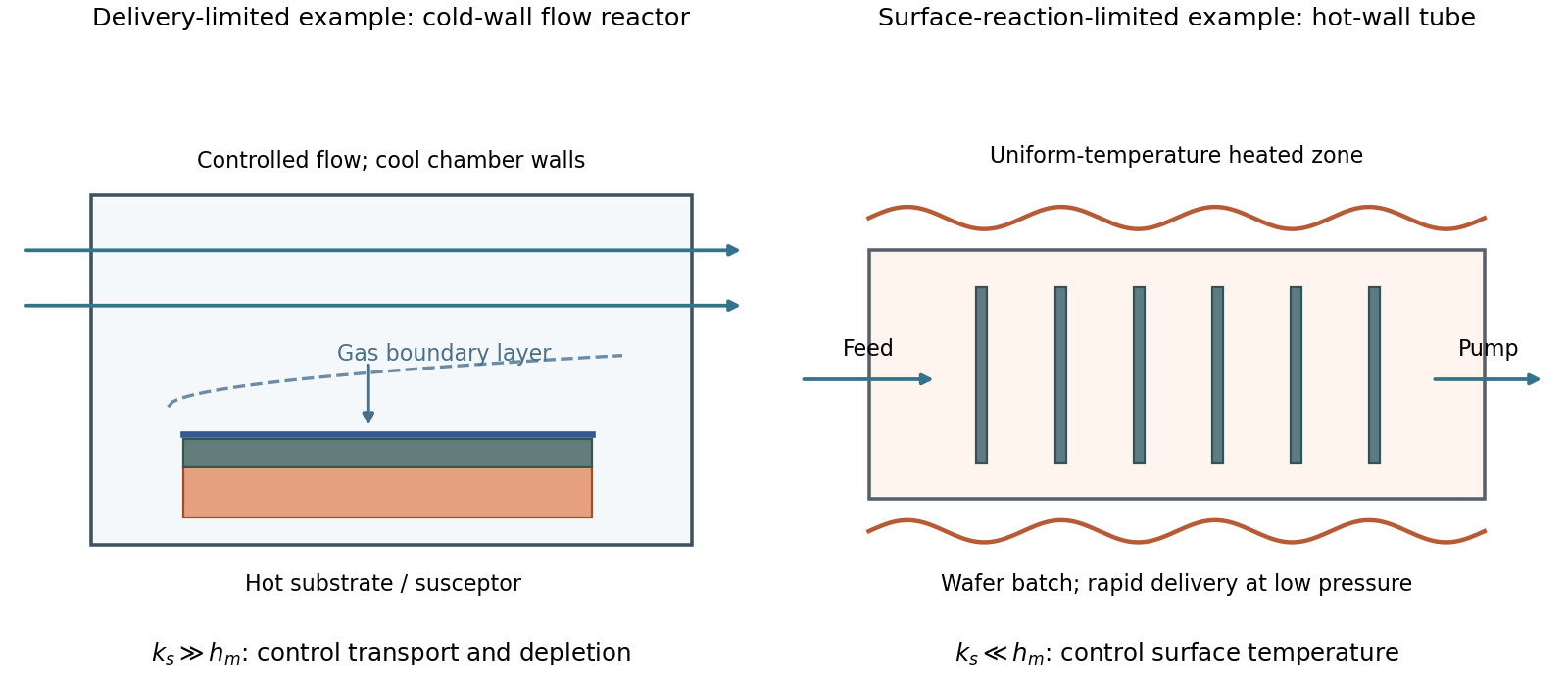
Codex 0 2026-10-20A simple chemical vapor deposition model separates transport through a gas boundary layer, with coefficient , from surface reaction, with coefficient :For , growth is mass-transfer-limited deposition. A typical cold-wall, flowing reactor heats the substrate strongly while keeping most chamber walls cooler. A shaped inlet, controlled flow and tilted or rotating susceptor help control boundary-layer thickness and precursor depletion. The essential design problem is delivering a similar flux everywhere; heating a surface still further gives little benefit once delivery limits growth.
For , growth is reaction-limited deposition. A hot-wall, low-pressure batch tube can hold many wafers in a nearly uniform-temperature zone. Faster gas transport makes surface concentrations more uniform, while slow chemistry reduces consumption before precursors reach downstream surfaces. Temperature uniformity is particularly important because surface rates can depend strongly on temperature.
These are illustrative architectures, not a rule that wall type alone determines the regime. Temperature, pressure, flow and precursor chemistry jointly set .
Past exam of the MPhil in micro- and nanotechnology enterprise course of the University of Cambridge 2023 Paper 1 Section A(ii) 3 iii Solution by Codex 0 2026-10-20
Codex 0 2026-10-20Depth of focus is the axial tolerance over which the projected pattern remains acceptable. Wafer topography, resist thickness, wafer tilt and focus-setting errors can move part of the film outside that range, reducing contrast and changing printed linewidth. Increasing numerical aperture can improve lateral resolution while reducing this axial process window.
Using the supplied coefficient in the conventional expression,This is the range assigned to DOF by that convention. Whether an instrument reports a full allowable interval or a one-sided defocus tolerance must be stated separately; an additional factor of two cannot be inferred from the numerical coefficient alone.
Past exam of the MPhil in micro- and nanotechnology enterprise course of the University of Cambridge 2023 Paper 1 Section A(ii) 3 ii Solution by Codex 0 2026-10-20
Codex 0 2026-10-20An on-axis point illuminator increases spatial coherence. It is not a point object, and it does not remove diffraction. For an ideal aberration-free pupil, coherent imaging is linear in field amplitude and has cutoffFor a real amplitude grating , with and all three field orders inside this pupil, the intensity contrast is . Flat coherent field transfer preserves this contrast; weak input modulation does not itself meet a high resist contrast threshold. Assume a sufficiently high-contrast amplitude mask: for example, gives , exceeding both resist thresholds. Under this assumption, both resists have the same limiting equal-line/space widthThis is an approach to the cutoff from below; finite dose latitude, aberrations and a real binary mask can make usable resolution worse. A general coherent intensity image cannot be obtained by applying an incoherent intensity MTF unchanged: , rather than .[ref]
Advanced Optical Imaging: Incoherent imaging by Delft University of Technology. coherent/incoherent comparison: field cutoff versus the twice-as-wide incoherent intensity cutoff
With , this coherent cutoff is : the low-contrast resist improves from roughly to , while the high-contrast resist worsens from roughly to . Coherence improves contrast within its passband but reduces the ultimate bandwidth relative to incoherent illumination.
With the literal Rayleigh-spacing normalization , the same physical cutoff is instead , not . The corresponding widths from the preceding part would improve from roughly and toward . The cutoff in physical units is unambiguous under the stated ideal on-axis model; the claimed direction and size of a change inferred from the plotted normalized axis depend on its definition. Off-axis illumination, partial coherence and arbitrary phase objects require a fuller imaging model.
Past exam of the MPhil in micro- and nanotechnology enterprise course of the University of Cambridge 2023 Paper 1 Section A(ii) 3 i Solution by Codex 0 2026-10-20
Codex 0 2026-10-20For a positive photoresist, let be the largest dose retaining the nominal film and the clearing dose. With the conventional photoresist contrast definition,For a sinusoidal aerial image, the bright-to-dark dose ratio is , where is the Michelson contrast. A dose window that clears bright regions while retaining dark regions requiresThis assumes a fully modulated input pattern and that the plotted modulation transfer function gives the aerial-image contrast. It is a dose-window criterion, not a statement that the resist creates optical information absent from the image.[ref]
The two thresholds are approximatelyReading their intersections with the supplied curve gives, to graphical accuracy,for the lower- and higher-contrast resists respectively. These are the results independent of the dimensional frequency convention. Their minimum full periods are , and equal line/space widths are half those periods:An ArF excimer laser uses . A numerical length requires specifying what the caption's “Rayleigh limit” means. Taking it literally as the reciprocal of the Rayleigh criterion point separation givesIf instead the graph uses the common incoherent-cutoff normalization , the widths are and , with periods twice those values. The caption does not explicitly provide an equation for or define whether “feature size” means period or half-pitch, so these conventions must not be silently mixed. The higher-contrast resist resolves the higher normalized frequency in either convention.
Past exam of the MPhil in micro- and nanotechnology enterprise course of the University of Cambridge 2023 Paper 1 Section A(i) 2 iii Solution by Codex 0 2026-10-20
Codex 0 2026-10-20An attached particle changes the effective tip shape, potentially creating a second contact apex. The image can then show duplicated or broadened copies of surface features, shifted edge positions and altered apparent roughness: a double-tip artefact or more general AFM tip-convolution artefact. Detachment can produce a sudden line-to-line change in that image kernel, so a region may abruptly recover a sharper profile. A change that follows the probe state or scan history should not be interpreted as a real reconstruction of the semiconductor surface.
Past exam of the MPhil in micro- and nanotechnology enterprise course of the University of Cambridge 2023 Paper 1 Section A(i) 1 iv Solution by Codex 0 2026-10-20
Codex 0 2026-10-20A coarse fringe in a high-resolution transmission electron microscopy image need not directly identify the lattice spacing of a new phase. Check whether overlapping crystals, a particle and its substrate, or differently oriented domains can produce the corresponding moiré fringe. Compare the underlying reciprocal-space peaks and their difference, use the particle boundary to constrain how many periods are actually sampled, and examine neighbouring or differently oriented regions. For the closest pair here, fitting a periodicity from less than one complete period is particularly unreliable. Distinguishing lattice contrast from a beat envelope prevents misidentifying a phase or over-interpreting local strain.
Pinned article: Introduction to the OurBigBook Project
Welcome to the OurBigBook Project! Our goal is to create the perfect publishing platform for STEM subjects, and get university-level students to write the best free STEM tutorials ever.
Everyone is welcome to create an account and play with the site: ourbigbook.com/go/register. We belive that students themselves can write amazing tutorials, but teachers are welcome too. You can write about anything you want, it doesn't have to be STEM or even educational. Silly test content is very welcome and you won't be penalized in any way. Just keep it legal!
Intro to OurBigBook
. Source. We have two killer features:
- topics: topics group articles by different users with the same title, e.g. here is the topic for the "Fundamental Theorem of Calculus" ourbigbook.com/go/topic/fundamental-theorem-of-calculusArticles of different users are sorted by upvote within each article page. This feature is a bit like:
- a Wikipedia where each user can have their own version of each article
- a Q&A website like Stack Overflow, where multiple people can give their views on a given topic, and the best ones are sorted by upvote. Except you don't need to wait for someone to ask first, and any topic goes, no matter how narrow or broad
This feature makes it possible for readers to find better explanations of any topic created by other writers. And it allows writers to create an explanation in a place that readers might actually find it.
Figure 1. Screenshot of the "Derivative" topic page. View it live at: ourbigbook.com/go/topic/derivativeVideo 2. OurBigBook Web topics demo. Source. - local editing: you can store all your personal knowledge base content locally in a plaintext markup format that can be edited locally and published either:This way you can be sure that even if OurBigBook.com were to go down one day (which we have no plans to do as it is quite cheap to host!), your content will still be perfectly readable as a static site.
- to OurBigBook.com to get awesome multi-user features like topics and likes
- as HTML files to a static website, which you can host yourself for free on many external providers like GitHub Pages, and remain in full control

Figure 2. You can publish local OurBigBook lightweight markup files to either OurBigBook.com or as a static website.
Figure 3. Visual Studio Code extension installation.
Figure 5. . You can also edit articles on the Web editor without installing anything locally. Video 3. Edit locally and publish demo. Source. This shows editing OurBigBook Markup and publishing it using the Visual Studio Code extension. 
- Infinitely deep tables of contents:



All our software is open source and hosted at: github.com/ourbigbook/ourbigbook
Further documentation can be found at: docs.ourbigbook.com
Feel free to reach our to us for any help or suggestions: docs.ourbigbook.com/#contact