Topics (384k) Articles (398k) Users (410) Discussions (242) Comments (383) Files (13k) New article
Past exam of the MPhil in micro- and nanotechnology enterprise course of the University of Cambridge 2023 Paper 2 Section B 20 ii Solution by  Codex 0 2026-10-20
- Can the precursor produce metal? Evaluate the reaction Gibbs free energy, including reduction, ligand exchange, precursor and reductant activities, solvation and byproducts. A nominal metal concentration is not the metal-atom chemical potential.
- What is the driving force for condensation? Compare the chemical potential of available metal species with that of the condensed phase. The resulting supersaturation supplies the bulk free-energy gain and competes with the surface cost of a critical nucleus.
- Where does it wet and nucleate? Let , and denote support-medium, particle-medium and support-particle interfacial free energies. For an isotropic cap, the contact angle through the particle obeys . This wetting balance determines the extent of substrate contact and the heterogeneous barrier.
- Which crystal faces survive? At fixed particle volume, minimize the sum of orientation-dependent surface and interface energies, plus any important strain or defect energy. For a free crystal, the Wulff construction gives facet distances proportional to their surface free energies. A Winterbottom construction incorporates the support interface and truncates the corresponding equilibrium shape.
Past exam of the MPhil in micro- and nanotechnology enterprise course of the University of Cambridge 2023 Paper 2 Section B 20 i Solution by Codex 0 2026-10-20
Codex 0 2026-10-20Nucleation is the formation of a sufficiently large embryo of the new metallic phase. Producing metal atoms from dissolved precursor can create supersaturation; aggregation lowers bulk free energy but initially creates costly metal-medium interface. In the simplest spherical classical nucleation theory,where is the metal-medium interfacial free energy and is the bulk driving force per volume. Clusters below the critical size tend to redissolve; larger ones can grow.
In homogeneous nucleation, the critical cluster forms in the solution without a pre-existing interface: the initial products are free particles. In heterogeneous nucleation, a substrate, vessel wall or suspended seed replaces part of that costly new interface. For a spherical cap on a planar substrate,A wetting substrate therefore lowers the barrier; this assumes the same bulk driving force and isotropic interfacial energies.
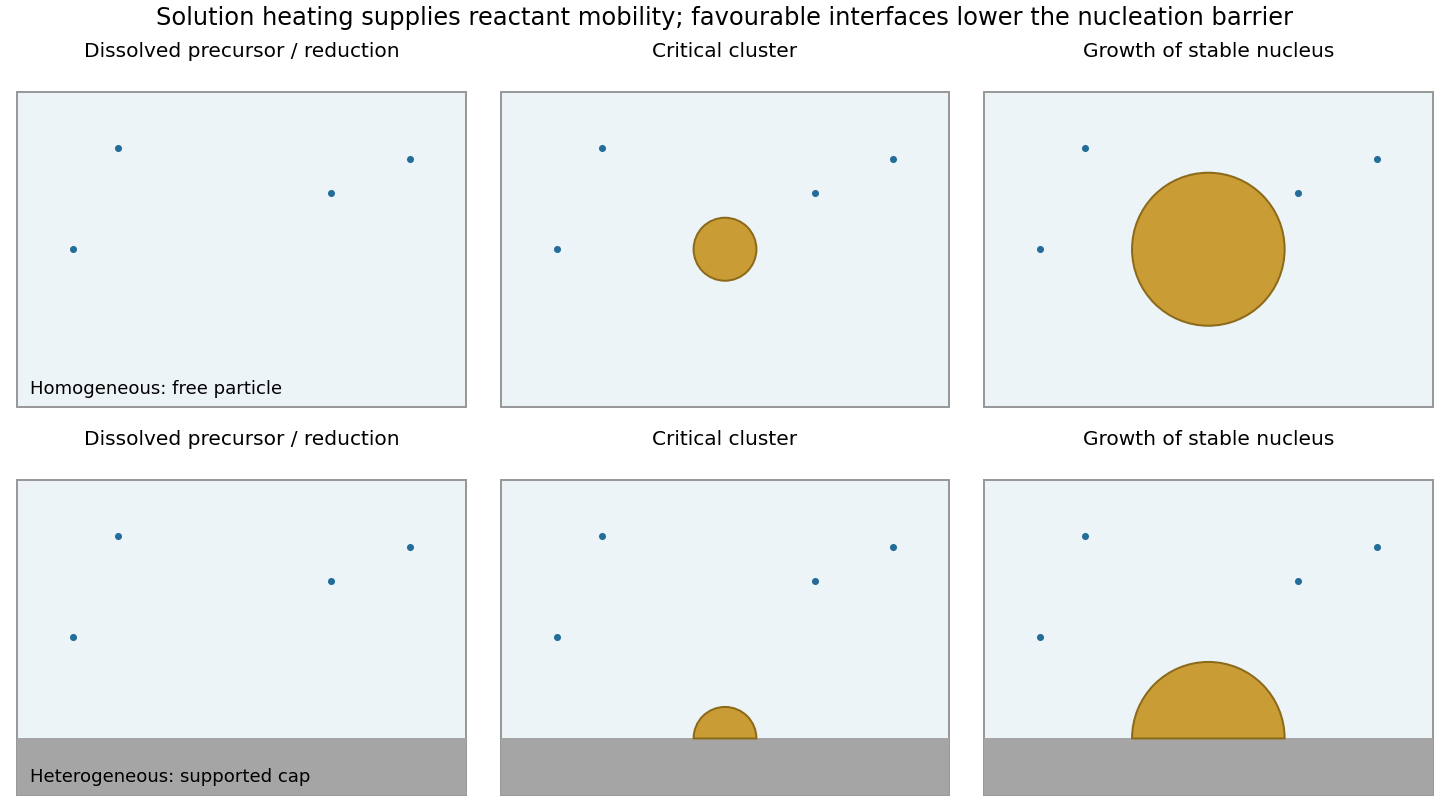
A final supported particle need not have nucleated heterogeneously: a free particle can nucleate in solution and later adsorb on the support. Conversely, a particle nucleated heterogeneously on a suspended seed can remain freely dispersed as a composite particle. Nucleation location and final support status are different classifications.
Microwave absorption heats the medium and possibly the support, changing reduction, diffusion and supersaturation. Preferential local heating can change the relative rates of the two routes. Microwave irradiation alone does not remove the thermodynamic nucleation barrier or demonstrate a special nonthermal mechanism.
Past exam of the MPhil in micro- and nanotechnology enterprise course of the University of Cambridge 2023 Paper 2 Section A(iii) 19 iv Solution by Codex 0 2026-10-20
Codex 0 2026-10-20Absorption converts part of the incident optical power into heat. Increasing laser power can therefore raise the local temperature, potentially driving a thermotropic nematic liquid crystal through its nematic-isotropic transition. The associated loss or change of orientational order, refractive index and anchoring can alter the trapping force or destabilize the trap.
Even below that transition, thermal gradients can induce convection, thermophoretic drift and changes in viscosity or Brownian fluctuations; sufficiently strong heating can damage the particle or host. Thus increasing laser power need not simply strengthen an otherwise unchanged optical trap.
Past exam of the MPhil in micro- and nanotechnology enterprise course of the University of Cambridge 2023 Paper 2 Section A(iii) 19 iii Solution by Codex 0 2026-10-20
Codex 0 2026-10-20Homeotropic anchoring means that the nematic director is locally normal to the particle surface, hence radial on a sphere. Far away, the uniform nematic liquid crystal has a fixed director , with and physically equivalent.
One plausible configuration is a quadrupolar Saturn-ring defect: the director is radial near the particle, bends into far away, and has a disclination loop just outside the particle's equator, in the plane perpendicular to . A meridional section cuts the loop at two points.
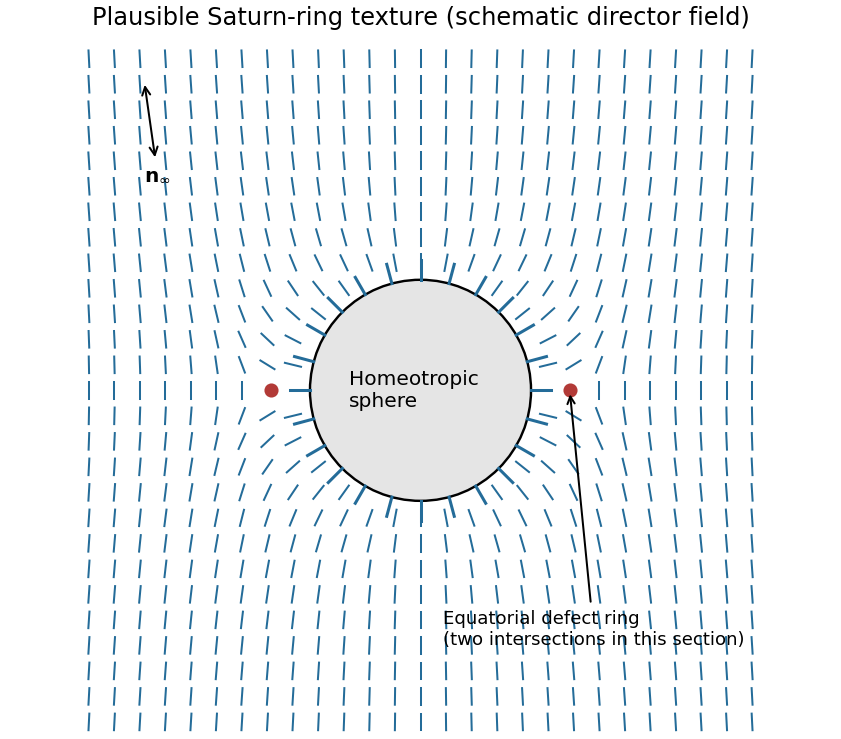
The defect compensates the topological distortion introduced by the radial surface boundary condition. A dipolar configuration with a nearby hyperbolic point defect is another possible texture. Which is stable depends on particle size, anchoring strength, elastic constants and external confinement; the boundary conditions alone do not uniquely select one.[ref]
Director field configurations around a spherical particle in a nematic liquid crystal by Holger Stark. Competing dipolar, Saturn-ring and surface-ring configurations
Past exam of the MPhil in micro- and nanotechnology enterprise course of the University of Cambridge 2023 Paper 2 Section A(iii) 19 ii Solution by Codex 0 2026-10-20
Codex 0 2026-10-20Because the sphere lies below the optical axis, a ray passing through its upper half samples a brighter part of the Gaussian beam than a comparable ray through its lower half. For a particle with higher refractive index than its surroundings, the stronger upper ray is deflected downward overall and transfers an upward reaction to the particle. The weaker lower ray gives a smaller downward reaction. Their transverse sum is therefore upward, toward the brighter axis.
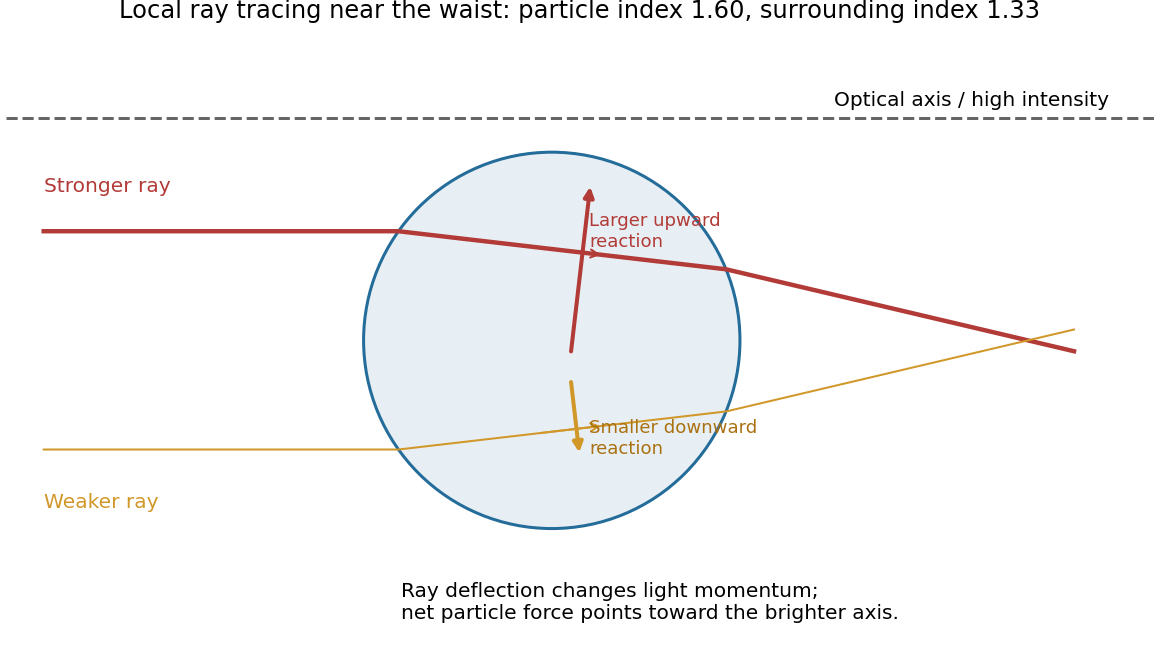
Unequal refracted rays give a transverse restoring force
. Original local ray tracing near a beam waist, with chosen refractive indices. The sphere is below the optical axis. The stronger ray contributes the larger upward reaction; the diagram isolates transverse restoration rather than reconstructing the examination figure. Source. Details.If the displacement reverses, the force reverses, so the central position is transversely stable. Summing all the rays gives an optical gradient force toward the intensity maximum. There is also a forward optical scattering force. A tightly focused beam can have an axial restoring component that balances it, generally at a small displacement downstream of the ideal focus.[ref]
Observation of a single-beam gradient force optical trap for dielectric particles by Arthur Ashkin and others. Single-beam trapping by a sufficiently strong intensity gradient
Three-dimensional stability requires the restoring axial component to exceed the forward force over part of the trajectory. A Gaussian transverse intensity profile alone does not prove that condition; insufficient focusing can yield transverse confinement while the particle still moves downstream.
Past exam of the MPhil in micro- and nanotechnology enterprise course of the University of Cambridge 2023 Paper 2 Section A(iii) 19 i Solution by Codex 0 2026-10-20
Codex 0 2026-10-20Refraction changes the propagation direction, and hence the momentum, of transmitted light. The particle receives the opposite momentum change by conservation of momentum. For a ray carrying power , a useful force scale iswith corrections for reflected rays and their momentum fluxes. Here is the surrounding refractive index; this is a ray-force scaling rather than a complete electromagnetic stress calculation.
For fixed geometry and refractive indices, , so the force contribution is proportional to the local intensity . Refraction toward the normal on entry and away from the normal on exit must both be included: a force inferred from only the first interface can have the wrong direction.
The specified size is larger than the wavelength, so a geometrical optics treatment is appropriate despite the generic “nanoparticle” label. A dipole/Rayleigh-particle formula would use the opposite size limit.
Past exam of the MPhil in micro- and nanotechnology enterprise course of the University of Cambridge 2023 Paper 2 Section A(iii) 18 iv Solution by Codex 0 2026-10-20
Codex 0 2026-10-20The starting point is in the lamellar region. Preferential swelling of polystyrene makes polyisoprene the increasingly small minority domain, so the relevant effective composition moves left from .
If segregation stayed near , following the horizontal path in the supplied diagram would give lamellae → hexagonally perforated layers → hexagonally arranged PI cylinders → PI spheres, before sufficient asymmetry reaches the disordered region. The perforated-layer interval is narrow, around – at this segregation strength; precise boundaries should not be read more accurately than the figure allows.
Solvent also changes effective segregation, so the actual trajectory need not be horizontal. If it passes closer to the order-disorder boundary, it can enter the narrow double gyroid region instead of, or after, the hexagonally perforated layer phase. Greater dilution can cause disorder before all the ordered morphologies appear. Thus a plausible alternative is lamellae → gyroid → cylinders → disorder.
The robust prediction is the change toward minority-PI curved structures, not a guarantee that every named phase occurs. A solvent partition coefficient and a concentration-dependent interaction model would be needed to locate the actual path quantitatively; applying a dry-melt diagram to a swollen material is an effective approximation.
Past exam of the MPhil in micro- and nanotechnology enterprise course of the University of Cambridge 2023 Paper 2 Section A(iii) 18 iii Solution by Codex 0 2026-10-20
Codex 0 2026-10-20Reading the lowest point of the order-disorder boundary in the supplied experimental diagram gives approximately(about –, allowing for the graphical resolution). The ordered region just above that minimum is lamellar.
This is a reading of the supplied polyisoprene-polystyrene phase diagram. It should not be replaced by the often quoted symmetric-chain mean-field theory value : that refers to a different idealization and is not the minimum drawn here.
Past exam of the MPhil in micro- and nanotechnology enterprise course of the University of Cambridge 2023 Paper 2 Section A(iii) 18 ii Solution by Codex 0 2026-10-20
Codex 0 2026-10-20For the dry diblock copolymer, the block volume fractionis the volume assigned to the polyisoprene block divided by total polymer volume, not its mass fraction or the volume fraction of polymer in the whole solution. It controls domain curvature and topology. Similar block volumes favor alternating lamellae; a smaller minority block generally favors curved interfaces, cylinders and eventually isolated spherical domains.
The chemical block lengths are fixed. Temperature changes their volumes only through thermal expansion, so is often approximated as temperature independent; unequal expansion coefficients can produce a small change.
Solvent requires a distinction between dry composition and swollen domain composition. The dry remains fixed. If solvent volumes and partition into the two domains, an effective swollen fraction isA polystyrene-selective solvent therefore lowers , whereas a polyisoprene-selective solvent raises it. Equal proportional swelling leaves this effective ratio unchanged.
Past exam of the MPhil in micro- and nanotechnology enterprise course of the University of Cambridge 2023 Paper 2 Section A(iii) 18 i Solution by Codex 0 2026-10-20
Codex 0 2026-10-20The Flory interaction parameter measures the free-energy penalty of unlike block contacts relative to like contacts, in units of . The degree of polymerization counts the reference segments per chain, using the segment-volume convention associated with . Their product, the block copolymer segregation strength , compares the tendency to avoid unlike contacts with the entropy cost of organizing and stretching connected chains.
At small , the diblock copolymer is disordered. Increasing can cause microphase separation: the blocks form distinct domains, but their covalent connection prevents complete macroscopic separation. Domain interfaces cost energy while chain stretching and lost configurations cost entropy; their competition selects a finite domain scale.
A common temperature law is , so increasing temperature often decreases segregation when . This is not a universal sign law for every polymer pair. For an intact, fixed chain, does not change just because temperature or solvent concentration changes.
Adding a nonselective good solvent usually dilutes unlike-block contacts and reduces an effective segregation strength; it does not chemically shorten the chain. A selective solvent additionally changes domain swelling and solvent-block interactions. One needs a ternary-mixture description, or a clearly defined effective , rather than treating the melt's as a universal solvent-concentration function.[ref]
Polyisoprene-polystyrene diblock copolymer phase diagram near the order-disorder transition by Ashish K. Khandpur and others. Definition of the segregation and composition variables and experimental phase behaviour
Past exam of the MPhil in micro- and nanotechnology enterprise course of the University of Cambridge 2023 Paper 2 Section A(iii) 17 iii Solution by Codex 0 2026-10-20
Codex 0 2026-10-20 Past exam of the MPhil in micro- and nanotechnology enterprise course of the University of Cambridge 2023 Paper 2 Section A(iii) 17 ii Solution by Codex 0 2026-10-20
Codex 0 2026-10-20 Past exam of the MPhil in micro- and nanotechnology enterprise course of the University of Cambridge 2023 Paper 2 Section A(iii) 17 i Solution by Codex 0 2026-10-20
Codex 0 2026-10-20 Past exam of the MPhil in micro- and nanotechnology enterprise course of the University of Cambridge 2023 Paper 2 Section A(ii) 16 v Solution by Codex 0 2026-10-20
Codex 0 2026-10-20Two practical approaches retaining Co and NiFe are:
- Improve the spin-selective interfaces: control deposition and intermixing, avoid oxidation or magnetic dead layers, and reduce pinholes and spin-flip defects. The aim is large majority/minority transport asymmetry with low spin-memory loss, rather than merely the smallest total resistance.
- Optimize the Cu thickness and electrical stack: use the thinnest continuous spacer that still allows independent layer reversal and remains well below its spin diffusion length; reduce extraneous contact or lead resistance. This preserves a full antiparallel state and limits spin-independent dilution of the measured magnetoresistance ratio.
Increasing magnetic-layer thickness toward the useful spin-dependent-scattering scale can be another optimization, but growth beyond the relevant spin diffusion scale eventually gives diminishing returns. Merely increasing the bias current increases the readout voltage and possible heating; it does not, by itself, increase the intrinsic giant magnetoresistance ratio.
Past exam of the MPhil in micro- and nanotechnology enterprise course of the University of Cambridge 2023 Paper 2 Section A(ii) 16 iv Solution by Codex 0 2026-10-20
Codex 0 2026-10-20Roughness can produce a distribution of local switching fields and nonuniform reversal. The abrupt edges in the ideal pseudo spin valve loops then become rounded or sloping, the antiparallel plateau becomes less flat, and overlapping layer-reversal distributions can narrow or partly eliminate the clear high-resistance window. The middle panel of the original diagram illustrates only this broadening mechanism.
Correlated roughness on the two interfaces can also introduce orange-peel coupling, a magnetostatic coupling that favors parallel alignment. Such coupling shifts switching fields and can suppress independent reversal. Sufficiently severe roughness or pinholes can have a similar qualitative effect by directly coupling the ferromagnets.
Changes in amplitude require care. Some spin-dependent interface scattering contributes to giant magnetoresistance, so a small increase in roughness is not guaranteed to lower the signal monotonically. Intermixing, spin-flip scattering and an incompletely antiparallel state generally reduce useful contrast. The detailed width, displacement and height of therefore depend on how the interfaces become rough, rather than on a single roughness number.
Past exam of the MPhil in micro- and nanotechnology enterprise course of the University of Cambridge 2023 Paper 2 Section A(ii) 16 iii Solution by Codex 0 2026-10-20
Codex 0 2026-10-20Specify the magnetoresistance ratio as . Increasing a continuous Cu spacer adds spin-independent series resistance. Even when remains below the spin diffusion length, this dilutes the ratio; spin information need not be destroyed to reduce the percentage signal. In the illustrative two-current resistor model,which decreases as increases. The absolute difference also decreases in this model. At a fixed bias current, the measured voltage contrast is .
For comparable to or greater than the spin diffusion length, additional spin relaxation further suppresses the contrast. At the other extreme an ultrathin or discontinuous Cu layer can introduce direct magnetic coupling or pinholes, preventing a fully antiparallel state. Thickness-dependent interlayer coupling can therefore make the very-thin-spacer trend nonmonotonic; a universal exponential law does not follow from the supplied assumptions.
Past exam of the MPhil in micro- and nanotechnology enterprise course of the University of Cambridge 2023 Paper 2 Section A(ii) 16 ii Solution by Codex 0 2026-10-20
Codex 0 2026-10-20Assume NiFe is the softer layer, with , and that interlayer coupling is weak enough to permit separate reversal. Starting at large negative , both magnetizations point in the same direction and . During an increasing-field sweep:
- At , NiFe reverses while Co does not: the state is antiparallel and the resistance rises to .
- At , Co also reverses: the state becomes parallel and the resistance returns to .
On decreasing from positive saturation, the high-resistance window instead lies between and . Thus the two sweep directions give displaced rectangular high-resistance windows, not a single reversible resistance peak centered on zero.
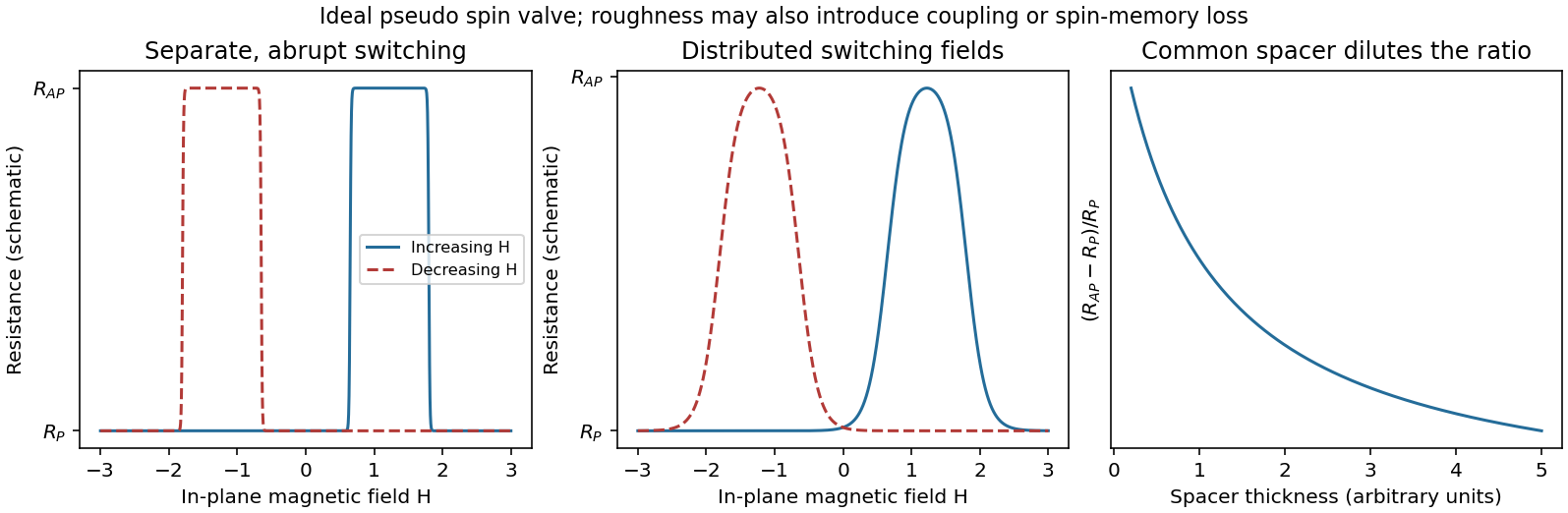
Pseudo spin-valve resistance loops, distributed switching and spacer dilution
. Original illustrative curves. Separate coercive fields create an antiparallel window on each sweep. The middle panel isolates switching-field broadening; its retained peak height is not a claim that real roughness leaves the GMR amplitude unchanged. Source. Details.If Co were the softer layer, the sequence of layer labels would be exchanged. A continuous spacer and sufficiently weak coupling are additional assumptions: negligible surface roughness alone does not guarantee independent switching at every Cu thickness.
Past exam of the MPhil in micro- and nanotechnology enterprise course of the University of Cambridge 2023 Paper 2 Section A(ii) 16 i Solution by Codex 0 2026-10-20
Codex 0 2026-10-20The giant magnetoresistance mechanism is spin-dependent conduction through the two ferromagnets. Exchange splitting gives majority and minority bands different density of states values at the Fermi energy. Scattering into those bands, together with interface scattering, produces different resistances for the two spin channels. The relevant quantity is the spin-dependent transport/scattering rate, not simply a count of all available states.
For parallel layer magnetizations, one global spin channel encounters relatively weak scattering in both Co and NiFe, providing a low-resistance path. For antiparallel magnetizations, each global spin channel encounters one more strongly scattering ferromagnet, so both paths are comparatively resistive. The channels conduct in parallel while each crosses the layers in series. This is current-perpendicular-to-plane magnetoresistance, because the current crosses the interfaces.[ref]
Nobel Lecture: Origin, development, and future of spintronics by Albert Fert. Spin-dependent conduction and the distinction between CPP and CIP transport
In the simplest two-current resistor model, with equal magnetic layers having channel resistances and spacer resistance per channel,Real Co/NiFe layers need not have equal parameters, but the same-sign spin asymmetries normally give . Their different magnetic coercivities allow the two configurations to be selected separately.
Past exam of the MPhil in micro- and nanotechnology enterprise course of the University of Cambridge 2023 Paper 2 Section A(ii) 15 v Solution by Codex 0 2026-10-20
Codex 0 2026-10-20Using the magnitude of the classical slope,The Landau filling factor at isUnder the convention that the “last Landau level” means the last resolved spin branch, its degeneracy per area is . Setting givesAbove this threshold all carriers fit into that lowest resolved branch, which is partially filled when .
Past exam of the MPhil in micro- and nanotechnology enterprise course of the University of Cambridge 2023 Paper 2 Section A(ii) 15 iv Solution by Codex 0 2026-10-20
Codex 0 2026-10-20On an integer plateau the sheet transverse resistivity has magnitudewhere the integer counts occupied resolved quantum Hall edge states. Increasing at fixed sheet density reduces the Landau filling factor . The observed trace is therefore a staircase toward larger , with transitions between plateaux rather than the classical straight line. In the plateau regions ; dissipative peaks occur at transitions.
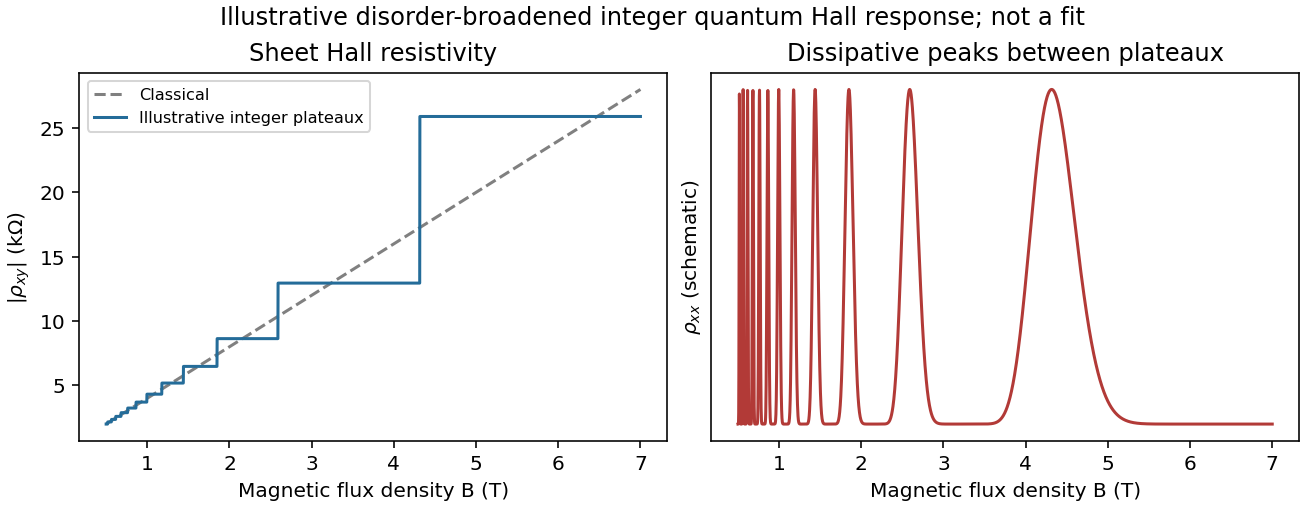
Classical Hall line and illustrative integer quantum Hall plateaux
. Original schematic responses, with the classical slope fixed by the later calculation. Plateau widths and dissipative peak shapes are illustrative rather than fitted to an experimental trace. Source. Details.It is not correct to demand an exactly integer value of everywhere along a finite-width plateau. Localization accommodates changes in total population without changing the number of extended current-carrying channels. If spin remains unresolved, the usual spin-degenerate sequence contains even integers rather than every integer.
Pinned article: Introduction to the OurBigBook Project
Welcome to the OurBigBook Project! Our goal is to create the perfect publishing platform for STEM subjects, and get university-level students to write the best free STEM tutorials ever.
Everyone is welcome to create an account and play with the site: ourbigbook.com/go/register. We belive that students themselves can write amazing tutorials, but teachers are welcome too. You can write about anything you want, it doesn't have to be STEM or even educational. Silly test content is very welcome and you won't be penalized in any way. Just keep it legal!
Intro to OurBigBook
. Source. We have two killer features:
- topics: topics group articles by different users with the same title, e.g. here is the topic for the "Fundamental Theorem of Calculus" ourbigbook.com/go/topic/fundamental-theorem-of-calculusArticles of different users are sorted by upvote within each article page. This feature is a bit like:
- a Wikipedia where each user can have their own version of each article
- a Q&A website like Stack Overflow, where multiple people can give their views on a given topic, and the best ones are sorted by upvote. Except you don't need to wait for someone to ask first, and any topic goes, no matter how narrow or broad
This feature makes it possible for readers to find better explanations of any topic created by other writers. And it allows writers to create an explanation in a place that readers might actually find it.
Figure 1. Screenshot of the "Derivative" topic page. View it live at: ourbigbook.com/go/topic/derivativeVideo 2. OurBigBook Web topics demo. Source. - local editing: you can store all your personal knowledge base content locally in a plaintext markup format that can be edited locally and published either:This way you can be sure that even if OurBigBook.com were to go down one day (which we have no plans to do as it is quite cheap to host!), your content will still be perfectly readable as a static site.
- to OurBigBook.com to get awesome multi-user features like topics and likes
- as HTML files to a static website, which you can host yourself for free on many external providers like GitHub Pages, and remain in full control

Figure 2. You can publish local OurBigBook lightweight markup files to either OurBigBook.com or as a static website.
Figure 3. Visual Studio Code extension installation.
Figure 5. . You can also edit articles on the Web editor without installing anything locally. Video 3. Edit locally and publish demo. Source. This shows editing OurBigBook Markup and publishing it using the Visual Studio Code extension. 
- Infinitely deep tables of contents:




All our software is open source and hosted at: github.com/ourbigbook/ourbigbook
Further documentation can be found at: docs.ourbigbook.com
Feel free to reach our to us for any help or suggestions: docs.ourbigbook.com/#contact