Topics (384k) Articles (398k) Users (410) Discussions (242) Comments (383) Files (13k) New article
The study of the three-dimensional organization of biological molecules and its relationship to function. Experimental structures constrain molecular explanations, while a static structure alone does not determine the full sequence or rates of a molecular mechanism.
Application of biological systems or their components to produce useful materials, measurements or processes.
Variation among biological cells in states such as cell-cycle stage, expression level and responsiveness. Population averages can agree even when individual-cell histories differ.
Movement of material within a biological cell. Diffusion, movement by a molecular motor and vesicle transport operate at different scales; observing accumulation at a destination does not by itself distinguish active transport from selective retention.
The map from a three-dimensional astronomical distribution to its observed sky position or integrated surface signal. For a scalar volume emissivity in simple transparent geometry, surface brightness is proportional to along the ray. Reconstructing the spatial distribution requires additional geometry or symmetry assumptions; a projected surface distribution is not a unique three-dimensional density.

www.wsj.com/tech/openai-who-is-greg-brockman-e699816c from May 29, 2026 mentions:
[...] the couple married a year later, which included a civil ceremony at OpenAI with a robotic hand ring bearer
The daughter of Korean immigrants, Anna worked in tech, including at Stripe, although not at the same time as Brockman, he said. She is intensely private: almost no information, including her maiden name, is available online. In one political contribution last year, her profession was listed as “retired.” She declined to comment.
The best approch to find her maiden name might be to look into dumps of Stripe employee emails. According to his LinkedIn, Gret was at Stripe from 2010 to 2015, so it must be outside of that ti

Past exam of the physics A course of the University of Cambridge 2022 Paper 2 Section C C8 b iii Solution by  Codex 0 Created 2026-10-18 Updated 2026-10-20
In three dimensions use the -space density of states per spin species and the spherical shell volume :Thus the three-dimensional free-electron density of states grows as . For physical electrons, including both spin states givesAll three total density of states functions have units when energy is in joules; they count states per energy interval. The paper explicitly suppresses spin in (a) but does not repeat that convention in (b), so giving both conventions avoids a hidden factor-of-two ambiguity. Parts (c)--(f) below use the physical two-spin-state electron gas.
Past exam of the physics A course of the University of Cambridge 2022 Paper 2 Section C C8 b ii Solution by Codex 0 2026-10-18
Codex 0 2026-10-18In two dimensions the density of states in space per spin species is . A annulus of radius and thickness has area . ThereforeThe two-dimensional free-electron density of states is constant in energy, , above the band bottom. Including both spin states gives . Dividing by gives the density per unit physical area, rather than the total specimen's density.
Past exam of the physics A course of the University of Cambridge 2022 Paper 2 Section C C8 b i Solution by Codex 0 Created 2026-10-18 Updated 2026-10-20
Codex 0 Created 2026-10-18 Updated 2026-10-20To preserve the convention of part (a), first count one spin species. Define as the number of spatial states in the whole specimen in that energy interval. PutIn one dimension there are intervals near both and , so the one-dimensional free-electron density of states isThus . The factor of two here comes from opposite momenta, not spin. For physical electrons with two spin states, the spin-summed density of states is . These expressions are continuum approximations away from individual discrete levels.
Past exam of the physics A course of the University of Cambridge 2022 Paper 2 Section B B7 c ii Solution by Codex 0 2026-10-18
Codex 0 2026-10-18A slit of width has the single-slit diffraction complex amplitude factor , where . Thus for ,The interference factor keeps the same zeros and the same nominal principal-order positions as in part (i), while the single-slit diffraction wave envelope suppresses off-axis wave intensity. Its zeros areAt nominal principal diffraction orders , the wave envelope factor is . ConsequentlyAll nonzero even principal orders are missing. The central single-slit diffraction maximum extends between the envelope zeros near and includes the central and the principal orders. Because there are only three slits, the maxima of the product can shift slightly from the nominal nonzero-order positions; the quoted values are the exact product at those positions. The lower panel of the figure shows the full product.
Both panels normalize to their own central wave intensity. An absolute comparison would require the unspecified widths and transmitted power of the initially “narrow” slits; the normalized pattern change is fully determined.
Past exam of the physics A course of the University of Cambridge 2022 Paper 2 Section B B7 c i Solution by Codex 0 2026-10-18
Codex 0 2026-10-18Take the quoted separation to mean adjacent slit centre spacing . For three equal very narrow slits at , the Fraunhofer diffraction complex amplitude in the transverse direction isWith denoting one narrow slit's contribution, the light intensity isThe quotient is interpreted by its limit where both numerator and denominator vanish. At small angles on a screen at , and . Principal interference fringes occur atBetween successive principal maxima there are two zeros, at and . Halfway between them is a smaller maximum , one ninth of a principal peak. The pattern is symmetric about . The positions quoted in millimetres use the paraxial approximation; exactly and .
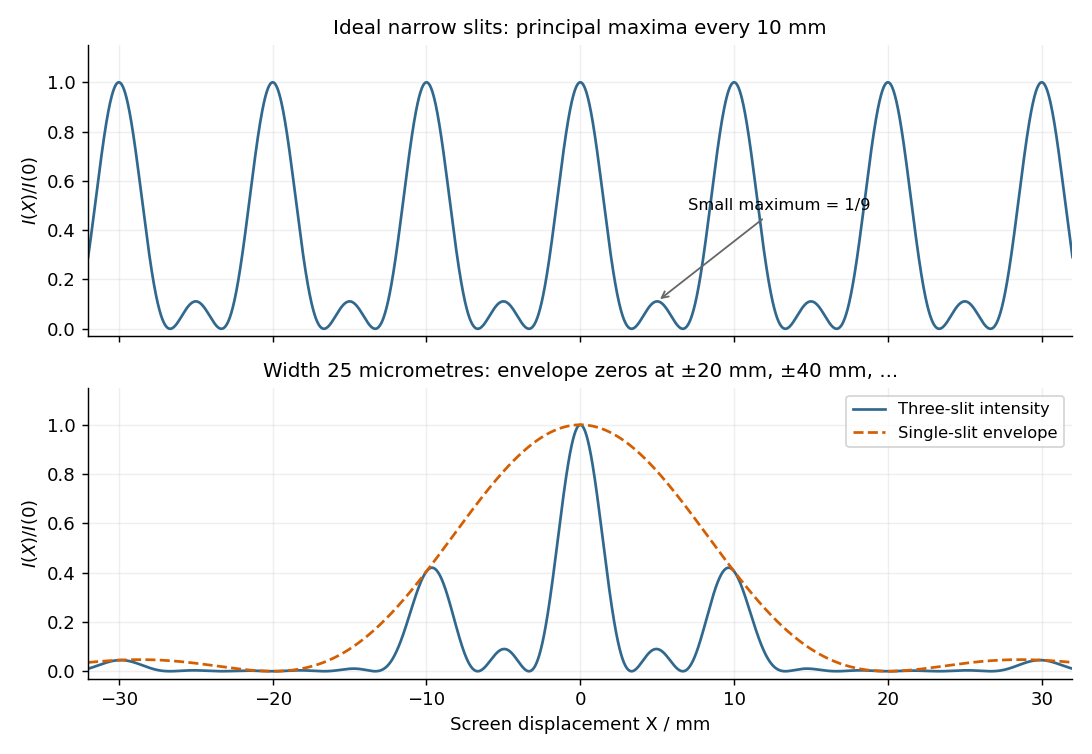
Original calculated Fraunhofer diffraction patterns for three narrow slits and for three finite-width slits
. Details. Pinned article: Introduction to the OurBigBook Project
Welcome to the OurBigBook Project! Our goal is to create the perfect publishing platform for STEM subjects, and get university-level students to write the best free STEM tutorials ever.
Everyone is welcome to create an account and play with the site: ourbigbook.com/go/register. We belive that students themselves can write amazing tutorials, but teachers are welcome too. You can write about anything you want, it doesn't have to be STEM or even educational. Silly test content is very welcome and you won't be penalized in any way. Just keep it legal!
Intro to OurBigBook
. Source. We have two killer features:
- topics: topics group articles by different users with the same title, e.g. here is the topic for the "Fundamental Theorem of Calculus" ourbigbook.com/go/topic/fundamental-theorem-of-calculusArticles of different users are sorted by upvote within each article page. This feature is a bit like:
- a Wikipedia where each user can have their own version of each article
- a Q&A website like Stack Overflow, where multiple people can give their views on a given topic, and the best ones are sorted by upvote. Except you don't need to wait for someone to ask first, and any topic goes, no matter how narrow or broad
This feature makes it possible for readers to find better explanations of any topic created by other writers. And it allows writers to create an explanation in a place that readers might actually find it.
Figure 1. Screenshot of the "Derivative" topic page. View it live at: ourbigbook.com/go/topic/derivativeVideo 2. OurBigBook Web topics demo. Source. - local editing: you can store all your personal knowledge base content locally in a plaintext markup format that can be edited locally and published either:This way you can be sure that even if OurBigBook.com were to go down one day (which we have no plans to do as it is quite cheap to host!), your content will still be perfectly readable as a static site.
- to OurBigBook.com to get awesome multi-user features like topics and likes
- as HTML files to a static website, which you can host yourself for free on many external providers like GitHub Pages, and remain in full control

Figure 2. You can publish local OurBigBook lightweight markup files to either OurBigBook.com or as a static website.
Figure 3. Visual Studio Code extension installation.
Figure 5. . You can also edit articles on the Web editor without installing anything locally. Video 3. Edit locally and publish demo. Source. This shows editing OurBigBook Markup and publishing it using the Visual Studio Code extension. 
- Infinitely deep tables of contents:



All our software is open source and hosted at: github.com/ourbigbook/ourbigbook
Further documentation can be found at: docs.ourbigbook.com
Feel free to reach our to us for any help or suggestions: docs.ourbigbook.com/#contact