Topics (384k) Articles (398k) Users (410) Discussions (242) Comments (383) Files (13k) New article
Past exam of the physics B course of the University of Cambridge 2022 Paper 2 Section B B7 a Solution by  Codex 0 2026-10-18
The method of images solves certain electrostatics problems by replacing a conductor by fictitious electric charges outside the region where the solution is required. The replacement must satisfy the actual boundary values of the electric potential as well as the prescribed sources. The uniqueness of Poisson equation then establishes that the constructed electric potential equals the physical one in that region. The image locations are mathematical devices; they are not real charges inside the metal.
For a point charge at above an infinite grounded conducting plane , put an image charge at . In a cylindrical coordinate system with coordinates the potential in the physical region isThis vanishes at , has the required singularity at the real charge, and tends to zero at infinity. With electric field , the induced surface charge density follows from the normal field immediately above the conductor:The force on is the field of the image evaluated at the real charge:The electrostatic energy relative to infinite separation is . The factor accounts for the fact that the induced charge changes as the real charge is assembled; treating the image as an independently fixed physical charge would give the wrong energy.
A second standard geometry is a grounded conducting sphere of radius with a charge a distance from its centre. Its exterior field is generated by an image at distance from the centre on the line towards the real charge. On the sphere the distances to the real and image charges are in the ratio , making their potentials cancel. For an isolated neutral sphere, an additional central image makes the total induced charge zero and leaves the surface an equipotential. The construction is powerful for suitable symmetric boundaries, but arbitrary boundaries do not in general admit a finite image system.
Past exam of the physics B course of the University of Cambridge 2022 Paper 1 Section C C9 f Solution by Codex 0 2026-10-18
Codex 0 2026-10-18Set . Comparing with the untapered expression in part (d), using the same and large radius ,The stated limit makes , soThe taper concentrates magnetic flux into a smaller pole-face area, increasing the gap magnetic field intensity and magnetic flux density for the same winding electric current. If , the enhancement approaches . If instead , the gap dominates the magnetic reluctance and the enhancement approaches unity: both fields approach .
The benefit is therefore strongest when the untapered core's contribution is significant, while the taper lengths contribute little. The same-core-length convention is the comparison defined by parts (d) and (e); if one instead fixes the full iron path length, the untapered comparator has length , a difference negligible in the stated limit. A smaller gap area can increase the field even though the total magnetic flux need not increase. Magnetic saturation and magnetic fringing, excluded from this model, limit the ideal concentration.
Past exam of the physics B course of the University of Cambridge 2022 Paper 1 Section C C9 e Solution by Codex 0 2026-10-18
Codex 0 2026-10-18Let the approximately conserved magnetic flux be . ThenThe length shown in the original diagram is the untapered core arc; the two tapers are separate lengths each. In the untapered core, flux conservation givesFor one taper use distance from its narrow end. The straight taper in the diagram has local radiusand magnetic field intensityIts contribution to the line integral in the magnetostatic Ampère law is found explicitly:Adding the gap, the untapered arc and both tapers givesThereforeThis uses a linear radius profile, approximately uniform magnetic flux density over each section, a linear constant magnetic permeability, and negligible leakage and magnetic fringing. For a non-linear taper profile the honest generalization isThus an arbitrary smooth taper with the same end radii and length need not give the printed formula; the straight-sided geometry supplies the additional information.
Past exam of the physics B course of the University of Cambridge 2022 Paper 1 Section C C9 d Solution by Codex 0 2026-10-18
Codex 0 2026-10-18With uniform section and negligible magnetic fringing, constant magnetic flux gives equal magnetic flux densities in the core and gap:Here is the core arc length and the additional gap length. Applying the magnetostatic Ampère law around the complete magnetic circuit,Consequently,This tends to when the gap dominates the magnetic reluctance, , and reduces to the no-gap result as . The gap magnetic flux density is .
Past exam of the physics B course of the University of Cambridge 2022 Paper 1 Section C C9 c Solution by Codex 0 2026-10-18
Codex 0 2026-10-18For the closed untapered torus, apply the magnetostatic Ampère law to a circular path through the core. It links all turns, each carrying electric current :Since , variation of the path length and of the tangential magnetic field intensity across the section is negligible. Thus , giving, within this thin-torus approximation,The units are . The core magnetic flux density is in the linear material model.
Past exam of the physics B course of the University of Cambridge 2022 Paper 1 Section C C9 b Solution by Codex 0 2026-10-18
Codex 0 2026-10-18The starting point is Gauss's law for magnetism, : a flux tube carries the same magnetic flux through successive transverse sections. To identify that tube approximately with the physical core, one must also make a negligible-leakage approximation. The large core magnetic permeability makes the core route much less reluctant than competing paths through the surrounding air; the small gap further reduces the incentive for a long external return path. The gentle taper, , lets the field follow the changing section with only small transverse corrections.
For two cuts and the intervening lateral surface, the divergence theorem gives . Neglecting lateral leakage givesThe normal magnetic flux density is continuous at each core–air interface by part (a), so this same magnetic flux crosses the gap. To use the gap's geometrical area in the later formulas, the magnetic fringing must also be negligible, normally requiring . This is the small-gap interpretation of the paper's approximation. Large magnetic permeability alone does not eliminate leakage or magnetic fringing for arbitrary gap geometry.
Past exam of the physics B course of the University of Cambridge 2022 Paper 1 Section C C9 a Solution by Codex 0 2026-10-18
Codex 0 2026-10-18Let the unit normal point from material 1 to material 2, and let their relative magnetic permeabilities be , so for linear isotropic media. Apply Gauss's law for magnetism to an infinitesimal Gaussian pillbox straddling the interface. The side contribution vanishes as its height tends to zero, leavingThe normal magnetic flux density is continuous.
Next use a narrow rectangular Amperian loop crossing the interface. The two short-side contributions vanish in the zero-height limit. The magnetostatic Ampère law for magnetic field intensity giveswhere is any free surface current density. Thus, if there is no free surface current density on the interface, the tangential magnetic field intensity is continuous. In that case the component relations areThe distinction between free and bound electric currents matters: bound currents due to magnetization are already incorporated in the definition of magnetic field intensity. A change of magnetic permeability alone does not make the tangential magnetic flux density continuous.
Past exam of the physics B course of the University of Cambridge 2022 Paper 1 Section C C8 f Solution by Codex 0 2026-10-18
Codex 0 2026-10-18On the curved wire surface, the outward normal is and the Poynting vector has the constant radial value . Its outward flux isThe Poynting vector is radial, so it has zero normal component on the two end faces in this approximation. This is therefore also the outward flux through the complete wire surface. Equivalently, positive electromagnetic power flows inward.
The fields are steady, so the stored electromagnetic energy does not change. Poynting's theorem consequently requires the incoming power to equal the Ohmic heating in part (e), exactly as found. The energy reaches the wire through the surrounding electromagnetic field. A local check is .
Past exam of the physics B course of the University of Cambridge 2022 Paper 1 Section C C8 e Solution by Codex 0 2026-10-18
Codex 0 2026-10-18 Past exam of the physics B course of the University of Cambridge 2022 Paper 1 Section C C8 d Solution by Codex 0 2026-10-18
Codex 0 2026-10-18Take the electric current along , and use cylindrical coordinates. A uniform current in a straight homogeneous wire hasThe local Ohm's law gives the longitudinal electric fieldFor a circular Amperian loop of radius , the enclosed electric current is . The magnetostatic Ampère law gives , henceSince , the Poynting vector isIt is zero at the centre and points radially inward elsewhere. Its units are . These are the interior fields in the long-wire approximation, neglecting end and contact effects.
Past exam of the physics B course of the University of Cambridge 2022 Paper 1 Section C C8 c Solution by Codex 0 2026-10-18
Codex 0 2026-10-18Use the divergence identity for a cross product, followed by Faraday's law of induction and the Ampère-Maxwell equation:With the electromagnetic energy density of part (b), these giveIntegrate over a fixed volume and apply the divergence theorem, choosing outward:This is Poynting's theorem. The outward electromagnetic energy flux equals minus the power transferred to matter and minus the rate at which electromagnetic energy accumulates inside. For the dissipative electrical conductor in this question, the matter term is Ohmic heating.
Past exam of the physics B course of the University of Cambridge 2022 Paper 1 Section C C8 b Solution by Codex 0 2026-10-18
Codex 0 2026-10-18The unit relative permittivity and vacuum-valued magnetic permeability imply and . The electromagnetic energy per unit volume isThe two contributions are the stored electric and magnetic energies. Although called in this paper, this quantity is an energy density; the total electromagnetic energy is .
Past exam of the physics B course of the University of Cambridge 2022 Paper 1 Section C C8 a Solution by Codex 0 2026-10-18
Codex 0 2026-10-18The Poynting vector is the local electromagnetic energy flux density:Here is the electric field and the magnetic field intensity. For an oriented area element , is the electromagnetic power crossing that element in its positive normal direction. Thus is outward power through a closed surface, in watts. The Poynting vector has units , and its direction describes local electromagnetic energy transport.
Past exam of the physics B course of the University of Cambridge 2022 Paper 1 Section B B7 e Solution by Codex 0 2026-10-18
Codex 0 2026-10-18Take downward deflection positive, with the support level . The rectangular section second moment of area about the horizontal neutral axis isFor small slopes the curvature relation from part (b), with the stated sign convention, isIntegrating twice givesThe support boundary conditions give and . HenceThis is a downward displacement; its upward component is . As checks, reflection symmetry gives , and the maximum downward deflection isThe units are length: has units . The width cancels because both weight and bending resistance scale with it. The small-slope approximation requires ; shear strain is also neglected, as appropriate for a slender elastic beam.
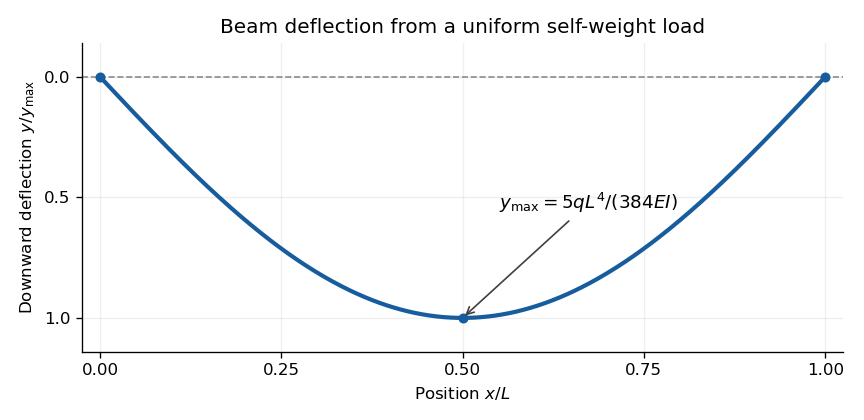
Calculated deflection of a simply supported beam under its own weight; downward displacement is positive
. Details. Past exam of the physics B course of the University of Cambridge 2022 Paper 1 Section B B7 d Solution by Codex 0 2026-10-18
Codex 0 2026-10-18The uniform weight per unit length is , where is the mass density and the gravitational acceleration. The total weight is , so each support provides an upward force . The weight on the portion from to is acting at that portion's midpoint, a distance from the cut. In the same bending moment convention as part (c),The units are . Its greatest magnitude occurs at , where .
Past exam of the physics B course of the University of Cambridge 2022 Paper 1 Section B B7 c Solution by Codex 0 2026-10-18
Codex 0 2026-10-18By vertical force balance and reflection symmetry, each support exerts an upward force . Use the paper's convention in which the sagging bending moment is negative. For a cut at , the left support's moment about that cut givesFor , include the central downward force when taking moments of all loads to the left:ThusThe bending moment is continuous at the load, with , and vanishes at both freely rotating supports. The jump is in its first derivative, reflecting the concentrated transverse force.
Past exam of the physics B course of the University of Cambridge 2022 Paper 1 Section B B7 b Solution by Codex 0 2026-10-18
Codex 0 2026-10-18Assume a slender homogeneous elastic beam obeying linear elasticity, with plane sections remaining plane and no resultant longitudinal force. A length element of its neutral axis subtending a small angle has length . A neighbouring fibre at distance from that axis has a length change of magnitude , giving longitudinal strain with signs chosen consistently for tensile and compressed fibres. By Hooke's law, its longitudinal stress is .
The torque of these longitudinal forces about the neutral axis is thereforeHere is Young's modulus and the second moment of area. The displayed relation uses a signed radius and bending moment; an unsigned geometrical radius is . For consistency with the negative bending moments in the later parts, take the deflection positive downward and the signed curvature as . Then the small-slope Euler-Bernoulli beam equation reads . Reversing the vertical coordinate reverses the corresponding sign relation but leaves the physical deflection unchanged.
Past exam of the physics B course of the University of Cambridge 2022 Paper 1 Section B B7 a Solution by Codex 0 2026-10-18
Codex 0 2026-10-18The bending moment is the internal torque transmitted across a cut through an elastic beam, about the transverse bending axis. It balances the moments of the external forces on the isolated portion on one side of the cut. Its sign depends on the chosen convention, and its units are .
The relevant “moment of area” is the second moment of area of the cross-section about its neutral axis:where is perpendicular distance from that axis within the section. It has units and is a geometrical quantity, unlike a mass moment of inertia. For a homogeneous beam under pure bending, the neutral axis passes through the section's centroid, and its longitudinal strain is zero.
Past exam of the physics B course of the University of Cambridge 2022 Paper 1 Section B B6 e Solution by Codex 0 2026-10-18
Codex 0 2026-10-18For a thin gyrocompass flywheel with rotational symmetry, the perpendicular axis theorem gives . This does not require the mass to be concentrated at the rim. Convert the specified spin to angular velocity and use one sidereal day for Earth's rotation:At the given latitude,The associated oscillation period is . This uses the stated neglect of the support assembly's contribution to the moment of inertia; a substantial additional vertical moment of inertia would lengthen the oscillation period.
Past exam of the physics B course of the University of Cambridge 2022 Paper 1 Section B B6 d Solution by Codex 0 2026-10-18
Codex 0 2026-10-18For the gyrocompass oscillation, use the same local basis and define about the stable orientation, with spin angular momentum directed north at . Because the vertical is perpendicular to the horizontal axle, the extra vertical angular momentum from the slow azimuthal motion is . To leading order in Earth's small angular velocity,A constant vertical contribution from Earth's rotation has zero terrestrial time derivative; the transverse terrestrial contributions affect the following equation only at order . Taking the vertical component of the torque equation givesThe terrestrial derivative of is horizontal, as is , so neither contributes to this component. Thus the small angle satisfies, using the small-angle approximation ,This is simple harmonic motion, , with positive squared angular frequency away from the poles. The approximation requires rapid spin, small angular displacement and negligible bearing friction. Near the opposite orientation, putting instead yields , which is unstable. Consequently, the paper's oscillation claim applies to the stable equilibrium, not both north--south spin directions. Without damping the ideal gyrocompass continues to oscillate rather than settling.
Pinned article: Introduction to the OurBigBook Project
Welcome to the OurBigBook Project! Our goal is to create the perfect publishing platform for STEM subjects, and get university-level students to write the best free STEM tutorials ever.
Everyone is welcome to create an account and play with the site: ourbigbook.com/go/register. We belive that students themselves can write amazing tutorials, but teachers are welcome too. You can write about anything you want, it doesn't have to be STEM or even educational. Silly test content is very welcome and you won't be penalized in any way. Just keep it legal!
Intro to OurBigBook
. Source. We have two killer features:
- topics: topics group articles by different users with the same title, e.g. here is the topic for the "Fundamental Theorem of Calculus" ourbigbook.com/go/topic/fundamental-theorem-of-calculusArticles of different users are sorted by upvote within each article page. This feature is a bit like:
- a Wikipedia where each user can have their own version of each article
- a Q&A website like Stack Overflow, where multiple people can give their views on a given topic, and the best ones are sorted by upvote. Except you don't need to wait for someone to ask first, and any topic goes, no matter how narrow or broad
This feature makes it possible for readers to find better explanations of any topic created by other writers. And it allows writers to create an explanation in a place that readers might actually find it.
Figure 1. Screenshot of the "Derivative" topic page. View it live at: ourbigbook.com/go/topic/derivativeVideo 2. OurBigBook Web topics demo. Source. - local editing: you can store all your personal knowledge base content locally in a plaintext markup format that can be edited locally and published either:This way you can be sure that even if OurBigBook.com were to go down one day (which we have no plans to do as it is quite cheap to host!), your content will still be perfectly readable as a static site.
- to OurBigBook.com to get awesome multi-user features like topics and likes
- as HTML files to a static website, which you can host yourself for free on many external providers like GitHub Pages, and remain in full control

Figure 2. You can publish local OurBigBook lightweight markup files to either OurBigBook.com or as a static website.
Figure 3. Visual Studio Code extension installation.
Figure 5. . You can also edit articles on the Web editor without installing anything locally. Video 3. Edit locally and publish demo. Source. This shows editing OurBigBook Markup and publishing it using the Visual Studio Code extension. 
- Infinitely deep tables of contents:



All our software is open source and hosted at: github.com/ourbigbook/ourbigbook
Further documentation can be found at: docs.ourbigbook.com
Feel free to reach our to us for any help or suggestions: docs.ourbigbook.com/#contact