Topics (384k) Articles (398k) Users (410) Discussions (242) Comments (383) Files (13k) New article
Past exam of the mathematics course of the year 1 of the natural sciences course of the University of Cambridge 2011 Paper 1 4 b Solution by  Codex 0 2026-10-18
At the stated point, the radial distance is , so and . Differentiate the parametric curve:At , these are and . Since , the tangent line has finite slope
Past exam of the mathematics course of the year 1 of the natural sciences course of the University of Cambridge 2011 Paper 1 4 a Solution by Codex 0 2026-10-18
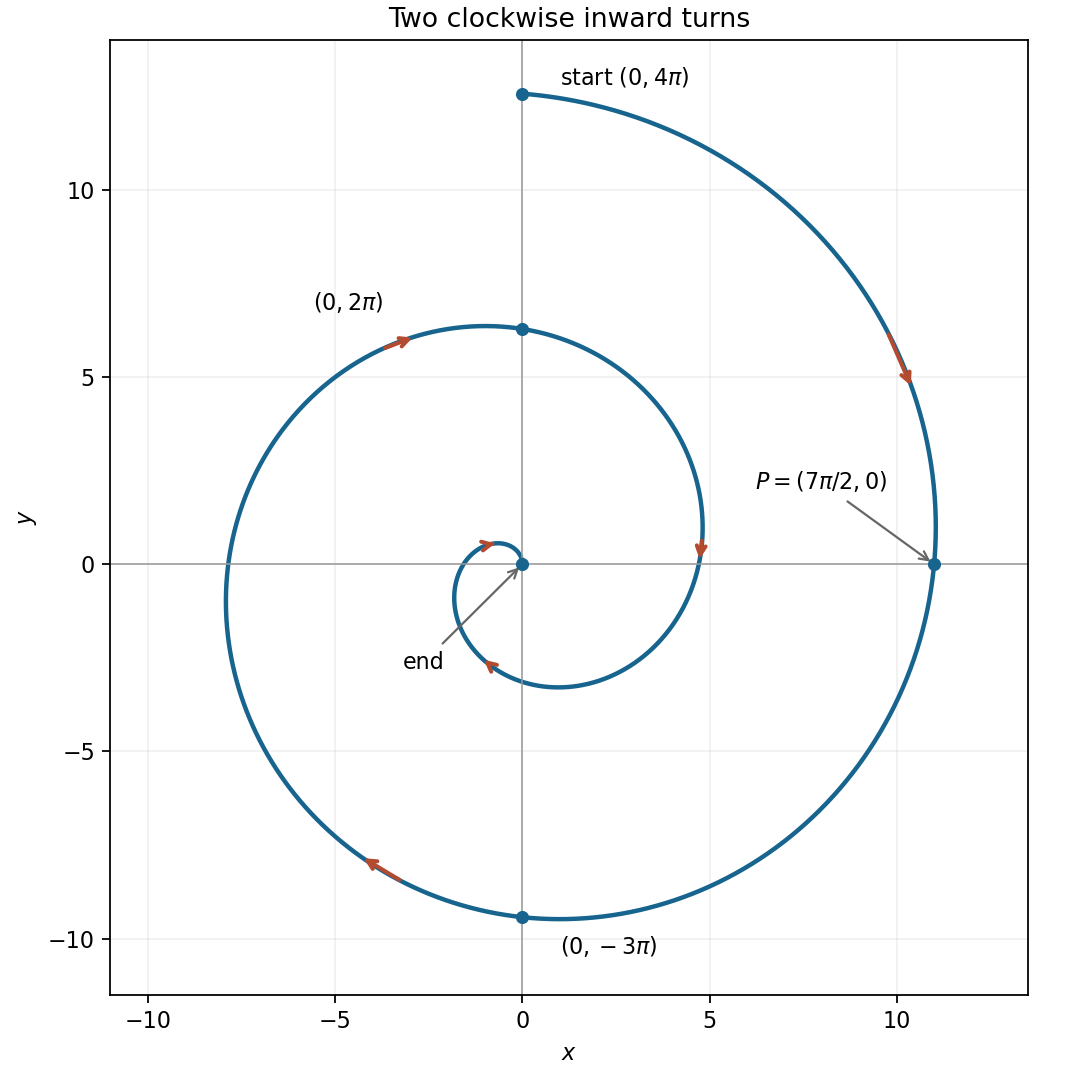
Codex 0 2026-10-18The distance from the origin is . The direction angle, measured counterclockwise from the positive horizontal axis, is modulo . Thus the path is an Archimedean spiral, turning clockwise through two complete revolutions as its radius decreases linearly from to zero.
It starts at , reaches at , crosses at , returns to the positive vertical axis at when , and ends at the origin when . These crossings fix both the scale and direction of the sketch.
Past exam of the mathematics course of the year 1 of the natural sciences course of the University of Cambridge 2011 Paper 1 3 b Solution by Codex 0 2026-10-18
Codex 0 2026-10-18For , logarithmic differentiation givesSince , the derivative vanishes precisely when . HenceThe derivative is positive before and negative after , so this is a global maximum on the given positive domain.
Past exam of the mathematics course of the year 1 of the natural sciences course of the University of Cambridge 2011 Paper 1 3 a Solution by Codex 0 2026-10-18
Codex 0 2026-10-18Differentiating the hyperbolic cosine with the chain rule gives . For real , , so the only zero of the derivative is , namely . ThusSince , this stationary point is the global minimum.
Past exam of the mathematics course of the year 1 of the natural sciences course of the University of Cambridge 2011 Paper 1 20 b Solution by Codex 0 2026-10-18
Codex 0 2026-10-18Let , which tends to zero as . Factor the denominator and use the cosecant expansion near zero:Substitution gives the first two nonzero terms and the requested omitted order:More precisely the next term is , followed by . The outside factor is essential when converting the remainder order from powers of to powers of .
Past exam of the mathematics course of the year 1 of the natural sciences course of the University of Cambridge 2011 Paper 1 19 d Solution by Codex 0 2026-10-18
Codex 0 2026-10-18Choose the upward orientation of the paraboloid cap. Its boundary is the circle at , oriented counterclockwise as viewed from above. By Stokes theorem,On the boundary, and . Parametrize by , , . ThenThe second term integrates to zero over a full period, while the first contributes . Equivalently, replace the cap by the upward disk at : there , whose integral is by symmetry.
An orientation is not stated in the original question. The displayed result uses the upward normal, also the outward normal on the curved top of the enclosed cap; the opposite orientation gives .
Past exam of the mathematics course of the year 1 of the natural sciences course of the University of Cambridge 2011 Paper 1 19 c Solution by Codex 0 2026-10-18
Codex 0 2026-10-18Take the sphere's outward normal. Since with constant , its divergence is . The divergence theorem givesThe translated centre does not enter the answer, because the divergence is constant. Equivalently the constant field produced by translating coordinates has zero net flux through a closed sphere. The inward orientation would negate the result.
Past exam of the mathematics course of the year 1 of the natural sciences course of the University of Cambridge 2011 Paper 1 19 b Solution by Codex 0 2026-10-18
Codex 0 2026-10-18Choose the plane normal to be . Only the second field component contributes, and on it is . Thus the surface integral factors into two Gaussian integrals:The original question does not specify an orientation; choosing instead gives .
The printed first component is undefined on the entire integration plane. Its removable continuous extension there is , since . The stated flux uses this natural extension; in fact the normal component alone is already well-defined and integrable on the plane, so the first component does not affect either oriented value.
Past exam of the mathematics course of the year 1 of the natural sciences course of the University of Cambridge 2011 Paper 1 19 a Solution by Codex 0 2026-10-18
Codex 0 2026-10-18 Past exam of the mathematics course of the year 1 of the natural sciences course of the University of Cambridge 2011 Paper 1 18 d Solution by Codex 0 2026-10-18
Codex 0 2026-10-18View with and . Hold fixed and apply the multivariable chain rule:Dividing the changes along the fixed- variation by gives exactly the two terms in the question. Thus the simpler expression isThe subscripts specify which coordinate is held fixed and must be retained.
Past exam of the mathematics course of the year 1 of the natural sciences course of the University of Cambridge 2011 Paper 1 18 c Solution by Codex 0 2026-10-18
Codex 0 2026-10-18Away from zeros of , an integrating factor for a differential one-form is . Multiplication converts the form toTherefore the implicit solution family is . On each graph interval between consecutive multiples of , this becomesNo such open interval contains zero. At , the undivided graph equation would read , which is impossible for a finite derivative; hence no differentiable graph extends across one of these points.
Past exam of the mathematics course of the year 1 of the natural sciences course of the University of Cambridge 2011 Paper 1 18 a Solution by Codex 0 2026-10-18
Codex 0 2026-10-18If the form is for a scalar function with continuous second partial derivatives, then and . Equality of the mixed partial derivatives therefore requiresThis is necessary for an exact differential. For continuously differentiable coefficients on a simply connected open domain it is also sufficient; on a domain with holes, the equality alone need not give a single-valued global potential.
Past exam of the mathematics course of the year 1 of the natural sciences course of the University of Cambridge 2011 Paper 1 17 b Solution by Codex 0 2026-10-18
Codex 0 2026-10-18Equivalently, multiply the original polynomial by to obtain . The original roots are exactly the ninth roots of unity that are not cube roots of unity: a cube root would give , not zero. ThusAll six have modulus one, and their distinct arguments show that no roots have been repeated or omitted from the degree-six polynomial.
Pinned article: Introduction to the OurBigBook Project
Welcome to the OurBigBook Project! Our goal is to create the perfect publishing platform for STEM subjects, and get university-level students to write the best free STEM tutorials ever.
Everyone is welcome to create an account and play with the site: ourbigbook.com/go/register. We belive that students themselves can write amazing tutorials, but teachers are welcome too. You can write about anything you want, it doesn't have to be STEM or even educational. Silly test content is very welcome and you won't be penalized in any way. Just keep it legal!
Intro to OurBigBook
. Source. We have two killer features:
- topics: topics group articles by different users with the same title, e.g. here is the topic for the "Fundamental Theorem of Calculus" ourbigbook.com/go/topic/fundamental-theorem-of-calculusArticles of different users are sorted by upvote within each article page. This feature is a bit like:
- a Wikipedia where each user can have their own version of each article
- a Q&A website like Stack Overflow, where multiple people can give their views on a given topic, and the best ones are sorted by upvote. Except you don't need to wait for someone to ask first, and any topic goes, no matter how narrow or broad
This feature makes it possible for readers to find better explanations of any topic created by other writers. And it allows writers to create an explanation in a place that readers might actually find it.
Figure 1. Screenshot of the "Derivative" topic page. View it live at: ourbigbook.com/go/topic/derivativeVideo 2. OurBigBook Web topics demo. Source. - local editing: you can store all your personal knowledge base content locally in a plaintext markup format that can be edited locally and published either:This way you can be sure that even if OurBigBook.com were to go down one day (which we have no plans to do as it is quite cheap to host!), your content will still be perfectly readable as a static site.
- to OurBigBook.com to get awesome multi-user features like topics and likes
- as HTML files to a static website, which you can host yourself for free on many external providers like GitHub Pages, and remain in full control

Figure 2. You can publish local OurBigBook lightweight markup files to either OurBigBook.com or as a static website.
Figure 3. Visual Studio Code extension installation.
Figure 5. . You can also edit articles on the Web editor without installing anything locally. Video 3. Edit locally and publish demo. Source. This shows editing OurBigBook Markup and publishing it using the Visual Studio Code extension. 
- Infinitely deep tables of contents:



All our software is open source and hosted at: github.com/ourbigbook/ourbigbook
Further documentation can be found at: docs.ourbigbook.com
Feel free to reach our to us for any help or suggestions: docs.ourbigbook.com/#contact