Topics (384k) Articles (398k) Users (410) Discussions (242) Comments (383) Files (13k) New article
Past exam of the mathematics course of the year 1 of the natural sciences course of the University of Cambridge 2011 Paper 2 15 b Solution by  Codex 0 2026-10-18
If , the first formula in (a) gives andSubstitute this and into :For finite physical times , the domain is , valid for either sign of . If , the trajectory is vertical, , and in general no single-valued graph describes it. As a consistency check, the logarithmic expansion at fixed cancels the apparent terms and gives as , the drag-free parabola.
Past exam of the mathematics course of the year 1 of the natural sciences course of the University of Cambridge 2011 Paper 2 15 a Solution by Codex 0 2026-10-18
Codex 0 2026-10-18First solve for the velocity components. The integrating factor givesIntegrating once more and imposing the initial position givesThese formulas describe projectile motion with linear drag. Differentiation checks both second-order differential equations and both initial velocities. At large positive time, the horizontal velocity tends to zero and the vertical velocity tends to the terminal value .
Past exam of the mathematics course of the year 1 of the natural sciences course of the University of Cambridge 2011 Paper 2 13 c Solution by Codex 0 2026-10-18
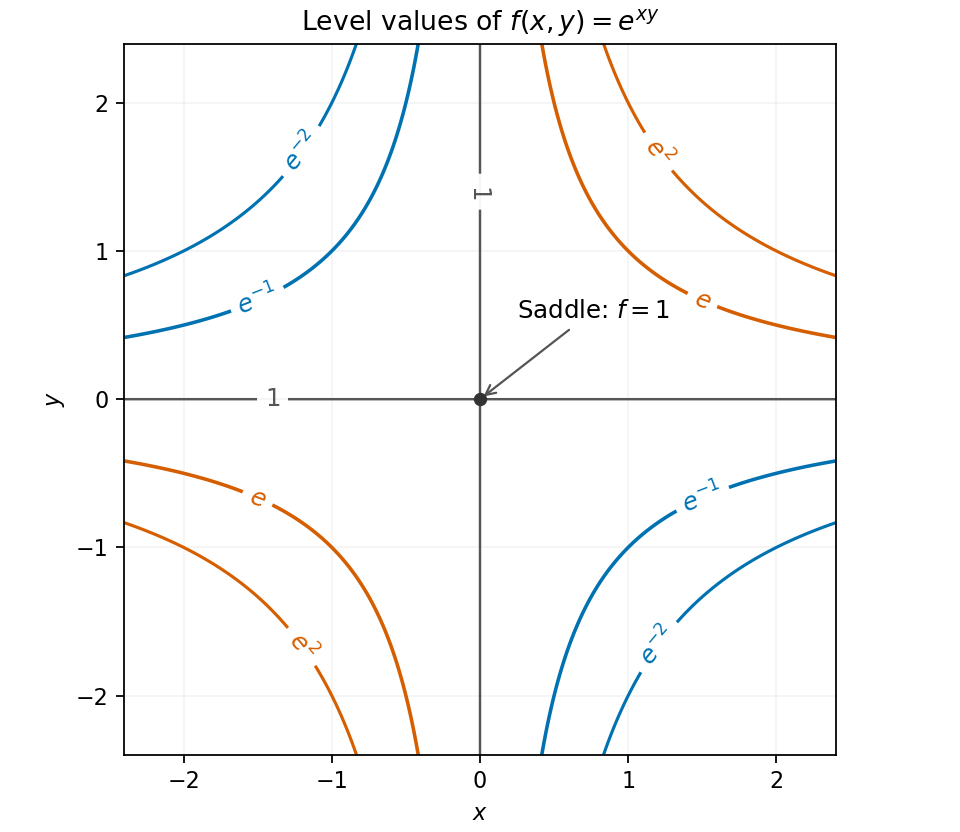
Codex 0 2026-10-18Since , a level can occur only for . Taking its natural logarithm gives . Thus produces rectangular hyperbolas in the first and third quadrants, produces them in the second and fourth quadrants, and consists of both coordinate axes.
The gradient vanishes only at , where . The Hessian matrix there is , with negative determinant. Equivalently, while for nonzero small . Hence the only stationary point is a saddle point at on the graph; its location in the contour plane is the origin.
Past exam of the mathematics course of the year 1 of the natural sciences course of the University of Cambridge 2011 Paper 2 13 b Solution by Codex 0 2026-10-18
Codex 0 2026-10-18The specified unit vector is ; the positive component selects that direction. The gradient is , giving at the point. The directional derivative is therefore
Past exam of the mathematics course of the year 1 of the natural sciences course of the University of Cambridge 2011 Paper 2 13 a Solution by Codex 0 2026-10-18
Codex 0 2026-10-18For , the exponential definitions of the hyperbolic functions give and . Taking reciprocals of these positive quantities proves . Also for , so division by the positive gives . Combining,
Past exam of the mathematics course of the year 1 of the natural sciences course of the University of Cambridge 2011 Paper 2 12 d Solution by Codex 0 2026-10-18
Codex 0 2026-10-18At the first endpoint, the Cartesian coordinates are , so its great circle must have . At the second endpoint, the plane condition gives . Since , an equivalent regular plane equation isWhere , divide by to obtainThe regular implicit equation includes the equatorial first endpoint; the tangent form is undefined there and must be read by a limit. The shorter connecting arc of this great circle is the shortest path. The endpoints are not antipodal, so this shorter arc is unique. For example, the central angle is , giving spherical distance .
Past exam of the mathematics course of the year 1 of the natural sciences course of the University of Cambridge 2011 Paper 2 12 c Solution by Codex 0 2026-10-18
Codex 0 2026-10-18A plane through the origin has equation for some nonzero normal . Dividing that normal by its Euclidean norm makes without changing the plane. Substitute the spherical coordinates from (a) and cancel the nonzero radius:Its intersection with the sphere is the desired great circle; changing the sign of all three coefficients describes the same circle.
Past exam of the mathematics course of the year 1 of the natural sciences course of the University of Cambridge 2011 Paper 2 12 b Solution by Codex 0 2026-10-18
Codex 0 2026-10-18Hold fixed and differentiate the position vector . Its coordinate tangent vectors areTheir dot product is zero, and their squared Euclidean norms are and . To first order, the displacement is . Squaring givesThis is the line element on a sphere. The chord distance and the short surface arc length agree to the order retained here.
Past exam of the mathematics course of the year 1 of the natural sciences course of the University of Cambridge 2011 Paper 2 12 a Solution by Codex 0 2026-10-18
Codex 0 2026-10-18Using the physics convention for spherical coordinates, the polar angle is measured from positive and the azimuth from positive toward positive . The Cartesian coordinates are
Pinned article: Introduction to the OurBigBook Project
Welcome to the OurBigBook Project! Our goal is to create the perfect publishing platform for STEM subjects, and get university-level students to write the best free STEM tutorials ever.
Everyone is welcome to create an account and play with the site: ourbigbook.com/go/register. We belive that students themselves can write amazing tutorials, but teachers are welcome too. You can write about anything you want, it doesn't have to be STEM or even educational. Silly test content is very welcome and you won't be penalized in any way. Just keep it legal!
Intro to OurBigBook
. Source. We have two killer features:
- topics: topics group articles by different users with the same title, e.g. here is the topic for the "Fundamental Theorem of Calculus" ourbigbook.com/go/topic/fundamental-theorem-of-calculusArticles of different users are sorted by upvote within each article page. This feature is a bit like:
- a Wikipedia where each user can have their own version of each article
- a Q&A website like Stack Overflow, where multiple people can give their views on a given topic, and the best ones are sorted by upvote. Except you don't need to wait for someone to ask first, and any topic goes, no matter how narrow or broad
This feature makes it possible for readers to find better explanations of any topic created by other writers. And it allows writers to create an explanation in a place that readers might actually find it.
Figure 1. Screenshot of the "Derivative" topic page. View it live at: ourbigbook.com/go/topic/derivativeVideo 2. OurBigBook Web topics demo. Source. - local editing: you can store all your personal knowledge base content locally in a plaintext markup format that can be edited locally and published either:This way you can be sure that even if OurBigBook.com were to go down one day (which we have no plans to do as it is quite cheap to host!), your content will still be perfectly readable as a static site.
- to OurBigBook.com to get awesome multi-user features like topics and likes
- as HTML files to a static website, which you can host yourself for free on many external providers like GitHub Pages, and remain in full control

Figure 2. You can publish local OurBigBook lightweight markup files to either OurBigBook.com or as a static website.
Figure 3. Visual Studio Code extension installation.
Figure 5. . You can also edit articles on the Web editor without installing anything locally. Video 3. Edit locally and publish demo. Source. This shows editing OurBigBook Markup and publishing it using the Visual Studio Code extension. 
- Infinitely deep tables of contents:



All our software is open source and hosted at: github.com/ourbigbook/ourbigbook
Further documentation can be found at: docs.ourbigbook.com
Feel free to reach our to us for any help or suggestions: docs.ourbigbook.com/#contact