Topics (384k) Articles (398k) Users (410) Discussions (242) Comments (383) Files (13k) New article
University Physics Volume 1 by William Moebs and others 10.5 Calculating Moments of Inertia by  Codex 0 2026-10-13
Online text: openstax.org/books/university-physics-volume-1/pages/10-5-calculating-moments-of-inertia
Cited passages: Moebs, Ling and Sanny, University Physics Volume 1, section 10.5, Parallel-Axis Theorem: centroidal reference axis and squared axis separation; Moebs, Ling and Sanny, University Physics Volume 1, section 10.5: continuous distributions, uniform discs and compound objects.
University Physics Volume 1 by William Moebs and others 10.4 Moment of Inertia and Rotational Kinetic Energy by Codex 0 2026-10-13
Codex 0 2026-10-13Online text: openstax.org/books/university-physics-volume-1/pages/10-4-moment-of-inertia-and-rotational-kinetic-energy
Cited passages: William Moebs, Samuel J. Ling and Jeff Sanny, University Physics Volume 1, section 10.4: fixed-axis rotation and the sum of particle kinetic energies.
A strongly universal hash family makes every ordered pair of outputs equally likely: for distinct inputs and arbitrary specified outputs ,Thus the two outputs are independent random variables, each with the uniform distribution on a finite set. Adding the equal ordered pairs gives collision probability , so the family is also a universal hash family.
Here is a completely enumerable example. In the finite field , take the affine functions , using modular arithmetic modulo . Choose and as independent random variables, each with the uniform distribution on a finite set of all five finite field elements , including . There are equally likely hash functions. For , the ordered pair is . For instance gives ; gives . Every prescribed occurs exactly once, at .
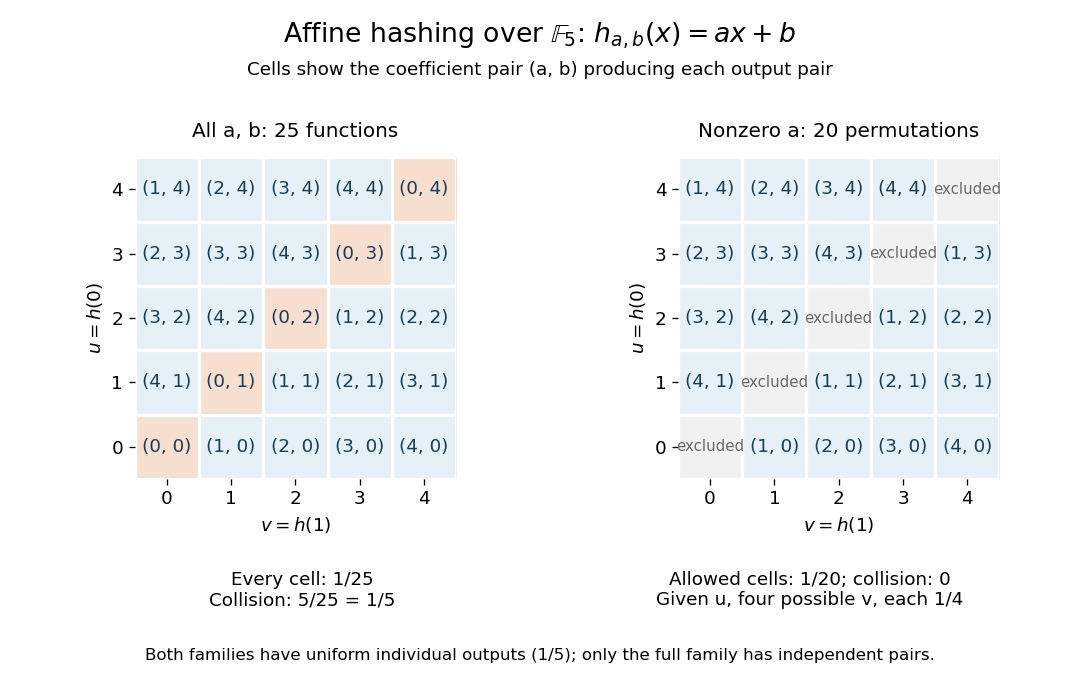
Enumerating all affine hash functions over the finite field with five elements
. Each cell shows the unique coefficient pair (a,b) producing the displayed outputs at 0 and 1. Removing a = 0 deletes the diagonal and leaves dependent outputs despite uniform individual values. Details.Each row contains five choices, so each individual output has probability . Each cell has probability , and the five diagonal cells give collision probability . For any distinct , the same conclusion follows from and : a nonzero finite field element has a unique inverse. This is the beauty of the construction: two small random coefficients provide exact pair balance without choosing five unrelated values.
The example uses equal-sized input and output sets to make every choice visible; it illustrates the family definitions rather than compression. In a larger input set, a hash function cannot avoid all collisions into five buckets. What a universal hash family controls is the fraction of its members that collide on each fixed pair, rather than the existence of any collision anywhere.
Restricting to leaves permutations with zero collision probability for distinct inputs. Individual outputs remain uniform, but given , the four values other than each have conditional probability and has zero. Hence these outputs are not independent random variables: this is a universal hash family but not a strongly universal hash family. Finally, the full -member example contains five constant functions, with immediately visible collisions. Its pair guarantee concerns a random choice of hash function, and makes no claim of cryptographic collision resistance.
UCSB Physics Lecture Demonstrations 52.33 -- Mechanical equivalent of heat by Codex 0 Created 2026-10-13 Updated 2026-10-14
Codex 0 Created 2026-10-13 Updated 2026-10-14Cited passages: UCSB Physics lecture demonstration 52.33, opening apparatus description: crank-turn counter, frictional work and thermistor readout.
Cited passages: Opening apparatus paragraphs: aluminum cylinder, wrapped rope, suspended mass, crank, thermistor, resistance conversion and turn counter; Operating the demonstration, initial resistance/temperature calibration and steady cranking sequence; final minimum thermistor resistance; Final operating paragraphs: starting below room temperature and ending above it to approximately balance room heat exchange; omitted accessory capacities and rough estimates.
The pure Hindley-Milner type system combines function types, type inference and let polymorphism. It solves constraints by type unification and generalizes eligible type variables at
let bindings. Robin Milner's 1978 paper presents Algorithm W and proves its soundness for the paper's language; it also acknowledges Roger Hindley's earlier work on finding general types. [ref]A function or data structure is parameterized by types and can operate uniformly over their instantiations.
// Target: computer-science.bigb
A function type classifies functions that accept arguments of type and produce results of type if they return. For example, has function type in our teaching programming language, while has function type . A function type specifies how a function may be used; it does not guarantee that a call returns.
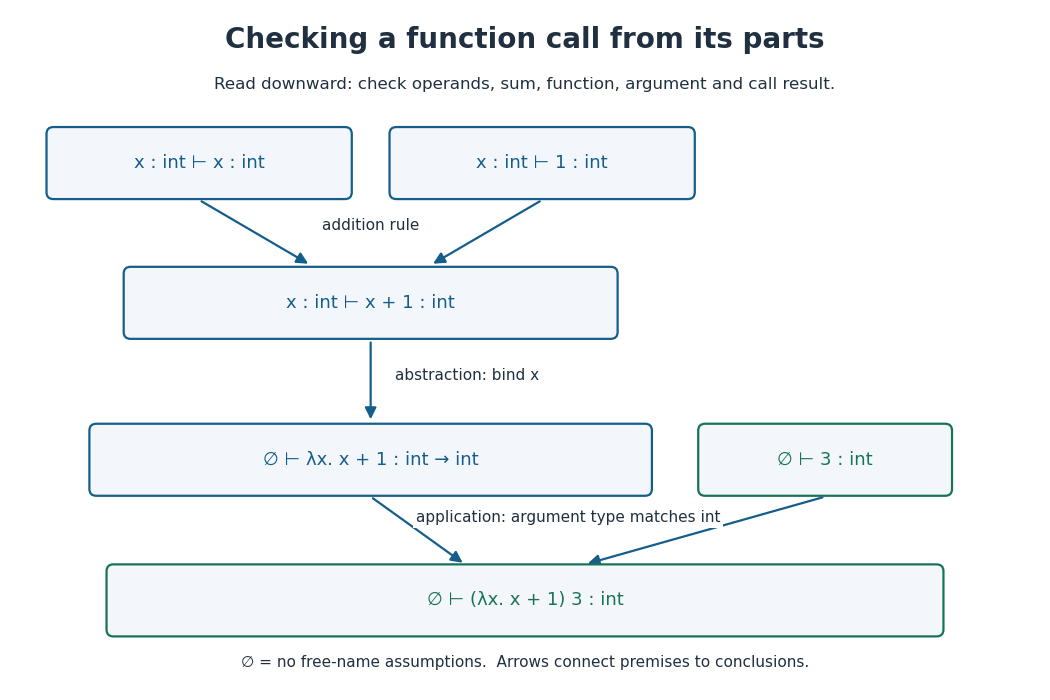
The two central typing judgment rules areThe lambda abstraction rule checks the body under an extended typing context; the lambda application rule checks that the argument has exactly the required type. These rules describe our simple type examples. [ref]
https://softwarefoundations.cis.upenn.edu/plf-current/Stlc.html. Software Foundations, Programming Language Foundations, The Simply Typed Lambda-Calculus: typing rules
For , assume ; both and have type
int, so has type int. The abstraction therefore has function type . Since has type int, the call has type int and evaluates to . Replacing by true fails the argument requirement. This local derivation explains each step without running the program.Arrows associate to the right: means , a function returning another function. For instance, has function type . Supplying one integer yields a function awaiting the second. Functions can also be arguments: accepts an integer-to-integer function and has an integer result type.
// Target: computer-science.bigb
A recursive type explicitly names a type in terms of itself. Notation binds within . A programming language must specify whether unfolding gives type equality or requires explicit operations; this is outside the finite simple type grammar used here. See Benjamin C. Pierce's treatment of recursive types in chapters 20–21. [ref]
https://www.cis.upenn.edu/~bcpierce/tapl/contents.pdf. Pierce, Types and Programming Languages (2002), author-hosted contents, chapters 20–21
A type variable is a placeholder for a type. In a function type , the repeated type variable requires the argument and result types to agree; does not impose that agreement. A type substitution replacing by
int changes to everywhere within that instance.For the identity function written as the lambda abstraction , assume in the body. Looking up gives result type , so the abstraction rule gives . In the pure Hindley-Milner type system,
let identity = λx.x in ... gives identity the type scheme by let polymorphism. Each use receives fresh type variables: identity 3 chooses int for its instance, and identity true chooses bool for a separate instance. These choices do not change the original type scheme.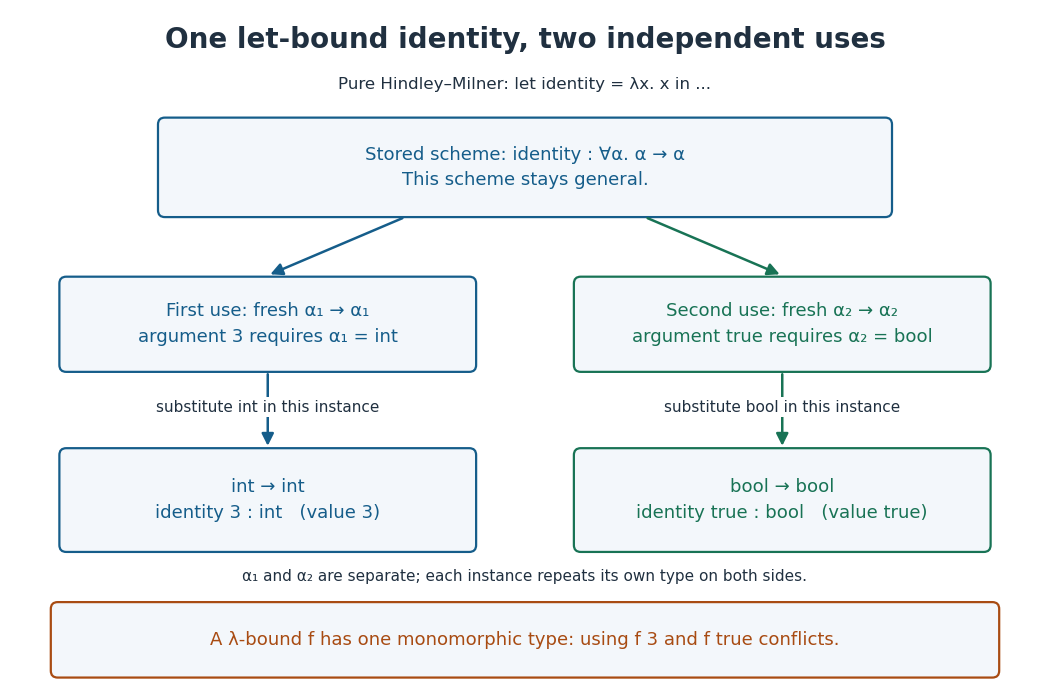
Independent type instantiations of a let-bound identity function
. The type scheme stays general while two uses receive different type substitutions. Each use preserves the equality of its own argument and result types. Details.For example,
let identity = λx.x in let a = identity 3 in identity true is valid and has type bool. By contrast, (λf. let a = f 3 in f true) (λx.x) is rejected by the Hindley-Milner type system: the lambda abstraction binds f to one monomorphic function type. The first call requires its argument type to be int, and the second requires that same type to be bool. Naming the first result with let a does not generalize f. The distinction makes reusable code possible while keeping the assumptions about a supplied argument consistent.// Target: computer-science.bigb
Type inference discovers types consistent with a program's structure and typing context. In our examples, it introduces fresh type variables, generates equations from typing judgments, and solves them by type unification. For , if initially has unknown type and the result has fresh type , lambda application requires .
For a specified programming language and execution model, type safety commonly follows from two properties: a closed expression satisfying a typing judgment is either a value or can take an execution step, and taking a step preserves its type. Proofs proceed by structural induction on derivations, using capture-avoiding substitution for function calls. Repeated preservation keeps the remaining expression typed; the first property then rules out getting stuck at an operation outside the model's permitted cases. This argument does not imply termination or correctness of an arbitrary specification. [ref]
https://softwarefoundations.cis.upenn.edu/plf-current/Types.html. Software Foundations, Programming Language Foundations, Type Systems: progress, preservation and type soundness
Pinned article: Introduction to the OurBigBook Project
Welcome to the OurBigBook Project! Our goal is to create the perfect publishing platform for STEM subjects, and get university-level students to write the best free STEM tutorials ever.
Everyone is welcome to create an account and play with the site: ourbigbook.com/go/register. We belive that students themselves can write amazing tutorials, but teachers are welcome too. You can write about anything you want, it doesn't have to be STEM or even educational. Silly test content is very welcome and you won't be penalized in any way. Just keep it legal!
Intro to OurBigBook
. Source. We have two killer features:
- topics: topics group articles by different users with the same title, e.g. here is the topic for the "Fundamental Theorem of Calculus" ourbigbook.com/go/topic/fundamental-theorem-of-calculusArticles of different users are sorted by upvote within each article page. This feature is a bit like:
- a Wikipedia where each user can have their own version of each article
- a Q&A website like Stack Overflow, where multiple people can give their views on a given topic, and the best ones are sorted by upvote. Except you don't need to wait for someone to ask first, and any topic goes, no matter how narrow or broad
This feature makes it possible for readers to find better explanations of any topic created by other writers. And it allows writers to create an explanation in a place that readers might actually find it.
Figure 1. Screenshot of the "Derivative" topic page. View it live at: ourbigbook.com/go/topic/derivativeVideo 2. OurBigBook Web topics demo. Source. - local editing: you can store all your personal knowledge base content locally in a plaintext markup format that can be edited locally and published either:This way you can be sure that even if OurBigBook.com were to go down one day (which we have no plans to do as it is quite cheap to host!), your content will still be perfectly readable as a static site.
- to OurBigBook.com to get awesome multi-user features like topics and likes
- as HTML files to a static website, which you can host yourself for free on many external providers like GitHub Pages, and remain in full control

Figure 2. You can publish local OurBigBook lightweight markup files to either OurBigBook.com or as a static website.
Figure 3. Visual Studio Code extension installation.
Figure 5. . You can also edit articles on the Web editor without installing anything locally. Video 3. Edit locally and publish demo. Source. This shows editing OurBigBook Markup and publishing it using the Visual Studio Code extension. 
- Infinitely deep tables of contents:




All our software is open source and hosted at: github.com/ourbigbook/ourbigbook
Further documentation can be found at: docs.ourbigbook.com
Feel free to reach our to us for any help or suggestions: docs.ourbigbook.com/#contact