Topics (384k) Articles (398k) Users (410) Discussions (242) Comments (383) Files (13k) New article
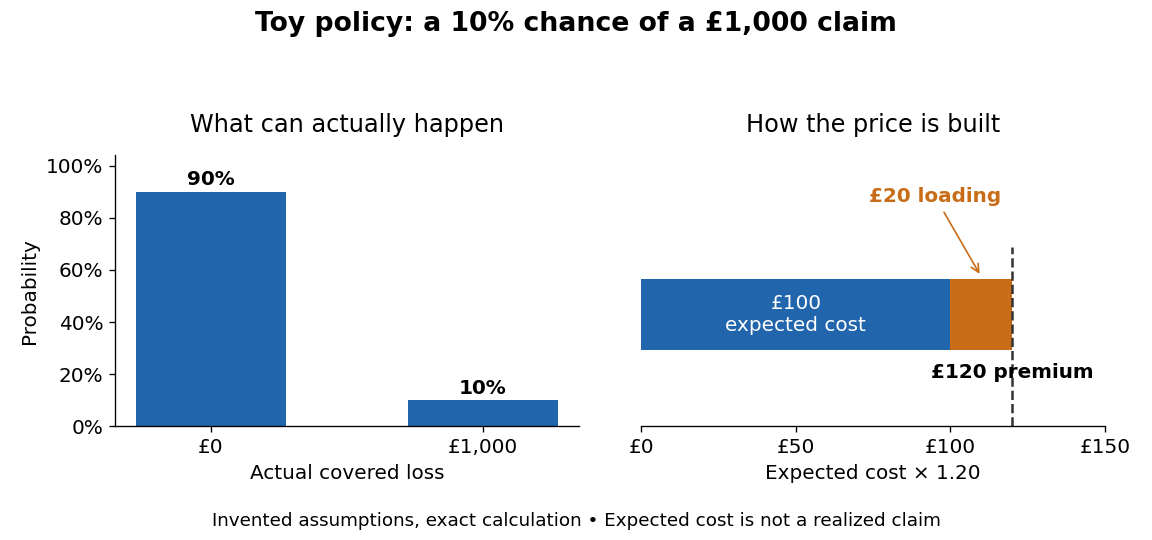
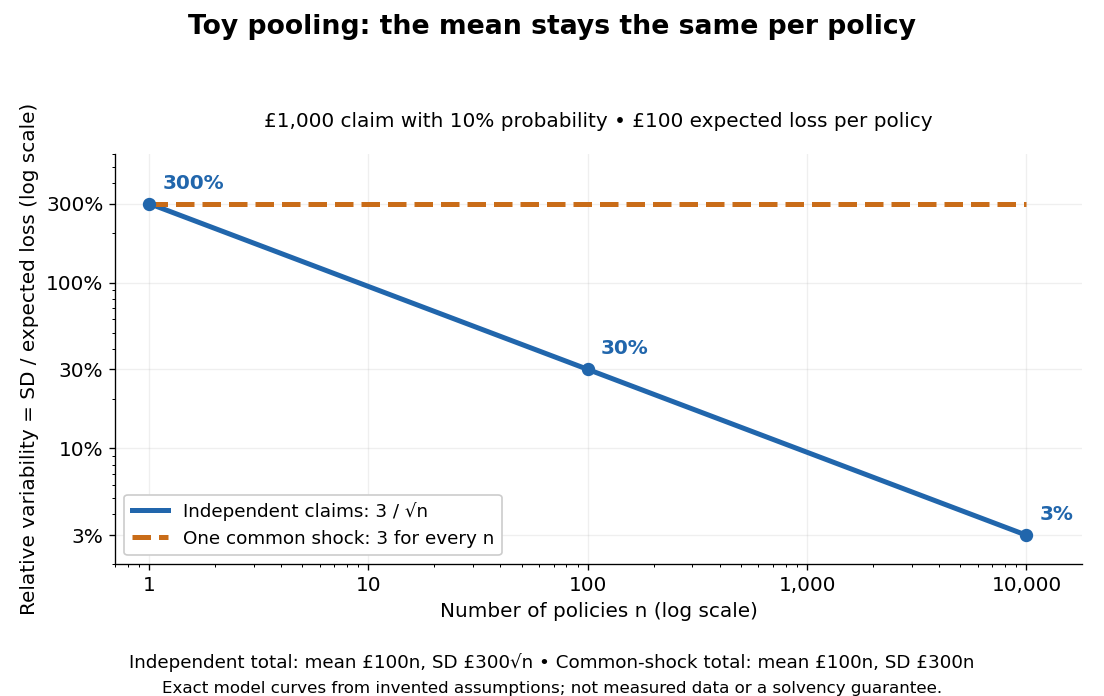
A policyholder's future insurance premiums depend on a finite discount level, updated according to whether a claim is submitted in each year. With independent yearly accidents and repair costs, and a claim decision depending only on the current level and cost, the level is a Discrete-time Markov chain. Accident probability and submitted-claim probability differ when the policyholder pays small repair costs without claiming.
The Arrhenius equation models the temperature dependence of a rate constant byHere is the pre-exponential factor, the activation energy, the molar gas constant, and the absolute thermodynamic temperature. In its original form, and are held constant over the range being modeled. It is an empirical relationship, not a universal rule for every reaction mechanism. See the Arrhenius equation.
Eliminating between two positive temperatures gives the useful predictionFor , warming increases . The logarithmic sensitivity is , so there is no universal doubling per ten degrees. The same rise from to gives a factor for , versus for .
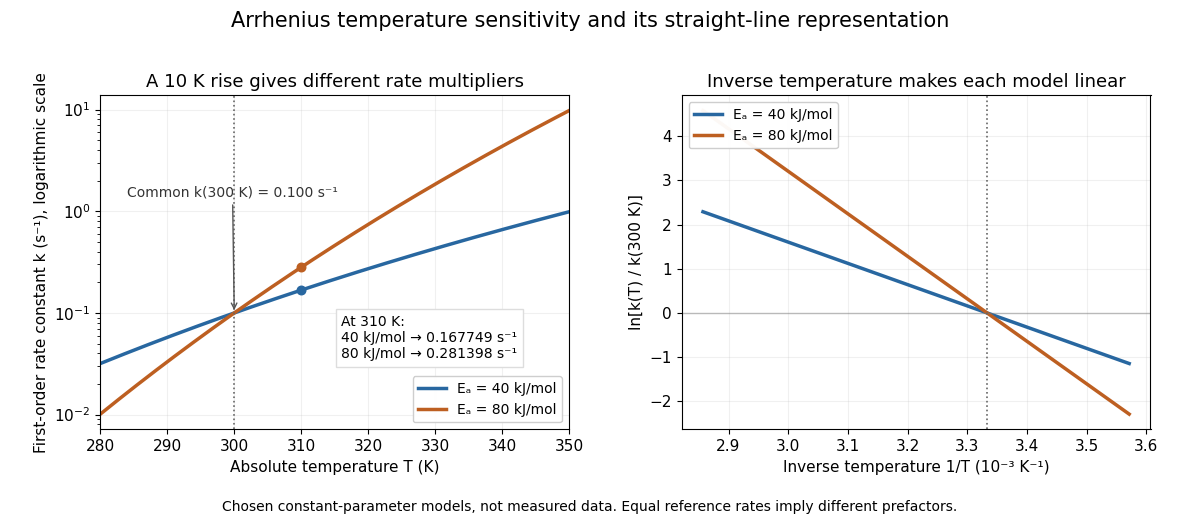
The useful simplification is that a strong change in reaction rate becomes a straight-line relation after changing variables. Measurements at several temperatures can estimate the slope and test whether one pair of constants describes the chosen range. Curvature can indicate a failure of that approximation; fitting a line does not uniquely establish a microscopic reaction mechanism.
Svante Arrhenius's 1889 paper on sucrose conversion through catalysis by a chemical acid compared the strong observed temperature dependence with the much smaller increase in collision frequency. He discussed van't Hoff's earlier temperature relations and proposed a small population of hypothetical active sucrose, replenished from ordinary sucrose, to interpret the dependence. The inspected translated excerpt derives an inverse-temperature relation in its equations (6)–(7) and then applies it to the reaction rate. That historical hypothesis is distinct from a modern transition state description. See the On the Reaction Velocity of the Inversion of Cane Sugar by Acids. The excerpt omits parts of the original paper; it does not provide a complete original apparatus description or dataset.
The pre-exponential factor must have the same units as the rate constant, since the exponential function supplies a dimensionless quantity. For a rate law , both and have units . Thus a first-order reaction uses , whereas a second-order reaction uses . Calling a frequency factor does not give it frequency units for every order of reaction. Its value includes the physical and geometrical factors allowed by the chosen reaction mechanism; equal activation energies need not mean equal reaction rates.
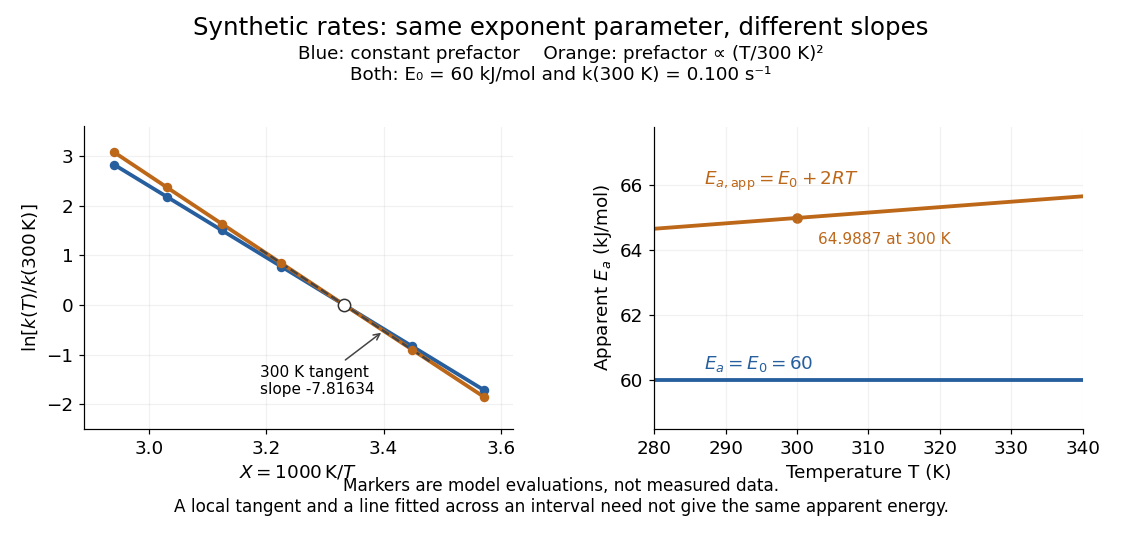
Synthetic Arrhenius plots: a constant pre-exponential factor and a temperature-dependent pre-exponential factor
. Both chosen first-order reaction models have and the same exponent parameter . Blue uses a constant pre-exponential factor; orange multiplies it by . All markers are synthetic evaluations, not observations. Left: natural logarithm of against . Right: the corresponding apparent activation energies, and in . The dashed orange tangent at has numerical slope on the displayed horizontal scale. Details.To read the blue Arrhenius plot, define the dimensionless quantity and . Its numerical slope is , giving . The slope against , by contrast, is . The orange tangent at gives ; its finite-interval slope between and gives about . The distinction between a local derivative and a fitted interval matters even with perfectly noise-free synthetic evaluations.
Two measured positive rate constants give a two-point estimateSeveral temperatures let linear regression test the constant-parameter approximation: inspect the regression residuals, keep the same rate law and composition convention, and account for uncertainty in both and . A straight line over a short range supports a useful local approximation; it does not uniquely identify a reaction mechanism. A fixed change of units or of shifts the intercept without changing the inferred activation energy.[ref]
12.5 Collision Theory. §12.5, Example 12.13 and alternate two-point approach: estimating activation energy from a slope
An apparent activation energy reports the temperature sensitivity of an observed rate constant, without assuming that it equals one microscopic reaction energy barrier. The chain rule converts the empirical activation energy definition into the local slope of an Arrhenius plot:The fixed reference keeps the natural logarithm dimensionless. A fitted straight-line slope estimates this quantity over the chosen temperature interval; curvature means that one number does not describe every local slope.[ref]
For the explicit model with constant exponent parameter , differentiation giveswhere is fixed. The second term demonstrates why a microscopic interpretation needs more than a slope. If were itself allowed to depend on temperature, differentiation would also contribute ; simply inserting a variable and naming it the measured activation energy is generally incorrect.
An instructive transition state theory example for an effective first-order reaction isHere and are the Boltzmann constant and Planck constant; is the entropy of activation, and the enthalpy of activation. With those two quantities constant over the chosen range and successful passage assumed, direct differentiation gives , while the Gibbs energy of activation is . These are three distinguishable quantities. The stated first-order reaction and fixed standard states matter when comparing these formulas with measurements.[ref]
A neuronal refractory period is the change in excitability following an action potential: recent firing changes whether, and how readily, a neuron can fire again. The absolute neuronal refractory period prevents a second regenerative action potential; during the relative neuronal refractory period, some stimuli that work after full recovery still fail. These are useful distinctions, but their durations are not universal constants. The preparation, temperature, starting membrane potential, stimulation protocol and criterion for detecting an action potential must accompany a measured interval.
The mechanism continues the opposing sodium and potassium electric currents described under action potential and the Hodgkin-Huxley model. After a spike, ion-channel inactivation leaves fewer sodium-selective voltage-gated ion channels available for regenerative depolarization, while persisting potassium electrical conductance opposes that depolarization. In the Hodgkin-Huxley model, recovery of restores sodium availability and relaxation of reduces potassium electrical conductance. Closed but available channels differ from inactivated channels: opening and recovery from ion-channel inactivation are different processes.[ref]
2.2 Hodgkin-Huxley Model. §2.2.1, Activation and De-inactivation; §2.2.3, Figure 2.6 and Ion channel dynamics during spike generation
This short memory matters for spike trains: a stimulus-only Poisson process can predict very short interspike intervals that a refractory neuron cannot produce. Neuronal paired-pulse recovery makes that memory visible. The phenomenological paired-pulse recovery example below separates a chosen recovery rule, pulse strength and event readout; refractory limits on neuronal firing then shows why an absolute bound is not a prediction of sustained firing rate.
A plane-parallel atmosphere with isothermal sound speed in gravity has mass density , . Above a rigid base, vertically directed adiabatic fluid perturbations satisfy and . Set and . The substitution converts finite Gaussian-weighted kinetic energy into square integrability for . Odd extension across the base and the oscillator lowering operator force to be an odd positive integer. Thus is proportional to the Probabilists' Hermite polynomial . These are vertical acoustic waves; a general stably stratified atmosphere also admits internal gravity waves with horizontal structure.
Burgers reduction of weakly nonlinear rightgoing acoustics by  Codex 0 Created 2026-10-13 Updated 2026-11-05
For a pure rightgoing acoustic wave, retarded time and slow distance separate fast oscillations from nonlinear steepening. Expanding the equation of state gives . The leading perturbations satisfy . Adding the first-order mass conservation and momentum conservation equations cancels the unknown first corrections and yields the displayed viscous Burgers equation. Inviscid characteristics satisfy , ; loss of invertibility marks shock formation and the end of the smooth inviscid approximation.
The pKa is the negative base-ten logarithm of the dimensionless acid dissociation constant. A lower pKa means a larger acid dissociation constant and a stronger tendency to donate a proton under the same standard state, solvent, and temperature conventions. The Henderson-Hasselbalch equation places equal weak acid and conjugate base thermodynamic activities at pH equal to pKa. See Flowers et al., Chemistry 2e, the Henderson-Hasselbalch equation.
Constant folding replaces a program expression whose value is known during translation by a literal value. For
x=2+3*4, first replace the multiplication subtree by Constant(value=12), then replace the addition subtree by Constant(value=14). The variable assignment and its Store target survive: the result still assigns to x. This illustrates why a bottom-up abstract syntax tree traversal is convenient: replacing one child can make its parent eligible for the next replacement.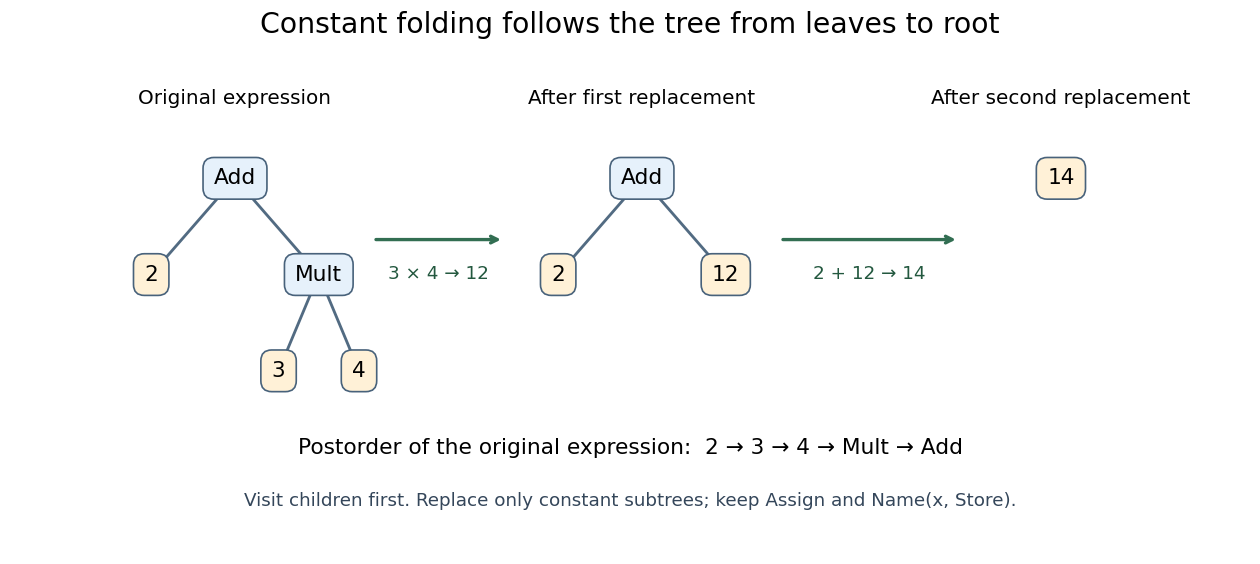
Here is a deliberately small Python transformer. Calling
generic_visit first transforms the children; returning a node replaces the visited node. The location helpers retain or supply the metadata expected for compilation. [ref]ast — Abstract syntax trees, Python 3.14 documentation. NodeTransformer, generic_visit, copy_location and fix_missing_locations
class FoldIntegers(ast.NodeTransformer):
    def visit_BinOp(self, node):
        self.generic_visit(node)
        if (isinstance(node.left, ast.Constant)
                and isinstance(node.right, ast.Constant)
                and type(node.left.value) is int
                and type(node.right.value) is int
                and type(node.op) in OPS):
            value = OPS[type(node.op)](node.left.value, node.right.value)
            return ast.copy_location(ast.Constant(value=value), node)
        return node

tree = ast.parse("x=2+3*4", optimize=0)
folded = ast.fix_missing_locations(FoldIntegers().visit(tree))
namespace = {}
exec(compile(folded, "<folded example>", "exec"), namespace)
assert namespace["x"] == 14
assert ast.unparse(folded) == "x = 14"
This transformer folds literal integer operands only. It leaves
a+3*4 as a+12, without inventing a value for the program identifier a. It leaves calls intact: replacing 0*f() by 0 could discard a side effect or a failure. Nor does it reassociate floating-point arithmetic, where changing parentheses can change rounding. For the supported integer arithmetic, a short structural induction explains correctness: a retained literal value has the same value; at each folded binary node, the already-correct child values are combined by exactly the original operation in the original left/right order. This claim concerns the supported fragment's values, not unrestricted equivalence of arbitrary Python programs.The University of Iowa's Electron Spin Resonance, University of Iowa laboratory protocol (revised July 2007, Experiment and Resonance Data Analysis, printed pp. 2–6) specifies DPPH on cotton in a tube inside an RF coil, between Helmholtz coils. A bridge monitors RF absorption; an oscilloscope records this output and the voltage across a current-monitor resistor. Sweeping the coil current passes through the resonant magnetic field. The protocol describes two dips when the sweep revisits resonance; these are repeated crossings, not two distinct spectral lines.
Its calibration replaces the sample with a Hall effect probe, maps the magnetic field in steps, and accounts for sample dimensions. At least four RF frequencies test the resonance relation. Sweep speed is adjusted to obtain comparable passages. Only a local peak-plus-background fit is prescribed, because the full shape is not Gaussian. The protocol also flags unexplained trailing spikes and possible electronics contributions. These controls constrain field and sweep errors; an empty-tube/cotton blank would be an additional background control, not a reported measurement in this protocol.[ref]
For an isolated effective spin one-half with dimensionless positive factor , the basic resonance model isHere is the Bohr magneton, is the Planck constant, is the applied frequency, and is the calibrated resonant magnetic field. A change in frequency should shift the resonance field proportionally in this model. The factor describes the electronic magnetic moment coupling, not the species' net electric charge.
A resonance supports the presence of detectable paramagnetism. It does not, by itself, identify an unknown radical: other species exhibiting paramagnetism, impurities, overlapping responses, and interactions with atomic nuclei can complicate interpretation. Conversely, absence of a detectable resonance need not mean absence of free radicals; a low concentration, a short lifetime, or an unsuitable measurement range can conceal them. The occupancy and chain diagrams are original bookkeeping illustrations; neither is a measured or simulated DPPH spectrum.
Pinned article: Introduction to the OurBigBook Project
Welcome to the OurBigBook Project! Our goal is to create the perfect publishing platform for STEM subjects, and get university-level students to write the best free STEM tutorials ever.
Everyone is welcome to create an account and play with the site: ourbigbook.com/go/register. We belive that students themselves can write amazing tutorials, but teachers are welcome too. You can write about anything you want, it doesn't have to be STEM or even educational. Silly test content is very welcome and you won't be penalized in any way. Just keep it legal!
Intro to OurBigBook
. Source. We have two killer features:
- topics: topics group articles by different users with the same title, e.g. here is the topic for the "Fundamental Theorem of Calculus" ourbigbook.com/go/topic/fundamental-theorem-of-calculusArticles of different users are sorted by upvote within each article page. This feature is a bit like:
- a Wikipedia where each user can have their own version of each article
- a Q&A website like Stack Overflow, where multiple people can give their views on a given topic, and the best ones are sorted by upvote. Except you don't need to wait for someone to ask first, and any topic goes, no matter how narrow or broad
This feature makes it possible for readers to find better explanations of any topic created by other writers. And it allows writers to create an explanation in a place that readers might actually find it.
Figure 1. Screenshot of the "Derivative" topic page. View it live at: ourbigbook.com/go/topic/derivativeVideo 2. OurBigBook Web topics demo. Source. - local editing: you can store all your personal knowledge base content locally in a plaintext markup format that can be edited locally and published either:This way you can be sure that even if OurBigBook.com were to go down one day (which we have no plans to do as it is quite cheap to host!), your content will still be perfectly readable as a static site.
- to OurBigBook.com to get awesome multi-user features like topics and likes
- as HTML files to a static website, which you can host yourself for free on many external providers like GitHub Pages, and remain in full control

Figure 2. You can publish local OurBigBook lightweight markup files to either OurBigBook.com or as a static website.
Figure 3. Visual Studio Code extension installation.
Figure 5. . You can also edit articles on the Web editor without installing anything locally. Video 3. Edit locally and publish demo. Source. This shows editing OurBigBook Markup and publishing it using the Visual Studio Code extension. 
- Infinitely deep tables of contents:




All our software is open source and hosted at: github.com/ourbigbook/ourbigbook
Further documentation can be found at: docs.ourbigbook.com
Feel free to reach our to us for any help or suggestions: docs.ourbigbook.com/#contact