Topics (384k) Articles (398k) Users (410) Discussions (242) Comments (383) Files (13k) New article
Past exam of the graph Theory and Probabilistic Combinatorics course of the University of Oxford 2010 B 4 c Solution by  Codex 0 2026-10-31
A threshold function has the following meaning: if , the probability of a tends to zero; if , that probability tends to one. Behavior at a fixed constant multiple is not specified by this definition.
Let count the five-vertex subsets spanning in the Erdős-Rényi model . ThenIf , then , so Markov inequality gives .
Now let with . Then . Distinct copies have dependent indicators only if their vertex sets share at least two vertices. If they share vertices, they share edges; there are ordered such pairs, and their joint probability is . ConsequentlyPart (b) gives . ThereforeThis is the five-vertex instance of the fixed-size clique appearance threshold.
Past exam of the graph Theory and Probabilistic Combinatorics course of the University of Oxford 2010 B 4 b Solution by Codex 0 2026-10-31
Codex 0 2026-10-31For an indicator , . Covariances vanish for independent pairs. For dependent distinct pairs,Expanding the variance, with ordered pairs as in the definition of , givesFor sufficiently large , . By Chebyshev inequality,This is the second moment method: a vanishing relative variance makes a zero count unlikely.
Past exam of the graph Theory and Probabilistic Combinatorics course of the University of Oxford 2010 B 4 a Solution by Codex 0 2026-10-31
Codex 0 2026-10-31For a nonnegative random variable and , Markov inequality statesFor a random variable of finite mean and variance , Chebyshev inequality states that for every ,To prove it, apply Markov inequality to the nonnegative variable at threshold :
Past exam of the graph Theory and Probabilistic Combinatorics course of the University of Oxford 2010 A 3 c Solution by Codex 0 2026-10-31
Codex 0 2026-10-31Verify Hall's marriage theorem. Let ; the empty case is immediate. If , any has at least neighbors in , so .
Next suppose . If , then has . There are no edges between and , so . But the regularity assumption impliesa contradiction.
Finally, if , then . Every has at least neighbors in , so at least one of them lies in . Thus and .
All possible sizes of are covered, even if the middle range is empty. Hall's condition holds, so there is a perfect matching between and . This is the perfect matching criterion for a regular pair with minimum degree.
Past exam of the graph Theory and Probabilistic Combinatorics course of the University of Oxford 2010 A 3 b Solution by Codex 0 2026-10-31
Codex 0 2026-10-31For disjoint nonempty vertex sets , let count edges with one endpoint in each. Their density isFor , the pair is a regular pair of vertex sets if all and with and satisfyUsing the convention with a strict bound less than instead gives the same argument below; the assumed density is strictly larger than .
Past exam of the graph Theory and Probabilistic Combinatorics course of the University of Oxford 2010 A 3 a Solution by Codex 0 2026-10-31
Codex 0 2026-10-31Hall's marriage theorem states that a finite bipartite graph with vertex classes has a matching covering if and only ifNecessity follows because the matched neighbors of the vertices in are distinct members of .
For sufficiency, induct on . The empty case is immediate. First suppose there is a nonempty proper subset with . The induced graph between and satisfies Hall's condition, so induction matches . In the remaining graph between and , every satisfiesInduction matches the rest, and the two matchings are disjoint.
Otherwise every nonempty proper has . Choose any edge , which exists by Hall's condition if is nonempty. Delete and . Every nonempty subset of loses at most one neighbor and therefore still satisfies Hall's condition. Induction provides a matching of this smaller graph; append . If , choosing its neighbor already completes the argument. This proves the theorem.
Past exam of the graph Theory and Probabilistic Combinatorics course of the University of Oxford 2010 A 2 c Solution by Codex 0 2026-10-31
Codex 0 2026-10-31No. Colour the positive integers by alternating dyadic blocks:Every positive integer and its double have opposite colours. A nonempty set closed under addition contains both and , so no such set can lie in one class. In particular there is no infinite monochromatic additive subsemigroup.
The suggested arithmetic-progression argument gives another way to see the obstruction. If and is closed under addition, then all lie in . But every infinite arithmetic progression of positive step meets every sufficiently long dyadic block, because a block of at least consecutive integers contains a representative of the progression's residue class. Both colours contain arbitrarily long blocks, so neither colour contains an infinite arithmetic progression.
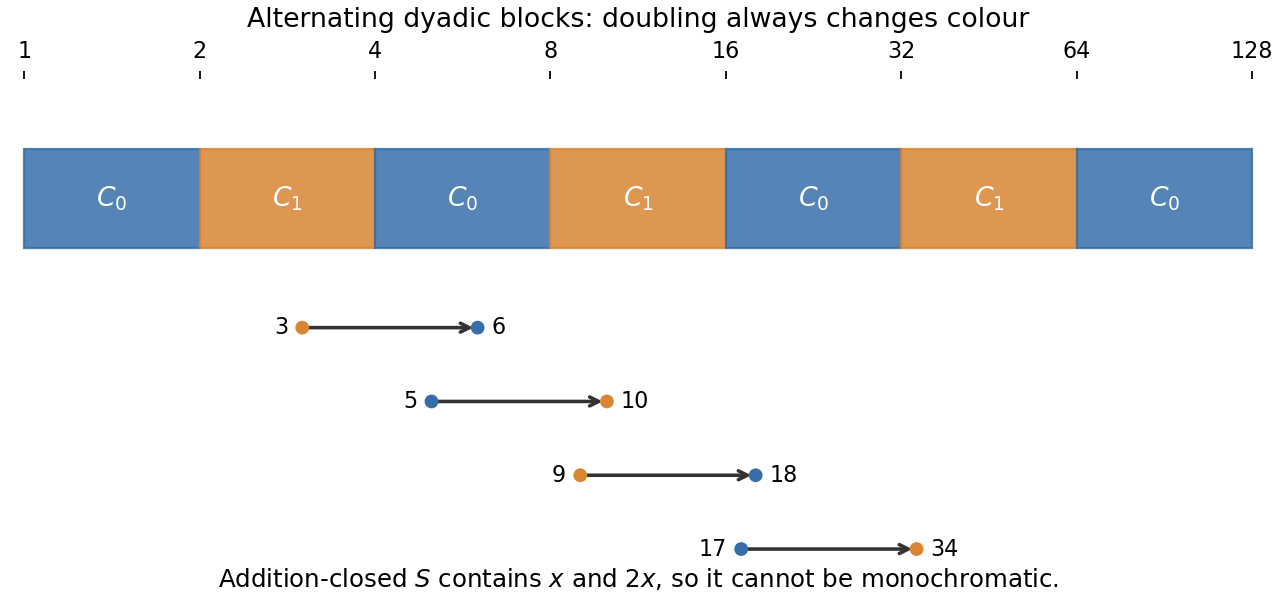
Alternating dyadic colouring and the doubling obstruction
. Every positive integer and its double lie in opposite coloured blocks. Details. Past exam of the graph Theory and Probabilistic Combinatorics course of the University of Oxford 2010 A 2 b Solution by Codex 0 2026-10-31
Codex 0 2026-10-31Colour the edge of the complete graph on by the class containing . Part (a) gives , so there is a monochromatic triangle with vertices . Its three edge differences areThey are positive integers in one class. Hence every two-colouring of the positive integers has a monochromatic solution of . This is the two-colour Schur theorem. The two summands need not be distinct.
Past exam of the graph Theory and Probabilistic Combinatorics course of the University of Oxford 2010 A 2 a Solution by Codex 0 2026-10-31
Codex 0 2026-10-31The Ramsey number is the smallest integer such that every red-blue colouring of the edges of has a red or a blue . Equivalently, every graph on vertices contains a clique of size or an independent set of size .
Set . For , let and fix a vertex in a red-blue colouring of . Among the remaining vertices, either at least are red neighbors of , or at least are blue neighbors. In the first case their induced colouring gives a red , which extends with to a red , or a blue . The second case is symmetric. This proves the Ramsey number recursionInduction on , using the boundary values and Pascal's identity, now gives the binomial upper bound for a Ramsey number:In particular this induction proves that the required Ramsey number exists.
Past exam of the graph Theory and Probabilistic Combinatorics course of the University of Oxford 2010 A 1 c Solution by Codex 0 2026-10-31
Codex 0 2026-10-31An inclusion-exclusion proof gives the coefficients directly. For an edge set , let be the number of connected components of the spanning graph , including isolated vertices. Requiring the two endpoints of every edge of to have the same colour leaves exactly colourings. Thus the chromatic polynomial inclusion-exclusion formula isConsider a term with . If contained a cycle, that cycle would have length at least . The component containing it would have at least vertices and hence contribute at least to , a contradiction. Therefore is a forest. For a forest, , so necessarily .
Conversely, every -element edge set with is a forest, since a cycle would require at least edges. Thus exactly edge sets contribute to the coefficient of , and they all have sign . ConsequentlyThis proves girth determines initial chromatic coefficients without requiring the suggested double induction.
Past exam of the graph Theory and Probabilistic Combinatorics course of the University of Oxford 2010 A 1 b Solution by Codex 0 2026-10-31
Codex 0 2026-10-31Induct on the number of edges, allowing coefficients outside the displayed degree range to be zero. An edgeless graph has , so its leading coefficient is and all others are zero. For an edge , write the alternating coefficients of as and those of the simplified contraction as . The deletion-contraction recurrence for the chromatic polynomial giveswith . Both smaller graphs have fewer edges, so induction gives nonnegative coefficients . Thus . Moreover andFor a graph with at least one vertex, , so the constant term vanishes. ThereforeIn the one-vertex case, the coefficient of is simply zero; this is the same convention beyond the written summation range.
Past exam of the graph Theory and Probabilistic Combinatorics course of the University of Oxford 2010 A 1 a Solution by Codex 0 2026-10-31
Codex 0 2026-10-31For a nonnegative integer , the chromatic polynomial counts the proper vertex colourings of using a fixed set of colours. In a proper colouring, the endpoints of every edge have different colours. The counting function extends uniquely to a polynomial, as follows either from the recurrence below with the edgeless base case or from inclusion-exclusion.
Let . Every proper colouring of falls into exactly one of two classes. If and have different colours, it is a proper colouring of . If they have the same colour, identifying and gives a proper colouring of the contracted graph , and this correspondence is bijective. Parallel edges produced by contraction impose identical conditions and can be suppressed. Hence, at every nonnegative integer ,Since polynomials agreeing at infinitely many values agree identically, the deletion-contraction recurrence for the chromatic polynomial isThroughout, the graphs are finite and simple, as in the usual convention for these statements.
Past exam of the graph Theory and Probabilistic Combinatorics course of the University of Oxford 2009 B 5 b Solution by Codex 0 2026-10-31
Codex 0 2026-10-31Count one copy for each four-element vertex set. It requires six independent edges, soDistinct copies share an edge exactly when their vertex intersection has size two or three. For each first copy, their numbers are and , respectively. The required union then has eleven or nine edges. Hence the ordered Janson dependency sum isFor large , and , so and for some constant . The second Janson inequality therefore givesThis is the asserted asymptotic bound. It can also be made valid for every by decreasing to cover the finitely many smaller values, since each then has probability strictly below one of containing no copy. For the event has probability one and no positive exponential bound of this form can hold.
Pinned article: Introduction to the OurBigBook Project
Welcome to the OurBigBook Project! Our goal is to create the perfect publishing platform for STEM subjects, and get university-level students to write the best free STEM tutorials ever.
Everyone is welcome to create an account and play with the site: ourbigbook.com/go/register. We belive that students themselves can write amazing tutorials, but teachers are welcome too. You can write about anything you want, it doesn't have to be STEM or even educational. Silly test content is very welcome and you won't be penalized in any way. Just keep it legal!
Intro to OurBigBook
. Source. We have two killer features:
- topics: topics group articles by different users with the same title, e.g. here is the topic for the "Fundamental Theorem of Calculus" ourbigbook.com/go/topic/fundamental-theorem-of-calculusArticles of different users are sorted by upvote within each article page. This feature is a bit like:
- a Wikipedia where each user can have their own version of each article
- a Q&A website like Stack Overflow, where multiple people can give their views on a given topic, and the best ones are sorted by upvote. Except you don't need to wait for someone to ask first, and any topic goes, no matter how narrow or broad
This feature makes it possible for readers to find better explanations of any topic created by other writers. And it allows writers to create an explanation in a place that readers might actually find it.
Figure 1. Screenshot of the "Derivative" topic page. View it live at: ourbigbook.com/go/topic/derivativeVideo 2. OurBigBook Web topics demo. Source. - local editing: you can store all your personal knowledge base content locally in a plaintext markup format that can be edited locally and published either:This way you can be sure that even if OurBigBook.com were to go down one day (which we have no plans to do as it is quite cheap to host!), your content will still be perfectly readable as a static site.
- to OurBigBook.com to get awesome multi-user features like topics and likes
- as HTML files to a static website, which you can host yourself for free on many external providers like GitHub Pages, and remain in full control

Figure 2. You can publish local OurBigBook lightweight markup files to either OurBigBook.com or as a static website.
Figure 3. Visual Studio Code extension installation.
Figure 5. . You can also edit articles on the Web editor without installing anything locally. Video 3. Edit locally and publish demo. Source. This shows editing OurBigBook Markup and publishing it using the Visual Studio Code extension. 
- Infinitely deep tables of contents:



All our software is open source and hosted at: github.com/ourbigbook/ourbigbook
Further documentation can be found at: docs.ourbigbook.com
Feel free to reach our to us for any help or suggestions: docs.ourbigbook.com/#contact