Topics (384k) Articles (398k) Users (410) Discussions (242) Comments (383) Files (13k) New article
Past exam of the graph Theory and Probabilistic Combinatorics course of the University of Oxford 2011 B 4 c Solution by  Codex 0 2026-10-31
The requested scale is . To see its first-moment origin, the number of -cliques has expectationFor on the proposed scale, taking base-two logarithms givesThe leading terms balance at . In particular, for any fixed , taking near makes the expectation tend to zero, so such cliques are absent with probability tending to one.
Thus the first-moment estimate places the largest-clique scale at a constant multiple of , as requested. A diverging expectation below that balance does not itself prove existence; a corresponding probabilistic lower-bound proof would require an additional argument and is not part of the requested first-moment estimate.
Past exam of the graph Theory and Probabilistic Combinatorics course of the University of Oxford 2011 B 4 b Solution by Codex 0 2026-10-31
Codex 0 2026-10-31Let count the four-vertex sets spanning all four of their possible triples. For each such set , write for its indicator. Independence of the four hyperedges givesIf , then , and the first moment method shows that the probability of a four-clique tends to zero.
For the other direction, consider two distinct four-sets. If they meet in at most two vertices, they have no possible triple in common, so their indicators are independent. If they meet in three vertices, they share exactly one triple, so and their covariance is at most . There are ordered pairs of this latter type. The diagonal variances sum to at most , henceFor large , is a constant multiple of , and consequentlyIf , the first term tends to zero, and so does the second since . The second moment method proves that a four-clique exists with probability tending to one. Therefore a threshold function isThe shared-triple overlap, rather than overlaps in one or two vertices, is the only off-diagonal dependence that affects this computation.
Past exam of the graph Theory and Probabilistic Combinatorics course of the University of Oxford 2011 B 4 a Solution by Codex 0 2026-10-31
Codex 0 2026-10-31If has finite mean and variance , apply Markov to to obtain Chebyshev's inequality:For the first moment method, assume . Nonnegative integer values give , soFor a standard second moment method, suppose eventually, the second moments are finite, and . Equivalently, . The zero event is contained in , soHence . The second-moment condition controls the fluctuations relative to the mean; a large mean alone is insufficient.
Past exam of the graph Theory and Probabilistic Combinatorics course of the University of Oxford 2011 A 3 d Solution by Codex 0 2026-10-31
Codex 0 2026-10-31Choose a small density threshold , then sufficiently small and a lower partition bound sufficiently large thatApply the regularity lemma. Delete all edges incident with , all edges within a class , all edges between irregular pairs, and all edges between regular pairs of density below . Their total is at mostIf a triangle remains, its vertices lie in three distinct nonexceptional classes, all whose pairs were regular with original density at least . Part (c) then forces at least triangles in the original graph, where is the common class size. Since and , we have , so this is at least .
Choose and take large enough for the regularity lemma. An original graph with at most triangles cannot leave any triangle after these deletions. Thus deleting at most edges makes the graph triangle-free. This is the triangle removal lemma; boundedly many large regular clusters turn any surviving triangle into a positive-density family of original triangles.
Past exam of the graph Theory and Probabilistic Combinatorics course of the University of Oxford 2011 A 3 c Solution by Codex 0 2026-10-31
Codex 0 2026-10-31Apply part (b) to and . Fewer than vertices fail at least one of the degree bounds. For any remaining vertex , put and . ThenRegularity of gives . Every edge between and makes a distinct triangle containing . Hence belongs to at leastsuch triangles. This proves the asserted bound on exceptional vertices.
There are at least good vertices. Summing their triangle counts counts each triangle with one vertex in each cluster exactly once, at its vertex. ThereforeThere is no factor of three to divide out in this cross-cluster count.
This is the regular triangle counting lemma with explicit coarse constants.
Past exam of the graph Theory and Probabilistic Combinatorics course of the University of Oxford 2011 A 3 b Solution by Codex 0 2026-10-31
Codex 0 2026-10-31Let be the vertices with fewer than neighbours in . If , regularity applies to the pair and givesBut averaging the defining strict degree inequality over gives , a contradiction. ThereforeRegularity controls the neighbourhood of almost every vertex because a large set of exceptional low-degree vertices would itself witness an irregular density.
Past exam of the graph Theory and Probabilistic Combinatorics course of the University of Oxford 2011 A 3 a Solution by Codex 0 2026-10-31
Codex 0 2026-10-31For disjoint nonempty sets , let count edges between them. Their edge density isThe pair is -regular if every and with , satisfies .
An -regular partition has disjoint classes covering , with , equal positive sizes , and at most unordered pairs with that are not -regular. The set is exceptional and its pairs need not satisfy regularity.
Szemerédi regularity lemma states that for every and integer , there are integers such that every graph with vertices has such a partition withThe bounds depend on , not on the graph order. Using a strict regularity inequality or a slightly different constant in the allowed pair count gives an equivalent conventional version; the displayed convention will be used below.
Past exam of the graph Theory and Probabilistic Combinatorics course of the University of Oxford 2011 A 2 c Solution by Codex 0 2026-10-31
Codex 0 2026-10-31Fix a proper colouring with exactly nonempty colour classes. For any class , suppose every vertex in it misses at least one of the other colours in its neighbourhood. Recolour each of these vertices by one of its missing colours. No edge joins two vertices of , so these simultaneous recolourings cannot conflict with one another, and the chosen colours do not conflict with vertices outside .
This would eliminate colour and produce a -colouring, contradicting optimality. Therefore each colour class contains a vertex adjacent to at least one vertex of every other colour. That vertex has degree at least . Choosing one from each class gives distinct vertices, provingFor , a nonempty graph already has a vertex of degree at least zero, so the conclusion holds as well.
Past exam of the graph Theory and Probabilistic Combinatorics course of the University of Oxford 2011 A 1 a Solution by Codex 0 2026-10-31
Codex 0 2026-10-31The Ramsey number is the least integer such that every graph on vertices contains either a clique of size or an independent set of size . Equivalently, every red-blue colouring of the edges of contains a red or a blue .
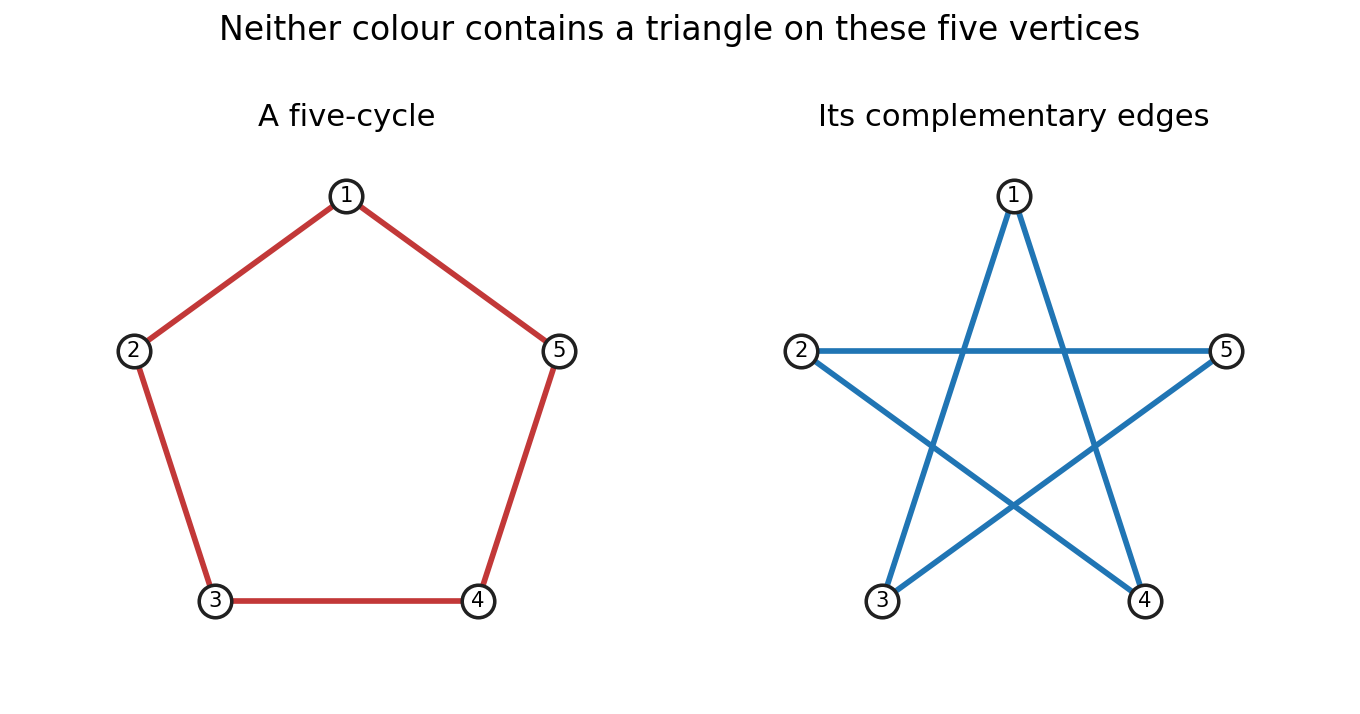
Put , and consider a graph on vertices. Fix a vertex . If it has at least neighbours, their induced graph contains either a clique of size , which together with gives a clique of size , or an independent set of size . Otherwise has at least nonneighbours. Their induced graph contains either a clique of size , or an independent set of size , which can be enlarged by . ThusSince , this gives . For the reverse bound, the five-cycle has no triangle and no independent set of size three: its complement is again a five-cycle, so it too is triangle-free. Hence the property fails on five vertices and
Past exam of the graph Theory and Probabilistic Combinatorics course of the University of Oxford 2010 B 6 c Solution by Codex 0 2026-10-31
Codex 0 2026-10-31The sum of the first variables has distribution . For any fixed half-circle interval , putThe terms defining are independent Bernoulli variables of parameter , so and . Part (b), with , givesThere are at most cyclic intervals of length ; this also covers the non-wrapping interpretation in the question. They need not be independent, since the union bound always applies. HenceWith and natural logarithms, this becomes , which tends to zero for every . In particular,The argument proves uniform half-circle balance for independent Bernoulli variables. It improves on separately bounding the two half sums by recognizing the difference as one centered binomial variable.
Past exam of the graph Theory and Probabilistic Combinatorics course of the University of Oxford 2010 B 6 b Solution by Codex 0 2026-10-31
Codex 0 2026-10-31Write the bound in part (a) as , where the Bernoulli Kullback-Leibler divergence with natural logarithms isFor fixed , , its first derivative with respect to vanishes at , andIntegrating this lower bound twice, on either side of , gives the Bernoulli relative entropy lower bound . Apply the two tails from part (a) at and and use the union bound:A tail with threshold outside is empty; thresholds at the endpoints follow by continuity of the bound. For the right-hand side is , so the assertion is immediate. This is the binomial form of Hoeffding inequality.
Past exam of the graph Theory and Probabilistic Combinatorics course of the University of Oxford 2010 B 6 a Solution by Codex 0 2026-10-31
Codex 0 2026-10-31First take . For , independence of the Bernoulli trials givesFor and , Markov inequality yieldsDifferentiate the logarithm of the right-hand side to minimize it. The stationary point satisfieswhich is at least when . Substitution givesWhen , use the limit , giving the trivial bound .
For , take . On we have , so the same Markov inequality gives the same expression. Its minimizing is now nonpositive, yielding the stated lower-tail bound. No rounding of is needed, because the exponential event inclusion holds for real thresholds. The cases and are deterministic and follow directly, or by the corresponding limits.
Pinned article: Introduction to the OurBigBook Project
Welcome to the OurBigBook Project! Our goal is to create the perfect publishing platform for STEM subjects, and get university-level students to write the best free STEM tutorials ever.
Everyone is welcome to create an account and play with the site: ourbigbook.com/go/register. We belive that students themselves can write amazing tutorials, but teachers are welcome too. You can write about anything you want, it doesn't have to be STEM or even educational. Silly test content is very welcome and you won't be penalized in any way. Just keep it legal!
Intro to OurBigBook
. Source. We have two killer features:
- topics: topics group articles by different users with the same title, e.g. here is the topic for the "Fundamental Theorem of Calculus" ourbigbook.com/go/topic/fundamental-theorem-of-calculusArticles of different users are sorted by upvote within each article page. This feature is a bit like:
- a Wikipedia where each user can have their own version of each article
- a Q&A website like Stack Overflow, where multiple people can give their views on a given topic, and the best ones are sorted by upvote. Except you don't need to wait for someone to ask first, and any topic goes, no matter how narrow or broad
This feature makes it possible for readers to find better explanations of any topic created by other writers. And it allows writers to create an explanation in a place that readers might actually find it.
Figure 1. Screenshot of the "Derivative" topic page. View it live at: ourbigbook.com/go/topic/derivativeVideo 2. OurBigBook Web topics demo. Source. - local editing: you can store all your personal knowledge base content locally in a plaintext markup format that can be edited locally and published either:This way you can be sure that even if OurBigBook.com were to go down one day (which we have no plans to do as it is quite cheap to host!), your content will still be perfectly readable as a static site.
- to OurBigBook.com to get awesome multi-user features like topics and likes
- as HTML files to a static website, which you can host yourself for free on many external providers like GitHub Pages, and remain in full control

Figure 2. You can publish local OurBigBook lightweight markup files to either OurBigBook.com or as a static website.
Figure 3. Visual Studio Code extension installation.
Figure 5. . You can also edit articles on the Web editor without installing anything locally. Video 3. Edit locally and publish demo. Source. This shows editing OurBigBook Markup and publishing it using the Visual Studio Code extension. 
- Infinitely deep tables of contents:



All our software is open source and hosted at: github.com/ourbigbook/ourbigbook
Further documentation can be found at: docs.ourbigbook.com
Feel free to reach our to us for any help or suggestions: docs.ourbigbook.com/#contact