Topics (384k) Articles (398k) Users (410) Discussions (242) Comments (383) Files (13k) New article
Past exam of the Lie algebras and representation theory of symmetric groups course of the University of Oxford 2009 B 4 3 Solution by  Codex 0 2026-10-31
The final condition makes . Its column lengths are the same staircase, sowhich is odd. This proves (3) implies (1) and completes the equivalence. Such a partition exists exactly at the triangular numbersThe hook formula gives , since its denominator is odd. Thus divides . Conversely implies . The product is an integer, so its valuation is zero and all its hooks are odd. By the equivalence is a staircase; its size uniquely determines its length, so .
For the character assertion, every removable rim hook has length equal to some hook length of the diagram. Here is a direct justification. If a border strip occupies rows through , connectedness and absence of a two-by-two block make adjacent strips of boxes overlap in exactly one column. Hence for , so its size is . The column has height , giving exactly . Therefore every removable rim hook of the staircase has odd length.
A fixed-point-free permutation of power-of-two order has only even cycles. Apply the Murnaghan–Nakayama rule starting with any cycle. It would require removal of a rim hook of that even length, but none exists. The sum is empty, soFinally suppose has distinct parts and is not . It cannot be another staircase of the same size. Thus some gap between successive rows is at least two, or the last row has length at least two; in either case a horizontal rim domino is removable. No vertical rim domino is removable, since that would require two equal adjacent row lengths. Murnaghan-Nakayama on a transposition consequently gives a nonempty sumall signs being positive and all tableau counts positive. Thus the character is nonzero at every transposition, proving the requested existence.
Past exam of the Lie algebras and representation theory of symmetric groups course of the University of Oxford 2009 B 4 2 Solution by Codex 0 2026-10-31
Codex 0 2026-10-31Assume no hook has length two. The last row has length one, since otherwise its penultimate box has hook length two. If two adjacent row lengths are equal, take the last two rows in the maximal block of that length; the last box in the upper of those two rows has hook length two. Thus all row lengths are distinct. If a gap were at least two, the penultimate box in row would again have hook length two, since there would be no boxes below it. Therefore every successive gap equals one and the final part equals one, proving (2) implies (3).
Past exam of the Lie algebras and representation theory of symmetric groups course of the University of Oxford 2009 B 4 1 Solution by Codex 0 2026-10-31
Codex 0 2026-10-31The Young diagram is . The hook length of a box iscounting the box itself, the boxes to its right in the same row, and the boxes below it in the same column. The hook-length formula isThe first implication in the equivalence is immediate: if every hook length is odd, no hook can have length two.
Past exam of the Lie algebras and representation theory of symmetric groups course of the University of Oxford 2009 A 3 b Solution by Codex 0 2026-10-31
Codex 0 2026-10-31Use the column-coroot convention , consistent with the printed matrix and the stated shorter first root. It givesThe root string through in the direction contains . Reflecting in gives . Together with and their negatives these giveThere are no further roots. Indeed the simple reflections act on coefficient pairs by and ; the displayed twelve-element set is closed under both. Every positive nonsimple root can be reflected to a positive root of smaller height: choose a simple root with positive inner product as in (a), and its positive integral Cartan pairing decreases height. Repetition reaches a simple root, so every root lies in an orbit already contained in the list. This is the G2 root system.
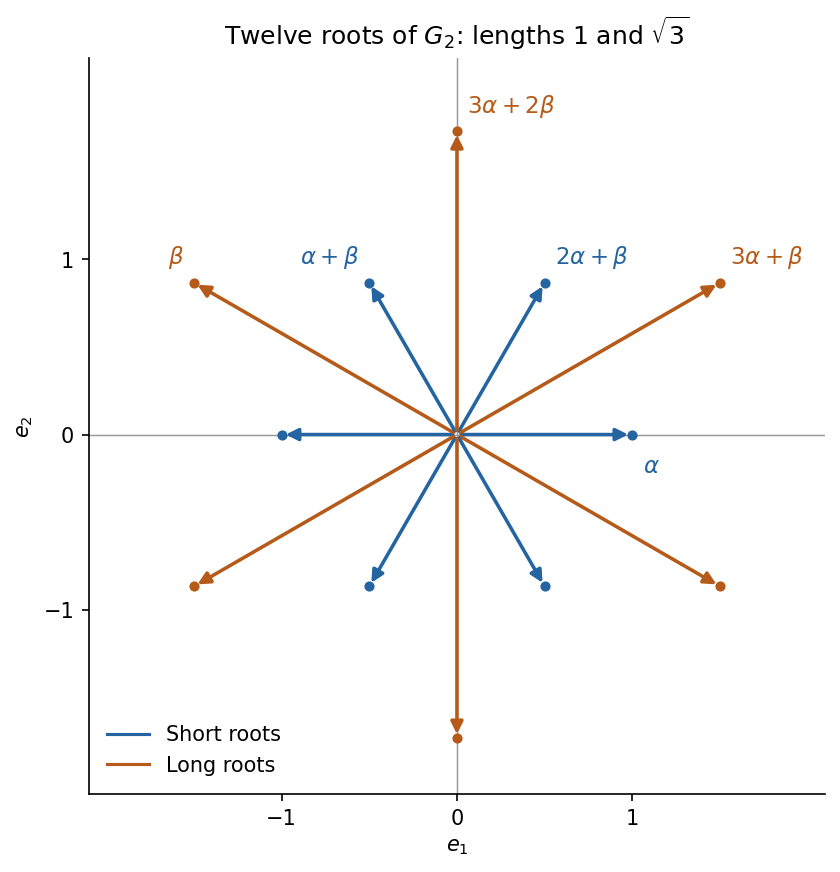
The twelve roots of G2 with the shorter simple root horizontal
. Details. Past exam of the Lie algebras and representation theory of symmetric groups course of the University of Oxford 2009 A 3 a Solution by Codex 0 2026-10-31
Codex 0 2026-10-31A base of a root system is a vector-space basis of the ambient Euclidean space such that every root is an integer combination of its elements with all coefficients nonnegative or all nonpositive. The corresponding nonzero nonnegative combinations are the positive roots.
If distinct had positive inner product, the allowed root-difference fact would make a root. Its simple-root coefficients have opposite signs, contradicting the definition. Hence distinct simple roots have nonpositive inner product.
For a positive root which is not simple, the identity gives a simple root with and . The allowed fact makes a root. Its coefficients remain nonnegative, and it is nonzero because is not simple. It has smaller height . Induction expresses it as a sum of simple roots with each partial sum a root; appending gives the required expression for .
Finally, reflection in a simple root changes only that root's coefficient:For positive , at least one other simple coefficient is positive: in a reduced root system the only positive root on the line of is itself. That other coefficient is unchanged. The reflected vector is a root, so its coefficients cannot all be nonpositive and must all be nonnegative. Thus preserves all positive roots except , which it sends to .
Past exam of the Lie algebras and representation theory of symmetric groups course of the University of Oxford 2009 A 1 c Solution by Codex 0 2026-10-31
Codex 0 2026-10-31Polarizing givesLet . Antisymmetry and this identity give and . The Jacobi identity therefore gives . Since the characteristic is not three, for every triple. ConsequentlyNo division by two was used, so the proof also applies in characteristic two with the usual alternating definition of a Lie bracket.
Past exam of the Lie algebras and representation theory of symmetric groups course of the University of Oxford 2009 A 1 b Solution by Codex 0 2026-10-31
Codex 0 2026-10-31Every subalgebra of a nilpotent Lie algebra is nilpotent, since its lower central series is contained term by term in the ambient lower central series.
Conversely, if were not nilpotent, part (a) would give for which is not nilpotent. Over an algebraically closed field, such an endomorphism has a nonzero eigenvalue and eigenvector . The vectors are independent because while . Their span is a two-dimensional subalgebra, and its lower central series is at every stage after the first. It is therefore not nilpotent, a contradiction. Thus
Past exam of the Lie algebras and representation theory of symmetric groups course of the University of Oxford 2009 A 1 a Solution by Codex 0 2026-10-31
Codex 0 2026-10-31First prove the unlettered common-eigenvector assertion, in the stronger form that some nonzero vector is killed by every operator in . This is the linear form of Engel's theorem.
Induct on , with the zero algebra immediate. If , the operator on is nilpotent: left and right multiplication commute, and every term in contains a power of at least . This argument works in every characteristic.
For a proper Lie subalgebra , its action on by brackets is therefore by nilpotent operators. The image of this action has dimension at most , so induction gives a nonzero class killed by . Thus the normalizer strictly contains . Choose maximal proper. Its normalizer must be , so is an ideal. Moreover has dimension one, since otherwise any one-dimensional subalgebra of the quotient would lift to an intermediate proper subalgebra.
Induction applied to acting on makes nonzero. This space is -invariant: for , . Choose complementing in . Its restriction to the nonzero space is nilpotent and has a nonzero kernel. A vector in this kernel is killed by and , hence by all of . This proves the preliminary assertion, with every common eigenvalue equal to zero.
Now apply it to the adjoint action of on itself. If , its common zero space is the center , which is therefore nonzero. Every induced adjoint map on remains nilpotent. Induction on dimension makes that quotient nilpotent. A central extension of a nilpotent Lie algebra is nilpotent: if its lower central series vanishes after projection, the next term lies in the center and the following term is zero. Hence is nilpotent. The zero algebra is immediate.
Past exam of the Lie algebras and representation theory of symmetric groups course of the University of Oxford 2008 B 8 c Solution by Codex 0 2026-10-31
Codex 0 2026-10-31For the characteristic-three Specht module for the two-by-two partition, reduce the matrices modulo three. The vector is fixed by every displayed transposition: and send it to , and interchanges its two terms. Thus its span is a proper nonzero trivial submodule.
On the quotient impose . Each generating transposition then acts as minus one, so the quotient is the sign representation. Consequentlyand the two composition factors are trivial and sign, each once. In the notation they are and respectively. Indeed the restricted tabloid form has Gram matrix , whose characteristic-three radical is precisely the trivial line, so the simple quotient is .
The extension does not split: the minus-one eigenspace of is the line through , but sends that line to the line through . Thus there is no sign submodule complementing the trivial line, consistent with the failure of semisimplicity.
Past exam of the Lie algebras and representation theory of symmetric groups course of the University of Oxford 2008 B 8 b Solution by Codex 0 2026-10-31
Codex 0 2026-10-31Choose the two standard tableauxand use their polytabloids , with column-vector coordinates. Writing for the tabloid with those two row sets givesThe coefficients at and prove independence over every field. Applying the generators directly givesand acts in the same way as . Their span is invariant under the generators, contains , and contains its whole orbit, hence is the Specht module. Thus it is a basis without needing a characteristic-zero argument. The matrices areThese integral matrices may be reduced in the chosen characteristic.
Past exam of the Lie algebras and representation theory of symmetric groups course of the University of Oxford 2008 B 8 a Solution by Codex 0 2026-10-31
Codex 0 2026-10-31Give the invariant symmetric bilinear form for which its tabloid basis is orthonormal. DefineIn characteristic , this quotient is nonzero and simple when is -regular, meaning that no part occurs or more times. For other partitions it is zero, so the label “simple module” includes the nonzero/-regular qualification.
The James submodule theorem states that for every -submodule , either or . Applied to submodules of , it says that every proper submodule lies in the radical of the restricted form, giving the simplicity of the displayed nonzero quotient.
Past exam of the Lie algebras and representation theory of symmetric groups course of the University of Oxford 2008 B 7 c Solution by Codex 0 2026-10-31
Codex 0 2026-10-31The stabilizer of an ordered pair is the subgroup fixing both entries, so the permutation module is . Induce in two stages through . The first stage is . The characteristic-zero induction branching rule for a symmetric group adds one box in every possible partition position, with multiplicity one. Thus the two second-stage decompositions areBy transitivity of induction this yieldsThe dimensions are , , and , whose sum is , checking the decomposition also at .
Past exam of the Lie algebras and representation theory of symmetric groups course of the University of Oxford 2008 B 7 b Solution by Codex 0 2026-10-31
Codex 0 2026-10-31Write for the tabloid with second-row entry and third-row entry . Equivariance gives for every distinct pair. For a tableau , the only nontrivial column antisymmetrizer is on the three entries in its first column. In its alternating sum, pair each column permutation with the permutation obtained by interchanging the two singleton-row positions. Their images under are the same unordered sum of two 's, while their signs are opposite. Hence for every polytabloid, proving .
For distinct ,Each summand is an image and two is invertible in characteristic zero. Thus every basis vector of is in the image, proving surjectivity. rank-nullity theorem then gives
Past exam of the Lie algebras and representation theory of symmetric groups course of the University of Oxford 2008 B 7 a Solution by Codex 0 2026-10-31
Codex 0 2026-10-31The permutation module has a basis consisting of row tabloids of shape : tableaux are identified when each row has the same set of entries. A permutation acts by applying it to every entry, and the action is extended linearly over . Its dimension is .
Here the two singleton rows form an ordered pair of distinct entries, soA standard tableau of the same shape must put one in its top-left corner. Choose two entries from for the two remaining boxes of the first column, in increasing order; all other entries then fill the top row in increasing order. Thus the standard-polytabloid basis gives
Past exam of the Lie algebras and representation theory of symmetric groups course of the University of Oxford 2008 B 6 c Solution by Codex 0 2026-10-31
Codex 0 2026-10-31The two partition diagrams are transposes, so their characteristic-zero Specht modules differ by tensoring with the sign representation. A transposition has sign minus one. ConsequentlyThe middle character is , since the standard representation is the point-permutation representation minus its trivial line, and a transposition fixes points.
Past exam of the Lie algebras and representation theory of symmetric groups course of the University of Oxford 2008 B 6 b Solution by Codex 0 2026-10-31
Codex 0 2026-10-31Write the hook cycle partition as , . At the identity, the representation dimension is : a standard tableau of shape is determined by the entry in its top-right box, any one of .
For , the only removable border strip of length is the vertical bottom strip. Its height is , and the remaining hook has size and dimension . A strip of length would leave the top-left box but disconnect the removed top-right box from the removed column, so none exists and the value is zero. For , the whole hook is a border strip of height and contributes . These cases combine asIn particular the formula includes zero at and the full-cycle sign at .
Past exam of the Lie algebras and representation theory of symmetric groups course of the University of Oxford 2008 B 6 a Solution by Codex 0 2026-10-31
Codex 0 2026-10-31If the cycle partition contains a part , the Murnaghan–Nakayama rule isA border strip is a connected skew Young diagram with no block; its height is its number of occupied rows minus one. The remaining boxes must be a partition diagram. The recursion starts with character one for the empty diagram at the empty cycle type, and an empty sum is zero. Repeated removal for all cycle lengths computes the character value.
Past exam of the Lie algebras and representation theory of symmetric groups course of the University of Oxford 2008 B 5 c Solution by Codex 0 2026-10-31
Codex 0 2026-10-31The equality exhausts the dimension of the regular representation. There is no room for another irreducible constituent, since it would contribute its positive squared dimension. ThusEach has the standard-polytabloid basis just proved. The usual split characteristic-zero statement follows over any characteristic-zero field because these integral Specht models remain irreducible after extension to an algebraic closure and already exhaust all dimensions there. In the literal wording of the source, polytabloids themselves are vectors; it is the Specht modules with those bases that form the family of representations.
Past exam of the Lie algebras and representation theory of symmetric groups course of the University of Oxford 2008 B 5 b Solution by Codex 0 2026-10-31
Codex 0 2026-10-31Let be the number of standard tableaux of shape . First the associated polytabloids are linearly independent. Order tabloids lexicographically by reading each row after sorting its entries. For a column-increasing tableau , the term in has coefficient one; every other tabloid term has larger row word. To see this, take the first row changed by a nontrivial column permutation. Earlier rows are fixed entry by entry, since each entry belongs to one original column. The changed row can only receive entries from lower positions of those increasing columns, so after sorting it is lexicographically larger. In a linear relation between standard polytabloids, choose the smallest row word with a nonzero coefficient. Its own tabloid coefficient cannot be cancelled by a larger standard polytabloid, a contradiction. Thus .
Work first over . The RSK bijection between permutations and pairs of standard tableaux of the same shape gives . The assumed pairwise nonisomorphic irreducible Specht modules, and the decomposition of the regular representation with irreducible multiplicities equal to their dimensions, give . Combining the two inequalities forces equality term by term: . Hence the independent standard polytabloids are a basis.
The same conclusion holds over every characteristic-zero field. All polytabloid coordinates in the tabloid basis are integers, so the ranks of their coordinate matrices are the same over any characteristic-zero field as over . In particular the dimension equality and independence transfer without requiring an embedding of the whole field into .
Past exam of the Lie algebras and representation theory of symmetric groups course of the University of Oxford 2008 B 5 a Solution by Codex 0 2026-10-31
Codex 0 2026-10-31Use the convention that insertion returns the insertion tableau first and the recording tableau second. Successive row insertions of giveFor example inserting five bumps six to the second row, and the final insertion of two bumps four from the first row and six from the second, creating the third row. The newly created boxes at these steps receive recording labels six and seven respectively.
The deletion input is this pair with the two tableaux interchanged. The symmetry property of RSK therefore gives the inverse permutation. One can also reverse-insert the boxes in descending recording-label order. The result isIndeed the displayed second row lists the positions of one through seven in the original permutation.
Pinned article: Introduction to the OurBigBook Project
Welcome to the OurBigBook Project! Our goal is to create the perfect publishing platform for STEM subjects, and get university-level students to write the best free STEM tutorials ever.
Everyone is welcome to create an account and play with the site: ourbigbook.com/go/register. We belive that students themselves can write amazing tutorials, but teachers are welcome too. You can write about anything you want, it doesn't have to be STEM or even educational. Silly test content is very welcome and you won't be penalized in any way. Just keep it legal!
Intro to OurBigBook
. Source. We have two killer features:
- topics: topics group articles by different users with the same title, e.g. here is the topic for the "Fundamental Theorem of Calculus" ourbigbook.com/go/topic/fundamental-theorem-of-calculusArticles of different users are sorted by upvote within each article page. This feature is a bit like:
- a Wikipedia where each user can have their own version of each article
- a Q&A website like Stack Overflow, where multiple people can give their views on a given topic, and the best ones are sorted by upvote. Except you don't need to wait for someone to ask first, and any topic goes, no matter how narrow or broad
This feature makes it possible for readers to find better explanations of any topic created by other writers. And it allows writers to create an explanation in a place that readers might actually find it.
Figure 1. Screenshot of the "Derivative" topic page. View it live at: ourbigbook.com/go/topic/derivativeVideo 2. OurBigBook Web topics demo. Source. - local editing: you can store all your personal knowledge base content locally in a plaintext markup format that can be edited locally and published either:This way you can be sure that even if OurBigBook.com were to go down one day (which we have no plans to do as it is quite cheap to host!), your content will still be perfectly readable as a static site.
- to OurBigBook.com to get awesome multi-user features like topics and likes
- as HTML files to a static website, which you can host yourself for free on many external providers like GitHub Pages, and remain in full control

Figure 2. You can publish local OurBigBook lightweight markup files to either OurBigBook.com or as a static website.
Figure 3. Visual Studio Code extension installation.
Figure 5. . You can also edit articles on the Web editor without installing anything locally. Video 3. Edit locally and publish demo. Source. This shows editing OurBigBook Markup and publishing it using the Visual Studio Code extension. 
- Infinitely deep tables of contents:



All our software is open source and hosted at: github.com/ourbigbook/ourbigbook
Further documentation can be found at: docs.ourbigbook.com
Feel free to reach our to us for any help or suggestions: docs.ourbigbook.com/#contact