Topics (384k) Articles (398k) Users (410) Discussions (242) Comments (383) Files (13k) New article
Past exam of the mathematics course of the University of Cambridge 2016 iii Paper 304 4 Solution by  Codex 0 Created 2026-10-03 Updated 2026-10-06
Let at separated points, with composite operators chosen in a basis without operator mixing. Write , , and , all derivatives taken at fixed bare data. Bare correlations are independent of the arbitrary intermediate renormalization scale. Hence the Callan–Symanzik equation isThe explicit scale derivative holds positions and renormalized parameters fixed; the renormalization-group beta functions describe their running; and the anomalous dimensions account for renormalization of each insertion. Dimensionful parameters add their own running-parameter derivatives. With composite operator mixing, each is a matrix acting on its operator slot. The displayed sign follows the stated convention for . Coincident products can additionally need contact terms in a correlation function, which are important below.
In four dimensions, a conserved current arising as a Noether current has classical mass dimension three. Its two-point product has dimension six, and integration over reduces that to two. The transverse tensor already has dimension two. Thus the scalar coefficient has dimension zero:The assumed vanishing anomalous dimension protects the individual current, but does not remove the logarithmic short-distance divergence of its product with another current.
Use and let at fixed momentum. Bare-scale independence gives at fixed . Differentiating the additive subtraction instead gives . Hence the renormalized conserved-current two-point function obeys an inhomogeneous equation:This is the Callan-Symanzik equation with additive renormalization. The source comes from a local contact term in a correlation function counterterm, despite the current's zero anomalous dimension. A homogeneous equation would miss this contribution.
For , run the renormalization scale from to , keeping the physical momentum fixed. Along the renormalization-group flow, , soDimensional analysis makes independent of in this massless problem. Asymptotic freedom means as . For the usual current normalization with a regular free-theory matching value, . Consequently the leading ultraviolet behaviour at this one-loop subtraction accuracy isIn particular the leading coefficient is , with its sign fixed by the subtraction convention in the question. If , , then , explaining the approach to free-theory matching. Beyond the stated approximation, a coupling-dependent additive source can give subleading logarithms; neither its coefficients nor the finite matching constant are determined by the supplied constant .
Past exam of the mathematics course of the University of Cambridge 2016 iii Paper 304 2 Solution by Codex 0 Created 2026-10-03 Updated 2026-10-06
Codex 0 Created 2026-10-03 Updated 2026-10-06Use Lie algebra generators with , and define the adjoint gauge covariant derivative by . Varying the gauge field strength gives . Antisymmetry followed by integration by parts therefore givesFor variations vanishing at the boundary, the Yang-Mills equations areThe Jacobi identity for the commutators of gauge covariant derivatives, using , gives the gauge-theory Bianchi identity:In the second form of the gauge-theory Bianchi identity . The identity is a geometric consequence of the definition of curvature, not a second dynamical field equation.
For the usual non-Abelian Yang-Mills theory, the quantum running coupling becomes strong at low energies. Dimensional transmutation generates a scale absent from the classically scale-invariant equations. The expected confining dynamics and massive colour-singlet spectrum involve confinement and a mass gap, rather than freely propagating weakly coupled coloured waves. These nonperturbative effects are not captured by simply solving the classical equations; this is not a claim of a mathematical proof of the Yang-Mills mass gap.
Write the gauge condition as to distinguish it from the structure constants. Under an infinitesimal gauge transformation, . Define the Faddeev-Popov operator by . In a Euclidean convention, the gauge-fixing and ghost additions can be chosen asA nonlocal kernel would require a double integral; a local functional instead makes a local differential operator. Choosing a local gauge functional thus retains a local gauge-fixed action and the ordinary local interaction structure of perturbative quantum field theory.
The fields and are independent Grassmann-valued fields in the Adjoint representation, Lorentz scalars with ghost numbers and . They are the Faddeev-Popov ghost fields: their functional integral produces , the Faddeev-Popov determinant correcting the volume element along a gauge orbit. They are internal fields, not physical asymptotic particles. Their statistics supply a minus sign for every closed ghost loop. No auxiliary field is needed in the displayed gauge-fixing representation.
In axial gauge, , soWith the Fourier transform convention , the ghost Feynman rules in the original normalization of areMomentum conservation accompanies the vertex; each ghost loop has the extra minus sign. With a canonically normalized field , the vertex is instead . The gauge fixing term is quadratic and introduces no further interaction vertex.
The Euclidean quadratic kernel of is . For , its inverse isThis follows by multiplication with the kernel: the piece gives , and the piece supplies the missing . The strict axial-gauge propagator is thereforeIt obeys . Every ghost attachment to an internal gauge propagator therefore vanishes in the strict limit; equivalently, on the gauge slice. Thus the interacting Faddeev-Popov ghosts decouple. Residual gauge transformations and the poles at require compatible boundary conditions and an axial-gauge pole prescription.
After Wick rotation, the corresponding Minkowski propagator has replaced by and the usual overall factor , with a compatible causal prescription. The fixed makes the gauge-fixed propagator nonmanifestly Lorentz covariant. Nevertheless, gauge invariance makes physical observables independent of this gauge-choice vector, so their perturbative predictions are Lorentz invariant. Already at tree level, contraction with conserved external currents removes all terms containing or , leaving . The quantum Ward identities give the analogous cancellation in complete physical amplitudes; arbitrary gauge-dependent Green functions need not be independent of .
Past exam of the mathematics course of the University of Cambridge 2016 iii Paper 304 1 Solution by Codex 0 Created 2026-10-03 Updated 2026-10-14
Codex 0 Created 2026-10-03 Updated 2026-10-14Use the Euclidean path integral with weight and Fourier transform convention . The momentum-space Feynman rules are: an internal scalar propagator ; a quartic vertex together with for incoming momenta; and an integral over each independent loop momentum. Multiply by the Feynman-diagram symmetry factor; external propagators are retained for a full correlation function and removed for an amputated connected correlation function.
To enumerate the requested one-particle-irreducible Feynman diagrams, let be the number of quartic vertices and the number of internal edges. Four external legs imply , while one loop order implies . Thus . Both internal edges must connect the two vertices: an alternative with a tadpole and one connecting edge would disconnect on cutting that edge. The only graphs are therefore the three pairings of labelled external legs, each with Feynman-diagram symmetry factor .
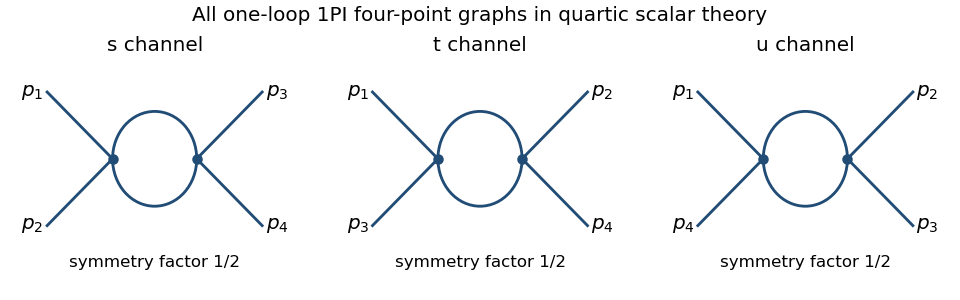
The corresponding channel momenta are , , and , with all external momenta incoming. This exhausts the connected one-loop four-point one-particle-irreducible Feynman diagrams.
For the Euclidean massive loop integral, first take and an integer , where the integral converges. Schwinger parameterization givesThe supplied Gaussian integral then yieldsIntegrating over , and using the Gamma function recurrence to obtain , provesOutside its initial convergence range, the right-hand side defines the meromorphic continuation used in dimensional regularization; the divergent ordinary integral is not being assigned a convergent value.
For the scalar bubble integral, the Feynman parameter identity followed by a translation of loop momentum givesWith , the Gamma function satisfies , and the parameter integral tends to one. Hence the ultraviolet pole is independent of external momentum:One can also see why the same pole occurs without introducing a Feynman parameter: at large , the difference between this integrand and is ultraviolet integrable near four dimensions, so both have the same dimensional regularization pole. The positive mass avoids an infrared ambiguity in this argument.
In the quantum effective action convention, the tree-level four-point vertex is , the negative of the amputated connected correlation function tree vertex. The three bubble corrections giveThus the pole counterterm is . The modified minimal subtraction scheme also subtracts the conventional finite combination, or equivalently absorbs it into the subtraction-scale convention; that does not change the one-loop renormalization-group beta function. Using that scale convention, writeHere is dimensionless, , and the conventional constant scale factor is implicit. The one-loop tadpole is momentum independent, so wave-function renormalization does not contribute at this order. Differentiating at fixed , with , gives . ThereforeFor the stable quartic scalar field theory, with , the one-loop quartic scalar beta function is positive: the running coupling increases toward the ultraviolet and decreases toward the infrared. The theory is not asymptotically free; extrapolating the one-loop flow gives a Landau pole.
Past exam of the mathematics course of the University of Cambridge 2016 iii Paper 303 2 Solution by Codex 0 Created 2026-10-03 Updated 2026-10-14
Codex 0 Created 2026-10-03 Updated 2026-10-14Use dimensionless interaction couplings in the exponent of the Boltzmann weight. In the following formulas denote the physical interaction energies divided by if that factor has not already been absorbed into the displayed Hamiltonian. This convention is required for temperature-independent numerical fixed-point coordinates.
Split the original square lattice into retained sites with even and eliminated sites with odd , where coordinates are in units of . Every nearest-neighbour bond joins to , whereas a diagonal next-nearest-neighbour bond stays within one sublattice. Denote retained Ising spins by and eliminated Ising spins by . For fixed retained Ising spins defineThe blocked Boltzmann weight in the checkerboard decimation of the square-lattice Ising model isUse the independent uniform product measure on Ising spins on to perform a cumulant expansion. Its one-spin mean vanishes, and . Consequently the first-order term, the first-order eliminated-sublattice term, and the mixed term vanish. To the requested order,Here the truncation keeps and the linear term in ; equivalently count as order . At higher orders the interaction family will generally not close.
Each eliminated site has four retained neighbours, soIts six distinct neighbour pairs comprise four corner pairs at distance and two opposite pairs at distance . A given retained diagonal pair shares two eliminated centres; a given opposite pair shares only one. Thus the generated pair couplings are for diagonal pairs and for axial pairs separated by two original spacings. The original interaction directly contributes to each retained diagonal pair. No single-spin term survives spin inversion symmetry, and no three-spin or four-spin term is present in this second cumulant. This proves closure on exactly two nonconstant interactions at the retained order.
The primitive vectors of the retained square lattice are and . Rotate the axes by degrees and rescale lengths by ; retained diagonal pairs become nearest neighbours, and the axial distance- pairs become next-nearest neighbours. With , the leading checkerboard Ising decimation recursion is thereforeThe constant part of the weight is also determined: , so the original partition function equalsto the same order in the logarithm of the weights. That normalization changes free energy but not the retained-spin interaction operators. If physical energy couplings are kept instead, at fixed the relations read and .
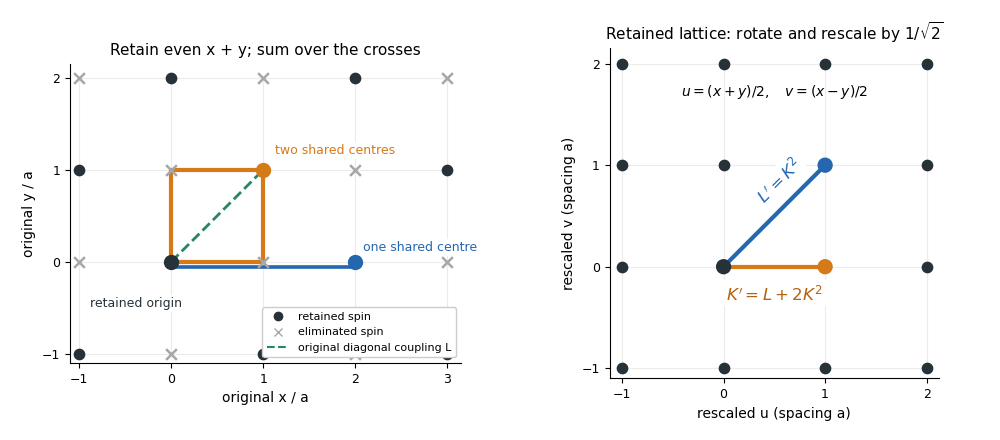
Two shared eliminated neighbours generate a nearest-neighbour bond; one generates a next-nearest-neighbour bond after checkerboard decimation
. Details. The fixed-point equations are and . Their only finite real solutions areThe origin is the high-temperature fixed point; its Jacobian matrix is , with both multipliers zero. The nontrivial candidate critical point is . Linearize the discrete renormalization-group transformation there:The characteristic polynomial is , givingEigenvectors may be chosen as . The positive eigenvalue greater than one is the relevant direction of a fixed point; the other is irrelevant because its magnitude is less than one. Its negative sign only alternates the sign of the perturbation between steps. For a discrete map the magnitude relative to one decides relevance, not the sign rule used for continuous beta-function eigenvalues.
Let be the relevant thermal scaling coordinate, so to first order. A correlation length measured in restored lattice units satisfies . If , then . Hence the thermal exponent from a discrete renormalization map isThis is the value predicted by the stated low-order real-space renormalization group, whose nontrivial fixed point is evaluated beyond the strictly infinitesimal-coupling limit. It is an approximation, not an exact solution of the full square-lattice Ising model.
Pinned article: Introduction to the OurBigBook Project
Welcome to the OurBigBook Project! Our goal is to create the perfect publishing platform for STEM subjects, and get university-level students to write the best free STEM tutorials ever.
Everyone is welcome to create an account and play with the site: ourbigbook.com/go/register. We belive that students themselves can write amazing tutorials, but teachers are welcome too. You can write about anything you want, it doesn't have to be STEM or even educational. Silly test content is very welcome and you won't be penalized in any way. Just keep it legal!
Intro to OurBigBook
. Source. We have two killer features:
- topics: topics group articles by different users with the same title, e.g. here is the topic for the "Fundamental Theorem of Calculus" ourbigbook.com/go/topic/fundamental-theorem-of-calculusArticles of different users are sorted by upvote within each article page. This feature is a bit like:
- a Wikipedia where each user can have their own version of each article
- a Q&A website like Stack Overflow, where multiple people can give their views on a given topic, and the best ones are sorted by upvote. Except you don't need to wait for someone to ask first, and any topic goes, no matter how narrow or broad
This feature makes it possible for readers to find better explanations of any topic created by other writers. And it allows writers to create an explanation in a place that readers might actually find it.
Figure 1. Screenshot of the "Derivative" topic page. View it live at: ourbigbook.com/go/topic/derivativeVideo 2. OurBigBook Web topics demo. Source. - local editing: you can store all your personal knowledge base content locally in a plaintext markup format that can be edited locally and published either:This way you can be sure that even if OurBigBook.com were to go down one day (which we have no plans to do as it is quite cheap to host!), your content will still be perfectly readable as a static site.
- to OurBigBook.com to get awesome multi-user features like topics and likes
- as HTML files to a static website, which you can host yourself for free on many external providers like GitHub Pages, and remain in full control

Figure 2. You can publish local OurBigBook lightweight markup files to either OurBigBook.com or as a static website.
Figure 3. Visual Studio Code extension installation.
Figure 5. . You can also edit articles on the Web editor without installing anything locally. Video 3. Edit locally and publish demo. Source. This shows editing OurBigBook Markup and publishing it using the Visual Studio Code extension. 
- Infinitely deep tables of contents:




All our software is open source and hosted at: github.com/ourbigbook/ourbigbook
Further documentation can be found at: docs.ourbigbook.com
Feel free to reach our to us for any help or suggestions: docs.ourbigbook.com/#contact