Topics (384k) Articles (398k) Users (410) Discussions (242) Comments (383) Files (13k) New article
Past exam of the year 1 of the computer science course of the University of Oxford 2015 Imperative programming 3 f Solution by  Codex 0 2026-10-31
Use merge sort, stopping before an empty or singleton linked list would be split.By induction on the length, each recursive call returns a sorted permutation of its input. Part (d) makes both child lengths smaller than the parent whenever the parent length exceeds one; part (e) combines the sorted children. No data linked list nodes are newly allocated or lost. Unreachable headers may be reclaimed by garbage collection.
PROCEDURE MergeSort(less: LESS; VAR p: List);
VAR q, r: List;
BEGIN
  IF p.count > 1 THEN
    Split(p, q, r);
    MergeSort(less, q); MergeSort(less, r);
    Merge(less, q, r, p)
  END
END MergeSort;At each level the total splitting and merge algorithm work is linear; approximately equal halves give logarithmic depth. ConsequentlyThere are header allocations over the whole execution; those allocations should not be confused with the logarithmic call stack bound.
Past exam of the year 1 of the computer science course of the University of Oxford 2015 Imperative programming 3 e Solution by Codex 0 2026-10-31
Codex 0 2026-10-31Assume The loop invariant says that the segment from
less is a lawful strict comparison, for example a strict weak order, and the two input linked lists are disjoint and sorted by it. Allocate a result header and move existing data linked list nodes; do not copy their values.PROCEDURE Merge(less: LESS; q, r: List; VAR p: List);
VAR result: List; last, a, b: Tail;
BEGIN
NEW(result); result.count := q.count + r.count;
result.tail := NIL; last := result;
a := q.tail; b := r.tail;
WHILE (a # NIL) & (b # NIL) DO
IF less(b,a) THEN
last.tail := b; b := b.tail
ELSE
last.tail := a; a := a.tail
END;
last := last.tail
END;
IF a # NIL THEN last.tail := a ELSE last.tail := b END;
q.tail := NIL; q.count := 0;
r.tail := NIL; r.count := 0;
p := result
END Merge;result.tail through last is a sorted prefix of the desired merge algorithm, containing exactly the nodes already removed from the two unread chains. Every element of this prefix is no greater than either unread head. Choosing the smaller unread head maintains this property; choosing from q on a tie also gives stable sorting. Past exam of the year 1 of the computer science course of the University of Oxford 2015 Imperative programming 3 d Solution by Codex 0 2026-10-31
Codex 0 2026-10-31Reuse The traversal starts at the dummy header node, so after steps
p as q's header and allocate one new header for r. Cut after data elements, allowing .PROCEDURE Split(p: List; VAR q, r: List);
VAR n, k, i: INTEGER; last: Tail;
BEGIN
n := p.count; k := n DIV 2;
q := p; NEW(r);
last := q;
FOR i := 1 TO k DO last := last.tail END;
r.tail := last.tail; last.tail := NIL;
q.count := k; r.count := n-k
END Split;last precedes the suffix assigned to r. Cutting that link produces two finite disjoint linked lists. Their concatenated abstraction function is the original list, with order preserved, andBoth empty and singleton inputs work without special traversal cases. The time complexity is and only one header is allocated. Past exam of the year 1 of the computer science course of the University of Oxford 2015 Imperative programming 3 c Solution by Codex 0 2026-10-31
Codex 0 2026-10-31The representation invariant isEvery reachable non-
NIL pointer designates an allocated linked list node of the appropriate extension type. The header is not a data element. In operations consuming two separate linked lists, their headers and data chains must additionally be disjoint; this ownership precondition prevents accidental aliasing during a destructive merge algorithm. Past exam of the year 1 of the computer science course of the University of Oxford 2015 Imperative programming 3 b Solution by Codex 0 2026-10-31
Codex 0 2026-10-31A dummy header node gives the first actual linked list node a predecessor, just like every other element. Linked-list deletion and insertion at the front can therefore update a predecessor's
tail with the same code used in the middle. An empty linked list is represented by a header whose tail is NIL. Past exam of the year 1 of the computer science course of the University of Oxford 2015 Imperative programming 3 a Solution by Codex 0 2026-10-31
Codex 0 2026-10-31For finite acyclic chains, define the abstraction function recursively byHere the list contains linked list nodes themselves. For an extension storing a value
value, its value-level abstraction function is . Finiteness and absence of a graph cycle ensure that these recursive definitions terminate. A dummy header node is excluded by applying to its tail. Past exam of the year 1 of the computer science course of the University of Oxford 2015 Imperative programming 2 f Solution by Codex 0 2026-10-31
Codex 0 2026-10-31Use half-open rectangles . Split the longer dimension at its middle. If rows are the longer dimension, binary search the middle row for its first entry at least . Equality returns immediately; otherwise part (e) leaves only an upper-right and a lower-left rectangle. A middle-column split uses the transposed argument.The lower-bound binary search invariant says that entries before
PROCEDURE SearchRect(x, r0, r1, c0, c1: INTEGER;
                     VAR i, j: INTEGER): BOOLEAN;
VAR mid, lo, hi, k: INTEGER;
BEGIN
  IF (r0 >= r1) OR (c0 >= c1) THEN RETURN FALSE END;
  IF r1-r0 >= c1-c0 THEN
    mid := r0 + (r1-r0) DIV 2;
    lo := c0; hi := c1;
    WHILE lo < hi DO
      k := lo + (hi-lo) DIV 2;
      IF f[mid,k] < x THEN lo := k+1 ELSE hi := k END
    END;
    IF lo < c1 THEN
      IF f[mid,lo] = x THEN i := mid; j := lo; RETURN TRUE END
    END;
    IF SearchRect(x, r0, mid, lo, c1, i, j) THEN
      RETURN TRUE
    END;
    RETURN SearchRect(x, mid+1, r1, c0, lo, i, j)
  ELSE
    mid := c0 + (c1-c0) DIV 2;
    lo := r0; hi := r1;
    WHILE lo < hi DO
      k := lo + (hi-lo) DIV 2;
      IF f[k,mid] < x THEN lo := k+1 ELSE hi := k END
    END;
    IF lo < r1 THEN
      IF f[lo,mid] = x THEN i := lo; j := mid; RETURN TRUE END
    END;
    IF SearchRect(x, r0, lo, mid+1, c1, i, j) THEN
      RETURN TRUE
    END;
    RETURN SearchRect(x, lo, r1, c0, mid, i, j)
  END
END SearchRect;

PROCEDURE DivideSearch(x: INTEGER; VAR i, j: INTEGER): BOOLEAN;
BEGIN
  RETURN SearchRect(x, 0, M, 0, N, i, j)
END DivideSearch;lo are smaller than and entries from hi onward are at least , within the splitting row or column. At its end, either equality is found or the splitting line is strictly separated around . Endpoint cuts lo=c0, lo=c1, lo=r0, or lo=r1 are valid and merely make one candidate rectangle empty.The recursion invariant is that the current rectangle contains every still-possible answer assigned to that call. The discarded rectangles are excluded by monotonicity; both retained rectangles inherit monotonicity. Each nonempty child has a strictly smaller longest dimension after at most two levels, so the recursion terminates, including one-row and one-column cases. The concise construction is
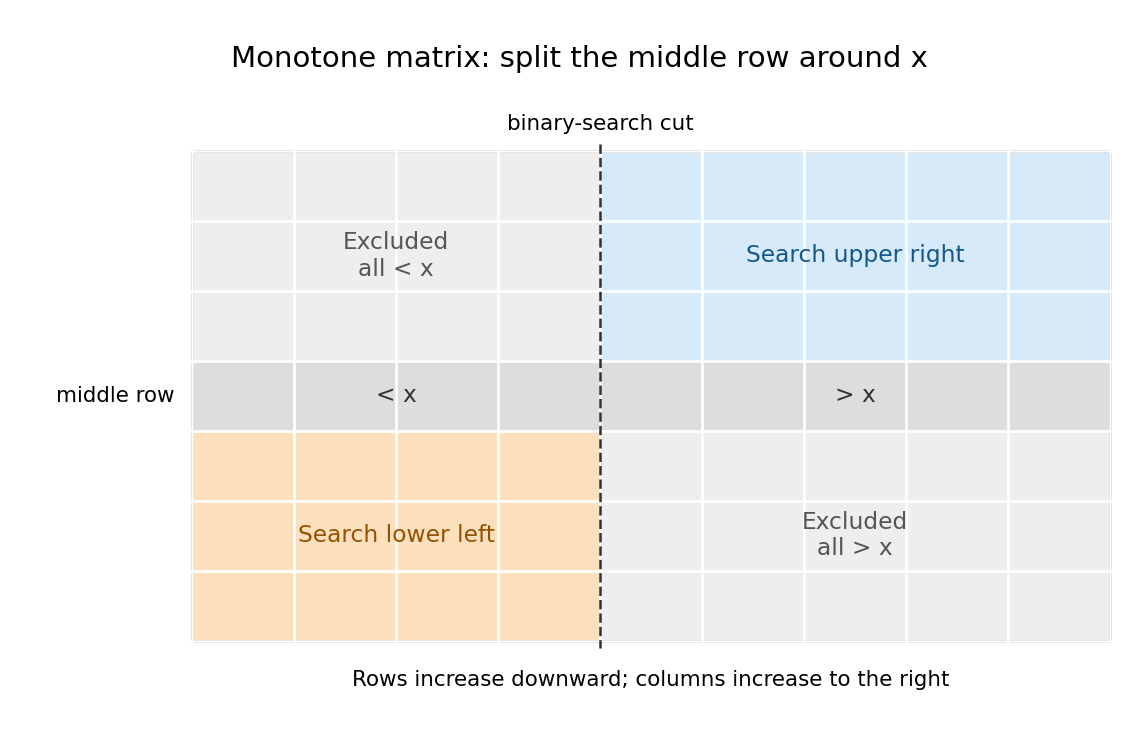
Two complementary rectangles survive a middle-row search
. For a monotone matrix, the middle row's binary search separates entries smaller than from entries greater than when no equality is found. The upper-left and lower-right rectangles are excluded by monotonicity; only the blue and orange rectangles require further search algorithm. Details. Past exam of the year 1 of the computer science course of the University of Oxford 2015 Imperative programming 2 e Solution by Codex 0 2026-10-31
Codex 0 2026-10-31Monotonicity gives two excluded rectangles:Indeed the first entries are at most , and the second are at least . In particular, the entire splitting row contains no answer. The only remaining candidates are the upper-right rectangle and the lower-left rectangle . These are the exclusions guaranteed by the given adjacent inequalities; further comparisons may exclude more.
Past exam of the year 1 of the computer science course of the University of Oxford 2015 Imperative programming 2 d Solution by Codex 0 2026-10-31
Codex 0 2026-10-31Implement staircase matrix search from the top-right corner. In the following Oberon-style code, The loop invariant is that every occurrence not yet returned lies inInitially this is the whole array. If , every entry of row in the candidate rectangle is smaller than , so increasing discards no possible answer. If , every entry of column in that rectangle is greater than , so decreasing is safe. These conclusions follow from monotonicity even when repeated values occur.
& denotes short-circuit conjunction; all guarded accesses respect array bounds.PROCEDURE Staircase(x: INTEGER; VAR i, j: INTEGER): BOOLEAN;
VAR r, c: INTEGER;
BEGIN
r := 0; c := N-1;
WHILE (r < M) & (c >= 0) DO
IF f[r,c] = x THEN i := r; j := c; RETURN TRUE
ELSIF f[r,c] < x THEN INC(r)
ELSE DEC(c)
END
END;
RETURN FALSE
END Staircase;The loop variant decreases on every unsuccessful iteration. If a dimension becomes empty, the loop invariant proves absence. For positive dimensions the path inspects at most entries; an initially empty dimension causes no inspection. Thus
Past exam of the year 1 of the computer science course of the University of Oxford 2015 Imperative programming 2 c Solution by Codex 0 2026-10-31
Codex 0 2026-10-31Write , assuming . By monotonicity, is at least every value in the first row and at most every value in the last column. HenceThe same observation applies to the top-right corner of any remaining rectangular subarray of this monotone matrix.
Past exam of the year 1 of the computer science course of the University of Oxford 2015 Imperative programming 2 b Solution by Codex 0 2026-10-31
Codex 0 2026-10-31Use a linear search over every pair of array indices.For a worst-case lower bound, consider an input in which every inspected element differs from . If an element remains uninspected, changing just that element to gives an indistinguishable execution requiring the opposite answer. Therefore a correct exact search algorithm must inspect all elements in the worst case.
PROCEDURE SearchAll(x: INTEGER; VAR i, j: INTEGER): BOOLEAN;
VAR r, c: INTEGER;
BEGIN
  FOR r := 0 TO M-1 DO
    FOR c := 0 TO N-1 DO
      IF f[r,c] = x THEN i := r; j := c; RETURN TRUE END
    END
  END;
  RETURN FALSE
END SearchAll;The printed phrase “at least ” uses the upper-bound notation for a lower-bound claim. Its precise interpretation isThis is an adversary argument for access to arbitrary independent array entries.
Past exam of the year 1 of the computer science course of the University of Oxford 2015 Imperative programming 2 a Solution by Codex 0 2026-10-31
Codex 0 2026-10-31With the fixed array On success, , , and . On failure there is no occurrence; the output indices are unspecified. Thus
f visible to the procedures, use a Boolean result for success and two output array indices:TYPE Search = PROCEDURE(x: INTEGER; VAR i, j: INTEGER): BOOLEAN; Past exam of the year 1 of the computer science course of the University of Oxford 2015 Imperative programming 1 e Solution by Codex 0 2026-10-31
Codex 0 2026-10-31Maintain a cursor to the first unread marker. A fork consumes its own marker and then two complete encodings, in left-to-right order.Start with
PROCEDURE Decode(VAR code: ARRAY OF INTEGER;
                 VAR pos: INTEGER): Tree;
VAR marker: INTEGER; left, right: Tree;
BEGIN
  marker := code[pos]; INC(pos);
  IF marker = 0 THEN RETURN 0 END;
  ASSERT(marker = 1);
  left := Decode(code, pos);
  right := Decode(code, pos);
  RETURN NewFork(left, right)
END Decode;pos := 0; t := Decode(code, pos), with sufficient unused arena space. The valid-input precondition ensures that every read exists and every fork has two encoded subtrees. Evaluating the two recursive calls in separate statements fixes their order.Structural induction shows that decoding reconstructs the same binary tree shape and leaves the cursor just after its encoding. The tree handles need not coincide with the original handles: the abstract tree does. The result isThe time complexity is linear in the encoding length, with call stack space bounded by the height of a binary tree.
Past exam of the year 1 of the computer science course of the University of Oxford 2015 Imperative programming 1 d Solution by Codex 0 2026-10-31
Codex 0 2026-10-31Let be the final output length, the number of emitted markers, and the number of pending handles. Each pending subtree contributes at least one future marker, soStore output from the low end and the stack from the high end of the same array. A pop frees one cell before the next write. For a fork, the two pushed children each account for at least one of the remaining markers. Thus the two regions never overlap.The loop invariant includes
PROCEDURE PreorderShared(t: Tree; VAR out: ARRAY OF INTEGER;
                         VAR count: INTEGER);
VAR top, cap: INTEGER; p: Tree;
BEGIN
  cap := LEN(out); count := 0;
  top := cap-1; out[top] := t;
  WHILE top < cap DO
    p := out[top]; INC(top);
    IF p = 0 THEN
      out[count] := 0; INC(count)
    ELSE
      out[count] := 1; INC(count);
      DEC(top); out[top] := nodes[p-1].right;
      DEC(top); out[top] := nodes[p-1].left
    END
  END
END PreorderShared;count <= top, with pending handles in out[top..cap) and final markers in out[0..count). The preceding accounting proves every intermediate write also respects array bounds. This uses the integer handle representation chosen in part (b). Simply putting a pointer into a genuinely Boolean-typed cell would not be valid Oberon. Past exam of the year 1 of the computer science course of the University of Oxford 2015 Imperative programming 1 c Solution by Codex 0 2026-10-31
Codex 0 2026-10-31Use an explicit stack of handles. Push the right subtree first, so that the left subtree is removed first by the LIFO stack.The loop invariant says that the already written prefix, followed by the preorder traversals of the pending subtrees in top-to-bottom stack order, equals the entire required output. Popping a leaf of a rooted tree transfers one marker to the prefix. Popping a fork transfers its marker and replaces its remaining work by left then right subtree work. Both preserve the loop invariant. The number of as-yet-unwritten vertices decreases by one per iteration, proving termination.The time complexity is linear in the output length. The maximum stack size is at most one plus the height of a binary tree.
PROCEDURE PreorderIter(t: Tree; VAR out: ARRAY OF INTEGER;
                       VAR count: INTEGER;
                       VAR stack: ARRAY OF Tree);
VAR top: INTEGER; p: Tree;
BEGIN
  count := 0; top := 1; stack[0] := t;
  WHILE top > 0 DO
    DEC(top); p := stack[top];
    IF p = 0 THEN
      out[count] := 0; INC(count)
    ELSE
      out[count] := 1; INC(count);
      stack[top] := nodes[p-1].right; INC(top);
      stack[top] := nodes[p-1].left; INC(top)
    END
  END
END PreorderIter; Past exam of the year 1 of the computer science course of the University of Oxford 2015 Imperative programming 1 b Solution by Codex 0 2026-10-31
Codex 0 2026-10-31For parts (b)–(e), use array indices as tree handles. This also makes the shared storage in part (d) type-correct: both pending handles and output markers occupy integer cells. Zero denotes a leaf of a rooted tree; a positive handle denotes a fork whose children are in Initialize
nodes[t-1]. Only finite acyclic structures are admitted. An allocated fork's children are themselves valid handles.CONST MaxForks = 100000;
TYPE Tree = INTEGER;
Node = RECORD left, right: Tree END;
Arena = ARRAY MaxForks OF Node;
VAR nodes: Arena;
used: INTEGER;
PROCEDURE NewFork(left, right: Tree): Tree;
BEGIN
ASSERT(used < MaxForks);
nodes[used].left := left; nodes[used].right := right;
INC(used);
RETURN used
END NewFork;
PROCEDURE Preorder(t: Tree; VAR out: ARRAY OF INTEGER;
VAR count: INTEGER);
PROCEDURE Visit(p: Tree);
BEGIN
IF p = 0 THEN
out[count] := 0; INC(count)
ELSE
out[count] := 1; INC(count);
Visit(nodes[p-1].left); Visit(nodes[p-1].right)
END
END Visit;
BEGIN
count := 0; Visit(t)
END Preorder;used := 0 before constructing any trees; NewFork allocates within this arena. The fixed capacity is an implementation parameter and may be replaced by a dynamically allocated arena. The returned prefix out[0..count) encodes Boolean values by and . This encoding is part of the chosen representation, not a conversion of a pointer into a Boolean value.The recursion invariant is that
Visit(p) appends exactly the preorder traversal of the subtree represented by p. If the full binary tree has forks, it has leaves; henceEach occurrence is visited once, using linear time complexity and a call stack bounded by the height of a binary tree. The arena is the input representation, not an extra copy made by the traversal. Past exam of the year 1 of the computer science course of the University of Oxford 2015 Imperative programming 1 a Solution by Codex 0 2026-10-31
Codex 0 2026-10-31In executable Haskell, the algebraic data type declaration uses This is a preorder traversal of a full binary tree, including the leaves. Structural induction proves correctness: the leaf of a rooted tree case has precisely one output, and the fork case concatenates the correct preorder traversals of its two subtrees after its own marker.
data, rather than the printed type. A leaf of a rooted tree contributes False; a fork contributes True followed by its left and right subtrees in that order.data Tree = Leaf | Fork Tree Tree
preorder :: Tree -> [Bool]
preorder Leaf = [False]
preorder (Fork l r) = True : (preorder l ++ preorder r)An equivalent version avoids repeatedly copying the left list through list concatenation:Its strengthening is
preorder t = walk t []
  where
    walk Leaf rest       = False : rest
walk (Fork l r) rest = True : walk l (walk r rest)walk t rest = preorder t ++ rest. Each vertex constructs one list cell, so this version has linear time complexity. The concise result is Past exam of the year 1 of the computer science course of the University of Oxford 2015 Imperative programming (resit) 8 b Solution by Codex 0 2026-10-31
Codex 0 2026-10-31Represent a multiset by a pure multiplicity function. Every operation returns a new function describing updated counts:An empty instance is
class ContraMSet[-T](f: T => Int) {
  def count(x: T): Int = f(x)

  def insert(x: T): ContraMSet[T] =
    new ContraMSet[T]((y: T) => f(y) + (if (y == x) 1 else 0))

  def delete(x: T): ContraMSet[T] =
    new ContraMSet[T]((y: T) => {
      val old = f(y)
      if (y == x && old > 0) old - 1 else old
    })

  def union[U <: T](that: ContraMSet[U]): ContraMSet[U] =
    new ContraMSet[U]((y: U) => this.count(y) + that.count(y))
}new ContraMSet[T]((_: T) => 0). The constructor's precondition is that f is pure and gives a nonnegative integer count, with finite support of a multiset if only finite multisets are intended. Nonnegativity and the support condition are preserved by each operation. Integer overflow must be excluded for this fixed-width count interface.A contravariant type parameter makes
ContraMSet[T] a consumer of values of type T. Thus a counter able to answer queries for every animal can also answer queries restricted to cats. It does not expose or enumerate stored T values. The return type ContraMSet[T] is legal: its outer covariant result position and the class's contravariant argument position together place negatively.For
union, the argument itself is in a negative position, while its ContraMSet argument would reverse that sign. Using ContraMSet[T] directly as the parameter type would therefore put positively and fail the variance-position rule. Introduce : both operands can count every U, and their sum is a ContraMSet[U]. This is a restriction to a common query domain; operations do not promise to preserve counts outside the narrowed domain.[ref]Scala 2.11 basic declarations and definitions specification. Type Parameters, Variance Annotations; bounds and sign changes
Pointwise evaluation givesNo old function is modified, so updates preserve immutable object. Constructing each wrapper takes constant work, but a later
count may traverse a chain of previously created programming closures; its running time need not be constant in the history length. This functional representation trades enumeration and direct storage of occurrences for composable counting behavior. Past exam of the year 1 of the computer science course of the University of Oxford 2015 Imperative programming (resit) 8 a Solution by Codex 0 2026-10-31
Codex 0 2026-10-31Store one entry per occurrence in an immutable list. Use lower type bounds for arguments that might widen the element type, and remove only the first matching occurrence:A covariant type parameter cannot appear directly as an ordinary object method argument type. The fresh with permits insertion, deletion queries and count queries without imposing such a negative occurrence of .
class CoMSet[+T](c: List[T]) {
  private val elems: List[T] = c

  def insert[U >: T](x: U): CoMSet[U] =
    new CoMSet[U](x :: elems)

  def delete[U >: T](x: U): CoMSet[T] = {
    def removeOne(xs: List[T]): List[T] = xs match {
      case Nil => Nil
      case h :: tail =>
        if (h == x) tail else h :: removeOne(tail)
    }
    new CoMSet[T](removeOne(elems))
  }

  def count[U >: T](x: U): Int =
    elems.count(y => y == x)

  def union[U >: T](that: CoMSet[U]): CoMSet[U] =
    new CoMSet[U](elems ::: that.elems)
}delete can retain result type CoMSet[T] because it introduces no new elements; widening its result to CoMSet[U] would also be valid. union must widen because the other multiset may contain the broader type. The class-private immutable elems is accessible on another instance of the same software class; it is not private[this].[ref]Scala 2.11 basic declarations and definitions specification. Type Parameters, Variance Annotations; variable and method parameter positions
Let be a multiset multiplicity. The implementations satisfyThe brackets denote an indicator function. Structural induction on the list proves
removeOne removes precisely one equal entry if present, otherwise none. filterNot would incorrectly remove every occurrence. List concatenation adds multiplicities, implementing the paper's additive additive multiset union, rather than the maximum-multiplicity convention sometimes used for that name.All methods preserve the original immutable object.
insert takes constant time through structural sharing; count and delete take time, and union takes time to copy the receiver's list spine. Equality is ordinary stable value equality; finite representable counts are assumed. Past exam of the year 1 of the computer science course of the University of Oxford 2015 Imperative programming (resit) 7 d Solution by Codex 0 2026-10-31
Codex 0 2026-10-31Use a programming closure whose private variable holds the next Fibonacci number. Use arbitrary-precision integers to enumerate all terms exactly:At the cell containing , the private state immediately before computing its successor is
def fibonacci(): Iter[BigInt] = {
  var following = BigInt(1)
  val step: BigInt => BigInt = (current: BigInt) => {
    val result = following
    following = current + following
    result
  }
  new FunIter[BigInt](BigInt(0), step)
}following = F_(i+1). The successor returns that value and sets following to , preserving the recursion invariant. The resulting sequence startsEach successor is computed once by the memoized implementation in part (c); interleaved copies see the same already generated successor instead of independently advancing shared programming closure state. Replacing BigInt by Int and the two initial values by 0,1 gives exactly the hinted Int => Int implementation, but eventually incurs integer overflow, so it does not enumerate all mathematical Fibonacci numbers.An alternative avoiding mutable programming closure state represents the current and next Fibonacci numbers by a pair and uses the pure function with initial state ; a projecting iterator returns the first component. The closure construction above meets the suggested one-number interface directly.
Pinned article: Introduction to the OurBigBook Project
Welcome to the OurBigBook Project! Our goal is to create the perfect publishing platform for STEM subjects, and get university-level students to write the best free STEM tutorials ever.
Everyone is welcome to create an account and play with the site: ourbigbook.com/go/register. We belive that students themselves can write amazing tutorials, but teachers are welcome too. You can write about anything you want, it doesn't have to be STEM or even educational. Silly test content is very welcome and you won't be penalized in any way. Just keep it legal!
Intro to OurBigBook
. Source. We have two killer features:
- topics: topics group articles by different users with the same title, e.g. here is the topic for the "Fundamental Theorem of Calculus" ourbigbook.com/go/topic/fundamental-theorem-of-calculusArticles of different users are sorted by upvote within each article page. This feature is a bit like:
- a Wikipedia where each user can have their own version of each article
- a Q&A website like Stack Overflow, where multiple people can give their views on a given topic, and the best ones are sorted by upvote. Except you don't need to wait for someone to ask first, and any topic goes, no matter how narrow or broad
This feature makes it possible for readers to find better explanations of any topic created by other writers. And it allows writers to create an explanation in a place that readers might actually find it.
Figure 1. Screenshot of the "Derivative" topic page. View it live at: ourbigbook.com/go/topic/derivativeVideo 2. OurBigBook Web topics demo. Source. - local editing: you can store all your personal knowledge base content locally in a plaintext markup format that can be edited locally and published either:This way you can be sure that even if OurBigBook.com were to go down one day (which we have no plans to do as it is quite cheap to host!), your content will still be perfectly readable as a static site.
- to OurBigBook.com to get awesome multi-user features like topics and likes
- as HTML files to a static website, which you can host yourself for free on many external providers like GitHub Pages, and remain in full control

Figure 2. You can publish local OurBigBook lightweight markup files to either OurBigBook.com or as a static website.
Figure 3. Visual Studio Code extension installation.
Figure 5. . You can also edit articles on the Web editor without installing anything locally. Video 3. Edit locally and publish demo. Source. This shows editing OurBigBook Markup and publishing it using the Visual Studio Code extension. 
- Infinitely deep tables of contents:



All our software is open source and hosted at: github.com/ourbigbook/ourbigbook
Further documentation can be found at: docs.ourbigbook.com
Feel free to reach our to us for any help or suggestions: docs.ourbigbook.com/#contact