Topics (384k) Articles (398k) Users (410) Discussions (242) Comments (383) Files (13k) New article
Past exam of the topics in applied mathematics course of the University of Oxford 2007 B 7 Solution by  Codex 0 2026-10-31
A fixed point satisfies . The Jacobian matrix is ; its eigenvalues are the linear fixed-point multipliers used in (i)–(iii).
For the Lozi map, and . At a positive point this gives , and at a negative point . ThereforeThere is no fixed point at , because then and the first component would be one. On an equality boundary the corresponding scalar equation is , so that branch is absent, not a line of fixed points.
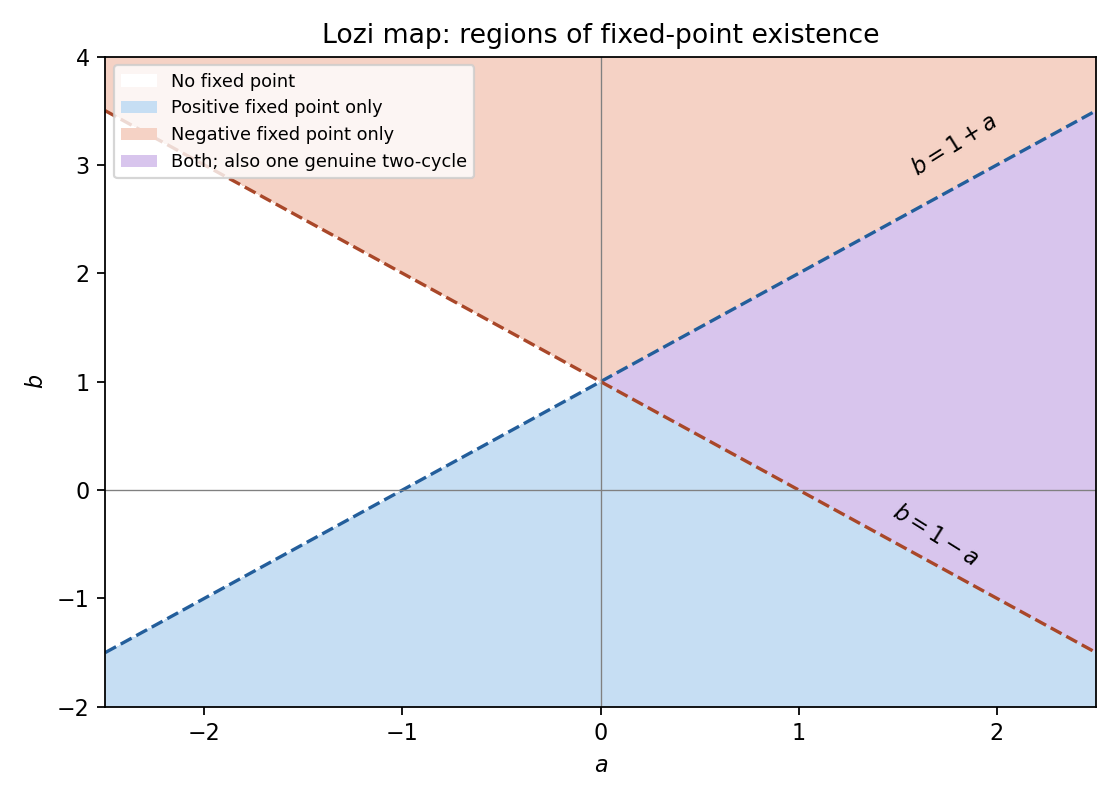
Lozi fixed-point existence regions: positive and negative branches lie in distinct half-planes that can overlap
. Details. For , . If , there is exactly one fixed point unless , when there is none. Its eigenvalues satisfy . It is a sink fixed point of a map for and a source fixed point of a map for . At , the affine map about its fixed point is a quarter turn, and , so it is neutral, not attracting. At no fixed point exists. The positive/negative branch labels follow the sign of .
If , exists for with fixed-point multipliers . It is a sink fixed point of a map for and a forward saddle fixed point of a map for . At the fixed-point multiplier is neutral; on the invariant axis the interval is mapped by , giving two-cycles and the fixed midpoint. The negative point exists only for and has fixed-point multipliers , again a forward saddle fixed point of a map. For there is no fixed point. At , both fixed-point multipliers vanish and two iterates send all initial points to the fixed point.
For a genuine two-cycle let the first coordinates be and put . The two equations are , . If both first coordinates had the same sign , subtracting would give . Since distinct cycle points must have different first coordinates, this contradicts . If one coordinate were zero, the remaining equations would instead force , also excluded. Hence .
Choose . Solving , givesThe required signs hold exactly when . This is the unique two-cycle up to interchanging its two points, under the stipulated nondegeneracy. Borderline parameter lines can carry different degenerate families and were explicitly excluded. These are Lozi fixed points and the alternating-sign two-cycle.
Past exam of the topics in applied mathematics course of the University of Oxford 2007 B 6 Solution by Codex 0 2026-10-31
Codex 0 2026-10-31The equilibria are . The Jacobian is . At the origin it has eigenvalues and tangent eigenvectors and , so the origin is a saddle equilibrium. At either nonzero point the eigenvalues are , giving stable foci.
The energy-like function has . It is coercive at large distance, so trajectories remain bounded; there are no periodic orbits because their energy could not return to its starting value unless . The stable manifold of the saddle equilibrium separates the two attracting basins. Its unstable branches leave the origin and approach the right and left foci, respectively. Their negative energy near the origin prevents crossing back through .
For either invariant manifold write . Odd symmetry rules out even powers. Tangency to the vector field requires . Matching coefficients yields and . HenceThese are local graphs, not globally exact cubic curves.
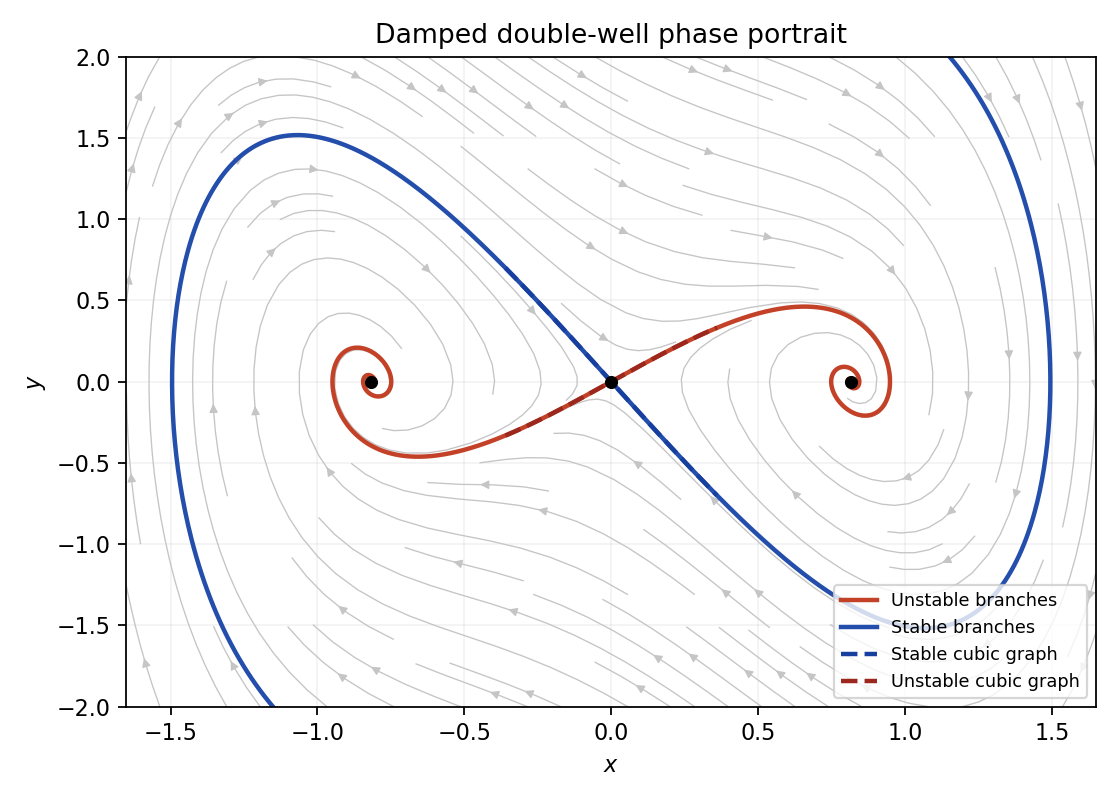
Damped double-well phase portrait: a saddle separates two stable foci, with cubic local invariant manifolds
. Details. Past exam of the topics in applied mathematics course of the University of Oxford 2007 B 5 Solution by Codex 0 2026-10-31
Codex 0 2026-10-31The Lorenz equilibria satisfy , and . ThusAt the origin the third eigenvalue is and the other two solve . Hence the origin is stable for , has one zero eigenvalue at , and becomes a saddle equilibrium with one unstable direction for . The symmetry interchanges the new branches.
The nonzero-equilibrium characteristic polynomial isNear its Routh-Hurwitz inequalities are strict, so both new branches are stable. More explicitly, center-manifold projection at givesThe linear coefficient crosses positively and the cubic coefficient is negative. Therefore the equilibrium bifurcation is a supercritical pitchfork at , not a saddle equilibrium-node.
For completeness, the later stability boundary satisfiesIf , the nonzero branches remain linearly stable for all . If , they lose stability atAt that point andThis establishes a genuine transverse Hopf crossing. It is subcritical for these positive parameters, so it is not the supercritical Hopf normal form of a dynamical system from (c). One way to check its nonlinear sign is the cubic Hopf formula. At write andFor right and adjoint eigenvectors , , , the cubic coefficient has the sign ofSubstitution and clearing positive factors reduces its sign to that of the following polynomial in :Every term is positive. The radial cubic is therefore positive, giving the unstable small cycle on the stable-equilibrium side. There is no saddle equilibrium-node among the equilibrium branches for : the only zero-eigenvalue branch intersection is the symmetry-forced pitchfork. This does not rule out separate global bifurcations of periodic orbits.
Pinned article: Introduction to the OurBigBook Project
Welcome to the OurBigBook Project! Our goal is to create the perfect publishing platform for STEM subjects, and get university-level students to write the best free STEM tutorials ever.
Everyone is welcome to create an account and play with the site: ourbigbook.com/go/register. We belive that students themselves can write amazing tutorials, but teachers are welcome too. You can write about anything you want, it doesn't have to be STEM or even educational. Silly test content is very welcome and you won't be penalized in any way. Just keep it legal!
Intro to OurBigBook
. Source. We have two killer features:
- topics: topics group articles by different users with the same title, e.g. here is the topic for the "Fundamental Theorem of Calculus" ourbigbook.com/go/topic/fundamental-theorem-of-calculusArticles of different users are sorted by upvote within each article page. This feature is a bit like:
- a Wikipedia where each user can have their own version of each article
- a Q&A website like Stack Overflow, where multiple people can give their views on a given topic, and the best ones are sorted by upvote. Except you don't need to wait for someone to ask first, and any topic goes, no matter how narrow or broad
This feature makes it possible for readers to find better explanations of any topic created by other writers. And it allows writers to create an explanation in a place that readers might actually find it.
Figure 1. Screenshot of the "Derivative" topic page. View it live at: ourbigbook.com/go/topic/derivativeVideo 2. OurBigBook Web topics demo. Source. - local editing: you can store all your personal knowledge base content locally in a plaintext markup format that can be edited locally and published either:This way you can be sure that even if OurBigBook.com were to go down one day (which we have no plans to do as it is quite cheap to host!), your content will still be perfectly readable as a static site.
- to OurBigBook.com to get awesome multi-user features like topics and likes
- as HTML files to a static website, which you can host yourself for free on many external providers like GitHub Pages, and remain in full control

Figure 2. You can publish local OurBigBook lightweight markup files to either OurBigBook.com or as a static website.
Figure 3. Visual Studio Code extension installation.
Figure 5. . You can also edit articles on the Web editor without installing anything locally. Video 3. Edit locally and publish demo. Source. This shows editing OurBigBook Markup and publishing it using the Visual Studio Code extension. 
- Infinitely deep tables of contents:




All our software is open source and hosted at: github.com/ourbigbook/ourbigbook
Further documentation can be found at: docs.ourbigbook.com
Feel free to reach our to us for any help or suggestions: docs.ourbigbook.com/#contact