At equilibrium and adding gives . The positive equilibrium isThis condition also gives . The nullclines are and . The second lies above the first for and below it for . Below the first nullcline ; above it . Below the second nullcline ; above it .
At the origin the Jacobian has trace and determinant . Its off-diagonal entries are positive, making the eigenvalues real, so this is an attracting node. At the positive equilibrium the slow reduced derivative is , while the fast derivative is ; equivalently the full Jacobian determinant is negative. Thus the positive point is a saddle equilibrium. Its stable manifold separates extinction from unbounded substrate growth.
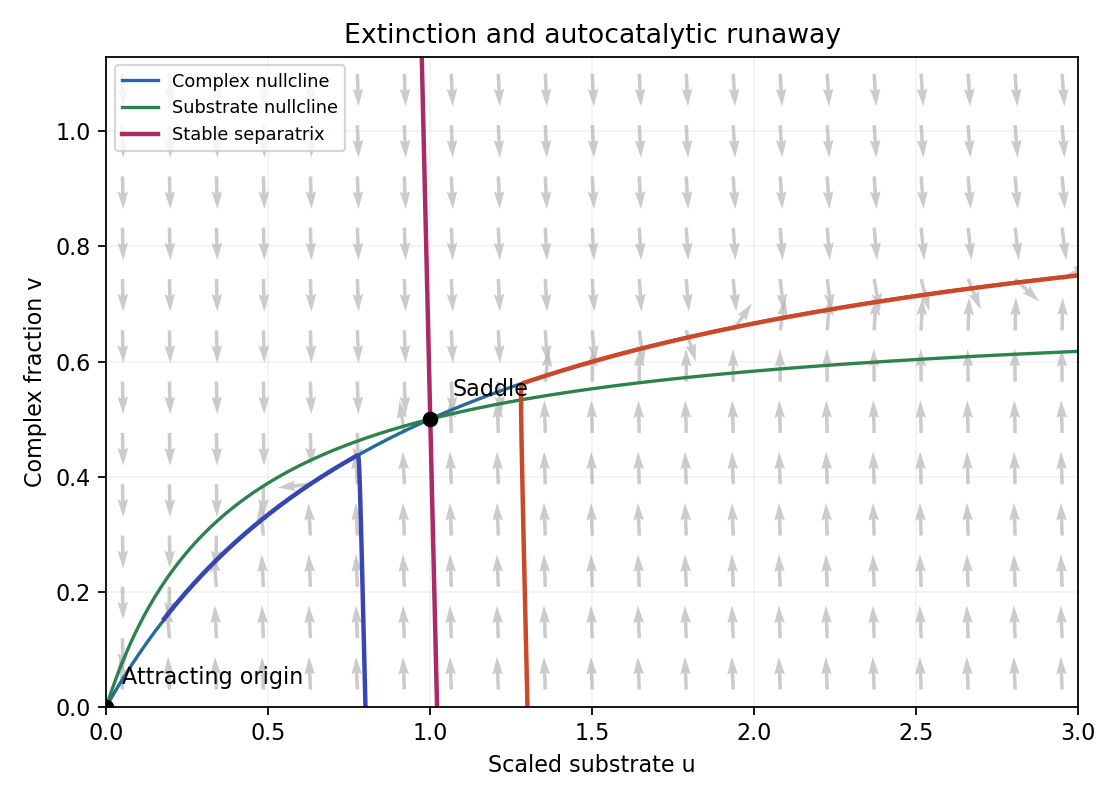
Autocatalytic enzyme phase plane: a fast complex fraction and a saddle threshold separate extinction from substrate runaway
. Details. 
After an initial layer of duration in slow time, while changes only slightly. The reduced substrate equation isBelow it decreases to zero; above it increases without bound. The exact threshold for initial is the intersection of the saddle equilibrium's stable manifold with that axis. For small it isIn dimensional initial-substrate units the leading threshold is . Comparing the actual initial value to this threshold determines its fate; the reference scale can be held fixed when varying the initial concentration.
The initial sequestration produces an correction if desired. Write the stable manifold as . The invariance equation at leading order gives and . Hencefor fixed parameters away from degenerate limits. The positive correction reflects the substrate consumed in building complexes from the initially enzyme-free-complex state.
The physical strip , is invariant, and the off-diagonal derivatives are nonnegative there, so ordered initial substrate values remain ordered. There are only the attracting origin and the saddle equilibrium. With Dulac function , the divergence of the weighted vector field is , excluding periodic orbits in its interior. The saddle equilibrium separatrix therefore gives the unique threshold on the initial axis: below it solutions tend to extinction, at it they tend to the saddle equilibrium, and above it they escape to infinity. Growth is at most exponential, so this is as time tends to infinity, not a finite-time blowup. This is autocatalytic enzyme clearance with a saddle threshold.
Articles by others on the same topic
There are currently no matching articles.