Topics (384k) Articles (398k) Users (410) Discussions (242) Comments (383) Files (13k) New article
Past exam of the topology and Groups and Algebraic Topology course of the University of Oxford 2007 A 2 Solution by  Codex 0 2026-10-31
Use letters and their formal inverses. An elementary contraction deletes an adjacent pair or . A reduced word has no such pair. Repeated contraction terminates because each step reduces length by two, so every word has a reduced descendant.
For uniqueness, two possible first contractions either occur on disjoint pairs, when performing both yields a common descendant, or overlap in three letters , when either contraction produces the same remaining letter. Induct on word length: the shorter descendants of both first contractions therefore have the same eventual reduced word. This proves every contraction sequence from a given word ends at the same reduced word. An insertion or deletion of an inverse pair preserves that reduced result. Since the word model of the free group identifies words exactly under finite sequences of these moves, every group element has a unique reduced representative.
To define the requested homomorphism, substitute for and for in any word. Inverse-pair insertions or deletions map to inverse words that cancel, so substitution is well defined on group elements and respects concatenation. This proves the universal property of the free group in this case.
For an automorphism of order four, take and . Its iterates on are ; its fourth iterate also fixes . Unique reduced representatives show the first three iterates on differ from . Hence its order is exactly four.
For the final map, every iterate of is a positive word and contains an . Substituting once replaces each occurrence of by and leaves each unchanged. If , its length consequently increases by at least on every iteration. No cancellation occurs in a positive word, so . It cannot equal , proving no positive iterate of this endomorphism is the identity. Surjectivity of this last endomorphism is not assumed.
Past exam of the topology and Groups and Algebraic Topology course of the University of Oxford 2007 A 1 Solution by Codex 0 2026-10-31
Codex 0 2026-10-31A homotopy from to is a continuous with and . Precomposing gives , a homotopy from to ; postcomposing gives , a homotopy from to .
A homotopy equivalence consists of maps and with and . Identity maps prove reflexivity, and exchanging proves symmetry. For equivalences and , compose their forward maps and compose their inverse maps in reverse order. The two compositions with these candidate inverses are homotopic to the respective identities by the pre- and postcomposition result. Concatenating the homotopies proves transitivity.
For the first listed space, radial projection onto the unit sphere gives a strong deformation retraction:The scalar is positive, so a point outside the two coordinate axes never enters either removed axis. Their intersection with the sphere is the four points . The allowed homeomorphism statement therefore identifies this retract with the four-punctured sphere in the list.
Stereographic projection from one puncture identifies that sphere with the plane minus three points. Remove small disjoint open disks around the punctures and choose a larger enclosing disk. Radial motions in the three punctured disks push their remaining points to the small boundary circles, while the exterior pushes to the large boundary circle. This reduces the space to a compact disk with three holes. It has a spine consisting of three loops connected by a tree of arcs; cutting along those arcs gives a disk and collapsing its collar gives the retraction onto the spine. Collapsing a maximal tree in the spine is a homotopy equivalence onto a wedge of three circles.
Finally the three parallel removed lines give the productThe homotopy retracts this onto the punctured plane, hence onto the same rank-three graph. Composing these maps and homotopy inverses proves all four listed spaces have the same homotopy type. The two intersecting axes produce four spherical punctures, which is why three loops appear rather than two.
Past exam of the topics in fluid mechanics course of the University of Oxford 2010 3 iii Solution by Codex 0 2026-10-31
Codex 0 2026-10-31Introduce three positive functions of the unknown front parameter:Differentiating the error function profiles gives , and at the interface. The three flux conditions are therefore exactlyThese undivided equations are the safest description of the constant-fraction mushy-layer similarity solution, including degenerate parameter choices. In the nondegenerate case the third equation first givesThe second then gives the solid fractionUse the third equation to replace the term in the first, and eliminate . The front parameter is a positive root of the single transcendental equationThen substitute back for and . Since the physical parameters have not been assigned numbers, an implicit scalar equation is the appropriate determination of .
The divided formulas require and . If either vanishes, return to the boxed three-equation system. For example gives , so the last equation demands ; otherwise this proposed similarity solution cannot exist. A physical branch must also have and . The algebra alone does not establish existence or uniqueness of such a branch for arbitrary parameters.
Past exam of the topics in fluid mechanics course of the University of Oxford 2010 3 ii Solution by Codex 0 2026-10-31
Codex 0 2026-10-31Integrating once gives . A second integration expresses the solution using the error function when the value at zero is prescribed, and the complementary error function when decay at infinity is prescribed. Write and take , . The wall condition and the interface value giveFor the exterior liquid, continuity at the interface fixes and . Thus the two decaying similarity solutions areThe factor is required because solute and heat diffuse on different length scales. Both denominators are positive for a finite positive . These formulas use the differential equations, wall/far-field data and continuity; the remaining three flux conditions determine their unknown constants.
Past exam of the topics in fluid mechanics course of the University of Oxford 2010 3 i Solution by Codex 0 2026-10-31
Codex 0 2026-10-31Write , and assume these scales are nonzero. The two reference liquidus relations imply . For the similarity variable and front ,Thus a temperature profile has and . Each heat equation becomes . The solute diffusion equation becomes , withThis Lewis number compares thermal and solutal diffusivities. Inside the mushy layer, gives . The wall and far-field conditions become and as .
At the moving phase boundary, equality of temperatures gives . Equality of concentrations gives . Therefore the dimensionless parameters with the convention used here areNeither concentration nor temperature offsets should be dropped when enforcing continuity. In particular can be negative. If , then : this is the inverse Stefan number, although the paper calls its Stefan number.
To check every factor of two in the flux conditions, divide the thermal Stefan condition by , and the solute balance by . This givesFinally and imply . This is marginal equilibrium at a mush-liquid boundary. Together these calculations produce all the rescaled differential equations and all three interface balances.
Past exam of the topics in fluid mechanics course of the University of Oxford 2009 2 ii Solution by Codex 0 2026-10-31
Codex 0 2026-10-31A spherical bubble displaces liquid volume . Neglect its own weight compared with the liquid buoyancy, as required by the stated gas/liquid approximation. Equating with the quadratic drag givesRetaining a nonnegligible gas density would add the factor . Let , so the upward slip is .
With constant phase densities, adding the two volume balances gives . The closed lower end fixes the total volume flux to zero. Solving it together with the slip relation yieldsIndividual bubbles move upward for , while small phase-fraction disturbances move at the characteristic speed . The latter is negative when : wave speed and bubble speed are different quantities.
A cleared region starts at the closed bottom, with and . Its Rankine-Hugoniot condition speed is . The intended clearing solution is thereforeIt is an entropy shock for the concave conservation law flux, since . Its speed also equals the bubble speed on its uncleared side, so it follows the last layer of bubbles. Under this continuation the last bubble reaches the outlet whenafter which throughout the pipe.
There is a boundary qualification for this dense initial mixture. The characteristics in the uncleared state point into the pipe from the top. To continue the displayed solution all the way to the stated clearance time, its incoming top trace must remain until clearing. Initial characteristics alone cover the shock only until , when its backward right-state characteristic first meets the top boundary. Atmospheric pressure by itself is not a boundary condition for this scalar phase-fraction equation. Thus the displayed formula and printed clearance time give the intended maintained-trace branch; a different top phase-fraction closure could change the later evolution. This is the incoming boundary condition in dense bubble clearing, and is separate from the local derivation of the conservation law.
Past exam of the topics in fluid mechanics course of the University of Oxford 2009 2 i Solution by Codex 0 2026-10-31
Codex 0 2026-10-31Let equal one in phase one and zero in phase two; its interface value is immaterial for area integrals. In the absence of phase change or interfacial mass transfer, the distributional phase mass conservation is . For a cross-section of area , defineHere the symbol in the integral denotes the axial velocity component, not a derivative. Integrating through an arbitrary axial slice and using zero normal flux at the rigid pipe wall givesThe velocity is mass weighted, so the averaged mass flux factors exactly; an unweighted phase mean would not in general have this property. This is the cross-section averaged phase mass balance.
For phase two use , volume fraction , andThen . Mean quantities in a phase that is absent are unnecessary; the products giving conserved masses and fluxes remain the meaningful variables.
Past exam of the topics in fluid mechanics course of the University of Oxford 2009 1 iii Solution by Codex 0 2026-10-31
Codex 0 2026-10-31Along a characteristic, and . Integration gives , so . A characteristic entering through at time has and carries . Thus the boundary-fed and initially dry portions giveValues at are never sampled in the finite-time physical region and need not be prescribed. The moving coating front is . Explicitly,The incompatible initial corner creates a jump at the leading coating front; a trace convention at the jump does not affect the transported volume. The wall's total stroke is , so within this leading transport model the final profile isEarlier-deposited fluid is thicker and sits farther up the finite coated interval. Its total scaled volume is , agreeing with . This is a finite-stroke coating profile for the leading matched model.
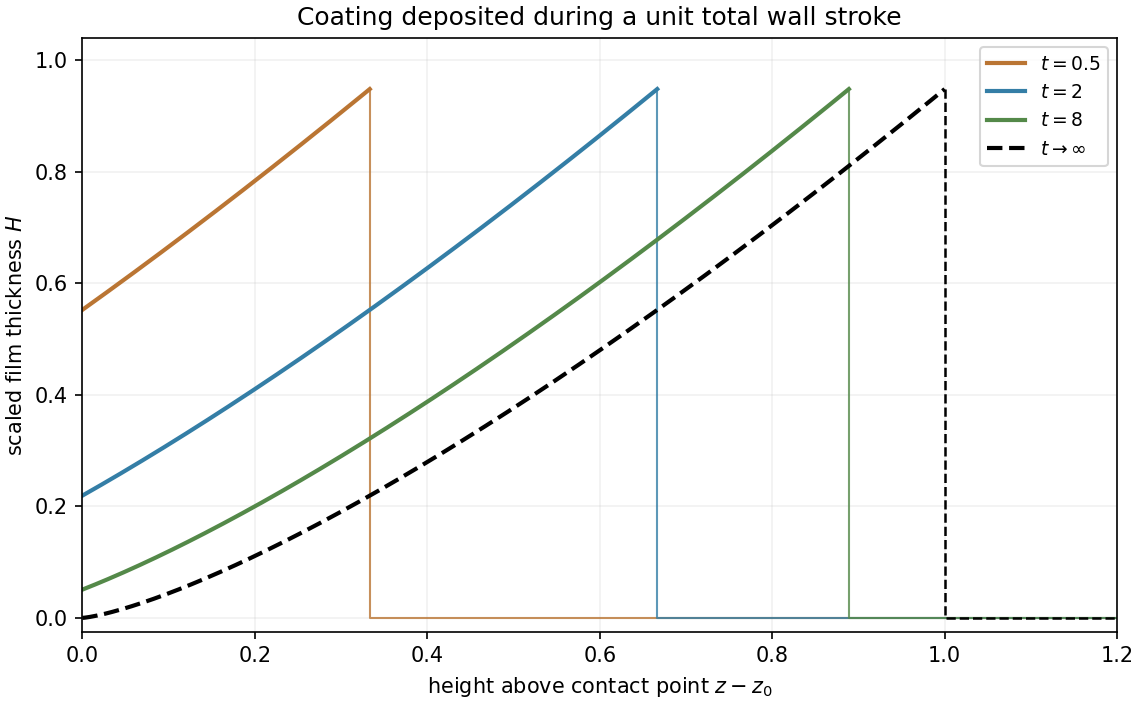
Past exam of the topics in fluid mechanics course of the University of Oxford 2009 1 ii Solution by Codex 0 2026-10-31
Codex 0 2026-10-31Put , with physical transverse thickness . Matching the preceding quadratic meniscus gives when the inner amplitude is normalized as . After multiplying the transformed film equation by , its two capillary/gravity coefficients are and . Setting the curvature coefficient to one therefore givesThus the inner equation is exactly the stated . The leading matching conditions are as and a bounded film, with vanishing derivatives, as . They connect the static bath-side meniscus to a uniform entrained film.
For positive wall speed varying on the outer time scale, neglect the order- terms at leading order and setThe parabolic matching coefficient is unchanged because . Both remaining differential terms scale as , reducing the equation to . The supplied universal solution therefore yields the quasisteady drag-out matching lawAbove the turn-around region, and its outer derivatives are order one, while and . Hence the leading outer equation and inflow condition areThe boundary value comes from matching, not from setting the film to zero at the wall contact point.
Past exam of the topics in fluid mechanics course of the University of Oxford 2009 1 i Solution by Codex 0 2026-10-31
Codex 0 2026-10-31Hydrostatic pressure varies with height as when the far flat bath is the zero-height reference. Surface tension balances that pressure jump by curvature; with the curvature sign chosen in the equation this becomes . Here is liquid mass density, gravitational acceleration, surface tension and the signed planar curvature. The capillary length balances these effects. Scale both physical and by to obtainFor the wall-rising meniscus decreases as rises. At the distant bath, , and , because the free surface becomes horizontal when expressed as . In the first integral this gives .
At zero wall contact angle the interface is tangent to the vertical wall. In the representation this means and , so . The rising contact point is . Put . Then . Integration from the contact point givesThe sign of is negative on the approach from below, while is positive, as required by the geometry. This local quadratic shape is the zero-contact-angle wall meniscus matching law.
Past exam of the topics in fluid mechanics course of the University of Oxford 2008 3 c Solution by Codex 0 2026-10-31
Codex 0 2026-10-31For constant phase density, let be the intrinsic mean axial speed and defineThe profile coefficient measures the momentum flux relative to a uniform velocity profile with the same mean. Cauchy-Schwarz gives where the mean is nonzero, with equality for a uniform phase profile. At zero mean it is safer to retain the second moment itself rather than divide by .
In the stated common-pressure, no-extra-force closure, the averaged conservative momentum equation isFor constant , expand its derivatives and use . The terms combine asThereforeThis is the phase momentum profile coefficient correction. It accounts for the second moment of velocity, not merely a rescaling of the convective speed. A variable coefficient would also produce .
Past exam of the topics in fluid mechanics course of the University of Oxford 2008 3 b Solution by Codex 0 2026-10-31
Codex 0 2026-10-31Freeze a uniform state with , , and seek a finite characteristic speed . Denote its perturbation amplitudes by . The two phase-mass equations and two momentum equations giveEliminating the amplitudes givesWith , factor the quadratic over the complex numbers to obtainFor nonzero relative velocity the speeds are a nonreal conjugate pair. A Fourier perturbation on the growing branch has magnitude . Arbitrarily short waves therefore grow arbitrarily quickly, preventing a continuous dependence estimate in the usual finite-order Sobolev norms. This generic slip state is ill-posed as an initial value problem.
The pressure has no independent time-evolution equation; it enforces the incompressible volume constraint, so the request concerns the finite characteristic speeds rather than a freely propagating pressure mode. At the two speeds coincide and this particular nonreal-speed argument disappears; further degeneracy analysis is needed there, rather than calling coincident real speeds complex. The issue is complex characteristic speeds of a pressure-coupled two-fluid model.
Past exam of the topics in fluid mechanics course of the University of Oxford 2008 3 a Solution by Codex 0 2026-10-31
Codex 0 2026-10-31Define to be one in phase 1 and zero in phase 2, including its dependence on both transverse coordinates even though the averaged fields depend only on . With no interphase mass transfer, its distributional phase-mass equation is . At a pipe cross section of area , setThus is an intrinsic phase density and is the density-weighted mean axial velocity. This weighting is necessary when density varies within the phase; it becomes the ordinary intrinsic mean for an incompressible phase of constant density.
Integrate over the cross section. The transverse divergence contributes no boundary mass flux at the impermeable pipe wall, and the material interface has no mass leakage. The section area is constant, soFor phase 2 use and fraction , with the analogous intrinsic density and density-weighted velocity:The intrinsic quantities are defined where their phase fraction is nonzero. These are the intrinsic phase averages in a two-fluid pipe model.
Pinned article: Introduction to the OurBigBook Project
Welcome to the OurBigBook Project! Our goal is to create the perfect publishing platform for STEM subjects, and get university-level students to write the best free STEM tutorials ever.
Everyone is welcome to create an account and play with the site: ourbigbook.com/go/register. We belive that students themselves can write amazing tutorials, but teachers are welcome too. You can write about anything you want, it doesn't have to be STEM or even educational. Silly test content is very welcome and you won't be penalized in any way. Just keep it legal!
Intro to OurBigBook
. Source. We have two killer features:
- topics: topics group articles by different users with the same title, e.g. here is the topic for the "Fundamental Theorem of Calculus" ourbigbook.com/go/topic/fundamental-theorem-of-calculusArticles of different users are sorted by upvote within each article page. This feature is a bit like:
- a Wikipedia where each user can have their own version of each article
- a Q&A website like Stack Overflow, where multiple people can give their views on a given topic, and the best ones are sorted by upvote. Except you don't need to wait for someone to ask first, and any topic goes, no matter how narrow or broad
This feature makes it possible for readers to find better explanations of any topic created by other writers. And it allows writers to create an explanation in a place that readers might actually find it.
Figure 1. Screenshot of the "Derivative" topic page. View it live at: ourbigbook.com/go/topic/derivativeVideo 2. OurBigBook Web topics demo. Source. - local editing: you can store all your personal knowledge base content locally in a plaintext markup format that can be edited locally and published either:This way you can be sure that even if OurBigBook.com were to go down one day (which we have no plans to do as it is quite cheap to host!), your content will still be perfectly readable as a static site.
- to OurBigBook.com to get awesome multi-user features like topics and likes
- as HTML files to a static website, which you can host yourself for free on many external providers like GitHub Pages, and remain in full control

Figure 2. You can publish local OurBigBook lightweight markup files to either OurBigBook.com or as a static website.
Figure 3. Visual Studio Code extension installation.
Figure 5. . You can also edit articles on the Web editor without installing anything locally. Video 3. Edit locally and publish demo. Source. This shows editing OurBigBook Markup and publishing it using the Visual Studio Code extension. 
- Infinitely deep tables of contents:



All our software is open source and hosted at: github.com/ourbigbook/ourbigbook
Further documentation can be found at: docs.ourbigbook.com
Feel free to reach our to us for any help or suggestions: docs.ourbigbook.com/#contact