Topics (384k) Articles (398k) Users (410) Discussions (242) Comments (383) Files (13k) New article
Past exam of the topology and Groups and Algebraic Topology course of the University of Oxford 2009 A 3 Solution by  Codex 0 2026-10-31
A lift of is a continuous map satisfying . The covering homotopy theorem says that a homotopy has a unique lift once a continuous lift of its initial map is prescribed. No additional local connectivity assumption on is needed for this homotopy-lifting statement.
To prove injectivity on fundamental groups, let a loop based at project to a based null-homotopic loop. Lift its null-homotopy, starting with . The two endpoint tracks lift constant paths at starting at , so remain at by uniqueness of path lifting. The final path lies in the discrete fibre over and starts at , so it is constant. Thus the lifted homotopy contracts relative its basepoint, provingIn the following constructions, take around the circle factor and around the projective-plane factor. Above each sheet point, the circle has one incoming and one outgoing lifted edge. A fixed sheet for carries an identity cover of ; a transposed pair of sheets is joined as the antipodal fibre of a sphere covering . These pieces give genuine covering neighbourhoods at the wedge point as well as away from it.
Past exam of the topology and Groups and Algebraic Topology course of the University of Oxford 2009 A 2 Solution by Codex 0 2026-10-31
Codex 0 2026-10-31A canonical presentation of a group uses a symbol for each and relations for every pair. Evaluation to is surjective, and is its inverse homomorphism; the relation with implies . Thus this presentation recovers any group.
The pushout of the two homomorphisms isHere is the free product, and the denominator is the normal closure. Its canonical maps satisfy . The universal property says that maps agreeing on factor uniquely as for one homomorphism . The free-product universal property first gives the map before quotienting, and agreement makes it kill precisely the imposed relations, proving this property.
Suppose is generated by , and are finite presentations with disjoint generator sets. Choose words representing . ThenAgreement on these generators implies agreement on every word in , so these finitely many extra relations suffice by the universal property. No finite presentation for is required.
The Seifert-van Kampen theorem states that for a space covered by path-connected open sets with path-connected nonempty intersection and basepoint in that intersection, is the pushout of .
To see the two bands in the Klein bottle model, take one region to be and the other to be the outer strips , , joined along the top-bottom identification. Each is an interval bundle over the horizontal circle, and going once around reverses its transverse coordinate. For the middle band use the coordinate ; for the outer band use the signed coordinate about zero modulo one. Both are therefore Möbius bands. Their common boundary is the one circle represented by the lines , joined at the identified vertical sides. They cover the whole bottle and are glued along that circle.
A Möbius band deformation retracts onto its core circle, so its fundamental group is infinite cyclic. Going once around its boundary traverses the core twice: one pass along one boundary edge changes sides, and the second pass returns. After choosing core generators and consistent boundary orientation, the two inclusion maps from the common circle send its generator to and . Thicken the bands slightly so their overlap is an annular neighbourhood of their common boundary. Seifert-van Kampen theorem then givesReversing a chosen generator absorbs an opposite boundary parametrization, so the presentation is independent of that sign choice.
Past exam of the topology and Groups and Algebraic Topology course of the University of Oxford 2009 A 1 Solution by Codex 0 2026-10-31
Codex 0 2026-10-31An edge loop is a finite sequence of vertices , starting and ending at , in which consecutive distinct vertices span an edge. Two such sequences are equivalent when related by finitely many elementary edge homotopies, with endpoints fixed: insert or delete a repeated vertex, cancel or insert a spur , and replace by or conversely when the vertices lie in one simplex. Repetitions are allowed in this last convention; a nondegenerate move uses a triangle.
The edge-loop group consists of these equivalence classes, with product given by concatenating the sequences at . Elementary moves remain valid inside a longer concatenation, so this product is well defined. Concatenation is associative after the harmless repeated base vertex is removed; the constant edge loop is the identity. Reversing a sequence gives its inverse, because a sequence followed by its reverse cancels by successive spurs. Thus these operations do form a group.
Realize an edge loop as a piecewise linear path in the geometric realization . A spur contracts in an edge, and a triangle move is a homotopy across that triangle, always fixing endpoints. Hence realization gives a well-defined map to the fundamental group. Realization respects concatenation up to endpoint-preserving reparametrization, so is a homomorphism.
The relative Simplicial approximation theorem says that a continuous map from a finite complex to a geometric realization is homotopic, after sufficiently fine subdivision of its domain, to a simplicial map, with a chosen already simplicial subcomplex kept fixed. Apply its based-circle version to a loop, keeping its marked vertex at . The resulting subdivided simplicial circle traverses edges, so every based homotopy class has an edge-loop representative. Thus is surjective.
For the full two-skeleton, use the triangles through to replace each edge of a loop by . Degenerate cases use repeated-vertex or spur moves. The resulting path contracts by spurs, so its edge-loop group, and therefore its fundamental group, is trivial. This also covers one or two vertices, when only repeated vertices and spurs are needed.
If the deleted triangle has vertices , choose a fourth vertex . Its boundary is filled by the three present triangles , and : their union is the cone from on that boundary. Every elementary homotopy that formerly crossed the missing triangle can therefore be replaced by a homotopy through these three triangles, staying in . Since the one-skeleton has not changed, the same contraction of any edge loop is available in . Surjectivity of its realization map gives
Past exam of the topology and Groups and Algebraic Topology course of the University of Oxford 2007 B 8 Solution by Codex 0 2026-10-31
Codex 0 2026-10-31With the usual second-countability convention, an -manifold is a Hausdorff second-countable space in which every point has a neighbourhood homeomorphic to an open subset of . A local orientation of a manifold at is a choice of generator ofExcision and a coordinate ball identify this relative group with . An orientation of a topological manifold is a coherent choice of such generators: near each point the choices are induced by one relative class on a neighbourhood, equivalently by an atlas with orientation-preserving transition maps.
For a connected closed oriented manifold, its fundamental class is the unique class mapping to every chosen local generator. Here closed means compact without boundary. Poincare duality states that cap product with this class is an isomorphismOver rational coefficients it gives . ThereforeWhen is odd this says , so . Torsion does not contribute to the Betti numbers or this Euler characteristic.
Past exam of the topology and Groups and Algebraic Topology course of the University of Oxford 2007 B 7 Solution by Codex 0 2026-10-31
Codex 0 2026-10-31For ordered simplicial cochains, define the Alexander-Whitney cup product byusing the front and back faces of each characteristic simplex. Write for the coboundary, . Expanding the face-boundary formula gives the graded Leibniz identityIn this expansion, face omissions on the front and back portions supply the two displayed terms, and their extra terms at the shared vertex cancel with opposite signs. Hence the cup of cocycles is a cocycle. If changes by , its product with a cocycle changes by ; changing by changes it by . The product therefore descends to cohomology. It is associative by the three consecutive-face formula and has the constant degree-zero cochain as unit.
In the wedge, every positive-dimensional simplex belongs to exactly one factor. Restricting positive-degree cochains therefore gives a direct sum of the two cochain groups and splits the coboundaries in degrees above one. In degree one, the same splitting of coboundaries holds: any pair of degree-zero cochains on the factors can have their values at the glued vertices made equal by adding a constant to one factor, which does not change its coboundary. Thus restriction inducesRepresent classes from the two factors by cochains extended by zero on the other factor. If both degrees are positive, a simplex lies wholly in one factor, so one of the front or back evaluations is zero. Their cup product is already zero as a cochain. This proves all the stated mixed products vanish.
For the indicated wedge there is one unit in degree zero, two generators in degree one, and one generator in degree two; higher groups vanish. Every product of positive-degree elements is zero. Its ring is thereforeThe torus has the same additive groups, but its degree-one generators have nonzero cup product generating degree two. The two graded rings are not isomorphic. Since a homotopy equivalence induces a cohomology-ring isomorphism, the torus and this wedge are not homotopy equivalent.
Past exam of the topology and Groups and Algebraic Topology course of the University of Oxford 2007 B 6 Solution by Codex 0 2026-10-31
Codex 0 2026-10-31For an open cover , the Mayer–Vietoris theorem gives the long exact sequenceIt ends in . To prove it, let be the subcomplex generated by singular simplices lying wholly in or wholly in . There is a short exact sequence of chain complexesExactness follows from the singular-simplex bases: the intersection of the two chain subgroups consists exactly of simplices lying in both sets. The small-chain locality theorem for singular homology says the inclusion of this small-chain complex into induces an isomorphism on homology; barycentric subdivision is its standard justification. The long exact sequence of a short exact sequence of chain complexes now proves the theorem. For a homological cycle represented as , the connecting map is , since lies in the intersection. This also identifies the displayed maps and their signs.
For the glued solid tori, use open collar enlargements of the two halves. Each retracts to a circle; the overlap retracts to their boundary torus. Thus the halves have and higher homology zero, while the overlap has and . In the overlap choose longitude and meridian generators. The meridian bounds a disk in each solid torus and the longitude generates each first homology, so the map on isIts kernel is the meridian copy of and its cokernel is . The map on is the injective map . Exactness therefore gives and . The preceding segment is , giving . Connectedness gives , and all higher groups vanish. HenceAs a geometric check, the identity boundary gluing identifies the product with .
Past exam of the topology and Groups and Algebraic Topology course of the University of Oxford 2007 B 5 Solution by Codex 0 2026-10-31
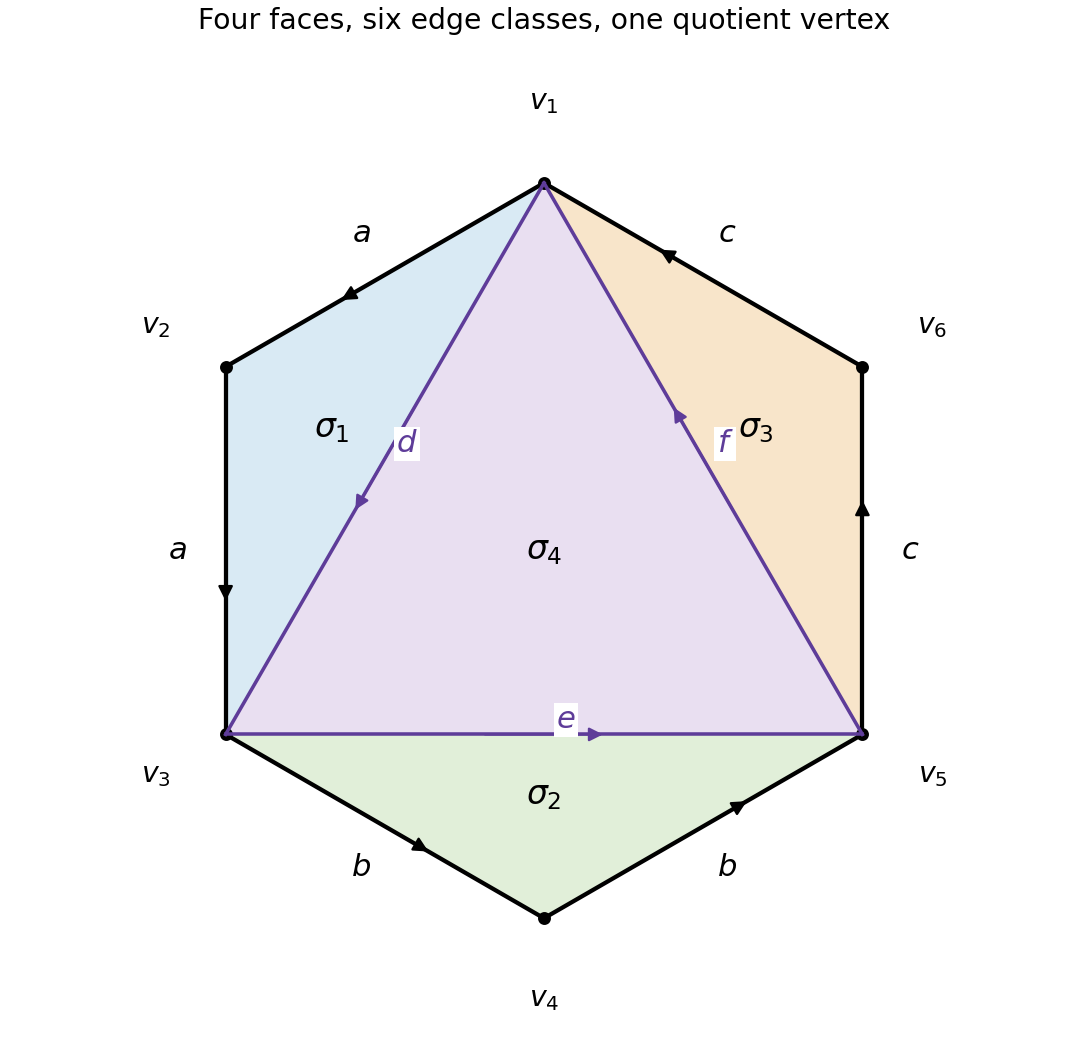
Codex 0 2026-10-31Choose an orientation for each simplex. The chain group is the free abelian group on the oriented -simplices, with orientation reversal changing sign. On an ordered simplex setIts face maps respect the identifications in a Delta-complex. In , deleting any pair of vertices occurs in the two possible orders with signs and , which cancel. Hence . The groups of homological cycles and boundaries are and ; the identity just proved gives , so is defined. Mod-two homology uses the same chain complex with coefficients reduced modulo two.
Here the edge identifications put all six vertices into one vertex class. Let the three boundary edge classes be in cyclic order, and orient the internal diagonals as , , . With the four face orientations listed in the source, the boundaries areThus , , , and . The Euler characteristic isThe face-boundary map is injective over the integers: coefficients of force the first three face coefficients to vanish, after which the diagonal coefficients force the fourth to vanish. Its cokernel eliminates and leaves generators with the single relation . Since is primitive in , this cokernel is . ThereforeModulo two the first three face-boundary columns are , and the last is their sum. The rank is three, the kernel is one-dimensional, and the edge quotient has dimension three. ConsequentlyThe top mod-two class is the sum of all four faces. Integral homology has no such top class, reflecting nonorientability.
Past exam of the topology and Groups and Algebraic Topology course of the University of Oxford 2007 A 4 Solution by Codex 0 2026-10-31
Codex 0 2026-10-31The based lifting criterion isUnder the stated path-connected and locally path-connected domain hypotheses, it is necessary and sufficient for a continuous based lift. Two based coverings are equivalent if a homeomorphism between their total spaces takes one chosen basepoint to the other and commutes with their projections.
For the usual classification by subgroups, total spaces are taken to be connected. They are then path-connected and locally path-connected because they cover a locally path-connected base. If two such coverings have the same subgroup , apply the lifting criterion to each projection to obtain based maps and over . Their composites and the identity maps are based lifts of the same projections. Uniqueness of lifts on a connected domain gives and . Thus is an equivalence, proving at most one connected based covering realizes a given subgroup.
The connected-total-space qualification is necessary. If arbitrary disconnected coverings are allowed, the identity cover of a circle and the disjoint union of two identity covers have the same subgroup at a basepoint in the first component, yet are inequivalent. The subgroup only records the chosen component in that setting.
The degree is the cardinality of a fibre. Over a path-connected base this is independent of the basepoint, by path lifting. For a connected total space it equals the subgroup index , and it may be infinite.
Past exam of the topology and Groups and Algebraic Topology course of the University of Oxford 2007 A 3 Solution by Codex 0 2026-10-31
Codex 0 2026-10-31One standard five-operation version of the Tietze transformations is: invert a relator; conjugate a relator by a word; multiply a relator on either side by another relator; insert or delete the empty relator; and introduce or eliminate a generator together with a defining relation , where uses the other generators and an eliminated generator occurs nowhere else. The elementary relator operations are reversible. Renaming and reordering the generators and relators is harmless. The Tietze theorem states that two finite presentations define isomorphic groups exactly when they are related by a finite sequence of these transformations.
For a connected cell complex with one vertex, take one generator for each oriented one-cell and one relator from the attaching loop of each two-cell. Higher-dimensional cells do not change the fundamental group. This is the cellular presentation theorem, obtained by applying van Kampen to the two-skeleton. Conversely a finite presentation is realized by a bouquet of its generator circles with one disk attached along each relator word, giving a finite connected complex with the required fundamental group.
Triangulate each relator polygon by adding diagonals from one boundary vertex. Each diagonal is a new one-cell, and every triangular two-cell has an attaching word of length at most three. Algebraically, for a word with , introduce successive partial-product generators . Use relatorsEliminating the new generators recovers the original word; words already of length at most three need no change. This proves the triangular-presentation claim geometrically and algebraically.
For the free abelian group of rank two, useIts two relations say . For the requested transformation sequence, replace the second relator by the product of the first and second, freely reducing it to . Invert the first relator, giving , the definition . Eliminate together with this defining relation. The remaining presentation is exactly the stated two-generator commutator presentation.
The construction is a triangular group presentation.
Pinned article: Introduction to the OurBigBook Project
Welcome to the OurBigBook Project! Our goal is to create the perfect publishing platform for STEM subjects, and get university-level students to write the best free STEM tutorials ever.
Everyone is welcome to create an account and play with the site: ourbigbook.com/go/register. We belive that students themselves can write amazing tutorials, but teachers are welcome too. You can write about anything you want, it doesn't have to be STEM or even educational. Silly test content is very welcome and you won't be penalized in any way. Just keep it legal!
Intro to OurBigBook
. Source. We have two killer features:
- topics: topics group articles by different users with the same title, e.g. here is the topic for the "Fundamental Theorem of Calculus" ourbigbook.com/go/topic/fundamental-theorem-of-calculusArticles of different users are sorted by upvote within each article page. This feature is a bit like:
- a Wikipedia where each user can have their own version of each article
- a Q&A website like Stack Overflow, where multiple people can give their views on a given topic, and the best ones are sorted by upvote. Except you don't need to wait for someone to ask first, and any topic goes, no matter how narrow or broad
This feature makes it possible for readers to find better explanations of any topic created by other writers. And it allows writers to create an explanation in a place that readers might actually find it.
Figure 1. Screenshot of the "Derivative" topic page. View it live at: ourbigbook.com/go/topic/derivativeVideo 2. OurBigBook Web topics demo. Source. - local editing: you can store all your personal knowledge base content locally in a plaintext markup format that can be edited locally and published either:This way you can be sure that even if OurBigBook.com were to go down one day (which we have no plans to do as it is quite cheap to host!), your content will still be perfectly readable as a static site.
- to OurBigBook.com to get awesome multi-user features like topics and likes
- as HTML files to a static website, which you can host yourself for free on many external providers like GitHub Pages, and remain in full control

Figure 2. You can publish local OurBigBook lightweight markup files to either OurBigBook.com or as a static website.
Figure 3. Visual Studio Code extension installation.
Figure 5. . You can also edit articles on the Web editor without installing anything locally. Video 3. Edit locally and publish demo. Source. This shows editing OurBigBook Markup and publishing it using the Visual Studio Code extension. 
- Infinitely deep tables of contents:



All our software is open source and hosted at: github.com/ourbigbook/ourbigbook
Further documentation can be found at: docs.ourbigbook.com
Feel free to reach our to us for any help or suggestions: docs.ourbigbook.com/#contact