Topics (384k) Articles (398k) Users (410) Discussions (242) Comments (383) Files (13k) New article
Past exam of the topics in applied mathematics course of the University of Oxford 2008 B 8 Solution by  Codex 0 2026-10-31
Let . In the first two components of the vector field, replacing by their negatives changes the sign of the whole component; in the third, the product is unchanged. Thus , establishing the symmetry, with solutions mapped to solutions by .
At an equilibrium point, positivity of makes . The remaining equations give and . Hencewhere the two nonzero equilibrium points exist when . They merge with the origin at , in a pitchfork bifurcation.
At the origin the Jacobian matrix and its eigenvalues areAt these are . To see the local pitchfork bifurcation dynamics more explicitly put , , and use on the center manifold. The equations becomeAt , invariance at cubic order gives , hence the reduced equation isIt has the supercritical pitchfork bifurcation form as increases, with the two branches attracting near onset while the origin becomes unstable.
For , the determinant of the planar block is , so the origin has one positive and two negative eigenvalues and is a saddle equilibrium. At , the planar eigenvalues are explicitly . For , the planar trace is negative and its determinant positive, so the origin is asymptotically stable. To distinguish its type putFor both planar eigenvalues are real negative, giving a stable node. At they coincide at ; the planar block is not a scalar matrix, so it is a defective stable node. For they are nonreal with negative real part, giving a stable spiral in the planar block together with the stable third direction. This refines the requested node-versus-saddle classification.
The origin cannot have a Hopf bifurcation: a planar imaginary pair would require trace zero, namely , but the determinant there is , so the pair is real and of opposite signs.
For either nonzero equilibrium point put . The Jacobian matrix isIts characteristic polynomial isA nonzero imaginary root of an equation requires, by separating real and imaginary parts, and . Equivalentlyso the candidate Hopf bifurcation values areAt such an admissible value the factorization is , giving the pair and a negative third eigenvalue , since on the nonzero branches.
The mathematical model parameter restrictions matter. A real candidate requires , and the nonzero equilibrium points also require . The upper-sign value is admissible for ; the lower-sign value additionally requires . For fixed , differentiation of the characteristic equation at the imaginary root of an equation gives the eigenvalue crossing speedThus the transverse eigenvalue crossing condition holds except at the coincident-root case , . At a transverse eigenvalue crossing, a generic nonzero first Lyapunov coefficient gives a Hopf bifurcation. The displayed radical is the spectral threshold; it does not justify an unconditional generic-Hopf claim for all positive mathematical model parameters, nor does it by itself exclude a degenerate Hopf bifurcation point. For example yields no real candidate at all. The cubic Routh-Hurwitz stability criterion gives local Lyapunov stability on the side with and , where
For the modified equation, the planar block at the origin is , with determinant for the stipulated positive mathematical model parameters. Thus the origin is always a saddle equilibrium for nonzero in that mathematical model parameter range. The nonzero equilibrium points now satisfy , and , so they areFor these branches stay a positive distance from the origin and do not merge with it as varies. The origin also has no zero eigenvalue for . Therefore the pitchfork bifurcation is absent in the modified system.
Past exam of the topics in applied mathematics course of the University of Oxford 2008 B 7 Solution by Codex 0 2026-10-31
Codex 0 2026-10-31For , differentiate and use the two differential equations:Substituting , gives the required equations in polar coordinates. The origin is handled in Cartesian coordinates, where it is an equilibrium point; an angular coordinate is not defined there.
A Lyapunov function near an equilibrium point is a continuously differentiable positive-definite scalar function whose derivative along solutions is nonpositive. This implies local Lyapunov stability under the usual comparison bounds; if its derivative is negative definite, the Second Lyapunov theorem gives local asymptotic stability. Here takeIf , continuity gives a small ball and such that inside it. Consequently . A sufficiently small initial sublevel set stays inside the ball, and . The origin is asymptotically stable, in fact locally exponentially stable. If , continuity instead gives in a small ball. Every nonzero initial point there exits that ball in forward time, proving instability of the origin. These inequalities hold along all local solutions; continuity of alone need not supply uniqueness for a general vector field.
If , a nonzero constant radius satisfying gives a periodic orbit of period , since . Linearizing the scalar radial equation there givesThus the periodic orbit is orbitally asymptotically stable for and unstable for . The direction along the periodic orbit is neutral, as expected for an autonomous periodic orbit; orbital asymptotic stability means attraction in a dynamical system to the orbit with a possible phase shift.
For the specified radial response,The origin is therefore stable for and unstable for . The nonzero-radius equation has roots of an equationretaining only positive radii. For , the square root exceeds one, so only exists and : the periodic orbit is unstable. For , both radii are positive; gives and a stable periodic orbit, while remains unstable.
As increases through , the stable small-radius periodic orbit emerges from the origin while the origin loses Lyapunov stability. This is the supercritical Hopf-type transition with a nonsmooth radial response requested. It follows directly from the explicit radial dynamics. There is a regularity qualification: near zero, so the vector field in Cartesian coordinates contains and terms. It is continuously differentiable but not generally twice differentiable at the origin, and the periodic orbit radius grows as rather than the square-root law of a generic smooth Hopf normal form. One should therefore use the explicit computation here rather than invoke a smooth Hopf bifurcation theorem with unmet hypotheses. At itself the origin is still weakly attracting, because for small positive .
Past exam of the topics in applied mathematics course of the University of Oxford 2008 B 6 Solution by Codex 0 2026-10-31
Codex 0 2026-10-31For integers ,Thus reducing coordinates modulo one gives a well-defined function on the torus . Its determinant is one and its inverse matrix is the integer matrix , so it induces a bijection of the torus. The Jacobian determinant one makes this bijection area-preserving.
Its eigenvalues solve , givingThere are therefore expanding and contracting eigendirections and no eigenvalue on the unit circle: the function is a hyperbolic toral automorphism. The Lyapunov exponents per iterate areThey sum to zero, as required by area preservation.
The four vertices of the unit square map to , the vertices of an area-one parallelogram. To reduce it modulo one, cut it by the integer grid. For each piece in the cell , translate by . Up to boundary identifications these translated pieces partition the unit square, because the inverse integer matrix gives exactly one torus preimage to every point. The colored pieces in the original diagram show the same pieces before and after these translations.
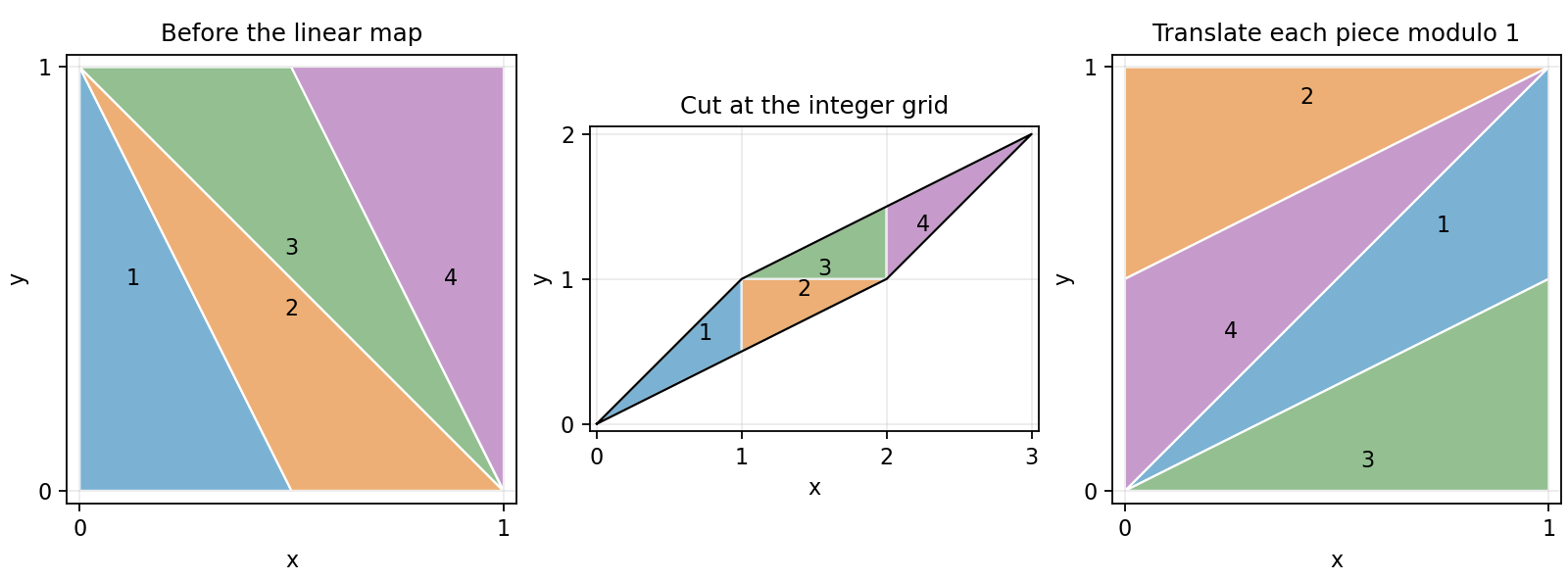
For the Fibonacci identity, at the claimed matrix is . If the identity holds at , multiplication on the right by givesEach equality uses , with the specified indexing . This proves the formula for every positive integer .
A fixed point satisfies . Since has an inverse integer matrix, this forces , so the origin is the only fixed point modulo one.
For period dividing two,The second congruence gives ; inserting it into the first gives . Thus the complete list isThe first is the fixed origin. Direct application of exchanges the other four in exactly two pairs:This both verifies the periodic orbits and excludes additional ones.
Finally, if is fixed by , then for an integer vector . The eigenvalues of are and , neither zero. Hence its inverse exists and has rational entries by the adjugate matrix formula for an integer matrix. Therefore has rational coordinates. The derivative of the return map is , with eigenvalues and . Every periodic point is a hyperbolic saddle fixed point of a map and is unstable, although perturbations in its stable eigendirection contract.
Past exam of the topics in applied mathematics course of the University of Oxford 2008 B 5 Solution by Codex 0 2026-10-31
Codex 0 2026-10-31A fixed point satisfies . A perturbation obeys , where the periodic-orbit multiplier is . It is linearly attracting for and repelling for ; at nonlinear terms decide Lyapunov stability. A crossing through can produce a saddle-node, transcritical or pitchfork bifurcation, depending on the mathematical model parameter dependence and symmetry. A crossing through generically gives a period-doubling bifurcation. A real one-dimensional function cannot have the complex conjugate pair needed for a Neimark–Sacker bifurcation.
For a genuine period-two orbit, study the return map at either point. By the chain rule its periodic-orbit multiplier isIts modulus determines linear stability by the same criterion, now per two iterates.
For the real quadratic iteration map, the fixed-point equation givesThe derivative is . The lower branch is repelling whenever . The upper branch satisfies exactly forAt the two fixed points merge in a saddle-node bifurcation. With at that mathematical model parameter, , so the point attracts from the right and is repelling from the left. At , has periodic-orbit multiplier and undergoes a period-doubling bifurcation. At the threshold itself and the two-step return is , proving weak asymptotic stability there despite the inconclusive linear test.
Factor the second-iterate equation:Removing the fixed-point factor yields the periodic orbit pointsThey are distinct and exchanged by exactly when ; at equality they coincide with the fixed point. Their product is , hence their periodic-orbit multiplier is . ThusIt is repelling for and reaches its next period-doubling bifurcation threshold at . At that exact endpoint it is weakly attracting: if is expanded about either periodic orbit point as , then , , and . Its second return is .
At put . The double-angle identity givesThis verifies the printed relation to the Bernoulli shift. Precisely, it is a semiconjugacy: , so it is not invertible on the circle. To obtain a genuine interval topological conjugacy, use the homeomorphism from onto , and the full tent mapThe same identity proves .
The full tent map has dense periodic points, is topologically mixing and has sensitive dependence on initial conditions. To see these properties directly, its th iterate has monotone branches on dyadic intervals of length , each mapping onto . Every nonempty open interval contains such a branch domain, and a later iterate covers all of , proving topological mixing. On any branch, the function graph of the iterate has a fixed point by the intermediate value theorem, so periodic points occur in every open interval. Given any initial point and any neighborhood, some iterate of that neighborhood covers the interval; one can choose a nearby point whose image differs from the initial point's image by at least a fixed positive distance. This proves sensitive dependence on initial conditions. Uniform continuity of the inverse homeomorphism transfers these properties to on .
Consequently the real quadratic iteration map is chaotic on its invariant interval in the Devaney sense: topological transitivity, dense periodic points and sensitive dependence on initial conditions, with all these orbits bounded. There are also aperiodic orbits: periodic points form a countable union of finite sets of roots of an equation of the equations , whereas the interval is uncountable. The semiconjugacy alone would not justify treating as invertible; the tent-map argument supplies the missing rigorous transfer.
Past exam of the topics in applied mathematics course of the University of Oxford 2007 B 8 Solution by Codex 0 2026-10-31
Codex 0 2026-10-31On the invariant biological population interval , the fixed points are and when meaningful. The zero fixed-point multiplier is : extinction attracts for . At , the nonzero branch crosses the origin in the full real-line family, giving a transcritical bifurcation. The nonzero point lies in the biological population interval for and has fixed-point multiplier , so it is stable for and loses stability through at .
Factoring and removing the fixed points gives the two-cycleIts two-step fixed-point multiplier isIt lies between and exactly for . At the upper endpoint it crosses , creating the next period doubling. The two-cycle amplitude tends to zero like at its birth, so the first flip is supercritical. At the equality endpoints linear fixed-point multipliers alone do not establish asymptotic stability.
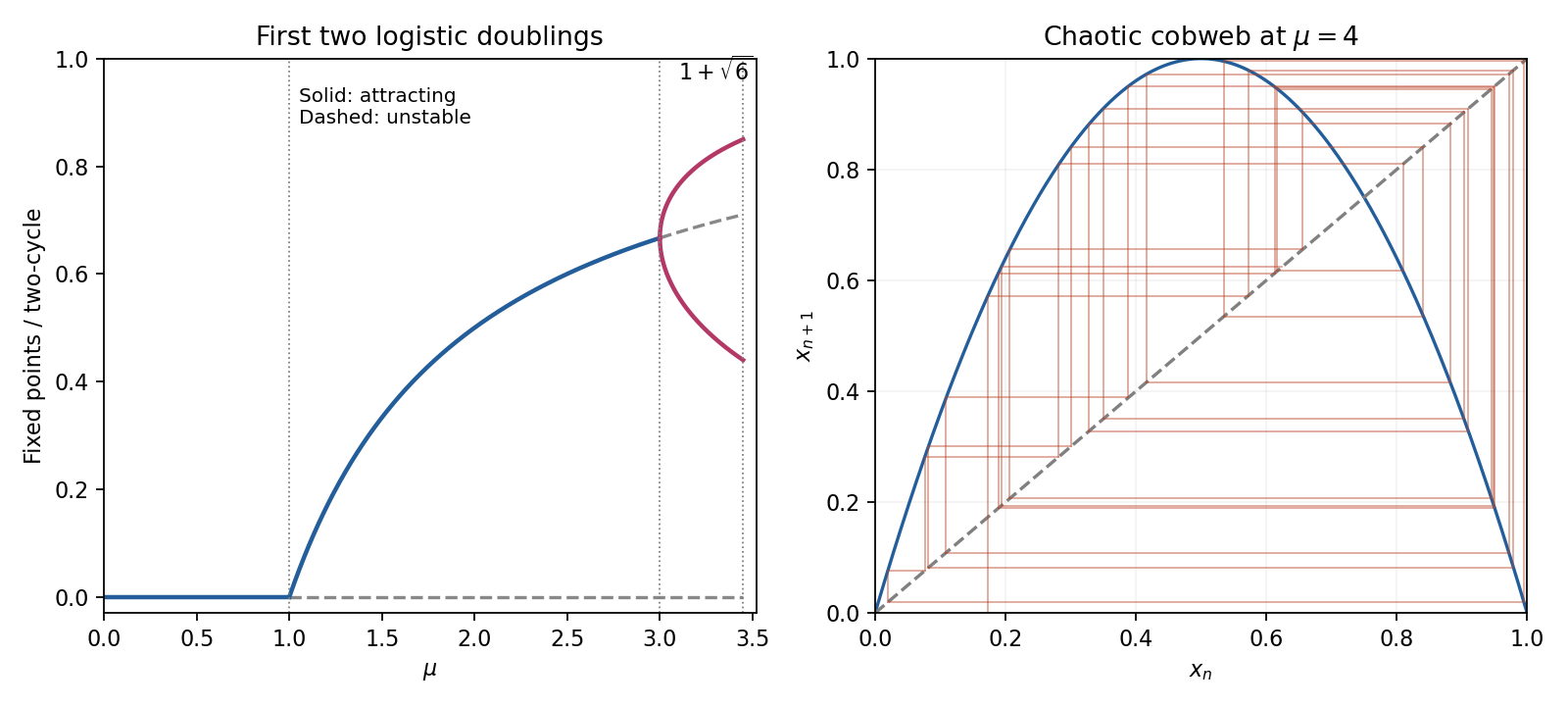
Period-doubling cascade universality concerns the continuation of this period-doubling cascade in smooth unimodal maps with a quadratic maximum. After suitable rescalings their repeated two-step maps approach the same limiting shape; successive parameter spacings have the Feigenbaum ratio approximately and the spatial rescaling has magnitude approximately . These are asymptotic statements involving later doublings, not numbers that can be established from the first two thresholds alone. The accumulation near is outside the first interval considered here. One should not claim chaos throughout the stable two-cycle interval.
Four useful dynamical properties to distinguish are sensitivity to initial conditions, topological transitivity or mixing, dense periodic points, and aperiodic orbits with persistent complex evolution. They concern the invariant set, not an assertion that every orbit must be aperiodic. A positive Lyapunov exponent for typical initial data is an additional quantitative diagnostic.
At , set . The double-angle identity gives the exact solutionFor a direct topological proof use the homeomorphism of . Then , where the full tent map isEvery branch doubles interval length until it crosses a fold; the finite binary cylinders have length and map onto the whole interval after steps. Thus every open interval eventually has an iterate covering the full interval: the map is topologically mixing and sensitive. Repeating a finite left/right branch word gives a periodic itinerary; arbitrarily long prescribed prefixes locate such periodic points in arbitrarily small cylinders, proving density. Nonperiodic binary itineraries yield uncountably many aperiodic orbits. Conjugacy transfers these properties to , proving chaotic behaviour while retaining its dense special periodic orbits.
As a metric check, its invariant measure has density and its typical Lyapunov exponent is . This is a typical-orbit assertion, not a claim about the derivative along every exceptional critical or preperiodic orbit. The explicit trigonometric solution and tent-map conjugacy explain why deterministic iteration of a map can nevertheless amplify uncertainty.
Pinned article: Introduction to the OurBigBook Project
Welcome to the OurBigBook Project! Our goal is to create the perfect publishing platform for STEM subjects, and get university-level students to write the best free STEM tutorials ever.
Everyone is welcome to create an account and play with the site: ourbigbook.com/go/register. We belive that students themselves can write amazing tutorials, but teachers are welcome too. You can write about anything you want, it doesn't have to be STEM or even educational. Silly test content is very welcome and you won't be penalized in any way. Just keep it legal!
Intro to OurBigBook
. Source. We have two killer features:
- topics: topics group articles by different users with the same title, e.g. here is the topic for the "Fundamental Theorem of Calculus" ourbigbook.com/go/topic/fundamental-theorem-of-calculusArticles of different users are sorted by upvote within each article page. This feature is a bit like:
- a Wikipedia where each user can have their own version of each article
- a Q&A website like Stack Overflow, where multiple people can give their views on a given topic, and the best ones are sorted by upvote. Except you don't need to wait for someone to ask first, and any topic goes, no matter how narrow or broad
This feature makes it possible for readers to find better explanations of any topic created by other writers. And it allows writers to create an explanation in a place that readers might actually find it.
Figure 1. Screenshot of the "Derivative" topic page. View it live at: ourbigbook.com/go/topic/derivativeVideo 2. OurBigBook Web topics demo. Source. - local editing: you can store all your personal knowledge base content locally in a plaintext markup format that can be edited locally and published either:This way you can be sure that even if OurBigBook.com were to go down one day (which we have no plans to do as it is quite cheap to host!), your content will still be perfectly readable as a static site.
- to OurBigBook.com to get awesome multi-user features like topics and likes
- as HTML files to a static website, which you can host yourself for free on many external providers like GitHub Pages, and remain in full control

Figure 2. You can publish local OurBigBook lightweight markup files to either OurBigBook.com or as a static website.
Figure 3. Visual Studio Code extension installation.
Figure 5. . You can also edit articles on the Web editor without installing anything locally. Video 3. Edit locally and publish demo. Source. This shows editing OurBigBook Markup and publishing it using the Visual Studio Code extension. 
- Infinitely deep tables of contents:




All our software is open source and hosted at: github.com/ourbigbook/ourbigbook
Further documentation can be found at: docs.ourbigbook.com
Feel free to reach our to us for any help or suggestions: docs.ourbigbook.com/#contact