
The capacitor energy is the electrostatic energy stored when electric charge is separated. For a linear capacitor of fixed positive capacitance , plate electric charge magnitude , and terminal electric potential difference , it isThe zero is the uncharged state. Thus the capacitor energy is positive for nonzero , even though the total electric charge of the two plates is zero. [ref].
For the parallel-plate capacitor example, capacitance and terminal electric potential difference giveThe plate electric charge magnitude is . Doubling terminal electric potential difference with capacitance unchanged doubles the plate electric charge magnitude and quadruples the capacitor energy.
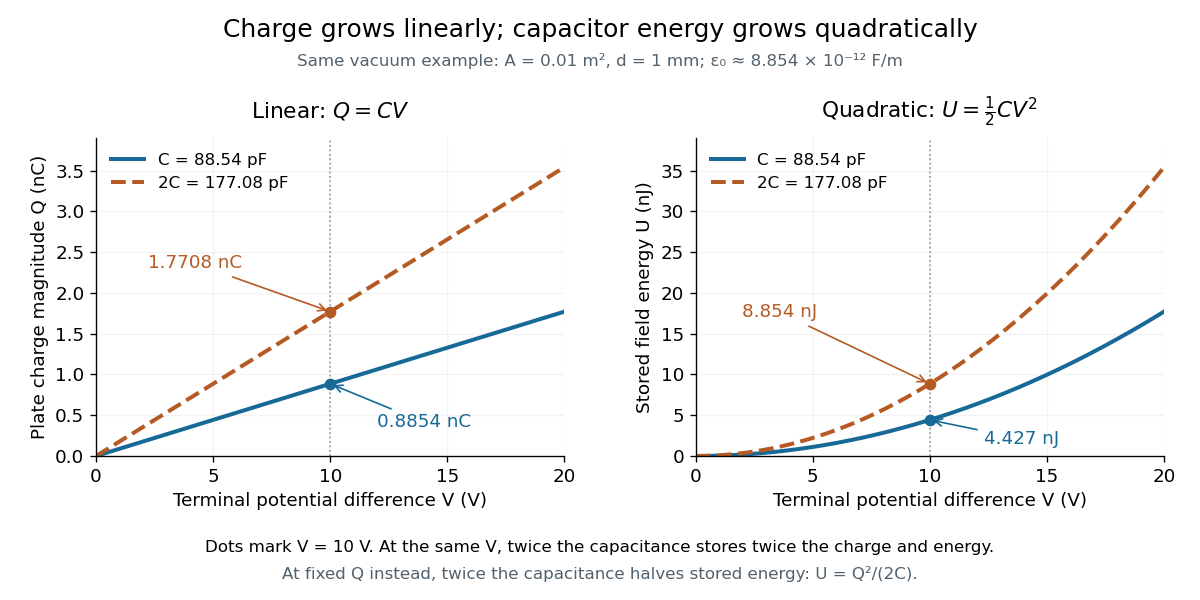

The electric charge is a linear function of terminal electric potential difference, while capacitor energy is a quadratic function. The second curve in each plot uses twice the capacitance: at a given terminal electric potential difference, both plate electric charge magnitude and capacitor energy double. These relations let us calculate how much energy an electrical circuit can receive when a capacitor discharges.
A brief charging argument explains the factor . If the plate electric charge magnitude has reached , the terminal electric potential difference is . Transferring a further amount of electric charge quasistatically requires work . With the geometry and permittivity fixed, the integral isUsing gives the other two forms. This integral accounts for the gradually rising terminal electric potential difference; it is the work stored in the capacitor's electric field, rather than a claim that all energy drawn from a fixed-voltage battery during charging ends up stored.
The field picture gives the same result. In the vacuum gap of a parallel-plate capacitor, the electric field has energy density . Multiplying by the gap volume gives the electrostatic energyFor the worked example, and reproduce . The electrostatic energy resides in the electric field throughout the gap, despite overall charge neutrality.
When capacitance changes, specify the constraint. At fixed plate electric charge magnitude , increasing capacitance decreases capacitor energy ; doubling capacitance halves it. At fixed terminal electric potential difference , increasing capacitance increases capacitor energy ; doubling capacitance doubles it. In the latter case a connected battery supplies additional electric charge and energy, and there may also be mechanical work. Use the fixed-voltage capacitor energy balance to account for all transfers before inferring a force from changing capacitor energy.
New to topics? Read the docs here!