
A chemical synapse transmits a signal by releasing neurotransmitter from a presynaptic neuron to act on postsynaptic receptors across a synaptic cleft. The two cell membranes remain separate. A typical fast transmission sequence is:
- An arriving action potential produces presynaptic depolarization, opening voltage-gated ion channels selective for calcium.
- Calcium ions enter down their electrochemical gradient. The local rise in calcium concentration activates release machinery, allowing already prepared synaptic vesicles to fuse with the presynaptic cell membrane by exocytosis.
- Released neurotransmitter crosses the synaptic cleft by diffusion and binds postsynaptic receptors.
- Ionotropic receptors directly gate an ion channel; metabotropic receptors activate an intracellular signaling pathway that can alter ion channels indirectly. Changed synaptic conductance changes electric current and usually produces a synaptic potential.
See Chemical Synapses and 3.1 Synapses. The fast pathway uses synaptic vesicles prepared near release sites; it does not require a distant synaptic vesicle to travel across the terminal after every action potential. See Basic Neurochemistry: calcium entry and vesicles at release sites. Some chemical synapses release neurotransmitter in response to graded presynaptic membrane potential changes rather than action potentials.
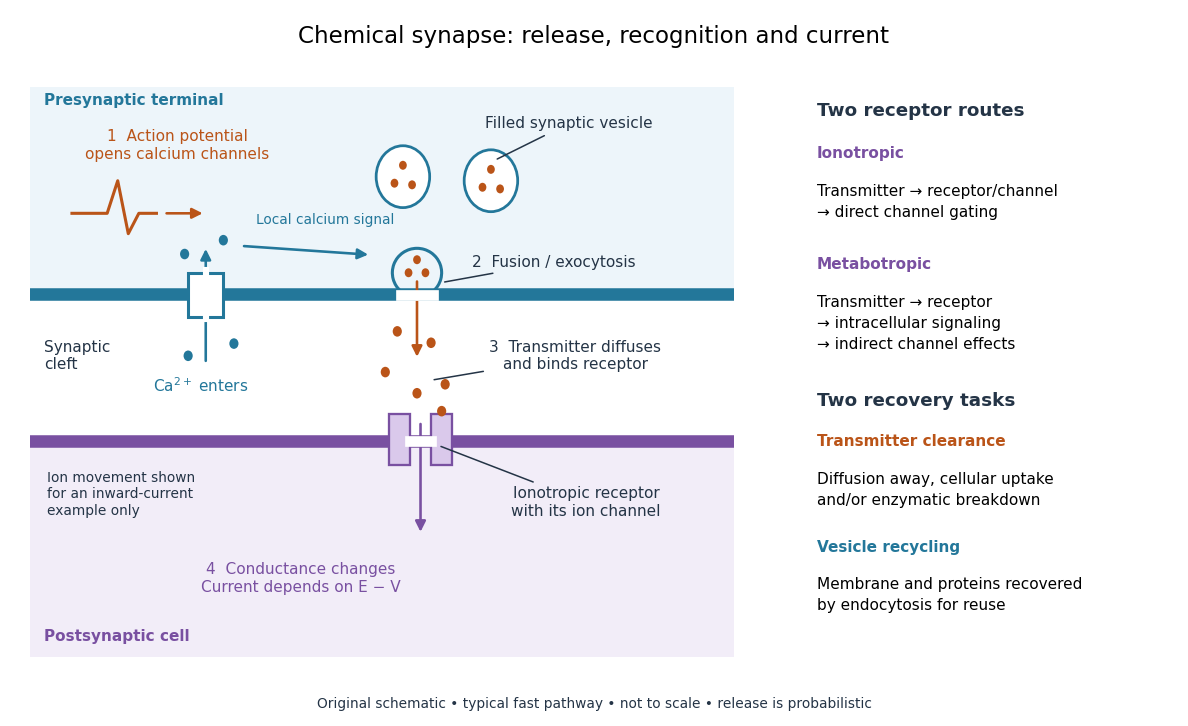

Neurotransmitter clearance limits how long released neurotransmitter remains available. Depending on the neurotransmitter and location, diffusion away, uptake through membrane transport proteins into the sending or neighboring biological cells, and breakdown by enzymes contribute. Receptor binding and unbinding also affect response duration. Recovering synaptic vesicle membrane is a separate recycling task; uptake of released neurotransmitter is not the return of an intact synaptic vesicle. See General Principles of Cell Communication.
This electrical-to-chemical-to-electrical sequence offers several places to adjust a signal: synaptic release probability, receptor availability and neurotransmitter clearance can change its strength or duration. It helps explain why synaptic plasticity can modify communication between neurons, and why an arriving action potential need not cause a postsynaptic action potential.
Otto Loewi's 1936 Nobel lecture describes his 1921 experiment: fluid from a frog heart whose nerves had been stimulated produced the corresponding response when transferred to another heart. The transferable substance established chemical mediation in that preparation. This was evidence for released chemical signaling, not yet an identification of synaptic vesicle fusion and not a claim that every synapse is chemical. See Loewi, The Chemical Transmission of Nerve Action, Nobel lecture, 12 December 1936.
New to topics? Read the docs here!