A synaptic potential is a postsynaptic change in membrane potential caused by activity at a synapse. Unlike the regenerative action potential, a passive synaptic potential is graded: its size depends on input strength, the initial membrane potential and the receiving cell membrane's properties. Local voltage changes can decay before reaching the soma; their timing and overlap help determine whether an action potential follows. See Ion Channels and the Electrical Properties of Membranes.
Depolarization means that the interior becomes less negative relative to the exterior; hyperpolarization means that it becomes more negative. Excitation and inhibition instead describe whether an input promotes or opposes postsynaptic action potential generation. An inhibitory postsynaptic potential can be depolarizing, and shunting inhibition can occur with no voltage change at rest. The receptor, permeating ions, ionic gradients and reversal potential matter. See Purves and colleagues: excitation, inhibition and depolarizing inhibition.
A worked passive model treats the receiving membrane as one compartment with capacitance , leak conductance , and activated synaptic conductances :All electric currents are inward-positive. Each term vanishes at its reversal potential ; . With constant parameters, the ordinary differential equation hasHere is total conductance, is effective electrical resistance, is the steady state and the time constant. Without imposed electric current, is a conductance-weighted average of the reversal potentials. This approximation omits spatial structure, changing ionic gradients and active voltage-gated ion channels; it calculates passive voltage responses, not actual action potential waveforms. See 3.1 Synapses for the mechanism behind the terms; the inward-positive convention here reverses that source's synaptic-current sign.
Take the same illustrative leak and capacitance as under shunting inhibition, start at and set . Opening with gives and . Its initial inward electric current is . Adding with changes to and . This is shunting inhibition of the same excitatory drive.
For comparison, with alone gives : hyperpolarization. With instead, it alone gives : depolarization. Yet adding this depolarizing conductance to the excitatory drive lowers that drive's from to . At an illustrative firing threshold , its electric current is , opposing threshold approach. The combined trace initially rises faster than the excitatory drive alone, before settling below it. Thus the sign of a voltage change at rest alone does not determine excitation or inhibition; a claim about firing must specify input strength, timing and the neuron's state.
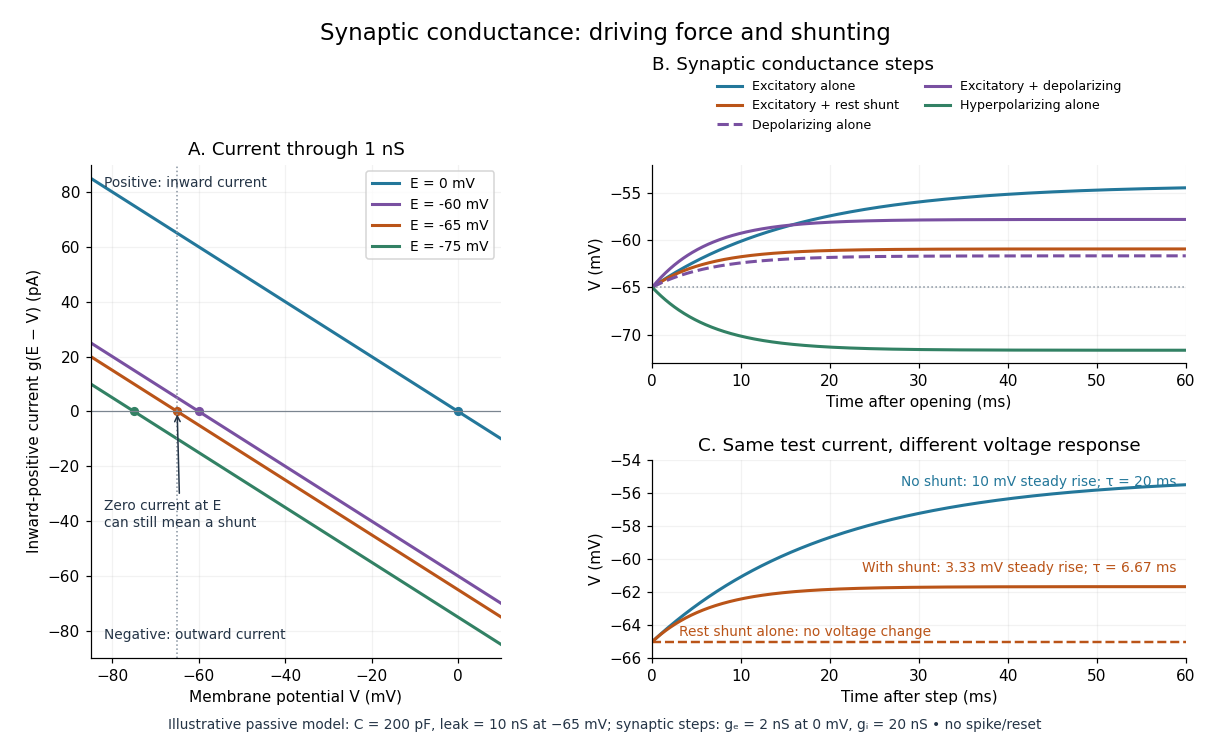

Synaptic conductance describes how strongly activated synaptic ion channels conduct electric current for a given driving force. In the passive approximation, , with inward-positive electric current. It is the electrical conductance contribution of a synapse; its postsynaptic voltage response also depends on the driving force, the other membrane electrical conductances, and the capacitance. The synaptic potential model and shunting inhibition example show why a nonzero synaptic conductance can have zero electric current at rest.
An excitatory postsynaptic potential is a synaptic potential associated with increased likelihood of a postsynaptic action potential. Its size and effect depend on the receiving neuron's state; the definition concerns firing, not a fixed neurotransmitter identity. See synaptic potential for the mechanism and source.
An inhibitory postsynaptic potential is a synaptic potential associated with decreased likelihood of a postsynaptic action potential. It can involve hyperpolarization or depolarization; an inhibitory conductance can even produce no measurable voltage change at rest. See synaptic potential and shunting inhibition for worked examples and sources.
Articles by others on the same topic
There are currently no matching articles.