A chemical synapse transmits a signal by releasing neurotransmitter from a presynaptic neuron to act on postsynaptic receptors across a synaptic cleft. The two cell membranes remain separate. A typical fast transmission sequence is:
- An arriving action potential produces presynaptic depolarization, opening voltage-gated ion channels selective for calcium.
- Calcium ions enter down their electrochemical gradient. The local rise in calcium concentration activates release machinery, allowing already prepared synaptic vesicles to fuse with the presynaptic cell membrane by exocytosis.
- Released neurotransmitter crosses the synaptic cleft by diffusion and binds postsynaptic receptors.
- Ionotropic receptors directly gate an ion channel; metabotropic receptors activate an intracellular signaling pathway that can alter ion channels indirectly. Changed synaptic conductance changes electric current and usually produces a synaptic potential.
See Chemical Synapses and 3.1 Synapses. The fast pathway uses synaptic vesicles prepared near release sites; it does not require a distant synaptic vesicle to travel across the terminal after every action potential. See Basic Neurochemistry: calcium entry and vesicles at release sites. Some chemical synapses release neurotransmitter in response to graded presynaptic membrane potential changes rather than action potentials.
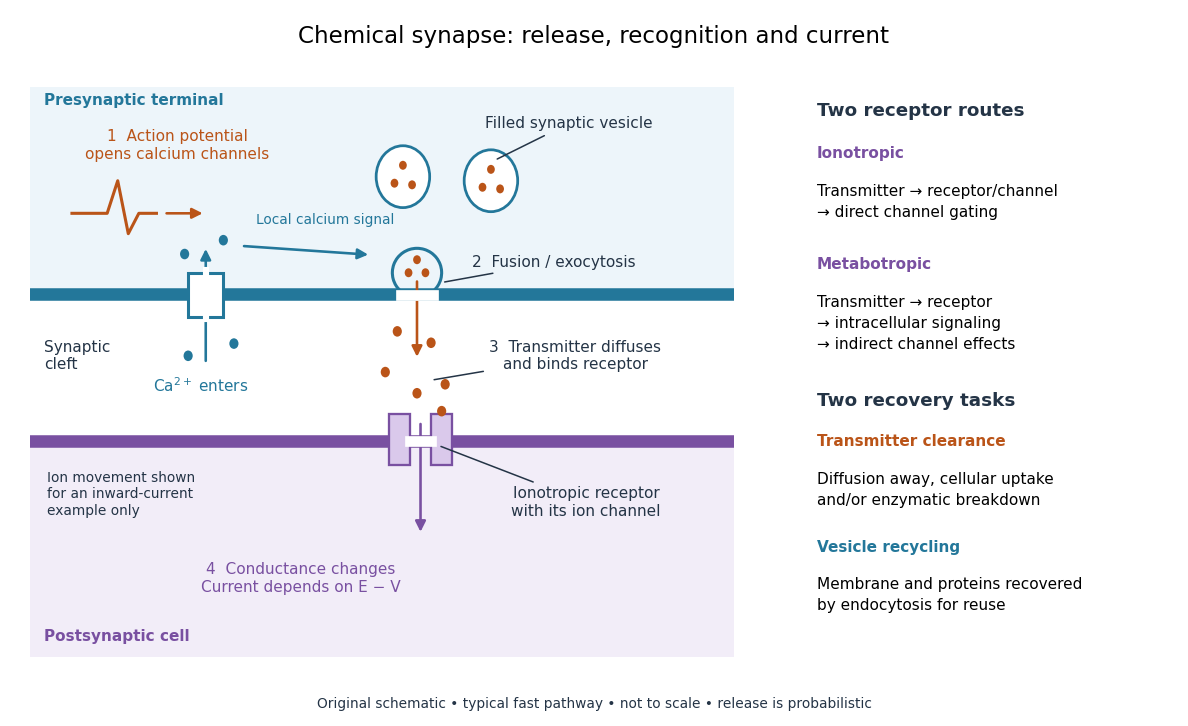

Neurotransmitter clearance limits how long released neurotransmitter remains available. Depending on the neurotransmitter and location, diffusion away, uptake through membrane transport proteins into the sending or neighboring biological cells, and breakdown by enzymes contribute. Receptor binding and unbinding also affect response duration. Recovering synaptic vesicle membrane is a separate recycling task; uptake of released neurotransmitter is not the return of an intact synaptic vesicle. See General Principles of Cell Communication.
This electrical-to-chemical-to-electrical sequence offers several places to adjust a signal: synaptic release probability, receptor availability and neurotransmitter clearance can change its strength or duration. It helps explain why synaptic plasticity can modify communication between neurons, and why an arriving action potential need not cause a postsynaptic action potential.
Otto Loewi's 1936 Nobel lecture describes his 1921 experiment: fluid from a frog heart whose nerves had been stimulated produced the corresponding response when transferred to another heart. The transferable substance established chemical mediation in that preparation. This was evidence for released chemical signaling, not yet an identification of synaptic vesicle fusion and not a claim that every synapse is chemical. See Loewi, The Chemical Transmission of Nerve Action, Nobel lecture, 12 December 1936.
Release or signalling by more than one transmitter from a neuron or pathway. Manipulating a cell identified by one transmitter can therefore change other signals as well.
Neurotransmitter clearance removes released neurotransmitter from the region where it can activate receptors, through diffusion, cellular uptake or enzyme-mediated breakdown. Its routes and rates help delimit a chemical synapse's response in space and time; see the mechanisms and source under chemical synapse.
The synaptic cleft is the extracellular gap between the sending and receiving cell membranes of a chemical synapse. Released neurotransmitter crosses this gap to reach a receptor. [ref]
A synaptic vesicle is a small membrane-bounded compartment in a presynaptic terminal that stores neurotransmitter for release. Fusion with the cell membrane exposes its contents to the synaptic cleft; the packet supplied by one synaptic vesicle is a quantum of release. Quantal neurotransmitter release refers to these discrete packets, rather than the release of one molecule at a time. The postsynaptic response to a packet can vary with its contents, receptors and recording conditions. See Purves and colleagues: vesicles as the source of transmitter quanta.
The useful cycle is filling, preparation for fusion, calcium-triggered exocytosis, and recovery of membrane and proteins through endocytosis for reuse. Different recovery routes occur; recycling need not preserve a particular synaptic vesicle as an identifiable container throughout. Limited availability of prepared synaptic vesicles can reduce release during repeated stimulation, while changes in synaptic release probability can also change successive responses. See Basic Neurochemistry: secretion machinery and vesicle reuse and 3.1 Synapses.
For an illustrative calculation, assume four release sites, each with one prepared synaptic vesicle, each releasing with synaptic release probability during one presynaptic action potential. Assume independent Bernoulli trials and at most one release per site. The released packet count has a binomial distribution:The probability of no release is ; at least one release has probability . An expected value of one packet does not mean that every action potential releases one packet. If each packet contributes a stipulated conductance increment and increments add, the expected value of that increment is , with zero increment on about of trials. These assumptions are a teaching model: shared calcium fluctuations, unequal sites, depletion and nonlinear receptor responses can invalidate them.
Quantal neurotransmitter release is release of neurotransmitter in discrete packets associated with individual synaptic vesicles. Packet count and postsynaptic packet response are different quantities; see the binomial distribution example under synaptic vesicle.
Synaptic release probability is the probability of release at a specified site during a specified opportunity, such as one presynaptic action potential. It depends on the site's state and conditions; it is not the probability that the receiving neuron fires. In the example under synaptic vesicle, refers to one available site, whereas refers to any of four independent sites releasing.
Shunting inhibition is suppression of another input's effect through increased synaptic conductance: opening additional ion channels lowers effective electrical resistance, reducing the voltage response to a given added electric current. When the added reversal potential equals the resting membrane potential, there can be no voltage change at rest and still be inhibition of a simultaneous input. See 1.4 Limitations of the Leaky Integrate-and-Fire Model.
Use the passive synaptic potential model below with leak , and capacitance . A sustained inward test electric current of alone gives a steady voltage increase of , so . Effective electrical resistance is and the time constant is .
Now hold a shunting conductance open with . With no test electric current, rest stays at . With the same test electric current, total conductance becomes , so the steady voltage increase is only : . Effective electrical resistance is and the time constant is . A faster response can therefore be smaller. At the original rest the shunting electric current is zero; at it is , opposing the voltage excursion.
The factor of three reduction applies to this constant-electric current, constant-conductance example. A finite pulse, conductance-driven input or spatially extended dendrite need not have the same reduction. The interesting feature is conditional action: the shunt can leave a quiet neuron's voltage unchanged yet reshape its response when another input arrives. A model that represents all inhibition as a fixed outward electric current misses this behavior.
Articles by others on the same topic
There are currently no matching articles.