
Fano's inequality turns remaining uncertainty into a constraint on decision errors. If an observation leaves many plausible answers, a decoder cannot usually recover the answer reliably. Its elegant idea is to separate two uncertainties: whether the guess was wrong, and which alternative was correct when it was wrong.
Let be discrete random variables, with taking values in a finite alphabet of cardinality . Choose any deterministic decoder whose output lies in , and define its average error probability . With base-two logarithms, Fano's inequality statesHere is conditional entropy and is binary entropy, with at the endpoints. Both sides are measured in bits; using natural logarithms throughout gives the same inequality in nats. No uniform source, independence of , or optimality of the decoder is assumed. Requiring its output to belong to the same alphabet is what leaves at most alternatives after an error.[ref]
For an exact toy example, give the discrete uniform distribution on . A channel reports with probability and reports each of the other three symbols with probability , where . Use the decoder . The output is uniform, and the conditional probabilities after any report areThus and direct calculation of the conditional entropy givesThis is equality in Fano's inequality for every . At , each report leaves probabilities , up to their order, and bits. The two contributions are bits for the error flag and bits for identifying the correct alternative after an error. These are theoretical probabilities, not measured data.
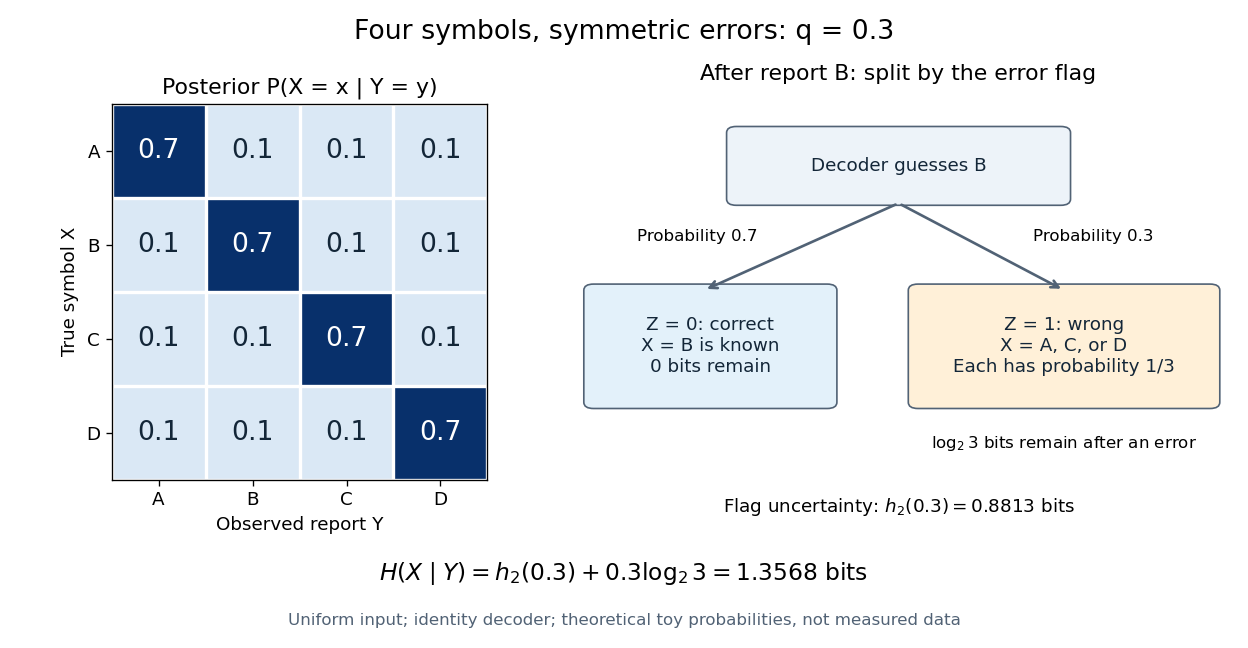
The identity decoder in this example minimizes error only for : its guessed symbol has the largest posterior probability exactly when . At , are independent random variables and all four guesses tie. For , guessing any one of the three other symbols has error probability . Equality in Fano's inequality therefore does not certify an optimal decoder.
For usefulness, combine with to obtain the simpler consequenceFor a uniform , , so this becomes . This connects mutual information to unavoidable decision error in channel coding or classification in statistical learning; it can rule out reliable recovery regardless of the chosen decoder.[ref]
https://web.stanford.edu/class/ee376a/files/lecture_notes.pdf. Weissman, Ochoa and Tatwawadi, EE376A course notes, Sections 5.7–5.8
The sharper right-hand side increases from zero to on , then decreases: in the interior, . When interpreting the inequality by inverting a curve, use its increasing branch to obtain a lower error threshold. A decoder that chooses a largest posterior probability, as in maximum a posteriori decoding, always has , since the largest of conditional probabilities is at least . Arbitrary decoders can have larger error. In particular, low conditional entropy does not force every decoder to work well: with a fair binary and , the rule has even though . Fano's inequality supplies a constraint, not an exact error prediction for each rule.


Fano's inequality is a result in information theory that provides a lower bound on the probability of error in estimating a message based on observed data. It quantifies the relationship between the uncertainty of a random variable and the minimal probability of making an incorrect estimation of that variable when provided with some information. More formally, consider a random variable \( X \) with \( n \) possible outcomes and another random variable \( Y \), which represents the "guess" or estimation of \( X \).
New to topics? Read the docs here!