Fixed-step gradient descent on a positive-definite quadratic
ID: fixed-step-gradient-descent-on-a-positive-definite-quadratic

Consider the original two-dimensional exampleThe Hessian matrix is , a symmetric matrix and positive-definite matrix. Its eigenvectors are the coordinate directions, its eigenvalues are and , and its Euclidean norm condition number is . The unique global minimum is , so the error equals . The linear map , with the identity matrix, givesFor , the two coordinate error multipliers are and . Consequently , , and the second coordinate changes sign at every step while both shrink. The Euclidean norm of the error contracts by each step. The objective gap, which we call the quadratic energy, contracts by its square:The level sets of are ellipses. Oscillation across their narrow direction is compatible with strictly decreasing energy.
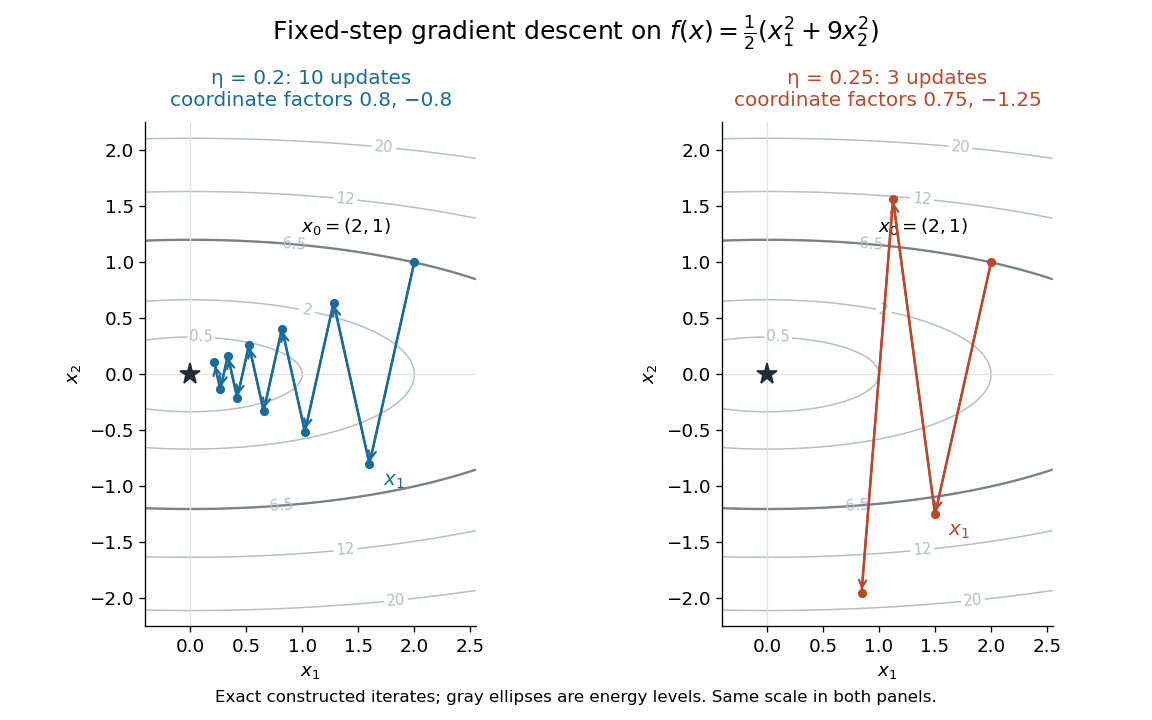
Original gradient descent iterates on : step size contracts both directions, whereas expands the second
. Details. For , the coordinate error multipliers become and , giving . The first coordinate still tends to zero, but the second alternates and grows. Direct substitution givesThus a larger positive step size can turn a strictly convex function into a divergent iteration. Energy and error are different quantities: coordinate errors carry signed multipliers, while each coordinate's contribution to energy carries the squared multiplier.
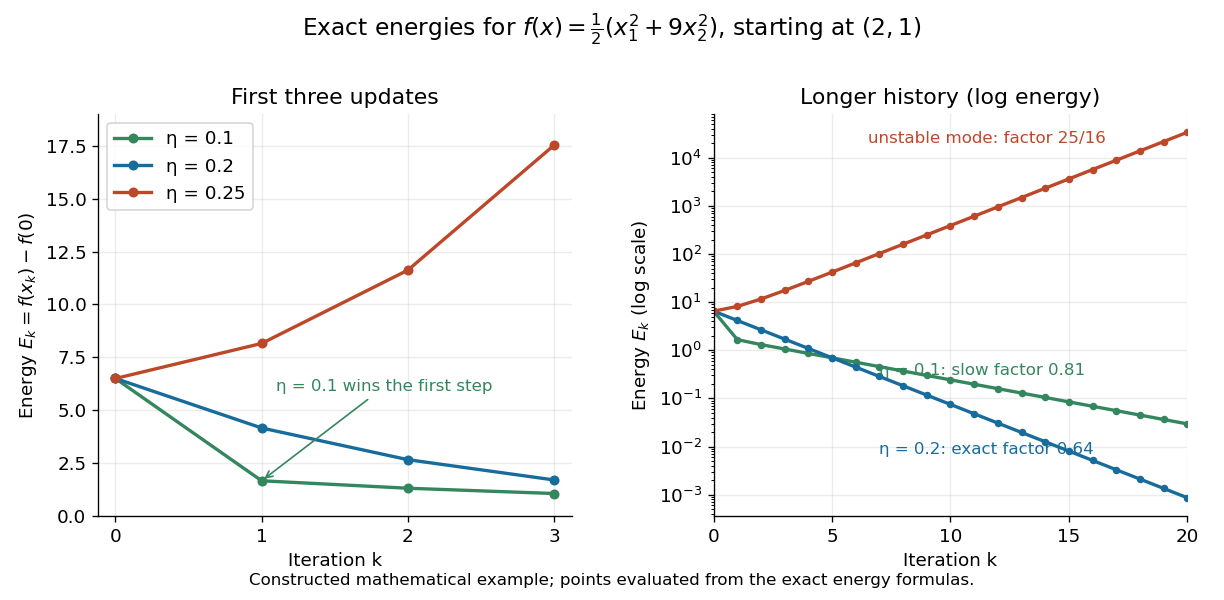


For the general quadratic form with linear termthe error obeys the same linear map . The spectral theorem for real symmetric matrices supplies an orthonormal basis of eigenvectors with positive eigenvalues . Writing gives the exact solution and energy identityTherefore convergence from every initial vector is equivalent toAt , a nonzero error component along a largest-eigenvalue eigenvector flips sign without shrinking. Above that threshold it grows. A particular start can still converge if it has zero components in every unstable direction; the interval is the condition for all starts. If , then and . These bounds follow by summing the squared components in the orthonormal basis.
New to topics? Read the docs here!