
On a measure space of positive total measure, the L-infinity norm of an essentially bounded measurable function is . The absolute value matters: a constant function has L-infinity norm three, even though its essential supremum is . The norm belongs to the equivalence class in Lp space; different representatives equal almost everywhere give the same answer. [ref]
Lp spaces (Chapter 7 of Measure Theory). Hunter, Measure Theory, Definition 7.4: the L-infinity norm
.For the function in essential infimum and essential supremum, under Lebesgue measure, whereas its supremum norm is four. Replacing the exceptional values by the ordinary values leaves every finite Lp norm unchanged as well: . This tends to one as . That agreement explains why the endpoint with exponent uses an essential bound rather than a pointwise bound.
A finite probability space makes the distinction between zero and small measure explicit. Let , , and . Assign weights , , , where . For ,When , the singleton is a null set and . For every , however small, . For example, gives and , yet the large- Lp norms approach ten. The ordinary pointwise supremum norm is ten in both cases.
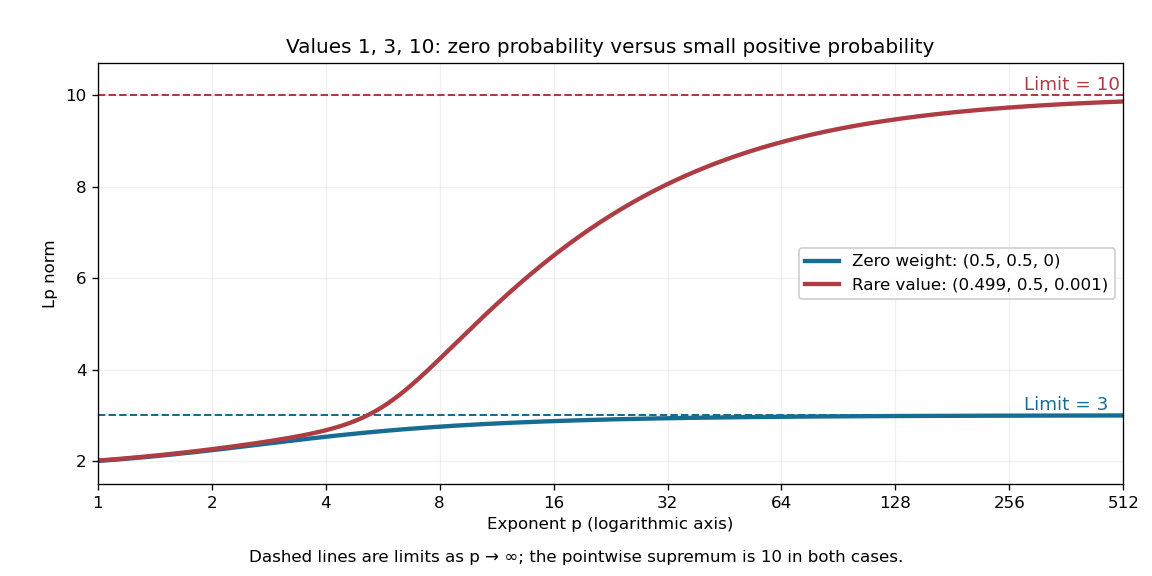
A zero-weight value disappears from every Lp norm, while a rare positive-weight value determines the limiting L-infinity norm
. The original three-point example has values . The curves use weights and , respectively. Dashed levels show the limiting norms three and ten; the plotted finite exponents do not themselves reach those limits. Details.
Why can a rare value dominate? For a bounded function on a probability space, an almost everywhere bound gives . If , the set has positive probability, so . As , the factor tends to one. These two bounds squeeze the limit to . The probability measure assumption keeps total measure finite; this explanation does not assert the same finite- integrability on arbitrary infinite-measure spaces.
New to topics? Read the docs here!