The essential supremum is the upper bound for a measurable function after disregarding null sets for a specified measure . Its definition iswith values allowed in the extended real number line. A supremum controls every value; an essential supremum controls values almost everywhere. It therefore depends on the chosen measure, as well as on the function. [ref].
For a worked example, use Lebesgue measure on and putIts supremum is ten, attained at . But its essential supremum is one: outside the singleton , which is a null set. Every candidate fails, because the interval has positive Lebesgue measure and includes values larger than ; changing one point cannot remove that interval. In particular, , while .
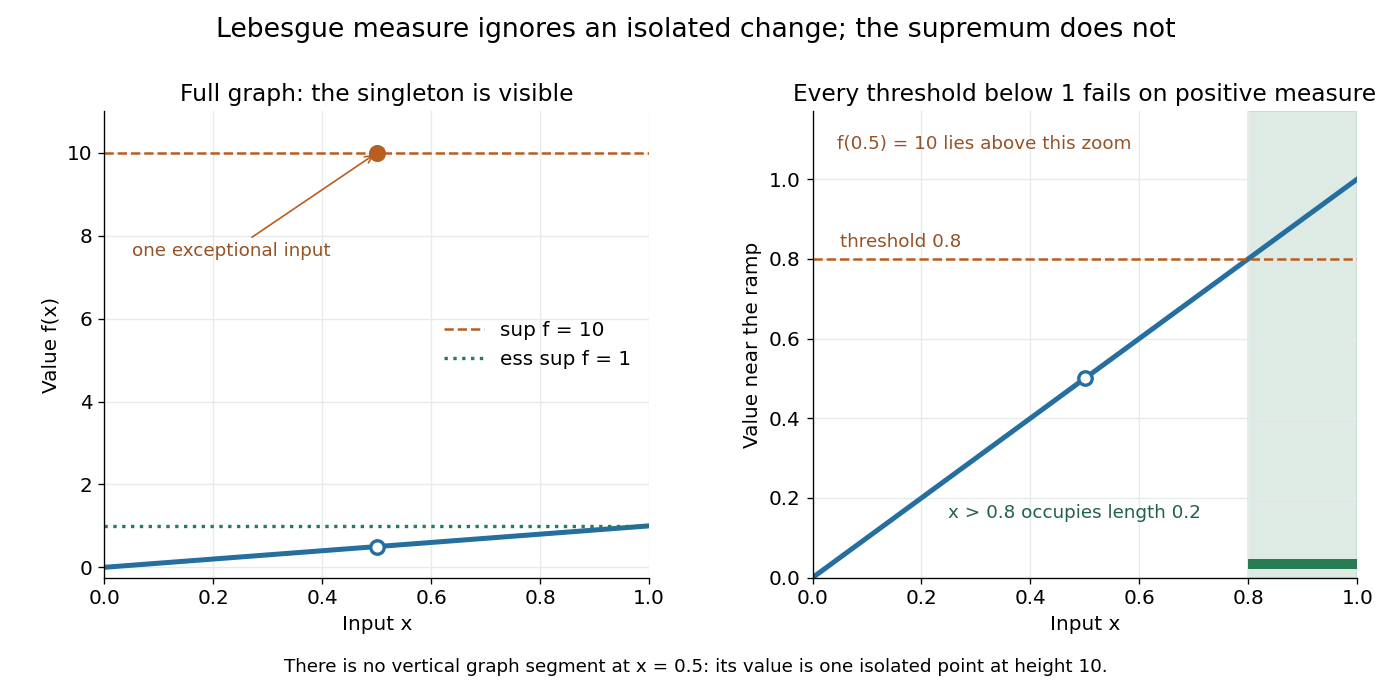

Why is this useful? Lebesgue integrals ignore changes on null sets, and Lp spaces identify functions that agree almost everywhere. The L-infinity norm uses so it respects that identification. For this nonnegative example the supremum norm is ten and the L-infinity norm is one; replacing by changes the former while leaving the latter unchanged. [ref].
The measure qualification is essential. For , the Dirac measure concentrated at the exceptional input, that singleton has measure one and this function has essential supremum ten. A set ignored by one measure need not be ignored by another. The lower counterpart is the essential infimum, with .
Articles by others on the same topic
There are currently no matching articles.