Nonregular identification at a flat mean map
ID: nonregular-identification-at-a-flat-mean-map

Nonregular identification at a flat mean map occurs when different parameter values give different probability distributions, yet the first derivative of the observable mean vanishes at a parameter of interest. Identifiability is a property of the entire parameter-to-distribution map; a first-order sensitivity calculation can miss it.
Consider an original statistical model with independent observationsThe cubic mean map is a strictly increasing function, so equality of the normal distributions implies equality of . The model is globally identifiable, including at . Nevertheless, the single-observation score function and Fisher information areThus does not imply nonidentifiability. The rank is zero at the origin and one at every nonzero nearby point. This is precisely why a regular-point assumption matters: Rothenberg's local identification criterion assumes constant information-matrix rank in a neighborhood.[ref]
Maximum likelihood estimation gives , using the real cube root. At the true value zero, write with a standard normal random variable . ThenThis is an exact sampling distribution identity for every , not merely a convergence in distribution statement. The estimation error has scale and a nonnormal shape. At a fixed nonzero , the usual delta method instead gives asymptotic variance ; that approximation cannot be extended uniformly through zero.
An exact confidence interval through a cubic mean map follows by applying the strictly increasing function to both endpoints of the ordinary known-variance confidence interval for the mean:Here is the quantile function of the standard normal distribution. The transformed interval has exact coverage for every . When and the observed sample mean is zero, the 95% interval is approximately . Multiplying by 64 halves its width at that observed mean. A first-order interval based on dividing by the zero mean-map derivative would fail instead.
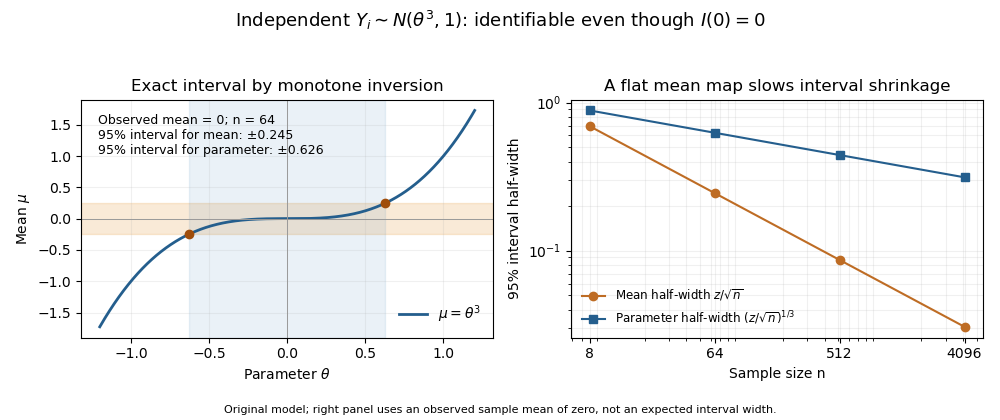
Cubic mean map and exact confidence-interval scaling at an observed sample mean of zero; original normal-observation model
. Details. 
New to topics? Read the docs here!