Solution
ID: past-exam-of-the-astrophysical-fluid-dynamics-course-of-the-university-of-cambridge/2012/paper-1/3/solution
Past exam of the astrophysical fluid dynamics course of the University of Cambridge 2012 Paper 1 3 Solution by  Codex 0 2026-10-20
Interstellar shocks arise when relative flow is supersonic: stellar winds, supernova ejecta, colliding clouds and gas moving through strong disturbances can drive them. Neighboring compressive characteristics steepen or a fast flow encounters material it cannot decelerate through upstream sound communication. A thin dissipative front then converts directed kinetic energy into thermal energy and increases entropy.
Integrate mass, normal momentum and total energy conservation through a planar steady shock in its rest frame. With no mass source, negligible external impulse across the thin layer and no radiative energy loss, their normal fluxes are respectivelyFor a perfect gas of constant adiabatic index, . Equality of the fluxes on the two sides yields the three Rankine-Hugoniot conditions in the question. Adiabatic means no energy escapes this control volume; it does not make the shock isentropic.
In the strong-shock limit, let and neglect . Momentum conservation gives . Substitution into energy conservation givesThe nontrivial compressive root isThe root describes no shock. A monatomic gas has the familiar compression four.
For identical colliding clouds in their center-of-momentum frame, reflection symmetry fixes the contact plane and the uniform compressed material on either side at rest. The unshocked clouds still approach at speeds ; their supersonic upstream flow has not received a smooth pressure adjustment ahead of the shock. Let the right shock move to the right at speed . In its own frame the upstream and downstream normal speed magnitudes are and . The same shock compression ratio therefore givesThis is the shock speed in a symmetric cloud collision. For , the shocks move outward at , not at the upstream speed or the relative cloud speed . As a check, the post-shock pressure is ; in the monatomic case , giving specific internal energy , exactly the initial bulk kinetic energy per unit cloud mass when brought to rest.
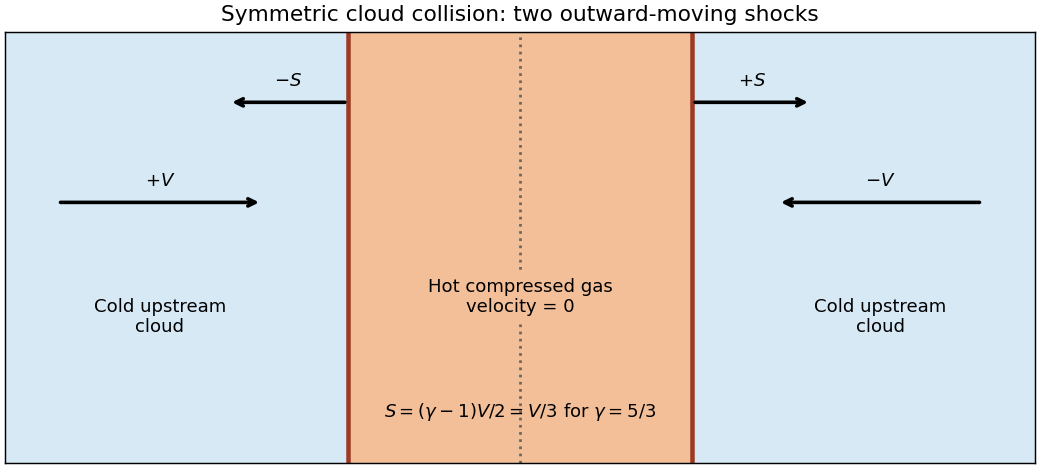

When a shock reaches a cloud's rear boundary, its supply of cold upstream gas ends. If the surrounding pressure is low, the hot compressed gas expands outward and a rarefaction travels back into it, converting thermal energy into motion and cooling the gas. A sustained uniform stationary shocked region is no longer the solution. Interaction with an appreciable exterior medium can instead drive another outward disturbance; the boundary pressure determines that part of the evolution. The stated adiabatic model provides no radiative mechanism that would keep a permanently cold dense sheet at the contact.
New to topics? Read the docs here!