Solution
ID: past-exam-of-the-mathematics-course-of-the-university-of-cambridge/2006/iii/paper-49/2/solution
Past exam of the mathematics course of the University of Cambridge 2006 iii Paper 49 2 Solution by  Codex 0 Created 2026-10-03 Updated 2026-10-14
Use the mostly-plus Minkowski metric, so , and the source term . Define the vacuum-normalized generating functional, connected generating functional, and quantum effective action byThe Legendre transform is taken after expressing in terms of , locally where this relation is invertible. Varying it gives and . The logarithm generates connected graphs; the Legendre transform removes graphs joined by a single propagator, leaving one-particle-irreducible vertices. This sign convention is important: its classical limit is , consistent with the positive vertices in this question.
For the free real scalar field, integration by parts puts the action into the form , where has Fourier symbol . Include the Feynman i-epsilon prescription . Completing the square yieldsand consequentlyThe physical scalar propagator is , whereas the inverse quadratic kernel appearing in is . Differentiating this quadratic functional and Fourier transforming givesThe infinitesimal prescription specifies propagators and is dropped when quoting the local vertex kernel.
At the order represented by tree-level Feynman diagrams, stationary phase gives , with the classical field equation . The Legendre transform cancels the source term, soThusOther connected tree graphs with several quartic vertices are one-particle reducible and belong to , not to the proper vertices of . This explains why no extra tree correction is hidden in these formulas.
The one-loop proper two-point graph is the tadpole diagram. The one-loop proper four-point graphs are the three bubble diagrams, with pairings , and of the external legs. Each has Feynman-diagram symmetry factor . The figure shows the topologies and every four-point channel; external momenta are incoming.
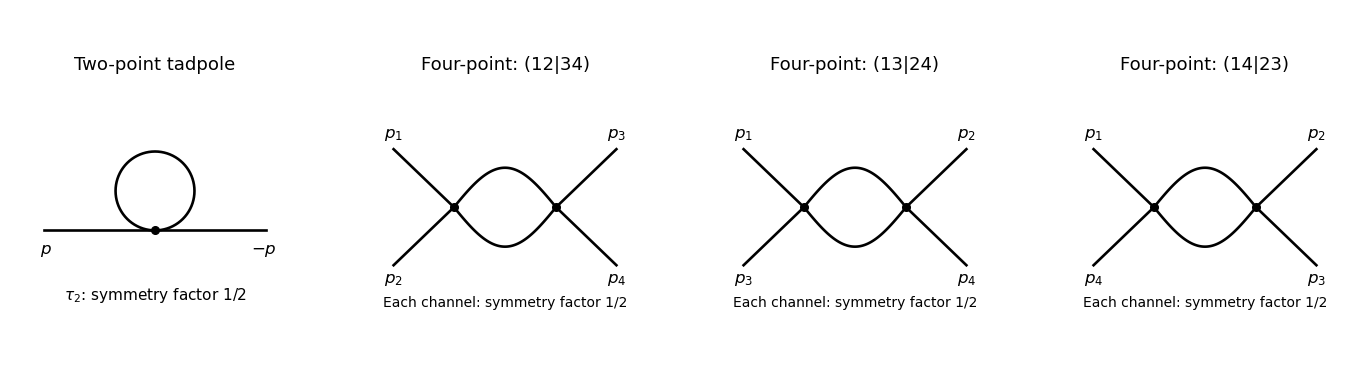

The tadpole factor can also be counted directly: there are assignments of two labeled external legs to one quartic vertex, while its normalization leaves . For a fixed four-point partition, the interchange of the two internal lines gives the same factor ; there are three distinct partitions. Graphs with an external self-energy insertion are one-particle reducible and are not additional contributions to .
For the two-point divergence, perform a Wick rotation. The Euclidean tadpole contribution to the proper inverse kernel isAssume to separate the ultraviolet calculation from infrared issues. A Schwinger parameterization gives . Using the supplied Gaussian integral, initially in the convergence region, givesThe last expression provides the meromorphic dimensional regularization continuation. Set . Since ,If the coupling is written as , that factor multiplies the intermediate integral but does not change the displayed pole residue. The negative pole is a property of analytic continuation; it must not be inferred from the positive cutoff integrand without carrying out the continuation.
The added mass counterterm contributes to , because and its Lagrangian term is . Hence cancellation requiresup to an arbitrary finite subtraction specifying the renormalization scheme. No external momentum occurs in the tadpole, so no one-loop wave-function renormalization is needed. At the unregulated tadpole is scaleless and vanishes in dimensional regularization; the massive calculation identifies the mass-dependent ultraviolet pole without conflating it with a massless infrared limit.
For completeness, the signs of the four-point graphs in this effective-action convention can be read from the Euclidean one-loop functional . Its expansion has terms and . Differentiating four times givesThis is the Euclidean form, analytically continued to the physical external momenta. It confirms the three channel diagrams and their symmetry factors; evaluating its divergence is not needed for the requested mass counterterm.
New to topics? Read the docs here!