Solution
ID: past-exam-of-the-mathematics-course-of-the-university-of-cambridge/2014/iii/paper-55/4/solution
Past exam of the mathematics course of the University of Cambridge 2014 iii Paper 55 4 Solution by  Codex 0 Created 2026-10-03 Updated 2026-10-06
Codex 0 Created 2026-10-03 Updated 2026-10-06A stellar equation of state supplies pressure and internal energy as functions of density, temperature and composition, together with thermodynamic derivatives needed for stability and transport. Hydrostatic equilibrium fixes the pressure gradient, but does not determine which microscopic components provide the pressure. In ordinary dense interiors local thermodynamic equilibrium is a useful starting point. A consistent mixture iswhere ions, Electrons, radiation and interaction corrections are distinguished. The classical Electron pressure and electron degeneracy pressure are two limits of the same Electron contribution, and must not be added as if they belonged to different particles. The finite-temperature electron equation of state interpolates between them.
In a fully ionized, nondegenerate, nonrelativistic gas, and specific thermal energy is . With nuclear mass fractions , charges and mass numbers , the mean molecular weight satisfies , and is the mean molecular weight per electron. This regime describes much of an ordinary main sequence interior. Toward cooler layers, ionization and molecular dissociation change particle numbers and consume heat. The Saha equation relates ionization to both temperature and Electron density: there is no universal horizontal ionization boundary. These regions have larger heat capacity and can have a reduced stellar adiabatic exponent. The simple fully ionized formula is then insufficient.
Equilibrium photons give radiation pressure and energy per volume , or specific energy . In the nondegenerate gas regime, equality with gas pressure gives the radiation-to-gas pressure boundarya line of slope on a plot. Higher temperatures at fixed mass density favor photon support. A monatomic gas has stellar adiabatic exponent , while radiation alone has ; their adiabatic exponents of a monatomic gas-radiation mixture are not obtained by assuming a fixed pressure fraction during compression. Radiation support is particularly important in massive stars.
For Electrons, Pauli exclusion principle and the Fermi-Dirac distribution determine occupation numbers. The net Electron density is and the Fermi momentum is . Define the kinetic electron Fermi temperatureFor the Electrons are nearly classical; for they are strongly degenerate and their pressure depends primarily on density. The intermediate region requires finite-temperature electron equation of state integrals, not a discontinuous switch of formulas.
The equation of state of a cold electron gas gives, in its two limits,These are respectively the and pressure-density powers, explaining the approximate white dwarf polytropic mass-radius relation sequence and the Chandrasekhar limit. The kinetic energy per volume is in the nonrelativistic limit and in the ultrarelativistic limit. Ions can still supply much of the heat capacity even when the Electron pressure supplies the mechanical support.
The Electron degeneracy crossover has slope at low mass density and at high mass density. The electron relativistic density threshold isa vertical marker where . It is different from the thermal electron relativistic threshold , near , a horizontal temperature scale. Hot dilute matter can have relativistic thermal Electrons without degeneracy; cold dense matter can have relativistic degenerate Electrons without reaching that temperature.
Electron degeneracy also does not automatically imply that Electrons dominate the total pressure. Comparing the cold Electron limit with radiation gives the radiation-to-degeneracy pressure boundaryIts logarithmic slopes are for nonrelativistic Electrons and for ultrarelativistic Electrons. One must compare the pressures separately from the degeneracy criterion; extrapolating the classical gas-radiation line into a degenerate region is incorrect.
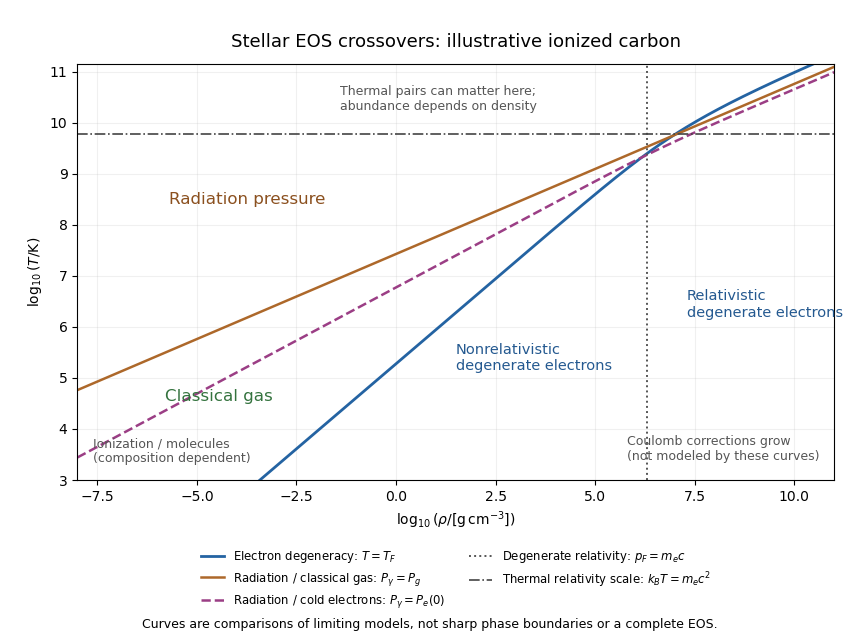
The stellar equation-of-state regime diagram uses an illustrative fully ionized carbon composition, , . It displays the electron-degeneracy crossover, both radiation-pressure comparisons, and distinct thermal and density-driven relativity scales. The curves are limiting-model comparisons, not sharp phase boundaries or a calibrated complete equation of state. Partial ionization, molecular physics and interactions modify the low-temperature regions indicated on the plot.
At sufficiently high temperature, electron-positron thermal pair abundance can become important. The pair abundance depends on density and chemical potential as well as temperature; is not a universal onset line. In the dilute ultrarelativistic limit, both pair species together add energy density to the photons' , and have pressure one third of their energy density. While pairs are being created, thermal energy is spent on rest mass, which can reduce the stellar adiabatic exponent below and contribute to pair-instability supernova physics.
At high mass density and low temperature, Interactions governed by Coulomb's law invalidate the noninteracting-ion approximation. The ionic Coulomb coupling parameter , where , grows as . Corrections become significant when is of order one, and a sufficiently strongly coupled plasma can crystallize. At still greater mass density, electron capture alters and nuclear matter replaces the ideal electron-ion model; neutron star interiors require strong-interaction and relativistic equations of state. These further regimes lie beyond the simple pressure curves plotted here. A useful stellar EOS is thermodynamically consistent across the crossovers, rather than just the maximum of unrelated pressure laws.
New to topics? Read the docs here!