The Chandrasekhar mass is the limiting mass of a cold nonrotating white dwarf supported by relativistic electron degeneracy pressure, about for ordinary composition. It bounds the retained remnant's mass, rather than the birth mass of a star that can lose an envelope. The ideal limit assumes fixed mean molecular weight per electron, Newtonian gravity and a noninteracting degenerate electron gas; electron capture, general relativity, stellar rotation and ignition can change the attainable endpoint.
The Chandrasekhar limit belongs to work of the early 1930s. In his 1983 retrospective, Subrahmanyan Chandrasekhar reprints the 1935 mass–radius sequence and then discusses stellar evolution and relativistic stability.[ref]
On Stars, Their Evolution and Their Stability by Subrahmanyan Chandrasekhar. Section 5, pp. 149–151, Figure 2; sections 7–8, pp. 156–159
The 1983 Nobel Prize in Physics recognized his broader theoretical work on stellar structure and stellar evolution; the other half recognized William Alfred Fowler's theoretical and experimental work on nuclear reactions underlying chemical element formation.[ref]The Nobel Prize in Physics 1983 by Nobel Prize Outreach. Award shares and motivations
Consider an ideal degenerate electron gas at zero temperature. Counting two spin states per phase space cell gives number density . The isotropic momentum flux gives pressureHere is Electron mass, is the speed of light, with Planck constant , and special relativity gives . The factor averages the directional momentum flux, and the spin factor is already included. This normalization makes a pressure, not an energy per Electron.
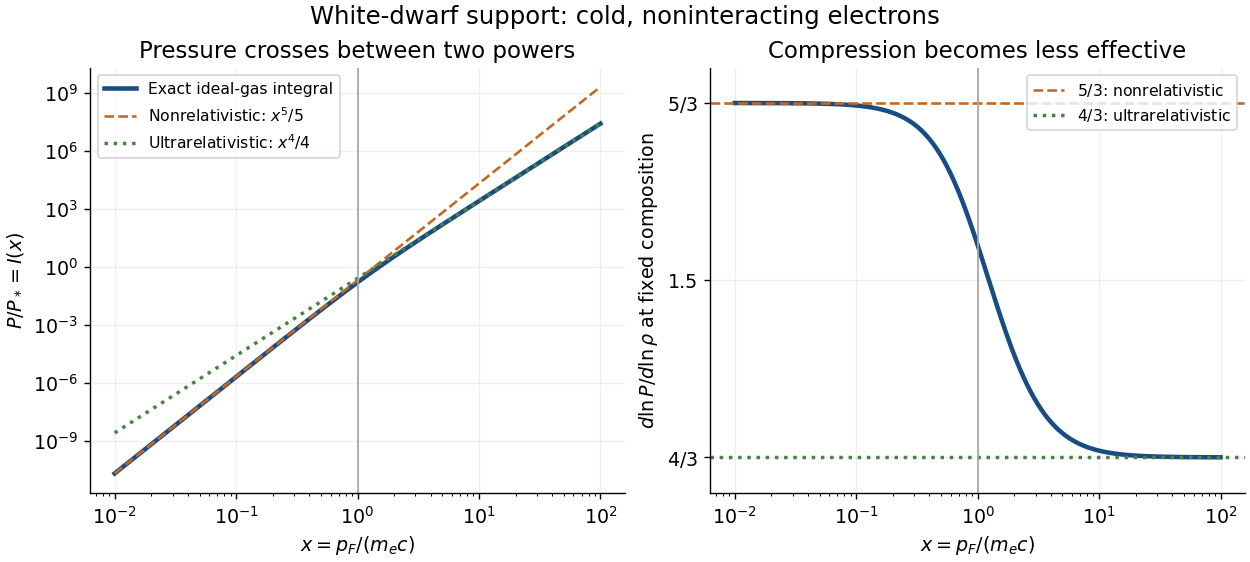
For , expand the denominator: and . For , the integrand approaches : and . At fixed composition, mass density is , with the mean molecular weight per electron and the unified atomic mass unit. Since , the logarithmic stiffness isPressure keeps rising; its fractional gain per fractional compression becomes smaller. Relativistic Electrons approach a speed ceiling while their momenta keep increasing. Thus the high-density equation of state loses the extra compression leverage of a nonrelativistic white dwarf. The Chandrasekhar mass from central polytropic constants supplies the corresponding global mass calculation.
For a calculated local example with , gives , and . Its stiffness is , intermediate between the two limits. These are ideal equation of state values at one point, not a measured central mass density or a whole white dwarf model. Finite temperature and interactions are excluded.
An ultrarelativistic degenerate electron gas has , so it forms an index-three stellar polytrope. Insert and into that equation of state: the radius cancels, leaving the displayed mass. For fully ionized helium, and . This is the ideal limiting Chandrasekhar mass, rather than a claim that every ordinary white dwarf has that mass.

