
A photodiode is a semiconductor diode producing photocurrent from photon absorption. Exciting an electron across the band gap leaves an electron hole. The depletion region's electric field separates the charge carriers; others can arrive by diffusion before electron-hole recombination. Contacts complete the electrical circuit.[ref]
Si photodiodes by Hamamatsu Photonics K.K.. Si photodiodes, p. 2, §1-1 and Figs. 1-1–1-2: generation, separation and collection
The useful bridge is from light to a measurable electric current: spectral responsivity converts incident radiant flux into photocurrent, while quantum efficiency counts collected signal charge carriers per incident photon. These answer different questions: how much electric current one watt produces, and how many incident photons contribute to the signal. The worked calculation below makes their relationship explicit.
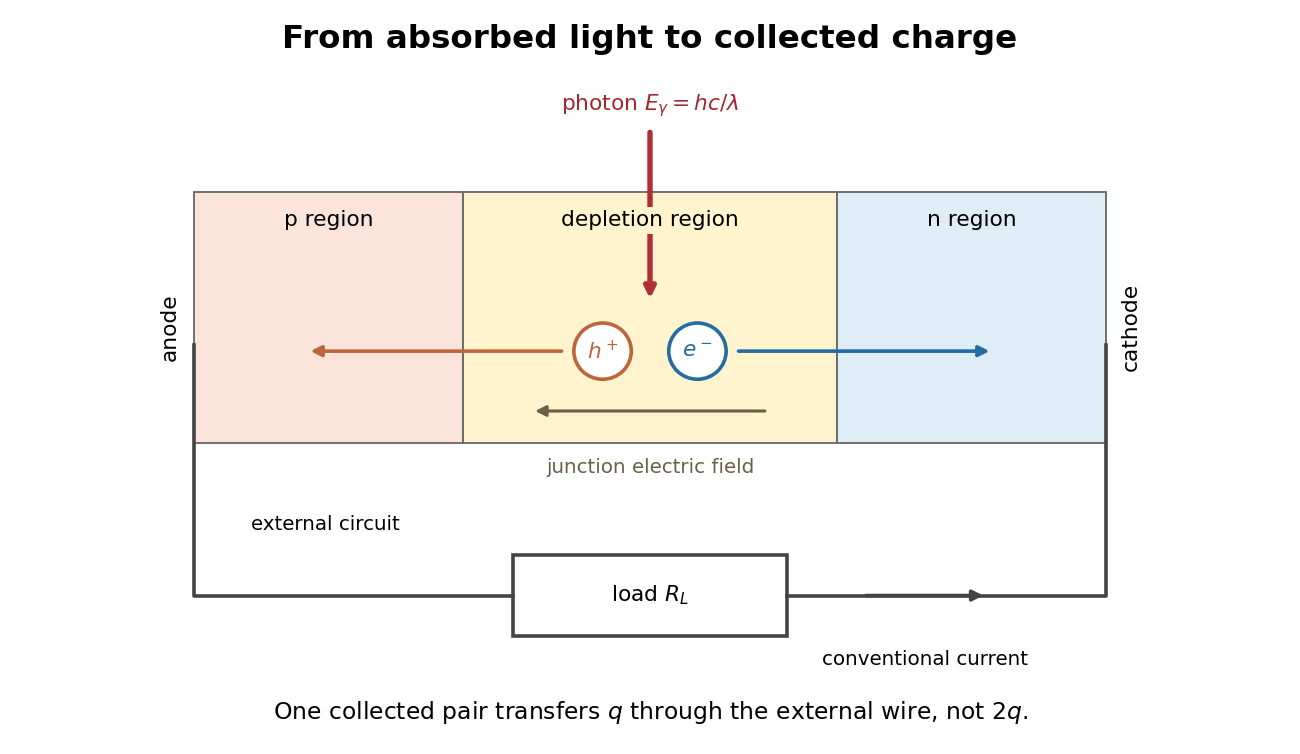
Photon absorption, junction separation and an external electric current
. Original qualitative p-n junction schematic with an external resistor. Collecting one electron–electron hole pair transfers one elementary charge through the external electrical circuit, rather than twice that amount. Dimensions and paths are schematic. Details.
New to topics? Read the docs here!