Photocurrent is the electric current attributable to illumination. Here denotes its magnitude after background subtraction. For a photodiode without internal multiplication, let be incident radiant flux concentrated at wavelength , and let be external quantum efficiency, including losses before collection. An incident photon has energy , with Planck constant and speed of light . Dividing energy per second by energy per photon gives the incident photon rate . Multiplying by gives the mean collected pair rate ; multiplying by elementary charge givesThe factor is : each collected pair replenishes an Electron at one contact and removes an Electron at the other. A cross-section of the external wire therefore counts one transferred Electron per completed pair, consistent with charge conservation. The Electron and electron hole are two internal charge carriers, not two independent transfers through that wire.
Choose an illustrative photodiode model with , and . Using the exact SI values , and givesA mean fraction does not require each fourth photon to be lost in a repeating pattern. It specifies a mean conversion rate. Nor does mean : quantum efficiency is dimensionless, whereas spectral responsivity compares electric current with power.
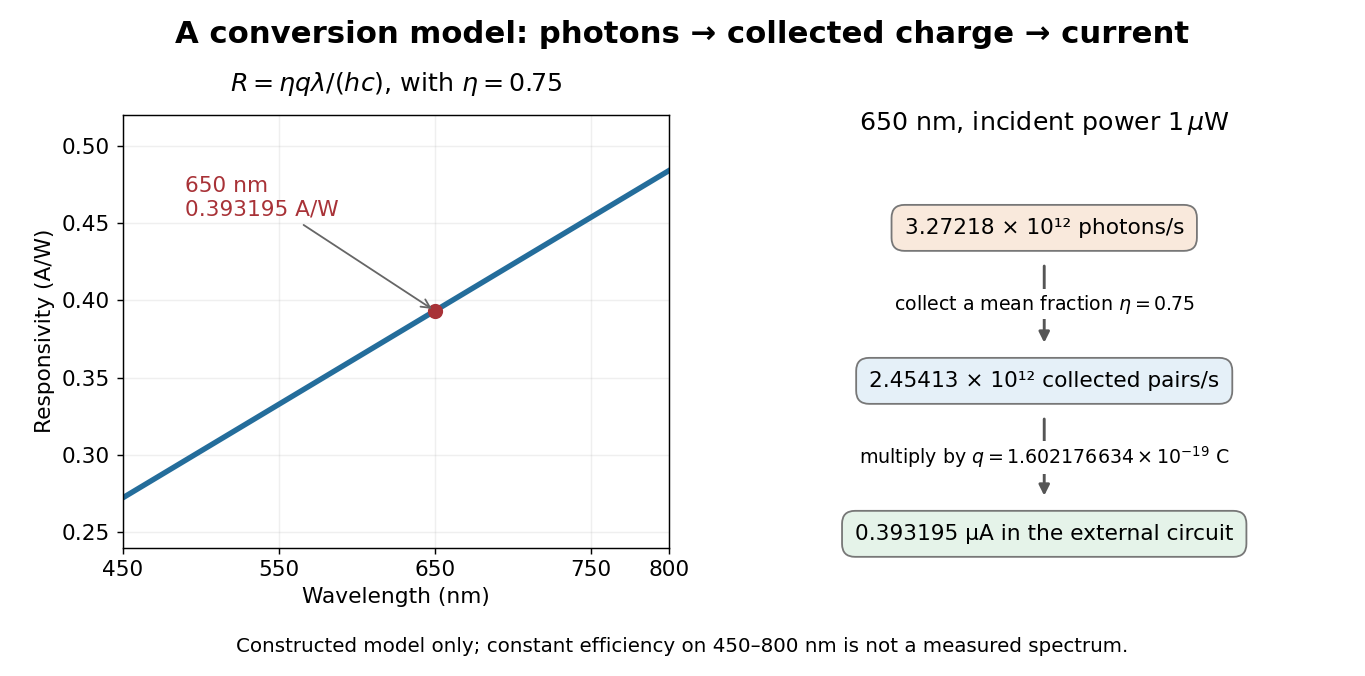

At fixed radiant flux, longer-wavelength photons have less energy, so more arrive per second. This explains the rising straight line when quantum efficiency is held constant. A real photodiode's quantum efficiency varies with wavelength; the plotted assumption cannot be extended past its band gap absorption cutoff. At fixed incident photon rate instead, has no additional factor of .
Articles by others on the same topic
There are currently no matching articles.