Thermal calibration of an optical trap
ID: thermal-calibration-of-an-optical-trap

A bead in a liquid keeps undergoing Brownian motion even when an optical trap holds its average position fixed. For a stationary harmonic optical trap in thermal equilibrium at absolute temperature , the equipartition theorem assigns mean potential energy to this one quadratic coordinate. With the Boltzmann constant and at equilibrium,At the same temperature, quadrupling the spring constant divides the position variance by four and the standard deviation by two. The Boltzmann factor gives the complete equilibrium probability density function, a Gaussian distribution:The prefactor makes ; its second moment is . The probability density function has units of inverse length, and its area gives probability. This density is exact for the ideal quadratic model. In a finite optical trap it approximates the occupied well when thermal excursions remain within the harmonic region and escape is negligible during observation. Driven motion, appreciable nonconservative forces or laser heating need not give this equilibrium density.
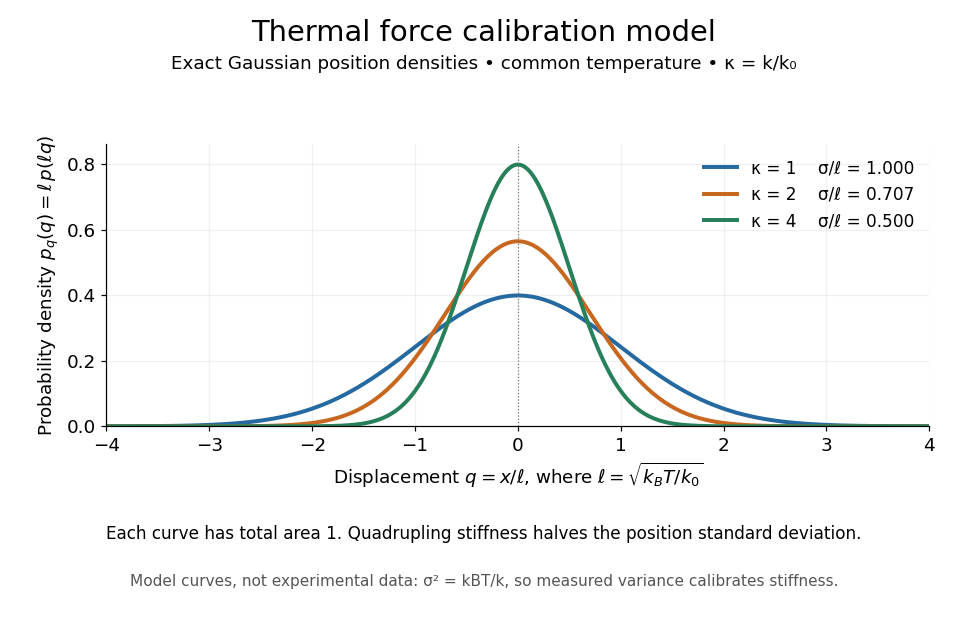
Thermal force calibration model: exact Gaussian position densities for relative trap stiffnesses 1, 2 and 4 at a common temperature
. Details. 
Here , and . The plotted density per unit is . Each curve has total area one; their dimensionless standard deviations are , and . The curves are exact model densities, not noisy experimental data.
Brownian motion becomes a measuring tool: a calibrated position measurement supplies , and the known temperature supplies . Once is known, a slowly applied constant external force shifts the mean by , so in the same harmonic range. Fluctuations therefore calibrate the conversion from displacement to force. Svoboda and Block used this equipartition theorem method when calibrating their bead traps. [ref]
https://www.andrew.cmu.edu/course/42-620/handouts/svoboda_cell_94.pdf. Svoboda and Block, 1994, trap stiffness calibration
.For the example stiffness and , and . Using a variance measured in uncalibrated detector units would not determine that physical stiffness. Measurement noise, finite exposure time, drift and insufficient sampling of the correlated Brownian motion can bias the estimate; record positions over many optical trap relaxation times and account for the detector response. The deterministic relaxation curve above describes relaxation without thermal forcing; an individual thermal trajectory continues to fluctuate.
New to topics? Read the docs here!