
Intergalactic medium 2026-10-13
Stellar parallax 2026-10-13
Stellar parallax is the apparent change in a star's viewing direction caused by the observer's changing position. Nearby stars shift more against a distant reference background. In an ideal circular Earth orbit, the conventional annual stellar parallax uses a baseline of one astronomical unit, approximately the Earth-Sun distance. Two opposite observing positions, about six months apart, are separated by approximately two astronomical units. Their maximum angular separation is , so is half that excursion, not the full January-to-July shift. The observed excursion depends on the projected baseline and observing dates. [ref].
For the perpendicular baseline in the diagram, a right triangle giveswhere in the final expression is in radians. Combining the small-angle approximation with the parsec convention givesThus arcseconds implies parsecs, while the ideal six-month excursion is arcseconds. Geometry supplies this distance without assuming a luminosity or a particular stellar atmosphere.
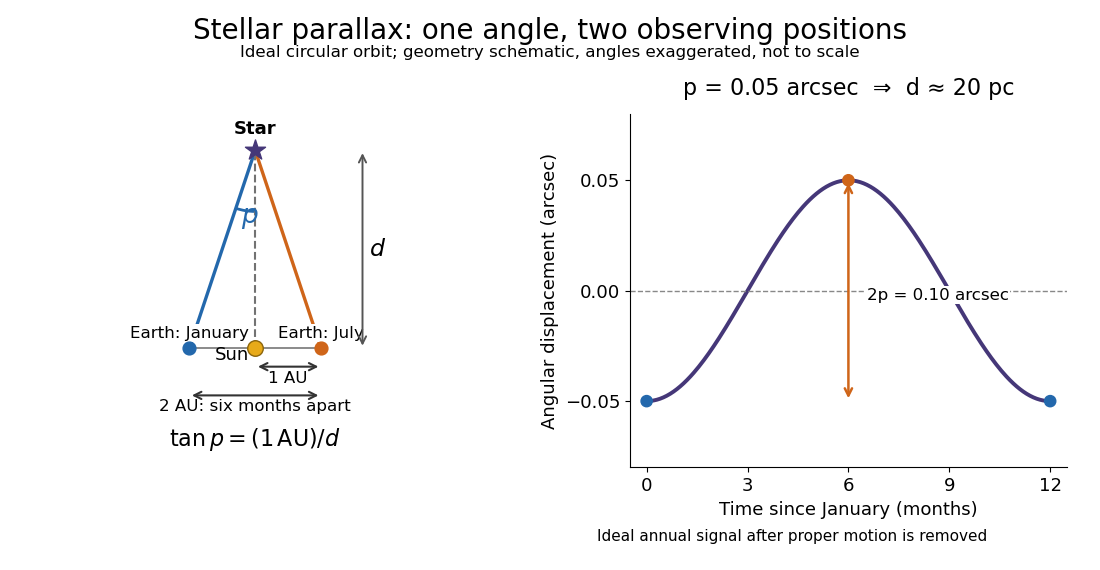
In practical astrometry, many observations separate the annual stellar parallax signal from proper motion, the star's own changing sky position. The Gaia DR3 catalogue reports stellar parallax and its uncertainty in milliarcseconds: arcseconds. A catalogue angle is a fitted measurement with measurement error. [ref].
For a positive stellar parallax with small standard deviation , first-order propagation gives . Thus with gives parsecs with parsecs, assuming systematic offsets are negligible. This linear estimate requires ; a reciprocal is nonlinear and does not generally preserve symmetric uncertainty intervals.
Point-like astronomical source 2026-10-13
A point-like astronomical source has an angular extent negligible for the calculation or measurement being considered. The ideal mathematical limit concentrates its luminosity at one source-plane position. In gravitational lensing, this approximation permits divergent formal magnifications on a caustic; a finite source averages the magnification over its emitting area. An unresolved source need not have negligible size compared with the lens's caustic scale.
Work by Asger Lund 2026-10-13
Work by Arturo C. Martí 2026-10-13
Work by Arthur Cayley 2026-10-13
Sorted array 2026-10-13
An array whose entries appear in nondecreasing order under a specified total order. The displayed inequalities allow repeated values.
For example, is a sorted array of integers. Inserting at index gives : with spare capacity, first shift one slot right. Appending would violate the sorted array property. Updating an entry also requires preserving the total order, or removing and reinserting it in a suitable position.
The useful combination is order plus direct indexed access: binary search eliminates a whole interval of candidates at each comparison, giving search time complexity under constant-cost comparisons and the array cost model. A sorted array is therefore attractive for many lookups between changes, while keeping it sorted can still require shifting work per insertion. A sorted linked list has the ordering information but does not supply the same constant-cost access to a middle index.
Column-major order 2026-10-13
Row-major order 2026-10-13
Storage of a multidimensional array with the last index varying fastest in consecutive positions. In a two-dimensional array, each row is contiguous. Row-major order is a layout convention; a program can traverse that array by rows or by columns. See the explicit address calculation in spatial locality.
Work by Arpon Raksit 2026-10-13
Work by Arno Solin 2026-10-13
Work by ARM Limited 2026-10-13
De Thiende 2026-10-13
Simon Stevin's De Thiende, published in 1585, presents calculation with decimal fractions for practical users. Its notation explicitly labels units, tenths, hundredths, and smaller decimal places; it does not use our modern decimal point. This is a historical example of changing representation to make the same arithmetic operations easier to organize. [ref]
https://www.dbnl.org/tekst/stev001thie01_01/stev001thie01_01_0005.php. Stevin, De Thiende, 1585 title page
[ref]https://www.dbnl.org/tekst/stev001thie01_01/stev001thie01_01_0003.php. DBNL edition, description of Stevin's notation and operations
.jpg)

.jpg)
Integer arithmetic 2026-10-13
Integer arithmetic computes with integers. Addition, subtraction and multiplication preserve integer values; division can instead return a quotient and remainder through Euclidean division. For example, gives five complete groups and a remainder of two. The ceiling count for fixed-size batches requires six groups to hold all 102 items.
Mathematical integers have no fixed size bound. A computer representation may have one, so an exact arithmetic formula still requires sufficient space for its inputs and intermediate values. The floor function and ceiling function define mathematical bounds independently of a chosen representation.
Figurate number 2026-10-13
A figurate number is an integer illustrated by a regular geometric arrangement of points. Triangular numbers and square numbers are basic examples: growing a prescribed shape turns a counting problem into a sequence of integers.
Sum of squares 2026-10-13
A sum of squares adds the squares of numbers for specified real numbers . It is nonnegative and vanishes exactly when every term is zero. For the coordinates of a vector, it is the squared Euclidean norm; for regression residuals, it gives the residual sum of squares minimized by ordinary least squares.
Inequality (mathematics) 2026-10-13
An inequality compares mathematical quantities using an ordering, such as or for real numbers. A strict inequality excludes equality; a non-strict inequality allows it. For example, is strict, while is true because equality is allowed. Adding the same real number preserves either comparison; multiplying by a negative real number reverses its direction.
Division (mathematics) 2026-10-13
For real numbers and , division asks for the unique number satisfying . Equivalently, uses the multiplicative inverse of . This description separates the role of the denominator from the result: the quotient undoes a specified multiplication.
For example, is the number whose double is three, so it is exactly . A second interpretation asks how many portions of size fit into an amount ; the answer is one and a half portions. Equal sharing and measuring with a specified portion size lead to the same quotient, although the units assigned to the result can differ.
In the natural numbers, exact division need not be possible. Euclidean division instead keeps a remainder: , with . Thus seventeen objects form three complete groups of five with two left over. As a rational number, the same quotient is . The remainder and the fractional part describe the same unfinished group in different ways.
Division by zero cannot retain the unique-solution rule. For , the equation has no solution; for , every real number solves , so there is no unique quotient. This explains both failures through multiplication, rather than assigning a value that would contradict ordinary arithmetic. [ref]
https://openstax.org/books/prealgebra-2e/pages/3-4-multiply-and-divide-integers. OpenStax, Prealgebra 2e, multiplication and division conventions
Number 2026-10-13
Numbers are mathematical objects used to express quantities and carry out operations. Familiar families include the natural numbers, integers, rational numbers, real numbers, and complex numbers; specifying the family determines which operations and solutions are available.
Online text: devenport.aoe.vt.edu/aoe3054/manual/expt3/text.html
There are unlisted articles, also show them or only show them.