
Ionic bonding 2026-10-13
Ionic bonding binds oppositely charged ions through attraction governed by electrostatics. In ordinary solid sodium chloride, each cation interacts with many anions, and also with other cations: attraction and repulsion together contribute to the binding of an extended ionic crystal. The chemical formula specifies equal numbers of the two kinds of ions; it does not divide the solid into isolated two-atom molecules.[ref]
This distinction explains a striking combination of properties: ordinary dry sodium chloride conducts electric current poorly, while its molten form or a sufficiently concentrated chemical solution in water conducts well. The ions already exist in the solid; their ability to move through the sample changes. A conductivity experiment on salt solutions tests this transport picture, rather than simply asserting that charged constituents must make every material conductive.
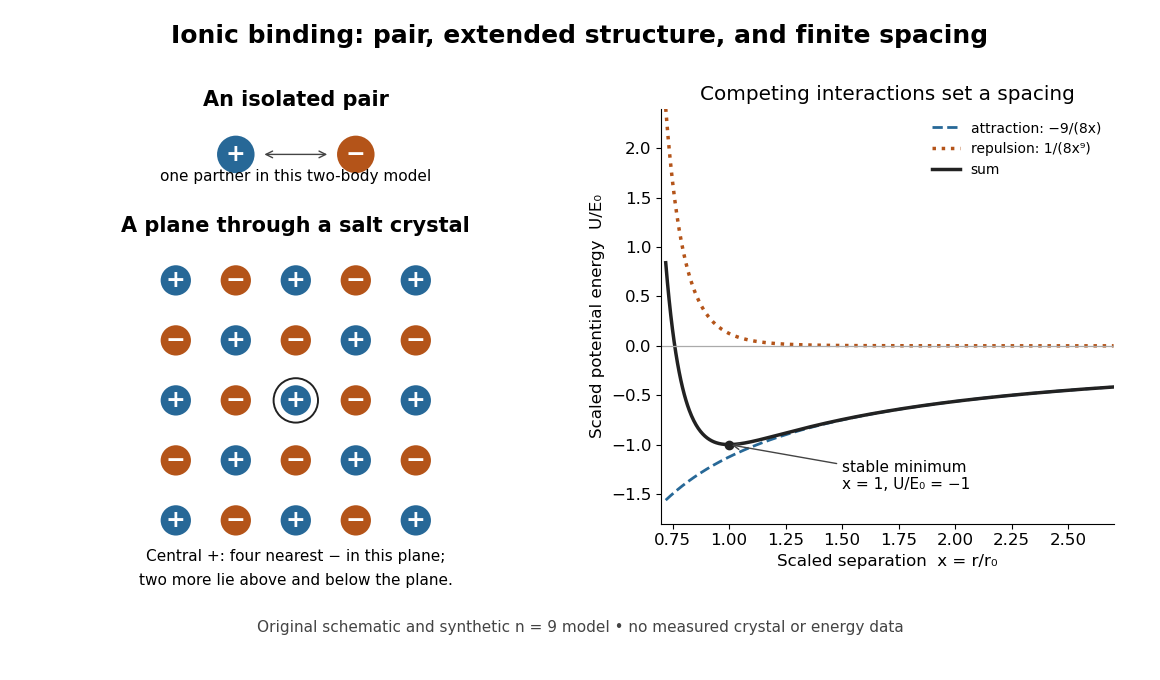
An isolated ion pair, a plane of an extended ionic crystal, and a synthetic potential energy model with a stable spacing
. Original schematic geometry and calculated model curves, not a measured electron density, diffraction pattern, or experimental lattice energy. Four nearest neighbours are visible in the plane of the rock salt structure; two more lie perpendicular to it. Disk sizes are arbitrary. The right-hand curves use the explicitly stipulated dimensionless model below. Details.
Electronegativity 2026-10-13
Electronegativity describes a chemical atom's tendency to attract electron density towards itself in a chemical bond. It helps answer a useful question: when two different chemical atoms share Electrons, which end of the chemical bond tends to be richer in electron density? For hydrogen chloride, the answer is chlorine: the covalent bond is a polar covalent bond, conventionally written . The symbols indicate partial atomic charges, not isolated ions carrying whole elementary electric charges.[ref]
Electronegativity is a comparison scheme, not the number of Electrons on a chemical atom. A partial atomic charge depends on how the electron density is partitioned; formal charge instead follows an integer allocation in a Lewis structure. Neither is numerically equal to electronegativity. Nor is electronegativity identical to electron affinity, which concerns adding an Electron to an isolated species. Different electronegativity scales use different measured inputs and conventions; compare numbers only after specifying the scale.[ref]
For a concrete comparison, the Royal Society of Chemistry lists Pauling electronegativities and . Their difference is , so the electronegativity rule predicts bond polarization towards chlorine in hydrogen chloride. An isolated molecular hydrogen molecule has identical ends and zero electronegativity difference. These examples explain a direction of unequal sharing, not a quantitative partial atomic charge.[ref][ref]
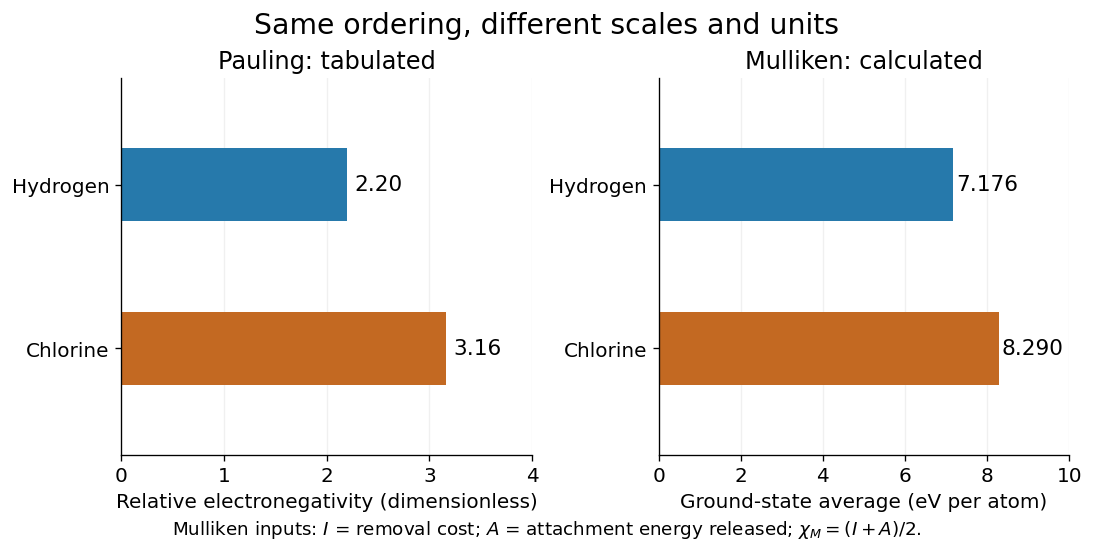
Pauling electronegativity and Mulliken electronegativity for hydrogen and chlorine: separate scales, separate units; the Mulliken electronegativity values are calculated from the stated ground-state inputs
. Details. 
A larger electronegativity difference often suggests stronger bond polarization, but there is no universal numerical boundary where a covalent bond suddenly becomes ionic bonding. Tables of cutoffs are classification aids with exceptions. Hydrogen fluoride, for example, is described by a polar covalent bond even when its electronegativity difference exceeds a textbook's nominal ionic threshold. The actual electron density, physical setting, and chemical substance's structure matter.[ref]
Chemistry 2e. §7.2, “Electronegativity and Bond Type”, general-guide warning and HF exception
The distinction from ionization energy is equally useful: an ionization energy measures the cost of removing an Electron from a specified isolated species, whereas electronegativity compares attraction for electron density in a bonded environment. Neither the removal cost alone nor the attachment release alone supplies a unique bonded-atom electronegativity. A scale combines selected measured inputs with a model and a convention.[ref]
electronegativity. E01990: multiple definitions; Mulliken average versus Pauling bond-energy differences
Photodissociation 2026-10-13
Photodissociation separates a molecule into fragments after photon absorption. For an isolated parent with a single absorbed photon, conservation of energy givesInternal excitation energies here are relative to the parent and product ground states used to define ; is the total product translational kinetic energy in the parent's centre of mass frame. Measuring one product's kinetic energy is insufficient by itself. For two fragments of masses , conservation of momentum gives when is detected. Unknown product excitation can conceal part of the available energy.
Heterolysis 2026-10-13
Homolysis 2026-10-13
Bond-dissociation energy 2026-10-13
A bond-dissociation energy specifies the energy needed for a stated dissociation into separated fragments. An energy from the lowest vibrational state, an energy from the bottom of a potential energy well, and a finite-temperature molar dissociation enthalpy require different conventions; do not silently mix them in an electronegativity formula.
Which fragments, in which quantum states, and at which temperature? For a neutral gaseous molecule with a specified two-electron covalent bond, the usual thermochemical convention is homolysis,Each fragment receives one of the two bonding Electrons; the dots denote unpaired Electrons. The final fragments are isolated from each other, with their own relaxed molecular geometry and specified electronic quantum states. The energy cost includes this relaxation, rather than merely stretching the initial chemical bond while freezing everything else. For a neutral parent, heterolysis instead produces , or the opposite assignment of electric charges; those are different final states and different energies. A value for gaseous neutral fragments cannot be transferred to ions, a chemical solution, or a solid without accounting for those changed conditions.[ref]
bond-dissociation energy. definition of bond-dissociation energy: molar enthalpy for homolysis of a specified molecular entity
The distinction is useful beyond terminology. Pauling electronegativity compares consistently defined bond-dissociation energies; photodissociation can reveal a specified ground-state threshold; a thermal chemical reaction balance requires compatible enthalpies. A threshold is also different from an activation energy: it compares initial and final quantum states, whereas a barrier can obstruct the path between them.
Density-gradient centrifugation 2026-10-13
Density-gradient centrifugation uses a liquid whose density varies along the separation direction. A band does not by itself establish which mechanism produced it: rate-zonal centrifugation separates by migration rate before equilibrium, whereas isopycnic centrifugation uses equilibrium positions set by buoyant density.
Differential centrifugation 2026-10-13
Differential centrifugation successively separates centrifugation pellets from supernatants by differences in settling rate. A first centrifugation pellet can enrich faster-settling material; a later centrifugation pellet from its supernatant can enrich slower-settling material. The fractions overlap because particles have different starting positions and can become trapped. Differential centrifugation is consequently an enrichment method, not automatic identification or complete purification.[ref]
https://www.beckman.com/resources/technologies/centrifugation/principles/particle-separation/. Particle Separation: differential pelleting, smaller particles initially near the tube bottom, and incomplete separation
Sedimentation coefficient 2026-10-13
The sedimentation coefficient is radial drift velocity divided by local centrifugal acceleration. It has units of time and combines particle properties with those of the surrounding liquid. In a dilute, deterministic mathematical model with negligible particle inertia, an effective displaced volume , particle mass , local liquid density and linear friction coefficient giveThe subtraction represents buoyancy. Equal mass does not imply equal : changing shape changes drag force, and changing the medium changes both buoyancy and viscosity.[ref]
https://www.beckman.com/resources/technologies/centrifugation/ultracentrifugation/. An Introduction to Ultracentrifugation, The Physics Behind the Technology: mass, size, shape, medium density and viscosity
For an isolated sphere of radius and uniform density , Stokes's law supplies , where is dynamic viscosity, and . ThereforeThis original force-balance check predicts fourfold on doubling with everything else fixed, and zero drift when . It applies to dilute isolated spheres in Stokes flow, not arbitrary folded proteins or crowded suspensions. If and remain constant in a uniform medium, the ordinary differential equation has the exponential function solution . Arrival at an outer boundary therefore depends on starting position as well as ; a separation has no universal size cutoff.
Supernatant 2026-10-13
A supernatant is the liquid remaining above settled or pelleted material. It can contain dissolved molecules and particles that have not reached the centrifugation pellet; a visually clear supernatant need not be chemically empty.
Centrifugation pellet 2026-10-13
A centrifugation pellet is material accumulated against the vessel wall by centrifugation. Its existence establishes collection, not purity; other suspended material can be trapped or co-sediment.
Centrifuge rotor 2026-10-13
A centrifuge rotor holds sample vessels around the rotation axis. A fixed-angle centrifuge rotor holds tubes at a fixed inclination; a swinging-bucket centrifuge rotor lets them swing outward during rotation. Material moves away from the axis, so a centrifugation pellet can first collect against an outer tube wall rather than travel along the entire tube axis. Geometry sets both the rotor radius and the travel distance.[ref]
Basics: Centrifugal Force & Centrifuge Type by Eppendorf. Basics: Centrifugal Force & Centrifuge Type, Fixed-angle or swing-bucket rotors? and Fixed-angle rotor: tube orientation and pellet position
Processor register 2026-10-13
A small storage location within a CPU used by its instructions. Some hold data; others describe control state, such as the program counter or stack pointer. Saving and restoring processor registers lets different software threads reuse the same CPU while retaining separate execution contexts.
Förster resonance energy transfer 2026-10-13
Förster resonance energy transfer is a nonradiative transfer of energy from an excited state of a FRET donor to a nearby FRET acceptor, through coupling of their electric dipoles. The transfer step does not emit a photon that the FRET acceptor subsequently absorbs. It competes with the FRET donor's own fluorescence and other routes out of its excited state. A fluorescent FRET acceptor can then emit fluorescence; an absorbing but nonfluorescent FRET acceptor can still receive the transferred energy.[ref]
Advanced Fluorescence Microscopy Techniques—FRAP, FLIP, FLAP, FRET and FLIM by Hellen C. Ishikawa-Ankerhold and others. §3.1: nonradiative dipole coupling and a potentially nonfluorescent acceptor
The striking use of FRET is to turn a change in molecular proximity into an optical readout. Proteins carrying a FRET donor and a FRET acceptor may change the readout when they associate, as in the chemotaxis FRET assay; two labels on one protein may report a change in its shape. Interpretation depends on the FRET spectral overlap, FRET dipole orientation factor and labeling geometry, as well as separation. A change in FRET is therefore evidence about proximity under specified conditions, rather than a direct measurement of an arbitrary distance.[ref]
Advanced Fluorescence Microscopy Techniques—FRAP, FLIP, FLAP, FRET and FLIM by Hellen C. Ishikawa-Ankerhold and others. §3.1 and §3.3: dependence on distance and orientation; inter- and intramolecular applications
For a single pair with fixed Förster distance and label separation , the FRET efficiency isAt , half the FRET donor excitations transfer energy. At , the model gives ; at , it gives . The sixth power makes FRET especially useful near the Förster distance, with little sensitivity to further separation once transfer is already negligible. These are model calculations, not measurements of a particular pair.
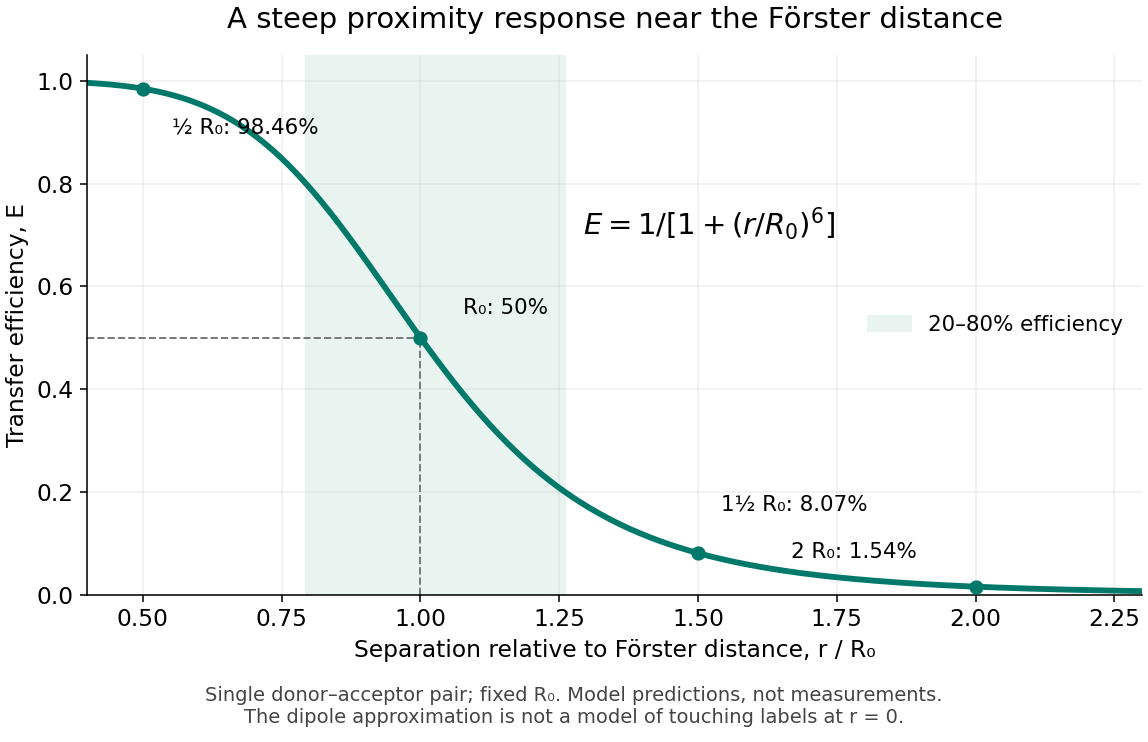
FRET efficiency versus separation relative to the Förster distance
. Original single-pair mathematical model with fixed Förster distance. The shaded interval is . The curve does not establish a universal working range or justify the electric dipole approximation for overlapping labels. Details.
This source is credited to an organization.
This source is credited to an organization.
This source is credited to an organization.
By Eppendorf.
Publisher: Eppendorf.
This source is credited to an organization.
Online text: www.eppendorf.com/gb-en/lab-academy/life-science/cell-biology/basics-in-centrifugation/
Cited passages: Basics: Centrifugal Force & Centrifuge Type, Fixed-angle or swing-bucket rotors? and Fixed-angle rotor: tube orientation and pellet position; Important definitions, Rcm vs rpm, and How to calculate relative centrifugal force: radius dependence and acceleration ratio.
Published in Proceedings of the National Academy of Sciences of the United States of America.
By Claes Weibull.
Published in Journal of Bacteriology.
Cited passages: pp. 688–689, Materials and Methods; pp. 692–694, release comparison and Figure 6.
There are unlisted articles, also show them or only show them.