
Past exam of the mathematics course of the University of Cambridge 2019 ib Paper 4 18C c Solution Created 2026-09-24 Updated 2026-10-14
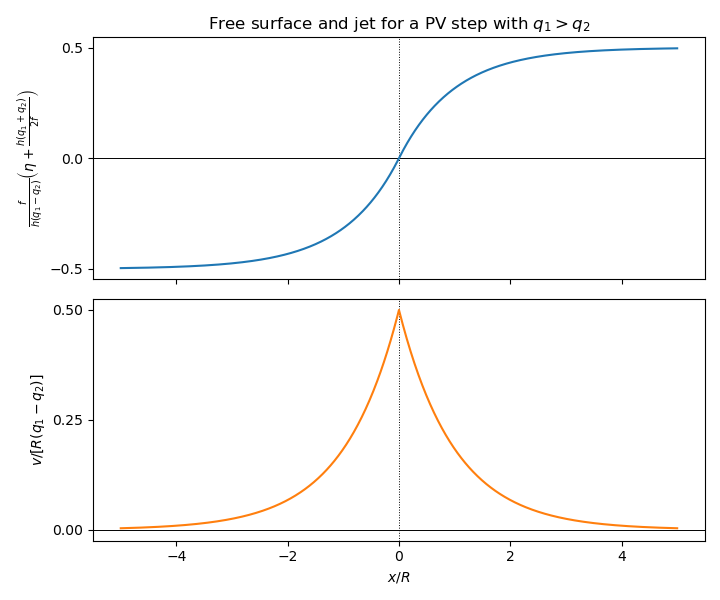
For a steady flow independent of , geostrophic balance givesHence , and the definition of becomesEquivalently,With the Rossby deformation radius , the bounded solution for the stated potential-vorticity step isContinuity of and at givesThereforeand
When , the surface height increases smoothly from to , while is a positive eastward jet with its maximum at the discontinuity and exponential decay on the Rossby-radius scale:

Past exam of the mathematics course of the University of Cambridge 2019 ib Paper 4 18C b Solution Created 2026-09-24 Updated 2026-09-29
The vertical relative vorticity isDifferentiate the -momentum equation with respect to and the -momentum equation with respect to , then subtract. The mixed pressure derivatives cancel, givingThe mass-conservation equation says . Therefore the linearized shallow-water potential vorticitysatisfiesThus
Past exam of the mathematics course of the University of Cambridge 2019 ib Paper 4 18C a Solution Created 2026-09-24 Updated 2026-09-29
The constant is the positive Coriolis parameter at northern latitude , is the gravitational acceleration, and is the undisturbed mean depth of the layer.
The linearized shallow water equations assume a homogeneous, incompressible, inviscid layer over a flat bed; a horizontal scale much larger than the depth, so the shallow-water approximation and hydrostatic approximation apply; depth-independent horizontal velocity; a free-surface displacement and sufficiently small velocity to neglect nonlinear products; and an f-plane on which is constant. The equations also omit viscosity, forcing, and bottom topography.
Past exam of the mathematics course of the University of Cambridge 2019 ib Paper 4 17B c Solution Created 2026-09-24 Updated 2026-10-14
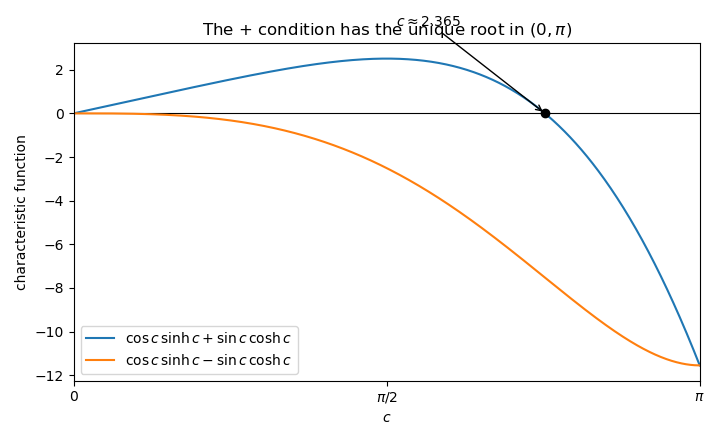
For and , the linear ordinary differential equation is , whose general solution isBy the stated parity reduction, an even eigenfunction has the form . The conditions have a nonzero solution exactly whenthat is,An odd eigenfunction has the form , and the corresponding determinant givesThus is an eigenvalue precisely under one of the two stated conditions.
The fourth-order eigenvalue condition and its roots
. Details. 
For the minus sign, division by away from gives . On , for , while on their signs differ, so there is no root. For the plus sign the equation isThere is no root in . On , the function increases strictly from to , so it has exactly one root by the intermediate value theorem. Numerically,Hence the combined condition has exactly one solution in .
Past exam of the mathematics course of the University of Cambridge 2019 ib Paper 4 17B b Solution Created 2026-09-24 Updated 2026-09-29
With and , the equation isMultiply by the real eigenfunction and integrate over . The clamped boundary conditions at both endpoints eliminate all boundary terms, soSince , the right side is a sum of nonnegative terms. It cannot vanish for a nonzero eigenfunction: if , the boundary conditions force . Thus
Past exam of the mathematics course of the University of Cambridge 2019 ib Paper 4 17B a Solution Created 2026-09-24 Updated 2026-09-29
Let . Repeated integration by parts gives the formal adjoint rulesThereforeEquality of the coefficients of in and requiresso . This also makes the zeroth-order coefficients equal because . Hence, under boundary conditions that remove the boundary terms,This is the self-adjoint fourth-order scalar differential operator .
Past exam of the mathematics course of the University of Cambridge 2019 ib Paper 4 16A c Solution Created 2026-09-24 Updated 2026-09-29
For , completing the square gives the Bogomolny boundConsequentlywith equality exactly when the Bogomolny equationholds everywhere. Separating variables, or differentiating the proposed form directly, gives all solutions with the required limits:These are the translated phi-four kinks.
Past exam of the mathematics course of the University of Cambridge 2019 ib Paper 4 16A b Solution Created 2026-09-24 Updated 2026-10-03
The integrandis nonnegative, so . If , both continuous summands vanish everywhere. Hence , so is constant; the common boundary value forces . Conversely, has and , so . Therefore
This agrees with part (a): at , the first variation vanishes because , andThus the constant configuration is a stationary local minimum as well as the global minimum identified directly.
Past exam of the mathematics course of the University of Cambridge 2019 ib Paper 4 16A a Solution Created 2026-09-24 Updated 2026-09-29
Write the admissible variation as , where at both ends. Differentiating the functional under the integral sign gives the first variationAfter integration by parts, with the boundary term vanishing,Thus the Euler-Lagrange equation isA second differentiation gives the second variation
Past exam of the mathematics course of the University of Cambridge 2019 ib Paper 4 15E d Solution Created 2026-09-24 Updated 2026-10-03
Yes. By an element of , part (a) puts the side between the - and -vertices on and the first vertex at . A reflection if needed puts the triangle on the chosen side. The remaining freedom is the ratio of the heights of the second and first vertices, and the equation from part (c) determines it uniquely because is strictly increasing on . The two incident circles are then fixed, so their other intersection and the triangle are fixed. Thus triangles with the same three angles are isometric, which is Hyperbolic AAA congruence.
Past exam of the mathematics course of the University of Cambridge 2019 ib Paper 4 15E c Solution Created 2026-09-24 Updated 2026-09-29
Because the half-plane metric is a conformal rescaling of the Euclidean metric, its angles are Euclidean angles. For each , the hyperbolic lines meeting the imaginary axis at a fixed angle at are the Euclidean circleswhere denotes the vertical coordinate. These circles have centres on the real axis and are therefore hyperbolic lines; varying gives the required collection.
To construct a triangle, put one vertex at and a second at on , with . Draw from these vertices the lines making interior angles and with . Their Euclidean centres and radii areIf their other intersection has angle , the law of cosines in the Euclidean triangle formed by the two centres and that intersection givesEquivalently,The right side is greater than one exactly when . Since ranges continuously and strictly increasingly from to infinity for , such a exists. The three lines therefore bound a hyperbolic triangle with the prescribed angles.
Past exam of the mathematics course of the University of Cambridge 2019 ib Paper 4 15E b Solution Created 2026-09-24 Updated 2026-09-29
An orientation-preserving isometry fixing every point of fixes more than two points in the upper half-plane and hence, as a Möbius transformation, is the identity. The mapfixes pointwise and preserves the hyperbolic metric; it is the hyperbolic reflection in . Consequently the pointwise stabilizer is exactly
For any isometry , use part (a) to choose that agrees with on one pointed line and its tangent direction. Then fixes that line pointwise, so it is either the identity or its reflection. Hence the Isometry group of the Poincare half-plane consists ofandwith real coefficients, modulo multiplication of all four coefficients by a nonzero scalar.
Past exam of the mathematics course of the University of Cambridge 2019 ib Paper 4 15E a Solution Created 2026-09-24 Updated 2026-09-29
A Geodesic in the Poincare half-plane model is a vertical line or a semicircle orthogonal to the real axis. Given a hyperbolic line , choose a real Möbius transformation sending its two ideal endpoints to and . After multiplying its representing matrix by a scalar and, if necessary, changing its sign, it represents an element of and sends to the positive imaginary axis .
The chosen point then maps to for some . The dilation , represented byfixes and sends to . Thus every pointed line can be sent to , proving transitivity on pointed hyperbolic lines.
Past exam of the mathematics course of the University of Cambridge 2019 ib Paper 4 14D c Solution Created 2026-09-24 Updated 2026-09-29
Taking and using givesSet . The Taylor series of the denominator isConsequentlyThe singular part at is thereforeUsing long-time asymptotics from a Laplace transform and part (a), the centre temperature has late-time behaviour
Past exam of the mathematics course of the University of Cambridge 2019 ib Paper 4 14D b Solution Created 2026-09-24 Updated 2026-09-29
Taking the Laplace transform in and using the initial condition , the radial heat equation in three dimensions becomesPut and . ThensoFiniteness at the centre forces .
Past exam of the mathematics course of the University of Cambridge 2019 ib Paper 4 14D a Solution Created 2026-09-24 Updated 2026-09-29
The Bromwich inversion formula givesFor , close the Bromwich contour in the left half-plane. The only enclosed singularity is the double pole at , whose residue isThe residue theorem therefore yields
Past exam of the mathematics course of the University of Cambridge 2019 ib Paper 4 13G c Solution Created 2026-09-24 Updated 2026-09-29
Define a continuous map by the standard embedded torus of revolution parametrizationIts image lies in becauseThe periodicity of the trigonometric functions makes and , so is constant on every -equivalence class. The universal property of the quotient topology therefore gives a unique continuous map
Every point of has cylindrical radius between and , so its polar angle determines modulo one, while the pair on the unit circle determines modulo one. Hence is surjective, and two parameters have the same image exactly when they differ by the endpoint identifications defining ; thus it is injective.
The quotient is compact as the continuous image of the given compact space under the quotient map. The surface is Hausdorff because it has the subspace topology inherited from . The compact-to-Hausdorff continuous bijection theorem now shows that is a homeomorphism. Therefore
Past exam of the mathematics course of the University of Cambridge 2019 ib Paper 4 13G b Solution Created 2026-09-24 Updated 2026-09-29
A closed set is compact because it is closed in the compact space . Its image is compact by the fact that a continuous image of a compact space is compact, and every compact subset of the Hausdorff space is closed. Thus the continuous bijection is a closed map. Its inverse is consequently continuous, so is a homeomorphism. This is the compact-to-Hausdorff continuous bijection theorem.
Past exam of the mathematics course of the University of Cambridge 2019 ib Paper 4 13G a Solution Created 2026-09-24 Updated 2026-09-29
If , the subspace topology on isIf is an equivalence relation on and is the natural projection, the quotient topology declares open exactly when is open in . For topological spaces and , the product topology on has as a basis all sets with open in and open in .
Past exam of the mathematics course of the University of Cambridge 2019 ib Paper 4 12E b iii Created 2026-09-24 Updated 2026-09-24
There are unlisted articles, also show them or only show them.