
Past exam of the mathematics course of the University of Cambridge 2015 ia Paper 1 7A iii Solution Created 2026-09-24 Updated 2026-10-06
Let with . Commutation givesThus belongs to the eigenspace , with the zero vector allowed. Since has distinct eigenvalues, each eigenspace is one-dimensional. Hence for some scalar . This is the fact that commuting maps preserve eigenspaces.
The standard linear independence theorem for eigenvectors belonging to distinct eigenvalues supplies a basis of eigenvectors of . The preceding argument makes every one an eigenvector of as well. Their column matrix therefore simultaneously diagonalizes and . This is simple spectrum gives simultaneous diagonalization.
For real matrices, this conclusion always holds over ; a real common basis follows when the distinct eigenvalues of are real. Real matrix entries alone do not ensure a real eigenbasis: a quarter-turn of , with , has eigenvalues . The matrices in this question have real spectra, so their common basis is real.
Past exam of the mathematics course of the University of Cambridge 2015 ia Paper 1 7A ii Solution Created 2026-09-24 Updated 2026-10-06
Suppose and for an invertible and diagonal matrices . Since diagonal matrices commute,Therefore simultaneous diagonalization implies commutation. This argument works over either or and explains why simultaneous diagonalization produces commuting operators.
Past exam of the mathematics course of the University of Cambridge 2015 ia Paper 1 7A i Solution Created 2026-09-24 Updated 2026-10-06
The characteristic polynomials, in the convention , areSolving the eigenvalue equations gives the complete eigenspacesEvery nonzero vector in a listed eigenspace is an eigenvector, and these are all the eigenvectors. For , the repeated eigenvalue has a two-dimensional eigenspace; for , all three eigenvalues are simple. The three displayed generating vectors form a basis because their column matrixhas determinant . Thus both matrices are diagonalizable, with diagonal entries for and for in this basis.
Past exam of the mathematics course of the University of Cambridge 2015 ia Paper 1 6C ii Solution Created 2026-09-24 Updated 2026-10-06
Let be the standard basis and define . By linearity,Thus every linear functional has this form. Its representing vector is unique because evaluating at each gives .
For the prescribed kernel of a linear map, the third listed vector is the first minus the second, so it adds no independent constraint. The first two requireTaking and gives , . Consequently all possible representing vectors areConversely, every such vector is perpendicular to each of the three prescribed vectors, so its linear functional vanishes on them. This also includes the zero linear functional.
Past exam of the mathematics course of the University of Cambridge 2015 ia Paper 1 6C i Solution Created 2026-09-24 Updated 2026-10-06
Write a vector in the domain as . The first and third equations defining the kernel of a linear map imply . Substitution into the second equation then givesFor , this forces , and . HenceThe kernel of a linear map has dimension one, so the rank-nullity theorem gives rank three and proves the assertion about the image of a linear map. Alternatively, the minor formed from columns has determinant , including a nonzero value at .
For , the parameters are free and , . ThusThe third row is the first row minus the second. The image of a linear map is therefore contained in . The first and third columns, and , are linearly independent, so the matrix rank is two and this containment is equality:This is the sole kernel jump in a parameter-dependent linear map; there is no further exceptional case at .
Past exam of the mathematics course of the University of Cambridge 2015 ia Paper 1 5B iii Solution Created 2026-09-24 Updated 2026-10-06
Apply the triangle inequality to the path from through to :This is one direction of the reverse triangle inequality. A second application of the triangle inequality, this time through , givesThe resulting four-point triangle inequality follows without any assumptions on coincidences among the four points.
Past exam of the mathematics course of the University of Cambridge 2015 ia Paper 1 5B ii Solution Created 2026-09-24 Updated 2026-10-06
Subtract the two constraints to obtain . The Cauchy-Schwarz inequality gives . Since , division and squaring give the distance bound from two hyperplane constraintsIf and , the intersection is empty. If and , the constraints describe the same hyperplane. Its points satisfy , with equality at . The fraction involving is undefined in this case and cannot be used.
Past exam of the mathematics course of the University of Cambridge 2015 ia Paper 1 5B i Solution Created 2026-09-24 Updated 2026-10-06
The Cauchy-Schwarz inequality in isHere the Euclidean norm is induced by the dot product. If , the result is immediate. If , the squared Euclidean norm of the component of perpendicular to is nonnegative:Rearrangement proves the Cauchy-Schwarz inequality. Equality holds precisely when and are linearly dependent, including the cases of a zero vector.
Expanding the squared Euclidean norm and using the Cauchy-Schwarz inequality givesTaking nonnegative square roots gives the triangle inequality. Applying the triangle inequality once more gives
Past exam of the mathematics course of the University of Cambridge 2015 ia Paper 1 3F c Solution Created 2026-09-24 Updated 2026-10-06
For , the exponent lies in , and . ConsequentlyThe last inequality uses the positive-term power series for . The final bound tends to zero, so the squeeze theorem gives limit .
Past exam of the mathematics course of the University of Cambridge 2015 ia Paper 1 3F b Solution Created 2026-09-24 Updated 2026-10-06
For sufficiently close to zero, . Apply the mean value theorem to the logarithm between and : there is a point between these endpoints withAs from either side, , so this quotient tends to . The exponential function is continuous, and thereforeThe hypotheses of the mean value theorem hold because is continuous and differentiable for , with derivative .
Past exam of the mathematics course of the University of Cambridge 2015 ia Paper 1 3F a Solution Created 2026-09-24 Updated 2026-10-06
For , the usual unit-circle area comparison, with angles measured in radians, gives . HenceThe cosine is a continuous function at zero, so the squeeze theorem yields the right-hand limit of a function . The quotient is even, so the left-hand limit of a function is the same. Thus the limit is .
Past exam of the mathematics course of the University of Cambridge 2015 ia Paper 1 1B b Solution Created 2026-09-24 Updated 2026-10-06
Put . Since , the finite geometric series giveswhere the second equality multiplies numerator and denominator by . Taking imaginary parts gives the finite trigonometric sumTaking real parts of the same finite geometric series givesThe denominator is nonzero by the restriction on . Equivalently, these finite trigonometric sums are and , respectively.
Past exam of the mathematics course of the University of Cambridge 2015 ia Paper 1 1B a Solution Created 2026-09-24 Updated 2026-10-06
Write . Using the complex conjugate, the squared complex modulus on the left is . Squaring the equality and dividing by , which is nonzero, givesCompleting the square identifies the candidate circle:Its centre is on the real axis and its radius is in the complex plane.
It remains to exclude extraneous points introduced by squaring. On this circle, , so the original right-hand side satisfiesThus taking the nonnegative square root recovers the original equality at every point of the circle. This is a circle from an affine complex-modulus equation, with the sign check essential to the geometric conclusion.
Past exam of the mathematics course of the University of Cambridge 2015 ia Paper 1 11D ii Solution Created 2026-09-24 Updated 2026-10-06
For a chord of length , consider the continuous function on . Since ,An endpoint zero already supplies the chord. Otherwise the endpoint values have opposite signs, so the intermediate value theorem supplies at some . Thus a horizontal chord of length exists.
For each integer , define on . The sampled differences telescope:If any sampled value is zero, it gives the required chord. Otherwise there must be both a positive and a negative sampled value. The intermediate value theorem, applied between their sample points, then gives . Hence a horizontal chord of length exists for every positive integer ; for , the endpoint chord itself suffices. This proves the horizontal chord of reciprocal-integer length result, without restricting to powers of two.
Past exam of the mathematics course of the University of Cambridge 2015 ia Paper 1 11D i Solution Created 2026-09-24 Updated 2026-10-06
The intermediate value theorem says that if is a continuous function, then every value between and is attained at some point of .
Endpoint values are already attained. Suppose and define . It is nonempty and bounded above, so exists. Continuity at ensures that contains points to the right of , and continuity at ensures that no point sufficiently close to belongs to . Hence .
By the definition of the supremum, there are points of approaching . If , continuity would exclude all such nearby points from , a contradiction. If , continuity would put some point to the right of in , again a contradiction. Therefore . When , apply this argument to . This proves the intermediate value theorem in all cases.
Past exam of the mathematics course of the University of Cambridge 2015 ia Paper 1 10D b Solution Created 2026-09-24 Updated 2026-10-14
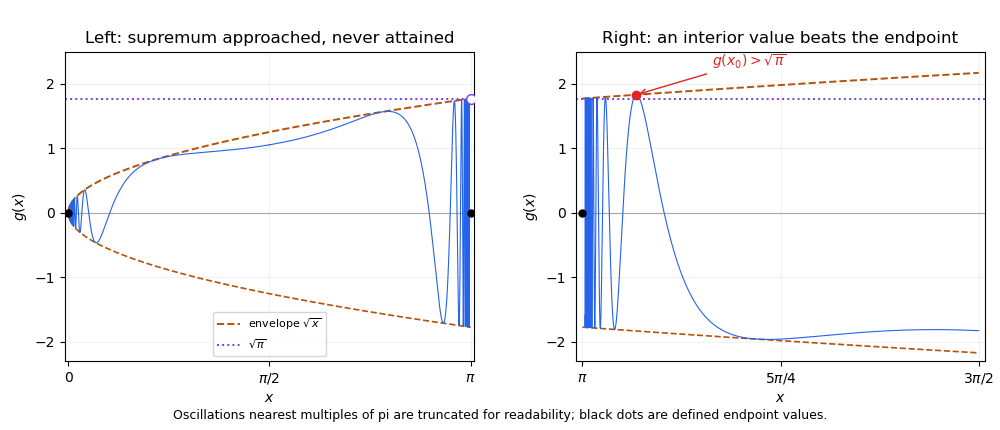
Away from integer multiples of , the function is a composition of continuous functions. At zero, the bound gives by the squeeze theorem. This is oscillation multiplied by a vanishing amplitude.
Fix and set and . Then , , andSo is discontinuous at every nonzero integer multiple of . Its set of continuity points is
On , for , while . With as above, . Consequently the supremum is and is not attained. This illustrates that supremum can fail to be attained at an oscillatory endpoint.
On , set . It lies strictly inside the interval, and , so . Choose . On ,On , is a continuous function, so the extreme value theorem gives a maximum there, at least . It exceeds every value on the discarded interval. Therefore does attain its supremum on . This is the interior-value criterion for an attained maximum.

Past exam of the mathematics course of the University of Cambridge 2015 ia Paper 1 10D a Solution Created 2026-09-24 Updated 2026-10-06
We use the Bolzano-Weierstrass theorem: every bounded real sequence has a convergent subsequence. If were unbounded on , there would be with . The Bolzano-Weierstrass theorem gives a subsequence , and the closed interval contains . Since is a continuous function, , contradicting . Thus is bounded.
Let . By the definition of the supremum, choose with . Again the Bolzano-Weierstrass theorem gives . Continuity yields . Applying the same argument to gives a point where attains its infimum. Therefore both the supremum and the infimum are attained. This proves the extreme value theorem for a closed bounded interval.
Past exam of the mathematics course of the University of Cambridge 2014 ib Paper 4 9H b ii Created 2026-09-24 Updated 2026-09-24
Past exam of the mathematics course of the University of Cambridge 2014 ib Paper 4 9H b i Created 2026-09-24 Updated 2026-09-24
Past exam of the mathematics course of the University of Cambridge 2014 ib Paper 4 9H a Solution Created 2026-09-24 Updated 2026-10-06
The Markov property and the Chapman-Kolmogorov equation giveFor each intermediate state, one first uses the next-step transition probability and then the following one; the sampled history adds no information once is known. Thus is a homogeneous Markov chain with transition matrix and initial law . In particular,If zero is not a state of , this probability is zero.
There are unlisted articles, also show them or only show them.