
Past exam of the mathematics course of the University of Cambridge 2014 ia Paper 3 3A a Solution Created 2026-09-24 Updated 2026-10-06
Past exam of the mathematics course of the University of Cambridge 2014 ia Paper 3 12A c ii Created 2026-09-24 Updated 2026-09-24
Past exam of the mathematics course of the University of Cambridge 2014 ia Paper 3 12A c i Created 2026-09-24 Updated 2026-09-24
Past exam of the mathematics course of the University of Cambridge 2014 ia Paper 3 12A b ii Created 2026-09-24 Updated 2026-09-24
Past exam of the mathematics course of the University of Cambridge 2014 ia Paper 3 12A b i Created 2026-09-24 Updated 2026-09-24
Past exam of the mathematics course of the University of Cambridge 2014 ia Paper 3 12A a Solution Created 2026-09-24 Updated 2026-10-06
DefineThey sum to , with and . Interchanging two slots of a tensor still produces a tensor, so these are a symmetric second-rank tensor and an antisymmetric second-rank tensor, not merely symmetric and antisymmetric arrays in a selected frame.
For uniqueness, if , then . The common difference is both symmetric and antisymmetric, so each of its components equals its own negative and vanishes over . Thus the decomposition is unique. These are the symmetric and antisymmetric parts of a matrix, with their tensor transformation law preserved.
Past exam of the mathematics course of the University of Cambridge 2014 ia Paper 3 11A iv Solution Created 2026-09-24 Updated 2026-10-06
Rotational symmetry of the vector field means : rotations fixing force the field to be parallel to , and rotations between directions make its magnitude depend only on . Its flux integral over the radius- sphere is . Applying the flux identity from part (i) to the ball, with the spherically symmetric source, givesTherefore the origin-regular spherical Poisson flux law isOnly source values at occur. Changing the exterior source can change the scalar potential by an interior constant, but cannot change this radial gradient. Regularity on all of , inherited from the Poisson equation setting, matters: on a punctured domain alone an additional would have zero divergence away from the origin and would not be fixed by the local source. It is excluded here by the origin regularity needed for the ball flux identity.
Past exam of the mathematics course of the University of Cambridge 2014 ia Paper 3 11A iii Solution Created 2026-09-24 Updated 2026-10-06
The electric field of this point charge is a translated and scaled version of the radial field in part (ii). If and , its divergence vanishes throughout , so the divergence theorem gives zero flux integral.
If lies inside , remove a small ball centered at . On the remaining volume the divergence is zero. Its boundary is together with the small sphere, whose outward normal for the punctured volume points towards . That inner sphere contributes , by the sphere flux computed in part (ii). Thus the exterior flux must be :This is Gauss's law for a point charge. The assumption that the charge is not on the boundary is essential to these alternatives.
Past exam of the mathematics course of the University of Cambridge 2014 ia Paper 3 11A ii Solution Created 2026-09-24 Updated 2026-10-06
On the outward-oriented sphere of radius , , so . HenceAway from the origin, the divergence and curl of a radial vector field with giveIf the enclosed volume excludes the origin and its boundary avoids it, this field is smooth throughout the volume. The divergence theorem then gives . The nonzero sphere flux is compatible with zero divergence away from the origin because the enclosed singularity prevents applying that smooth-volume theorem directly to the full ball.
Past exam of the mathematics course of the University of Cambridge 2014 ia Paper 3 11A i Solution Created 2026-09-24 Updated 2026-10-06
For , the definition of the Laplacian gives . Integrating over and applying the divergence theorem yieldsThis is the flux form of Poisson equation, for an outward-oriented piecewise smooth boundary and the usual smoothness of on a neighborhood of the volume. In particular, a singularity cannot be ignored when applying this identity.
Past exam of the mathematics course of the University of Cambridge 2014 ia Paper 3 10A c Solution Created 2026-09-24 Updated 2026-10-06
Direct use of partial derivatives givesWith the upward oriented surface element found in part (b), the curl flux integrand over the annulus becomesEvery term in the numerator is odd in or , so its integral over the symmetric annulus is zero. Thus the surface integral isEach boundary circle has constant , hence . Its line integral is therefore , with no contribution from the third field component. An anticlockwise radius- circle gives . The outward boundary orientation is anticlockwise at and clockwise at , soThe two computed values agree, verifying Stokes theorem with both boundary components. A downward choice would give on both sides.
Past exam of the mathematics course of the University of Cambridge 2014 ia Paper 3 10A b Solution Created 2026-09-24 Updated 2026-10-14
Use the positive graph . The printed PDF bounds are , so its projection is the annulus . The surface is the corresponding band of the upper sheet of a two-sheeted hyperboloid, bounded by circles of radii and at heights and .

The upper hyperboloid band between heights square root of two and square root of five, with annular projection
. Details. 
For the parametrization , its tangent vectors are and . Their cross product gives the upward vector surface element of a graph:Its magnitude gives the scalar surface area of a graph:Both formulas apply on . Reversing the orientation changes only the sign of the vector element.
Past exam of the mathematics course of the University of Cambridge 2014 ia Paper 3 10A a Solution Created 2026-09-24 Updated 2026-10-06
For an oriented piecewise smooth surface and a continuously differentiable vector field on a neighborhood of it, Stokes theorem statesThe oriented surface element and boundary direction must agree by the right-hand rule. Every boundary component is included; for an upward-oriented graph over an annulus the outer boundary is anticlockwise and the inner boundary clockwise when viewed from above.
Past exam of the mathematics course of the University of Cambridge 2014 ia Paper 2 8B iv Solution Created 2026-09-24 Updated 2026-10-14
For , the even equilibria are stable foci with eigenvalues , and the odd equilibria are saddle equilibria with eigenvalues . The local saddle directions are .
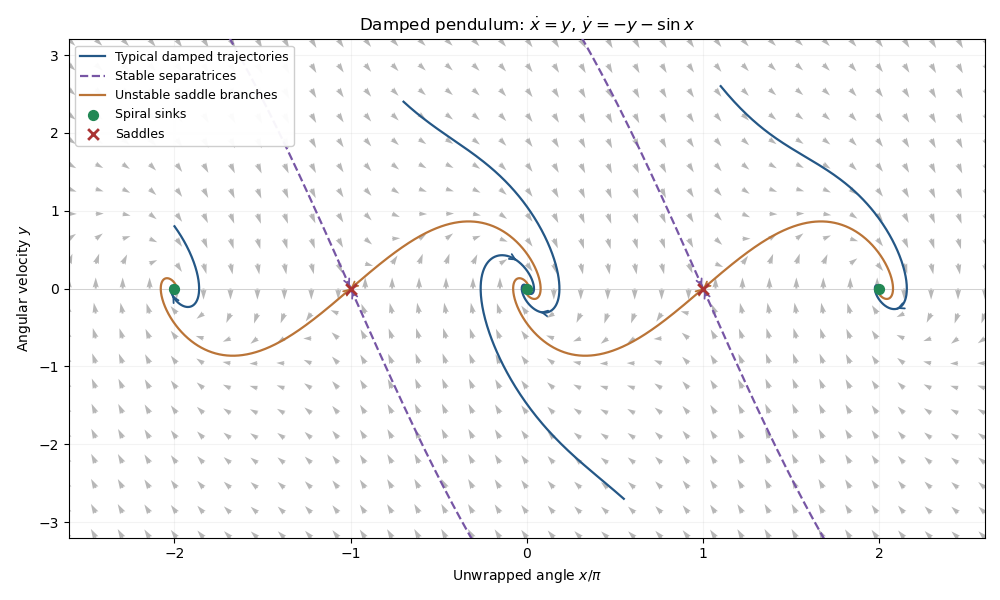
Phase portrait of a pendulum with unit damping, showing spiral sinks and the stable and unstable saddle branches
. Details. 
The phase portrait shows clockwise spiraling into each even equilibrium: on its right-hand horizontal axis, the flow initially points down. The stable separatrices of the saddles divide attraction basins on the unwrapped angle axis, while the unstable branches flow into neighboring sinks. Initial conditions with enough mechanical energy can cross one or more potential crests before being captured. The curves repeat under . They are trajectories, not conservative energy contours: energy dissipation of a damped pendulum rules out nonconstant periodic orbits.
Past exam of the mathematics course of the University of Cambridge 2014 ia Paper 2 8B iii Solution Created 2026-09-24 Updated 2026-10-06
The phase plane system is , . Its equilibrium points are for every integer . At such a point the Jacobian matrix and characteristic equation areFor even , the equilibrium point is a stable focus for , with eigenvalues ; it is a stable node for , with two distinct negative real eigenvalues. The excluded value gives the repeated critical case.
For odd , the eigenvalues are . One is positive and one negative, so each is a saddle equilibrium for every . These classifications follow from the linearization of a dynamical system, since all the relevant eigenvalues have nonzero real part for . The even equilibria remain hyperbolic at too, although their linearization then has a repeated eigenvalue; that critical case is excluded from the requested classification.
Past exam of the mathematics course of the University of Cambridge 2014 ia Paper 2 8B ii Solution Created 2026-09-24 Updated 2026-10-06
The small-angle approximation replaces by , giving the damped harmonic oscillator equation . Its characteristic roots satisfy .
For , put ; the motion is underdamped:It oscillates with decaying amplitude. For , the repeated root gives critical damping:For , the motion is overdamped:Both real exponents are negative, so there is no oscillatory factor. The two constants are arbitrary in each case; these approximations require the displacement to remain small.
Past exam of the mathematics course of the University of Cambridge 2014 ia Paper 2 8B i Solution Created 2026-09-24 Updated 2026-10-06
Differentiate the mechanical energy and use the damped pendulum equation:The energy dissipation of a damped pendulum makes nonincreasing, rather than strictly decreasing at every instant: its derivative vanishes at turning points. It is constant along an equilibrium trajectory. Along every nonstationary trajectory it strictly decreases over any nonzero time interval, because a vanishing integral of over an interval would force an equilibrium there and hence everywhere by uniqueness.
Past exam of the mathematics course of the University of Cambridge 2014 ia Paper 2 7B b Solution Created 2026-09-24 Updated 2026-10-06
Inspection gives in the degree-one Legendre differential equation. After division by , and . On either side of zero, reduction of order therefore givesA second solution is . Although is singular at zero, the product has a smooth continuation throughout . This illustrates reduction of order across a zero of the known solution. Since , , and , the required coefficients are . HenceThe ordinary differential equation has regular coefficients near zero, so the resulting initial-value solution is unique and the removable singularity in the intermediate representation causes no ambiguity.
Past exam of the mathematics course of the University of Cambridge 2014 ia Paper 2 7B a Solution Created 2026-09-24 Updated 2026-10-06
Substitute and use to cancel the terms proportional to . The remaining ordinary differential equation isOn an interval where , divide through and put :Thus reduction of order givesA nonzero multiplicative constant gives an independent solution; adding a constant inside the integral adds a multiple of . The Wronskian is proportional to and is nonzero on the interval. The undivided equation remains meaningful at a zero of , but this integral representation then needs continuation rather than direct division.
Past exam of the mathematics course of the University of Cambridge 2014 ia Paper 2 6B iii Solution Created 2026-09-24 Updated 2026-10-06
With zero initial time derivative, the integral term in the D'Alembert formula vanishes. The Heaviside step function representation givesThe rectangular pulse splitting under the wave equation consists of two width-two pulses of height , moving left and right at speed . At they coincide and add to the initial height-one pulse. Before the overlapping interval has height one; after the two pulses are separated. Values exactly at the fronts depend on the chosen convention. Away from the fronts the equation holds classically, and across the fronts it holds as a weak solution of the wave equation.
There are unlisted articles, also show them or only show them.