
Past exam of the mathematics course of the University of Cambridge 2017 ii Paper 3 19F iii Created 2026-09-24 Updated 2026-09-24
Past exam of the mathematics course of the University of Cambridge 2017 ii Paper 3 19F ii Created 2026-09-24 Updated 2026-09-24
Past exam of the mathematics course of the University of Cambridge 2017 ii Paper 3 19F i Created 2026-09-24 Updated 2026-09-24
Past exam of the mathematics course of the University of Cambridge 2017 ii Paper 3 18I Solution Created 2026-09-24 Updated 2026-10-05
Use singular homology with integer coefficients. The Künneth theorem for triangulable spaces gives a split short exact sequence with tensor terms and torsion terms . When one factor's homology groups are free abelian, the torsion terms vanish and the tensor map is an isomorphism.
The circle has and all other groups zero. Inductively, the homology groups of a torus are free, andPascal's identity givesGeometrically the generators correspond to choosing of the circle factors and taking their product, consistent with the cellular model having one -cell for each such subset and cancelling opposite boundary faces.
Past exam of the mathematics course of the University of Cambridge 2017 ii Paper 3 17G c Created 2026-09-24 Updated 2026-09-24
Past exam of the mathematics course of the University of Cambridge 2017 ii Paper 3 17G b Created 2026-09-24 Updated 2026-09-24
Past exam of the mathematics course of the University of Cambridge 2017 ii Paper 3 17G a Created 2026-09-24 Updated 2026-09-24
Past exam of the mathematics course of the University of Cambridge 2017 ii Paper 3 16I b Created 2026-09-24 Updated 2026-09-24
Past exam of the mathematics course of the University of Cambridge 2017 ii Paper 3 16I a Created 2026-09-24 Updated 2026-09-24
Past exam of the mathematics course of the University of Cambridge 2017 ii Paper 3 15H Solution Created 2026-09-24 Updated 2026-10-05
A graph Ramsey number is the least such that every red-blue edge colouring of the complete graph has a red or a blue . At a vertex in , either at least neighbours have red incident edges or at least have blue incident edges. In the first case find a red and adjoin the vertex, or a blue ; the second case is symmetric. ThusStarting with and , induction gives the binomial upper bound for a Ramsey numberFor the lower construction, partition vertices into two classes of size , colour inside-class edges red and between-class edges blue. Red cliques have at most vertices, and the blue graph is bipartite, so has no odd cycle.
Conversely, a graph without an odd cycle is bipartite: in each connected component colour vertices by the parity of the length of a path from a root; differing path parities would give an odd closed walk, hence an odd cycle. On vertices one of the two blue bipartition classes has at least vertices. Every edge within it is red, giving a red . Thus is the exact threshold for this alternative.
Past exam of the mathematics course of the University of Cambridge 2017 ii Paper 3 14H Solution Created 2026-09-24 Updated 2026-10-05
Zorn lemma states that a partially ordered set in which every chain in a partially ordered set has an upper bound has a maximal element. Include the empty chain in a partially ordered set, so the hypotheses imply that the set is nonempty. Suppose there were no maximal element. Every chain in a partially ordered set has an upper bound , and some ; therefore the set of elements strictly above every member of is nonempty. The axiom of choice selects one such element for each chain in a partially ordered set (and an element of when is empty).
By Hartogs theorem, there is an ordinal which does not inject into . Transfinite recursion defines for all : previous elements form a strictly increasing chain in a partially ordered set, including at limit ordinal stages. All are distinct, giving the forbidden injection. This proves Zorn lemma; the choice of is the use of the axiom of choice.
Apply Zorn lemma to linearly independent subsets of over , ordered by inclusion. A union along a chain in a partially ordered set is linearly independent because each finite linear relation occurs in one member of that chain in a partially ordered set. A maximal independent set spans , since a vector outside its span could be adjoined. Thus has a Hamel basis over .
For a finite basis, the Steinitz exchange lemma proves equality of basis sizes. This also rules out an infinite basis when a finite spanning set exists: write each member of the finite spanning set using finitely many elements of another basis; their finite union spans, and independence leaves no other basis elements. If a basis is infinite with cardinality , the finite-support description of every vector and countability of giveHere infinite cardinal arithmetic uses the axiom of choice. Thus any infinite basis has cardinality , proving all bases have the same cardinality. The zero space has its unique empty basis.
Past exam of the mathematics course of the University of Cambridge 2017 ii Paper 3 13C b Created 2026-09-24 Updated 2026-09-24
Past exam of the mathematics course of the University of Cambridge 2017 ii Paper 3 13C a Created 2026-09-24 Updated 2026-09-24
Past exam of the mathematics course of the University of Cambridge 2017 ii Paper 3 12B Solution Created 2026-09-24 Updated 2026-10-14
A fraction of adults survives each time step; is the adult mortality fraction. Adults produce larvae, which mature one step later with recruitment reduced by adult-dependent competition through . Eliminating larvae gives the second-order difference equationAt an equilibrium point, either orOnly nonnegative populations are admissible. At extinction the Jacobian matrix is and its characteristic polynomial is . Its positive root exceeds exactly when . For both roots have modulus less than ; at the roots are , so linearization is marginal. On the nonnegative state space extinction is still attracting at this equality: if two consecutive adult values are bounded by , the next is at most , with strict decrease away from zero; the maximum of two consecutive adult values strictly decreases after two steps whenever it is positive; continuity on its bounded state region then excludes a positive limiting maximum. Thus the extinction equilibrium point is unstable exactly when the positive equilibrium point exists, with equality understood through nonlinear rather than strict linear stability.
At the positive equilibrium point, the trace and determinant of the Jacobian matrix are and . The Jury stability criterion for requires , and . The strict linear stability analysis conditions areFor there is no upper bound on ; for the stable region is .
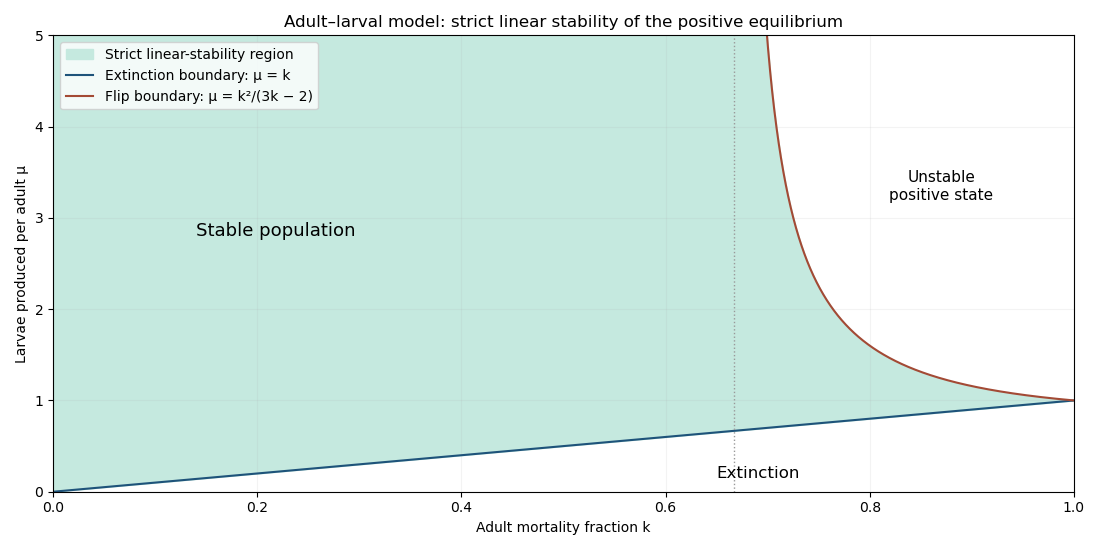

At the lower boundary , the positive equilibrium point merges with extinction, with a multiplier and slow recovery. At the upper boundary a multiplier reaches (the other is ), giving alternating adult/larval fluctuations. The nonlinear map confirms a supercritical period-doubling bifurcation, as follows. For , put and . A nonconstant period-two adult sequence satisfies and . Subtracting and adding these equations givesThus positive unequal values emerge for , with amplitude proportional to . The two larval phases are . If are the trace and determinant of the two-step Jacobian matrix, direct multiplication givesAt onset and , so the other two strict Jury stability criterion inequalities hold for sufficiently small positive . Hence just beyond the upper boundary, a stable period-two population cycle replaces the stable equilibrium. This is a local conclusion, not stability for arbitrarily large reproduction rates.
At the upper boundary itself, the positive equilibrium point is still locally asymptotically stable, despite its multiplier . To decide this equality case, apply the centre manifold theorem for a discrete dynamical system. Put and write the centre graph as with . If the reduced map is , its invariance equation is . Expanding the original recruitment map and this equation through cubic order givesConsequently . The stability at a nondegenerate flip bifurcation criterion shows algebraic attraction on the centre direction; the transverse multiplier has modulus less than one. Including this boundary, the complete local asymptotic-stability condition for a positive population is thereforeThe shaded figure shows the strict linear-stability region; its upper boundary adds this nonhyperbolic attracting case.
Demographic stochasticity near the lower boundary can lead to absorption at extinction; near the upper boundary it excites alternating fluctuations and can blur the deterministic period-doubling bifurcation. These qualitative predictions depend on the chosen stochastic recruitment and mortality rules.
Past exam of the mathematics course of the University of Cambridge 2017 ii Paper 3 11H c Created 2026-09-24 Updated 2026-09-24
Past exam of the mathematics course of the University of Cambridge 2017 ii Paper 3 11H b Created 2026-09-24 Updated 2026-09-24
Past exam of the mathematics course of the University of Cambridge 2017 ii Paper 3 11H a Created 2026-09-24 Updated 2026-09-24
Past exam of the mathematics course of the University of Cambridge 2017 ii Paper 3 10G d Created 2026-09-24 Updated 2026-09-24
Past exam of the mathematics course of the University of Cambridge 2017 ii Paper 3 10G c Created 2026-09-24 Updated 2026-09-24
Past exam of the mathematics course of the University of Cambridge 2017 ii Paper 3 10G b Created 2026-09-24 Updated 2026-09-24
There are unlisted articles, also show them or only show them.